Tuesday! The week goes on and on. It really is a non-stop treadmill. I really can't believe how wiped out I am these days and how quickly.
Okay the law firm Burke O'Neil LLC issued the following press release today:
Sixteen new lawsuits allege that KBR, Inc. jeopardized the health and safety of tens of thousands of American soldiers and private contractors in Iraq and Afghanistan by burning vast quantities of unsorted waste in enormous open-air burn pits with no safety controls.
The lawsuits were filed during the past week in federal courts throughout the nation by Burke O'Neil LLC and co-counsel on behalf of military veterans and private contractors. The suits allege that round-the-clock hazardous emissions from the burn pits caused illnesses such as multiple cancers, respiratory disease, pulmonary complications, chronic coughing, debilitating headaches, and neurological and skin disorders.
KBR is accused of allowing thick, noxious smoke, coming off of flames sometimes colored blue or green by burning chemicals, to hang over U.S. bases and camps across Iraq and Afghanistan since 2004.
According to the complaints, the burn pits are so large that tractors are used to push waste onto them and the flames shoot hundreds of feet into the sky. KBR allegedly burned waste such as biohazard materials including human corpses, medical supplies, paints, solvents, asbestos, items containing pesticides, animal carcasses, tires, lithium batteries, Styrofoam, wood, rubber, medical waste, large amounts of plastics, and even entire trucks.
Susan L. Burke, Elizabeth M. Burke, and Susan M. Sajadi, of Burke O'Neil LLC, in Washington, D.C., and co-counsel represent the more than 200 veterans, KBR employee-contractors and families in the cases which are pending in 37 states.
Elizabeth M. Burke, of Burke O'Neil LLC, stated, "KBR utterly disregarded the safety of the troops when they chose to use open air burn pits and failed to use incinerators and other safer methods of waste disposal. The hazards of operating large open-air burn pits were well known, and KBR promised to minimize the environmental effects of the burn sites they operated in Iraq and Afghanistan. KBR willfully endangered these men and women who honorably served their country in military service or in support of the military."
The legal team for the plaintiffs intends to seek class certification of the lawsuits to cover costs of medical monitoring, future medical expenses, and other damages for other individuals exposed to KBR burn pit emissions.
The new cases were filed in federal courts in Arkansas, Colorado, Connecticut, Idaho, Indiana, Kentucky, Maine, Massachusetts, Mississippi, Nevada, New Jersey, New Mexico, North Dakota, Tennessee, Virginia, and Washington. Earlier this year, dozens of other current and former military personnel, private contractors and families of men who allegedly died as a result of exposure to toxic emissions from KBR burn pits brought similar claims.
The defendants include KBR, Inc., of Houston; Kellogg, Brown & Root LLC, of Austin, Texas; Kellogg, Brown & Root Services, Inc., of Houston; and Halliburton Company, of Houston.
Attorney Contact: Susan Burke, of Burke O'Neil LLC, 202.445.1409.
Media Contact: Erin Powers, Powers MediaWorks LLC, for Burke O'Neil LLC, 281.703.6000.
KBR risked the lives of Americans, Iraqis and everyone else in that region temporarily or longterm. The damage they've done is immense and they need to be shut down with their assets sold off and put into a trust for the medical bills of their many victims.
They're not the only ones hurting Iraqis and service members. The war does it too. Tomorrow's Veterans Day and this is from Kelley B. Vlahos' latest column at Antiwar:
Veterans Day arrives tomorrow, and with it, the anticipated harvest of heartbreaking anecdotes driving the press coverage and our ever wandering attention back to less desirable realities: the disfigured but persevering hero, the homeless warrior, the unemployable sergeant, the father or son or daughter who came home a stranger and cannot be reached.
Usually, there is nothing more powerful than a personal story to pound home the cost of eight years of war overseas, but I think today there is something even more disturbing to bear.
It’s the number 89,457 [.doc].
As of Nov. 9, that’s how many American casualties there were in Iraq and Afghanistan since Oct. 7, 2001, when the Afghan war officially began. That includes a tire-screeching 75,134 dead, wounded-in-action, and medically evacuated due to illness, disease, or injury in Operation Iraqi Freedom (OIF), and 14,323 and counting in Afghanistan, or Operation Enduring Freedom (OEF).
That it may sound incredible – even unreal – is understandable. Early attempts to effectively count casualties (outside of battlefield fatalities) had been in earnest, then erratic, but finally dead-ended, frustrated by the Department of Defense, which has always been loath to break down and publicize the data on a regular basis.
IVAW notes this:
Veterans Day November 11, 2009GI and Veteran Writing Workshop 4 – 7PMOpen mic and Memorial 8 – 9PM
A silent Processional (Candle light vigil)A training for trainers workshop will also take place on Thursday, email or call for details. warriorwriters@gmail.com*We'll be around during the day on Wednesday at Ft. Hood for art making, talking, support, etc.Read more of this item
Here's C.I.'s "Iraq snapshot:"
November 10, 2009. Chaos and violence continue, Nouri continues his assault on a free press, KBR gets more lawsuits, Human Rights Watch releases a report on minorities in Iraq, and more.
Today in a huge blow to freedom of the press and a boost to thug Nouri al-Maliki, a Baghdad court declared the thug a winner. Martin Chulov and Julian Borger (Guardian) report: "An Iraqi court has ordered the Guardian to pay Nouri al-Maliki damages of 100m dinar (£52,000) after supporting a complaint by the Iraqi prime minister's intelligence service that he had been defamed by a Guardian story in April describing him as increasingly autocratic. The ruling ignored testimony by three expert witnesses from the Iraqi journalists' union summoned by the court, who all said that the article was neither defamatory nor insulting and argued that no damages were warranted." Charles Tripp (Guardian) observes Nouri got a cash award despite the fact that he wasn't an injured party and goes on to sketch the rise of Thug Nouri:
Throughout 2008 he used the Iraqi armed forces to reconquer the provinces of Iraq, projecting himself as the leader whose only thought was the unity of the country. This was the image he wanted to convey in the January 2009 provincial elections. So to make sure he got a good press, he promised that thousands of journalists would be awarded grants of land for a nominal price, or for free. He was reviving a form of land patronage long used by his predecessors to cement officers, officials and now journalists to their retinue.
Some welcomed it and others were appalled. But for those who persisted in investigating awkward questions, the government had no hesitation in using the courts. More journalists found themselves fighting charges of libel or of endangering national security -- a charge levelled at foreign news media, particularly from the Arab world.
There is a pattern here, in which the wires of the "shadow state" are again being assembled, leading to the hands of one man: intelligence services run from the prime minister's office, staffed mainly by "awlad al-Hindiyya" ["the lads from Hindiyya", Maliki's home region]; dismissals, promotions and transfers in the ministries of interior and defence that insert his loyalists at the expense of others; the introduction of censorship of imported books and control of the internet; the recent closure of Mustansiriya University and its reopening under the watchful eye of the Baghdad operations command, controlled by his office.
Nouri has a long history of attacking the press. In the summer of 2006, he had a 'plan' for security -- a four-plank 'plan' -- but the press reduced it to three in much of their coverage, bypassing the third plank which dealt with journalims (aaah, Thuggy's first effort at attacking freedom of the press). It has been non-stop attacks ever since with Nouri most recently -- in an attempt to stop live transmissions -- has demanded outlets get a government license. (This is done to keep them from reporting on bombings. Within a few hours, Iraqi forces usually prevent the press from having access -- often prevent via violence -- and the licenses are an attempt to prevent any broadcasting before the forces can secure the area.) Martin Chulov (Guardian) notes the Journalists Freedom Organisation sees this as "part of a wider crackdown against media outlets designed to discourage scrutiny of public officials" (they are correct) and quotes JFO's Jabar Dharad stating, "Legal cases have flooded from all sides into publishers and media outlets throughout Iraq. This is a very effective tactic to silence dissent. A key reason for the diminishing status of private media here is that parliament hasn't passed a law to protect journalists in Iraq. They are deliberately delaying doing so." The truth telling article that so enraged Nouri is Ghaith Abdul-Ahad's "Six years after Saddam Hussein, Nouri al-Maliki tightens his grip on Iraq" (April 30, 2009).
Meanwhile Timothy Williams (New York Times) reports Nouri's flunky Ali al-Alak states they want to force the MEK, Iranian dissidents at Camp Ashraf, out of the country, "A standoff has been in place since the deaths in July, through both Iraqis and members of Camp Ashraf worry about a new round of violence if a solution is not found soon. Among other complaints, members of the camp say that the Iraqi Army intermittently blocks fuled and food from reaching them and prevents them from cmoing and going. Iraq has prohibted news organizations and most humanitarian groups from entering Camp Ashraf since the July raid, but the government allowed a reporter and photographer inside the camp last week to interview its members and their relatives." And yet another political rival of Thug Nouri has been arrested. Caesar Ahmed and Ned Parker (Los Angeles Times) report Sahwa leader Mustafa Kamal Shibeeb was arrested "in connection with the deaths of five known members of the group Al Qaeda in Iraq who were killed in 2007 in Baghdad's Dora neighborhood, where Shibeeb commanded paramilitary fighters better known as the Awakening."
All of the deaths in Iraq and for what? To install a new Saddam named Nouri?
Turning to some of today's reported violence . . .
Bombings?
Deng Shasha (Xinhua) reports a Baquba motorcycle bombing left two people injured.
Shootings?
Laith Hammoudi (McClatchy Newspapers) reports 1 person was shot dead in Mosul. Deng Shasha (Xinhua) reports 2 police officers were shot dead in Aziz Balad and 1 'suspect' shot dead by Iraqi forces in al-Mu'atasim.
Staying with wounded and deaths, many US service members and contractors are physically ill due to exposure to various chemicals in Iraq. (And many Iraqis will be ill and will have birth defects due to those same hazardous wastes.) E. Thomas Wood (Nashville Post) reports on the lawsuit against KBR (and its various offshoots) brought by attorneys (Burke O'Neil LLC) for soldiers Anthony Ray Johnson and David Michael Rohmfeld. From Wood's article:
The lawsuit, which seeks class-action status, describes "burn pits" at U.S. bases in both military theaters that contain "every type of waste imaginable." Reading like a postmodern version of Jonathan Swift's Description of a City Shower, the catalog of rubbish in the pits includes:
"Tires, lithium batteries, Styrofoam, paper, wood, rubber, petroleum-oil-lubricating products, metals, hydraulic fluids, munitions boxes, medical waste, biohazard materials (including human corpses), medical supplies (including those used during smallpox inoculations), paints, solvents, asbestos insulation, items containing pesticides, polyvinyl chloride pipes, animal carcasses, dangerous chemicals, and hundreds of thousands of plastic water bottles."
"Flames shoot hundreds of feet into the sky" as the huge pits are set ablaze, the Nashville lawsuit claims.
Donna Goodison (Boston Herald) reports Iraq War veterans and Massachusetts Army National Guard members Jeffrey Cox and James Garland have also filed suit against KBR over the burn pits and that Cox has developed "a chronic cough and respiratory issues" while Garland "developed respiratory issues and was diagnosed with a rare form of carcinoma". Disclosure, I do know Susan Burke (and think she's a wonderful person and a brilliant attorney). I haven't spoken to her about this issue. In a press release, Burke O'Neill LLC notes there are 16 lawsuits against KBR "filed during the past week in federal courts throughout the nation by Burke O'Neil LLC and co-counsel on behalf of military veterans and private contractors. The suits allege that round-the-clock hazardous emissions from the burn pits caused illnesses such as multiple cancers, respiratory disease, pulmonary complications, chronic coughing, debilitating headaches, and neurological and skin disorders. KBR is accused of allowing thick, noxious smoke, coming off of flames sometimes colored blue or green by burning chemicals, to hang over U.S. bases and camps across Iraq and Afghanistan since 2004. According to the complaints, the burn pits are so large that tractors are used to push waste onto them and the flames shoot hundreds of feet into the sky. KBR allegedly burned waste such as biohazard materials including human corpses, medical supplies, paints, solvents, asbestos, items containing pesticides, animal carcasses, tires, lithium batteries, Styrofoam, wood, rubber, medical waste, large amounts of plastics, and even entire trucks."
KBR's burn pits were the subject of a hearing, see Friday's snapshot, by the Democratic Policy Committee. Senator Byorn Dorgan chaired the hearing. Video is posted at the Democratic Policy Committee website. And Kat's "Democratic Policy Committee" went up Friday. Sunday, at Third, we noted some of the testimony the committee heard but that Staff Sgt. Steven Gregory Ochs and Staff Sgt. Matt Bumpus did not testify at Friday's hearing. They couldn't because both men are dead. October 8th, Ochs' sister Stacy Pennington testified to the Senate Veterans Affairs Committee on behalf of her brother and her family and on behalf of Bumpus and his family.Stacy Pennington: Both of these brave soldiers you see before you dodged bullets, mortar attacks, roadside bombs and suicide bombers. Eventually their tours of duty would take their lives. The ultimate sacrifice for a soldier, for his country, is death. However, their deaths did not show up in the manner you may assume. In Balad is the site of the infamous enormous burn pit that has been called by Lt Col Darrin L. Curtis, USAF and Bio-environmental Engineering Flight Commander, as "the worst environmental site" he had ever visited. Staff Sgt Ochs and Staf Sgt Bumpus were both stationed in Balad and war, as strategic as it is, followed them home. Death lay dormant in their blood and waited for them to return safely home and into the arms of their loved ones. Like every silent ticking bomb, it eventually exploded. On September 28, 2007, just months after Steve's return home from his third tour, he was diagnosed with Acute Myeloid Leukemia, also known as AML. He spent the next ten months as a patient -- more like a resident -- at Duke University Hospital. Doctors at Duke said his aggressive form of AML was definitely chemically induced and, like Steve, both agreed it was due to the exposures he experienced while in Iraq and Afghanistan. However, the doctors refused to go on record citing as the reason that they could not prove it. The aggressive AML that Steve endured was similar to bullets ricocheting in the body causing torturous pain. The graphic images embedded in my mind are of Steve's last screams for air as he was rushed into ICU. Steve waved goodbye to my husband. Steve, with very little strength, said, "I love you, sis" and my mom kissed his forehead and said, "We will see you when you get comfortable." Five minutes later, while in the ICU waiting room, the nurse came in to tell us Steve went into cardiac arrest and they were working on him now. My mom ran into ICU -- fell to her knees as she realized her son was dying. Screams filled the air as we begged God to keep Steve here with us. We know Steve heard us as tears were in Steve's eyes. Doctors and nurses pumped on Steve's chest trying to revive him. But I knew immediately he was gone. His spirit that surrounded my dear, sweet brother was gone. We were left alone with Steve's body for hours as we were all in pure shock. My mom looked upon my brother's face and wiped away the tears puddled in his eyes. And at that very moment, our lives were changed forever. Steve died on July 12, 2008. Two weeks later, on the opposite of the coast, Staff Sgt Bumpus would succumb to the same fate. For Staff Sgt Matt Bumpus, the ticking time bomb exploded with a vengeance on July 31, 2006. Matt was rushed to the hospital by ambulance with acute appendicitis. In Matt's own words, I quote, "The next thing I remember is hearing that I had been diagnosed with AML." Doctors declared that there was chromosome damage due to exposures he must have come in contact with while in Iraq. Matt ended his prestigious service to the Army one short year before the war zone chemical warfare showed signs of its presence. As if this was not enough suffering, Staff Sgt Bumpus' family was met by the VA with harsh claims of denial to benefits. This battle continues to this day as Lisa, Staff Sgt Bumpus' wife, is left alone with two small children to raise with no VA or military benefits for her family. The aggressive assault of the AML in Matt's body was taking claim. Jo, Matt's mother, recalls the haunted look in Matt's eyes as he revealed to her that the AML invasion was back. Matt's mother will never forget the discouragement and sadness that overwhelmed Matt as the realization that promises he made to his wife and children to provide for his family, to love and protect them, and that his sacred word would be broken. He knew now that the battle was over and he would be leaving his family behind. Tuesday, July 29, 2008, Matt once again entered the hospital with fever and septic infection that discharged throughout his body. Doctors notified the family that it would just be days before his demise. Matt was heavily sedated as the pain and incubation was unbearable. Nate, Matt's ten-year-old son, bravely entered his father's hospital room to lay on his daddy's chest as he said his final goodbye. Nate curled up by his dad and cried and cried. Despite Matt's heavy sedation, Matt too was crying. Matt, being a devoted Christian, appropriately passed away on a Sunday morning, surrounded by his wife, mother, father and sister as they expressed to Matt their everlasting love. They, too, were in shock and stayed with Matt's body as the realization overwhelmed them that Matt would not be going home. Matt died on August 3, 2008.
Today Human Rights Watch released a new report entitled [PDF format warning] "On Vulnerable Ground: Violence against Minority Communities in Nineveh Province's Disputed Territories" which explores issues for minorities caught in the territories disputed by the KRG and the Baghdad based 'government'. To write the report, HRW took part in "a three-week fact-finding mission" visitng Arbil, Bashiqa, Bartalah, Qaraqosh, al-Qosh, Sulaymaniyah and Tal Usquf and speaking with 57 members "of the Chaldo-Assyrian, Yazidi, and Shabak communities." The report gets lost -- for a large section -- on year-old rumors that detract from valid complaints of abuse. The report would have benefitted from a little more pre-publication scrutiny. One example of where more care should have been taken? An August bombing which they have the wrong date for in their report. The report is strongest when detailing actual claims of abuse. It's at its weakest when offering that people have received many threats but never bothering to tell readers what those threats are.
The report notes the historical issues including the Arabization of the region by "previous Iraqi governments" which forced Kurds and other ethnic groupings out of the region. "After more than three decades," HRW states, "of forced expulsions, and in the aftermath of the overthrow of the government of Saddam Hussein, an emboldened KRG leadership insists it is entitled to claim this land as part of the territory that Kurds have historically lived in, which stretches from the western villages of Sinjar near the Syrian borader all the way to Khanaqin near the Iranian border in the east." Noting the ethnic diversity that has historically been part of the region -- including populations of Assyrian and Chaldean Christians, Shabaks, Turkmens and Yazidis, HRW's watch argues for a way for Kurds to find "redress for the crimes committed against them" which does not confuse the "rederss for past wrongs" with "the current struggle for political control over the dispuated territories". It goes on to argue, "The six-year US-led occupation of Iraq failed to resolve the tensions over the disputed territories in northern Iraq, or to provide redress for the victims of the arabization policies. The US-led coalition paid scant attention to the tensions there, and a drawn-out UN mediation effort has done little to bridge the gap between Arabs and Kurds." The report then refers to "a constitutionally-mandated referendum on the future of the disputed territories". Historically the report also notes, "Iraq made a declaration, on gaining independence and joining the League of Nations in 1932, that it would protect the rights of minorities -- the first non-European state to so declare." It also notes that the 2005 Constitution also includes "various provisions guaranteeing the rights of minority groups."
The report zooms in on Nineveh Province where "[m]any of these minorities -- weary after generations of subjugation at the hands of Arabs -- now fear being subjugated by the Kurds, who ironically share a common history of oppression by previous Iraqi government." From the report:
To consolidate their grip on Nineveh and to facilitate its incorporation into the Kurdistan Region, Kurdish authorities have embarked on a two-pronged strategy: they have offered minorities inducements while simulaneously wielding repression in order to keep them in tow. The goal of these tactics is to push Shabak and Yazidi communities to identify as ethnice Kurds, and for Christians to abide by the Kurdish government's plan of securing a Kurdish victory in any referendum concering the future of the disputed territories. Kurdish authorities have tried to win favor with the minority communities by spending millions of Iraqi dinars to build a pro-Kurdish system of patronage in minority communities, financing alternative civil society organizations to compete with, undermine, and challenge the authoritiy of established groups, many of which oppose Kurdish rule. The KRG also funds private militias created ostensibly to protect minority communities from outside violence, but which in reality serve to entrench Kurdish influence. Finally, the Kurdish leadership has enriched the coffers of some minority religious leaders, and paid for expensive new places of worship in order to win over minority religious establishments.
The report goes on to note minority self-reports of being threatened and KRG denials of making threats. What are the threats? That would make for a stronger report. This gets skipped and the report instead immeidately moves into assertions by "some minority representatives and Arab officials" of Kurds being involved in violence such as the assaulst on the Christian community in the second half of 2008 and bombings. That's a problem, for the report that's a problem.
The Kurds may have been involved -- may have led -- the assault on the Christians. If so, there is no proof of it. Over a year later, there is no proof of it. Why bring that into the report to begin with? It's now dismissed (fairly or unfairly) as paranoia. By bringing it in after referring to self-reported threats, HRW weakens the self-reported threats. And by not even offering an example of one of these threats (threats of your home being burned to the ground, threats of being killed, threats of what), it weakens the self-report. Again, the KRG may have directed and led the assaults on the Christian community in the second-half of 2008. There were some Chrisitans who publicly stated in October and November 2008 that they believed the Kurds were behind the assault and doing it to create a need for a strong-figure to protect Christians -- meaning that the Kurds created the violence so that they could be the hero who saved the day. That was a charge and it was widely made. If that charge was correct, it was never proven. And a year later it's seen (rightly or wrongly) as a baseless charge and one resulting from the paranoia of a persecuted people.
Even though it was never proven, it could be used in the report as an example of underlying tensions. For example, "Beliefs that the Kurds may have been behind the 2008 assault has led to many tensions . . ." But to put it with what are presumably real threats?
Further into the report (page 25) its noted that the finanical offers from the KRG are viewed with suspicion and an unnamed priest is quoted stating, "Before 2005, no one cared about our communities or churches and then overnight we started to receive funding. The Kurds have a hidden agenda and are using money to co-opt Christians -- it's not because they want to help our people . . . I beleive that anyone who disagrees with their agenda puts their life at risk." Other unnamed persons complain that financial assistance comes only when someone signs what is basically a loyalty oath. The KRG's Minister for Extra-Regional Affairs, Muhammad Ihsan, tells HRW, "We are not angels, we are politicians, and this is politics. Join with me and I will give you this and that." Some may see that statement as practical, some may see it as mercenary.
Some may see the fact that, as late as page 34, the rumor of Kurds carrying out the 2008 assualt are still being yammered on:
As evidence of Kurdish involvement, proponents of this theory point to the fact that the attacks happened in the part of Mosul relatively free from insurgent activity and controlled by the Iraqi army, which was dominated by a high percentage of Kurdish officers in that area. Some of the killigns happened in areas secured by Iraqi army checkpoints and, in some cases, in close proximity to them, leading some to believe that Kurdish officers or their proxies had a hand in the attacks. Kurdish authorities have rejected these assertions and accused Sunni Arab groups of having carried out the attacks to sow intercommunal tensions. In a rare disavowal, the Islamic State of Iraq, an umbrella organization comprising a number of insurgent groups including al Qaeda in Mesopotamia, has denied responsibility for the killings. More recently, Kurdish MP Mahmoud Othman blamed militias loyal to Prime Minister al-Maliki for being behind the violence. None of these allegations has been backed up by clear and convincing evidence.
What is clear, however, is that the attacks were systematic and widespread. Human Rights Watch interviewed family members of seven Christian victims murdered between late August and early October 2008. While other Christians have since returned to Mosul, these families remained in Christian villages in the Nineveh Plains, too fearful to return to their homes in the city. Some witnessed the murders themselves; others spoke to witnesses who saw the perpetrators killed their loved ones. Their accounts suggest an orchestrated and targeted campaign of violence intended to have maximum impact in devastating the community.
Based on these interviews, Human Rights Watch found no evidence suggesting that Kurds were directly invovled in that campaing of violence against Christains. According to the witnesses, the gunmen spoke fluent Iraqi Arabic, which appeared to be their mother tongue (in contrast to Kurds, whose native languages is Kurdish, but speak Arabic as a second language). The assailants had an Arab appearance and dress, and made it clear that they were attacking Christians on religious grounds. For example, one of the victims, mechanic Afnan Daoud Saeb al-Hadad, answered his door at 10:30 a.m. on September 28 in Mosul. A masked man demenaded that al-Hadad show him his identification. When al-Hadad asked who the person was, the masked man responded in Arabic, with a Mosul accent, "Don't be afraid, Ummu [uncle], I am with the secret police." After checking his identification, the masked man asked al-Hadad whether he was a Christian, to which al-Hadad said yes. The perpreator then fired several shots from an Iraqi-made 9mm Tariq pistol into al-Hadad's lower body, killing him. His family remained in Mosul for a week, until the funeral, and then fled to Qaraqosh.
Did you catch that? No evidence. A lot of pages for something with no evidence. Lot of referring to rumors for something with no evidence. Shabacks pop up on page 37. The group is estimated to be 200,000 to 500,000 people who predominately reside in Nineveh. Though they're Shia, they aren't seen as 'pure' Shia by some such as al Qadea in Mesopotamia which posted flyers in 2007 stating 'good' Shia were obliged to kill Shabacks. The report notes:
In one of the worst attacks in the Nineveh Plains since 2003, on August 11, 2009, two large trucks packed with bombs exploded simultaneously at around 5 a.m. in the Shaback village of al-Khazna, which is under the control of Kurdish peshmerga forces. The force of the blast destroyed the town, leaving 65 houses in heaps of rubble mixed with bed frames, mattresses, furniture, and bloodstained pillows. Most villagers were asleep at the time, many of them on their rooftops to escape the summer heat. The final casualty toll was at least 35 killed and almost 200 wounded.
The report notes that the attacks were then used for political football by both the Baghdad based government or 'government' and the KRG. And, for the record, that bombing took place August 10th. Yazidis Khalil Rashu Alias and Wageed Mendo Hamoo report they were tortured by Kurds during a six month imprisonment:
According to Hamoo, on May 1, 2007 at 4:30 a.m., Kurdish intelligence officers broke down the door to his home in Sinjar and stormed in. They told him that the intelligence unit's central command had ordered his detention without further explanation. The officers arrested Hamoo, an active member of the Yazidi Movement for Progress and Reform (YMRP) who had been arrested twice before for political activies, and placed his wife and children in the corner of a room while they searched his house. The officers then proceeded to the house of Alias, head of the YMPR's centeral committee, and arrested him as well.
At a military camp in Sinjar, the intelligence officers interrogated the two separately. During these interrogation sessions their captors gave Alias and Hamoo two options: accept that they were Kurds and denounce the YMPR, or confess that they were "terrorists." The pair described how their guards bound them hand and foot and hooded them, and took turns interrogating and beating them separately with fists, shoes, shovels, and cables for a period of about five hours. As a result of the ordeal, for more than a month Alias was unable to stand unassisted. He said his arms turned black from the bruising he sustained. Alias also said his captors initally refused to allow any treatment for his diabetic condition.
Four days after detaining the, Kurdish officials transferred the pair to a military camp, Kesik, between Mosul and SInjar. After 17 days, Kurdish officials separately interrogated the two again with their hands tied and eyes blindfolded. His Kurdish interrogator asked Hamoo, "What is your language?" When Hamoo replied, "Yazidi," the interrogation officer responded, "No, Yazidis have no language! Yazidis speak Kurdish." Hamoo said he replied, "Even if you kill me a hundred times I won't say that I'm Kurdish." The Kurdish officer told the guards to take him out to "teach him some manners." Outside the guards placed what felt like a piece of metal, maybe a knife, at the back of his neck. They ordered him to say a phrase prohibited by the Yazidi religion. If he failed to comply, he was told, "We're going to behead you just like the terrorist do with your people." When he refused, numerous guards severely beat him, he said. They took him back to his cell and told him, "If you want to live you have to confess to either being Kurdish or a terrorist." When he refused both, the beatings resumed; Hamoo said he lost count of how many officers beat and kicked him, breaking one of his ribs. At 4 a.m. the beating stopped and he was thrown back into his cell.
Alias told Human Rights Watch that in another cell four Kurdish officers beat and interrogated him, accusing him of being a "terrorist" responsible for attacks against police as well as Iraqi and US forces. The interrogating officer told him that if he quit the Yazidi reform movement and denounced its principles and agenda, he would be released. After he refused, he said, they laid him on the floor and beathim relentlessly on the soles of his feet and his stomach, shoulders, and chest.
On May 18, Kurdish authorities transferred the two back to the military camp in Sinjar, from where they were moved again the next day to the Lefoog al-Bogag prison. After an Iraqi judge reviewed the case, he ordered them released, but the two remained in various prisons until October 28, 2007. There has been no investigation of their alleged torture.
Which is pages 45 and 46. So the question is, when two people self-disclose torture, why toss that at the back of the report? This should have been moved to the front.
In July, US citizens Shane Bauer, Joshua Fattal and Sarah Shourd were visiting northern Iraq. They allegedly crossed over into Iran while allegedly hiking. The Chicago Tribune notes this morning that the three are now charged with espionage by the government of Iran. Iran's Press TV notes that Hillary Clinton, US Secretary of State, has stated the three should be released and dismissed the charges stating, "We believe strongly that there is no evidence to support any charge whatsoever. And we would renew our request on behalf of these three young people and their families that the Iranian government exercise compassion and release them so they can return home. And we will continue to make that case through our Swiss protecting power, who represents the United States in Tehran." The family of the three Americans have set up a website Free The Hikers which is down currently. Chris Carrassi (The Daily Californian) reports, "At a press conference held Monday during an overseas trip to Turkey, Iranian President Mahmoud Ahmadinejad said the hikers face a potentially harsh sentence, and will have to prove their innocence in court."
Yesterday we noted Nathanel Bodon being discharged from the army for the 'crime' of being gay. Pelin Sidki (CNN -- link has text and video) reports on another veteran who was discharged for the 'crime' of sexuality:
Darren Manzella: I'm Darren Manzella. I was in the United States Army from 2002 until 2008. My division deployed to Iraq and I served a year in the streets of Baghdad doing combat patrols. After returning from my first deployment in Iraq, after seeing death and violence, losing friends and comrades, really made me look over my life. I looked over some issues I had always had trouble with. You know, I had always debated, 'Am I gay?' Growing up, I never had that conflict because I didn't know anybody that was gay. I had my two brothers and I did everything they did. We worked on the farm together, we played football. But after returning from Iraq, I decided to come out to myself. Having a boyfriend -- it makes it very hard when you're at work, you can't talk about your significant other if it's the same sex. But I started, soon after I began this relationship, getting these e-mails and these phone calls from different people who were saying I was being investigated for being gay. So I told my supervisor about the phone calls, about the e-mails and what had happened was he went to the legal department and turned me in for breaking Don't Ask, Don't Tell. So after a month of the investigation, my commander called me in and said the investigation was closed and, despite my admission, they were told that they found no proof of homosexuality. In 2006, we deployed back to Iraq again and I was able to serve that entire deployment -- nearly 15 months -- openly. But it's something that nearly 65,000 men and women serving in the military that are gay, lesbian or bi-sexual, they couldn't do.
iraq
the guardian
julian borger
martin chulov
timothy williamsthe new york times
mcclatchy newspaperslaith hammoudi
xinhua
the nashville poste. thomas wood
human rights watch
the chicago tribunepress tvchris carrassithe daily californian
cnnpelin sidki
Tuesday, November 10, 2009
Monday, November 09, 2009
Isaiah, Third, details about the allegedshooter
Monday, Monday. :D Need a laugh? Me too. So here's
Isaiah's The World Today Just Nuts "That Barack"
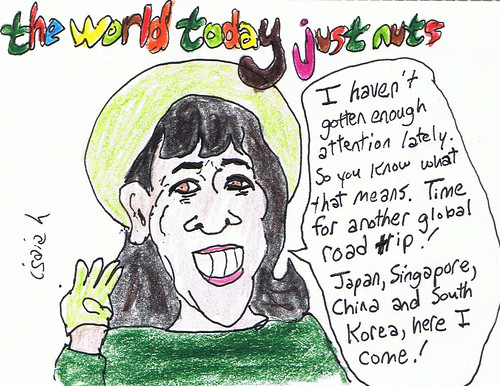
And? Everything I wrote after this is lost. So this will be a barebones post. It's too late to do another full post, sorry.
Here's C.I.'s "Iraq snapshot:"
Monday, November 9, 2009. Chaos and violence continue, the US military announces multiple deaths, two British soldiers testify about an Iraqi being beat to death in British custody, the election law passes, a US soldier is kicked out of the military for the 'crime' of his sexuality, and more.
Today the US military announced: "Contingency Operating Base Speicher, Iraq – Two U.S. Army pilots were killed when a helicopter experienced a hard landing in Salah ad Din Province, Nov.8. The names of the deceased are being withheld pending notification of next of kin and release by the Department of Defense. The names of service members are announced through the U.S. Department of Defense official website [. . .]The announcements are made on the Web site no earlier than 24 hours after notification of the service member's primary next of kin. The incident is under investigation." And they announced: "AL ANBAR PROVINCE, Iraq – A Marine attached to Multi National Force – West died as the result of a non-combat related incident here Nov. 8. The name of the deceased is being withheld pending notification of next of kin and release by the Department of Defense. [. . .] The incident is under investigation." The announcements bring the number of US service members killed in Iraq since the start of the illegal war to 4362.
In other reported violence . . .
Bombings?
Sahar Issa (McClatchy Newspapers) reports a Baghdad sticky bombing which left one person wounded, a Mosul explosion ("thermal charge") which left ten people injured, and a Falluja roadside bombing which wounded four people.
Shootings?
Sahar Issa (McClatchy Newspapers) reports 1 person shot dead in Mosul today and Hadi Laiybi ("Sadrist leader") was shot dead "on his doorstep" in Mosul last night.
Back in July, Robert Fisk (Independent of London) wrote, "I first heard about Baha Mousa from his family. He was working as a hotel receptionist in Basra when British troops surrounded the building and arrested seven men. They were taken to a British barracks, hooded and beaten. Two days later, as his weeping father recalled for me, Mousa was dead. His family was given $3,000 in compensation and rejected a further $5,000. What they wanted was justice. His father had been appointed a police officer by the British authorities themselves. He was wearing two pistols on his hips. He was 'our man', and we killed his son." There is an ongoing inquiry into Baha's death taking place in England. We last noted it in the October 6th snapshot.
The Right Honorable Sir William Gage brought today's proceedings to order, Today we are going to start the second half of the evidence in Module 2, which as I think I said before we broke off two weeks ago, we very much hoped would be complete by the time we come to our break at Christmas, the last day of which I think is 18 December. Just one other matter I want to mention. Today we have two witnesses giving evidence, the second of which is Mr. Reader. He will give evidence by videolink from Manchsester as I think you now all know." It seemed rather business as usual; however, later testimony made it a dramatic day for the inquiry. That was especially true of the second witness, Garry Reader. But not just him.
Gerald Elias: Mr Aspinall, I am not going to dwell on this at any stage, although I will come back to it very briefly, but it is right to say, isn't it, that in the months and years that followed the events that this Inquiry is concerned with, you were not at all times as helpful as you might have been.
Gareth Aspinall: Can you please elaborate more on that?
Gerald Elias: Well from time to time you told lies, didn't you, in the past, when asked questions about these events?
Gareth Aspinall: No, I have told no lies whatsoever. If there's anything that have been missed out on my statements it's purely because I have not been able to remember.
Gerald Elias: Is that true?
Gareth Aspinall: Yes, that's true.
Uh, actually it wasn't. As Aspinall would admit later, he gave false statements early on. He was worried, he said, what might happen to them. Punishment for Baha's deaht? No, future promotions, that sort of thing. "At that point," he declared, "I wasn't worried and I don't think any of the other lads was worried about being blamed. We had nothing to be worried about on that bit. What we was worried about was our own positions, as I have just said, and our futures within the army of telling the truth on what happened. [. . .] We talked about it. We was worried. We was worried what would happen if we told the truth. As I've said, that's why we stalled." He would cite Cpl Donald Payne -- being intimidated by him -- as one reason they did not supply the facts at the start of the investigation into Baha's death. Dropping back to the September 19, 2006 snapshot:
From the Bully Boy to another war war criminal -- in England, Corporal Donald Payne pleaded guilty "to inhumanely treating civilians detained in Iraq between Sept 13 and Sept 16 2003 in Basra, Iraq" (Telegraph of London). The Guardian notes that Payne ("one of seven British troops who went on trial today facing charges linked to the death of an Iraqi civilian") was pleading guilty to chrages that "relate to the death of Baha Musa, 26, an Iraqi civilian in Basra". Jeremey Lovell (Reuters) reports that Musa is said to have had "93 injuries on his body, including a broken nose and ribs" and that "another detainee was so badly beaten that he nearly died of kidney failure."
The first witness, Gareth Aspinall, described seeing Payne abusing the prisoners.
Gareth Aspinall: When I walked in there [interrogation], I remember seeing a number of detainees stood up and receiving punches off Mr Payne to the lower back area.
Gerald Elias: The number of detainees, were they hooded?
Gareth Aspinall: I can't remember.
Gerald Elias: Were they plasticuffed?
Gareth Aspinall: I can't 100 per cent say for certain, but I believe they would have been. But I can't remember if they was.
Gerald Elias: If you said, as you did in your statement of 10 October, that they were hooded, that would have been the position, would it?
Gareth Aspinall: Sorry, what? What do you mean?
Gerald Elias: If you said it on 10 October in your statement --
Gareth Aspinall: Yes.
Gerald Elias: -- that when you went into the TDF all the detainees were hooded, that would have been true?
Gareth Aspinall: Yes, if that's what I said in my statement at the time.
This continues with more descriptions of the beating.
Gerald Elias: Did there appear to be any reason for Mr Payne to be doing this?
Gareth Aspinall: No. He just seemed very angry.
Gerald Elias: He seemed angry? What gave you the impression he was angry?Gareth Aspinall: I don't know. His posture, his -- you can tell when someone looks angry.
Gerald Elias: Was he shouting?Gareth Aspinall: I think he was, yes.
Gerald Elias: And the punches that he was throwing, describe those to us?
Gareth Aspinall: There was -- they looked like full-on punches where he was bringing his arm back and, basically like a boxer, hitting them in the lower back area.
Gerald Elias: Full-on punches.
Gareth Aspinall: Well, they were quite -- they looked quite hard. I wouldn't like to have received one, put it that way.
He said the victims being beaten "yelled out in pain. Held their side." And he and the others didn't object. He offered an explanation of why.
Gareth Aspinall: Maybe because we felt, you know, what do we do here? What do we do in this situation? You know, was we to turn around, run out of the room and go straight to the ops room and report it to the commanding officer?
Gerald Elias: Well, why not?
Gareth Aspinall: Because we didn't know whether this is what happened in war. We was very young.
He testified that abuse was not limited to Sunday and continued on Monday when they were put in stress position and the punches continued.
Gerald Elias: On this Monday, you did see, didn't you, what I think came to be known as the choir, or the chorus?
Gareth Aspinall: Yes, I did.
Gerald Elias: Tell us what it was.
Gareth Aspinall: It's where the detainees were made to stand up, and Mr Payne, he would go about each individual detainee and he would poke them --
Gerald Elias: You are just dropping your voice a little bit.
Gareth Aspinall: Sorry. He would -- all the detainees would be stood up and he would move about the room poking them, just basically with his finger, and they would -- each and every one of them would scream out in pain. And he'd take turns in doing it to different ones, and he thought -- he developed this and he thought it was funny. The first time I saw it, I'll openly admit I did chuckle, but then as the day progressed and it started to wear me down and I really felt for the detainees. I felt it was a bit out of order that -- it was difficult to watch.
Gerald Elias: You say that Mr Payne would poke with a finger?
Gareth Aspinall: Yes.
Gerald Elias: Which part of the body?
Gareth Aspinall: Round the lower back area.
Gerald Elias: The same area to which he had been punching?
Gareth Aspinall: Yes. Yes.
Gerald Elias: What response would that produce from the detainee?
Gareth Aspinall: They'd scream in pain.
Monday night, he testified, he heard screaming and assumed Payne was doing his usual abuse. Suddenly a stretcher was called for an he saw Baha carried out on it. Payne quickly came outside and instructed, "If anyone asks, he banged his head." The second witness, Garry Reader, also spoke of 'instructions' given. Payne and Rogers told him that "s**t rolls downhill" and that if the truth got it, those under Payne and Rogers would be held responsible.
Gerald Elias: Now, the events of Monday evening, and what we know to be the incident that involved the detainee Baha Mousa, what was the first thing that you knew of something happening in relation to Baha Mousa?
Garry Reader: I entered the TDF via the right room door and seen Mr Baha Mousa standing there with his plasticuffs -- with his sandbag removed. I immediately shouted out, Private Cooper reacted --
Gerald Elias: Private Cooper was already in the room, was he?
Garry Reader: I think he was, yes.
Gerald Elias: Mm-hmm.
Garry Reader: I can't be 100 per cent certain, but immediately following was Corporal Payne. He come from the left doorway. They both grabbed hold of Mr Baha. There was a struggle and they were trying to get him into the central room where I seen both Private Cooper and Private -- Corporal Payne use physical force to get Mr Baha Mousa into the room. Outside of vision, I heard screaming, Baha Mousa, shouting of Corporal Payne and Private Cooper to words of, "Get on the f**king floor, get down, get down". At this point I went outside. I think I spoke to Private Graham --
Gerald Elias: Pausing there for a moment. Before you go outside, one or two aspects of what you described. After you saw Baha Mousa, you say, without plasticuffs and with a hood off his head, you --
Garry Reader: I don't think -- I can't remember if his plasticuffs were on or not, but I know his sandbag was removed from his head.
Gerald Elias: I understand, all right. You shouted, Cooper goes to -- to him, is that right, first?
Garry Reader: Yes.
Gerald Elias: Where did Mr Payne come from?
Garry Reader: Come from the left door.
Gerald Elias: Along the passageway?
Garry Reader: Yes.
Gerald Elias: The two of them, you said, I think, forceflly then put Baha Mousa into the middle room?
Garry Reader: That's correct.
Gerald Elias: What do you mean by "forcefully"?
Garry Reader: Dragging him, kicking him and punchin ghim.
Gerald Elias: Which was doing what?
Garry Reader: Both were kicking, punching and dragging.
Gerald Elias: Were you able to see where the kicks or the punches from both landed?
Garry Reader: Various regions of his body, his legs, arms, generally all round his body, really. They weren't specific areas that they were aiming for.
Gerald Elias: He was taken out of your sight, as I understand it, into the middle room?
Garry Reader: That's correct.
Gerald Elias: Had you seen him in the middle room earlier in the day?Garry Reader: Not that I can recall, no.
Gerald Elias: Once he had gone out of your sight, you heard the shouting that you talked about?
Garry Reader: Yes.
Gerald Elias: Then I gather you went outside.
Garry Reader: Yes.
Gerald Elias: Why did you go outside at that point.
Garry Reader: Didn't want to be there.
Gerald Elias: Because?
Garry Reader: It was wrong.
Gerald Elias: What did you think was wrong?
Garry Reader: The way they was treated.
Gerald Elias: I'm sorry? The way . . .?
Garry Reader: He was treated.
Approximately ten minutes later, he went back inside the building.
Gerald Elias: What happened when you went back in?
Garry Reader: (inaudible) talked to Baha Mousa. I shouted at him, got no response.
Gerald Elias: So you went into the middle room, did you?
Garry Reader: Yes.
Gerald Elias: Where was Baha Mousa when you went into the middle room, in what position?
Garry Reader: Slumped up against the wall with his head down. Sandbag was on his head and his plasticuffs behind his -- his hands were plasticuffed behind his back.
Gerald Elias: Forgive me, it is a little difficult to hear you. Did you say you shouted at him or to him?
Garry Reader: To him.
Gerald Elias: Why did you go in and shout to him?
Garry Reader: To make sure he was all right.
Gerald Elias: Why did you think he might not be all right?
Garry Reader: He had just had a good kicking.
Gerald Elias: You say you got no response?
Garry Reader: No.
Gerald Elias: So what did you do then.
Garry Reader: I noticed he wasn't moving. Took his sandbag off his head and his eyes were rolled back into the back of his head. Immediately lay him down, shouted someone to get me a knife because I couldn't lie him down properly because his hands were behind his back, and started first aid, CPR.
Gerald Elias: Did someone get you a knife?
Garry Reader: Yes, someone got me a knife to cut his plasticuffs.
Gerald Elias: And you cut them, did you?
Garry Reader: Yes.
Gerald Elias: Did you then put him down on the ground?
Garry Reader: Yes.
Gerald Elias: On his back, on his side, or what?
Garry Reader: On his back.
Gerald Elias: What did you do then?
Garry Reader: Immediately started CPR.
Gerald Elias: Were you able to resuscitate him?
Garry Reader: No.
Gerald Elias: I think we know that a medic or medics did come, did they?
Garry Reader: Evenutally a medic come. He took over the repetitions and I took over -- I just continued with the breaths for a while until the stretcher came.
Gerald Elias: Then he was taken away on a stretcher, was he?
Garry Reader: Yes.
Gerald Elias: But in the time that you were working with Baha Mousa, you got no sign, did you, of resuscitation or life?
Garry Reader: No.
Two witnesses testifying today as to how the 26-year-old Baha ended up dead while in British custody.
Sunday the Iraqi Parliament finally passed an election law. In the US, the White House issued this statement from Vice President Joe Biden who's been taxed with being the adminstration's lead on Iraq: "I congratulate Iraqi political leaders on today's passage of amendments to the Iraq elections law. Today's vote by the members of the Council of Representatives will allow for parliamentary elections in January 2010, as mandated under the Iraqi constitution. I commend the Council of Representatives for coming to agreement on the various difficult issues of considerable importance to Iraqis. I also extend my appreciation to the United Nations Assistance Mission in Iraq for its important role in providing technical advice. These elections will be a critical step forward in advancing national unity and forming an inclusive government. Our committment and friendship to Iraq remain strong." For those who don't grasp why Joe Biden got placed in charge, look at some of the remarks made by President Barack Obama and US Ambassador to Iraq Chris Hill which take the vote and turn it into "USA! USA! USA!" (Example, Los Angeles Times' Liz Sly quotes Hill declaring of the 'significance' of the law passed, "We can achieve the January time frame and the responsible draw-down as expected.") Kori Schake (Foreign Policy) takes issues with some of Obama and Hill's public statements and observes, "This denigrates the importance of Iraq's achievement for Iraqis."
Schake doesn't include Gen Ray Odierno in that list and that's too bad. Not because Odierno deserves to be included -- thus far he doesn't. But because it's rather telling when, for example, an ambassador (allegedly trained in diplomacy) is outshined by a military general on the issue of diplomacy. (Click here for the 'joint'-statement from Hill and Odierno that Odierno's people wrote. If Hill let Odierno write all his remarks, he might not taste shoe leather so often.) Adrian Blomfield (Telegraph of London) observes, "Yet it is doubtful that Iraq's notoriously fractious parliament would have stepped back from disaster unless it had not been bludgeoned into submission by direct pressure from the United States." Again, not the image for a diplomat. Neither is hair askew, yelling in the halls. But let's get to that. Alsumaria wonders, "Did Hill pressure Iraq MPs on election law?" Mohammed Jamjoon and Jomana Karadsheh (CNN) report MP Mahmoud Othman has accused US embassy employees of being "counterproductive" lead Hill to whine, "I wasn't trying to impose any solution. I wasn't wagging my finger and lecturing people about anything. I was trying to be helpful."
"GO UPSTAIRS AND VOTE!"
Helpful?
Timothy Williams and Sa'ad Izzi (New York Times) report: "'Go upstairs and vote!' he [Hill] shouted at a pair of slow-moving lawmakers as they climbed a set of stairs to the chamber before the session." The National charts Hill's behaivor Sunday as he "pleaded, intimidated and herdered the MPS into casting their vote." What a little bully and, typical Chris Hill move, so late after the deadline.
**Thursday, Sammy Ketz (AFP) quoted election commission head Faraj al-Haidari stating, "We can no longer organise elections on January 16 -- that would have been difficult even if we had received the law today. Whether they retain the old electoral law, amend it or adopt an entirely new one is a matter for members of parliament but we are the ones who will have to implement their decisions according to the timetable. We hope that MPs will resolve their dilemma but we are not going to sacrifice international norms and criteria -- we're obliged to respect the rules so that these elections are transparent." And you might think that would lead some of the reporters/saps to be less gullible (isn't skepticism supposed to be a hallmark of reporting?) but it didn't. The Associated Press, at least, began to have fun with their headlines and may have been the only US outlet to voice skepticism of anything passing last week. 90 days. Today, when the cry is (yet again) that the Parliament will pass something, is November 8th. The election commission says they need 90 days to prepare for the elections -- that's printing ballots, staffing polls, security planning, etc. [AFP reported that Faraj al-Haidari, head of the country's Independent High Electoral Commission, declared on Al-Sharquiay TV Tuesday, "The electoral commission held talks with the United Nations on Tuesday to discuss the timetable. We must receive the law in the next two days, otherwise we will be unable to hold the election on the scheduled date of January 16. There is material relating to the election, and international companies need time to print it. Fifteen thousand polling stations have to be made ready for the election, as do 50,000 personnel."] So what's the earliest that national elections, if the law is passed today, could take place? November has 30 days and today's the 8th. That leaves 22. December has 31 days. 31 + 22 + 53. 90 - 53? 37. Sadly, January only has 31 days. Which means for the elections to be considered legitimate (the UN and the elections committee have both voiced that rushing the process would de-legitimize the results), the earliest elections could be held would be February 6th.** All of the above between the "**" is from what we wrote for Third yesterday before the vote. "We" would be Dallas, "The Third Estate Sunday Review's Jim, Dona, Ty, Jess, and Ava, Rebecca of Sex and Politics and Screeds and Attitude, Betty of Thomas Friedman Is a Great Man, C.I. of The Common Ills and The Third Estate Sunday Review, Kat of Kat's Korner (of The Common Ills), Cedric of Cedric's Big Mix, Mike of Mikey Likes It!, Elaine of Like Maria Said Paz), Trina of Trina's Kitchen, Ruth of Ruth's Report, Wally of The Daily Jot,Isaiah of The World Today Just Nuts, Marcia of SICKOFITRDLZ, Stan of Oh Boy It Never Ends and Ann of Ann's Mega Dub." The thing comes too late for elections to be held in January and seen as legitimate. They can be held and rushed but they won't be seen as legitimate.
It's a fact that the American media repeatedly and intentionally overlooked yesterday and today because when the White House wants to sell a talking point, like good little Dan Rathers, the press says, "You just tell me where, sir." So damn pathetic. While they played dumb (all their life), Juan Cole (Indybay IMC) points out that, "Nevertheless, al-Zaman reports that the Iraqi High Commission says that this law was enacted too late to hold the election on time. He is requesting a 3-month delay, to April 16. This delay would affect Americans, since the US military is being kept in Iraq at this point primarily so that it can lock down the country for 3 days to allow voters to go to the polls without being blown up." This morning, AP's reported the electoral commission is stating the election will be held January 21st.
Sunday Jake Tapper (ABC News) and Carol E. Lee (Politico -- text and audio) reported on the vote. Today Mu Xuequan (Xinhua) reports the law requires voters be presented with an open list (listing names of candidates as opposed to a 'closed' list which would have only listed political party), that Iraq's "18 provinces will be considered a single electorate" and that the 2009 voter registration roll would be used in Kirkuk . . . but for a full year, the vote can be thrown into question as a result of a committee being placed over complaints-- which appears to be true of all 18 provinces: "If the committee finds irregularities of five percent in any province, then the voting will be abolished and will be held again later." Of the law, Ranj Alaaldin (Guardian) observes:
President Obama may hail the new law and the elections as an important "milestone" but it is important to maintain perspective, and history should teach him to use the word warily. The Iraqi parliament still remains incapable of solving the main issues despite the countless milestones we have had in the past, and even in this instance it took pressure from external forces including the Americans, British and Turks before the election law was passed. America's scheduled withdrawal is therefore by no means a certainty. Furthermore, it is difficult to dismiss the problems the "special review" mechanism might bring about in a place as sensitive and hotly disputed as Kirkuk, which could have its future status influenced to some degree by the outcome of the elections. The Kirkuk issue continues to be recklessly kicked down the road only for it to later explode into a violent and irreparable conflict.
The last point is picked up by Ryan Lucas (AP) who quotes Gulf Research Center's Mustafa Alani stating, "Because there was pressure to pass the law and have the election, they are just pushing this issue under the carpet. I don't see a clear solution to this problem."
Staying with the topic of elections, the most recent installment of Inside Iraq (Al Jazeera) began broadcasting Friday. Joining host Jasim Azzawi for this week's episode were Ghassan Atiyyah (Iraqi Foundation for Development and Democracy) and Fareed Sabri (Iraqi Islamic Party) and the topics included the new Iraqi National Movement -- a political bloc led by Ayad Allawi and Saleh al-Mutlaq.
Jasim Azzawi: Fareed Sabri, this new alliance was supposed to include several other blocs and several other parties instead it's limited to just two politicians. Was it the differences in politics as well as in orientation that prevented the others from joining this new movement.
Fareed Sabri: Well I think there is a kind of differences between the two main blocs headed by Ayad Allawi and Saleh al-Mutlaq. They wanted really to get the-the main share of the new Iraq -- of the new Iraqi politics after the elections. They wanted really to exclude Tariq al-Hashimi [Iraq's Sunni vice president], to exclude Raffie al-Issawi [also Sunni and currently the Deputy Prime Minister of Iraq] from the new bloc. And I think I've heard from some sources, they're saying that neighboring Iraqi countries have stressed on Saleh al-Mutlaq not to include other forces within this new alliances. I think the -- I mean, talking about the alliance between Saleh al-Mutlaq and Ayad Allawi, it really represents the-the old Ba'athist regime in New Iraq.
Jasim Azzawi: Is it the old Ba'athist regime, Ghassan Atiyyah, or are they trying to appeal to Iraqi nationalism and in particular to the seculars and to the liberals?
Ghassan Atiyyah: The fact that they call themselves "National," or whatever it is, actually now the mantle of sectarianism or religion is being taken off and they are wearing, in general, anew the mantle of nationalism. Even the Shia Islamic Council now they call them "National," even al-Maliki is "National," everyone is calling "National." But this is a response to the discontent of the Iraqi people who are really disgusted with the sectarian movement because they didn't get any much of this. Now to your question, al-Mutlaq and Allawi, actually, they are the odd couples -- the odd couples. They are different in every aspect. Don't tell me they are in this. Each one of them things in their own way. And now I will tell you the position. There was a hectic movement among secular, liberal Iraqis -- I was part of this effort -- to bring all these forces together mainly because Iraqis seen the way it is, highly paralyzed between Shia sectarianism, Sunni sectarianism and the Kurds. What is needed is a fourth force, a force which could play a role of balancing act between this. Without this force, we will be actually repeating the 2005 scene -- namely, Sunni, Shia Kurd.
Jasim Azzawi: Yes.
Ghassan Atiyyah: But there was an attempt to create this but actually Allawi and Mutlaq pre-empted this effort by declaring this position and refusing to cooperate with others --
Jasim Azzawi: Yes
Ghassan Atiyyah: -- on an equal basis. And this is the sad sad of the story.
Jasim Azzawi: They kept the door open, Sabri, for others to join them. You mentioned the Iraqi Vice President Tariq al-Hashimi, the former deputy prime minister Raffie al-Issawi and they're also thinking perhaps Adnan al-Dulaimi, the Accord Front, might join them [. . .] That might not happen simply because some of the coalitions, they have one person running on that ticket -- for instance, the Prime Minister Nouri al-Maliki for the State of Law. As for the Iraqi National Coalition headed by Ammar al-Hakim Adil Abdul-Mahdi [Shi'ite vice president of Iraq]. With this new alliance, the one we are talking about, Ayad Allawi as well as Saleh al-Mutlaq, they don't have a single fore runner for them, not at this moment at least. Is that the difference between the two men? Both of them, they want to be leaders?
Fareed Sabri: Exactly. That's what happened. See we talked with Ayad Allawi and we tried to join forces with him and with Saleh al-Mutlaq. But I think the main statement -- the main objection of Allawi is he wants to take all credit and he wants to be a prime minister. I mean the jostling of position -- I mean between Ayad Allawi and Saleh al-Mutlaq is who wants -- who will be the next prime minister. This is a problem. I think when you talk about being patriot, being patriot is not just a slogan you carry. It's what you did. Like for example, Ayad Allawi and Saleh al-Mutlaq, the past three years, they never attended Parliament. You never saw them in Parliament. You never saw them defending the Iraqi people. We've just seen them on the TV stations and see them on the press conferences. I quite agree with Dr. Atiyyah when he said that there is a move towards national unity or national parties based on secular and national sentiments. But the problem is it's only skin deep and it's only happening within the Sunni community. I mean the Shia and the Kurds are still sectarian and theu will -- the constituents will -- select their represenatives on sectarian bases while the Sunnis will be divided and I think this will backfire on the Sunni community after the elections because they will elect lists where there's Sunni and Shia -- like Ayad Allawi and Saleh al-Mutlaq -- while the Shia and the Kurds will elect only Shia and Kurdish representatives in the next Parliament
Jasim Azzawi: Yes, Ghassan Atiyyah, for thirty-five years, Iraq was headed by a strong man called Saddam Hussein. Everybody knew him and everybody said, 'You know this guy loves the limelight. He's a prima donna.' Looking at the Iraqi politicians, there isn't much difference between them and Saddam Hussein, is there?
Ghassan Atiyyah: Well at the time, there was only one Saddam Hussein but now we have tens of Saddam Husseins though in minature Saddam Hussein. Unfortunately, most of these parties -- with an exception or two parties -- they are a one man show.
Jasim Azzawi: You mean they don't have a grassroots support?
No, no. They might have some support here and there but for all the party is one person. And with the exception of maybe the Communist Party and the Islamic Party -- they have conferences, they have this -- and even the Dahwa Party has it -- but once the leadership differs, you see the loser will split rather than accept. Ibrahim al-Jaafari left the party and created his ownwing against al-Maliki. Similarly with Islamic Party, when al-Hashimi failed to win the leadership instead of abiding by the rules of the democratic rule, he split the party, tried to have his own faction. We don't have yet the tradition of the democratic parties and democracy without democrat is nonsense -- it doesn't appear. And today what we had happen really, I'm talking from direct contact with these people, we find that those politicians are really thinking in terms 'Who will be having the upper hand?' They don't accept work as team work. They don't accept collective leadership. This was put on the table with the secular and liberal forces. I tell you a story, I will take a minute. I talked with one of the entities who claimed to be a liberal-secular. I said to him, "Why don't you join forces with others? Then we create a big bloc because without a big bloc of liberals in the Parliament there is no -- there will be no effective change in Iraqi future because you need this bloc." He said, "I have my own party. I am the charasmatic leader, I am the strong one and they are welcome to join me and accept me as their leader. And if this is not enough, I have thiry-millions-dollars to spend. Can they match me."
The plan is to note another excerpt in a snapshot later this week. Last week, The Economist offered their look at some of the political parties in Iraq:
The most obviously sectarian leftover is the biggest Kurdish block. One of its two main components, the Patriotic Union of Kurdistan, led by Iraq's national president, Jalal Talabani, has split and may even disappear. Even if the Kurds' enviable discipline in parliament holds up, their role as kingmakers may be over. After a rule change, the chamber can now approve the next president with half the votes rather than two-thirds as before, thus weakening the Kurds' bargaining power.
The biggest Sunni block in the outgoing parliament, the Iraqi Accord Front, better known by its Arabic name, Tawafuq, is doing even worse. At provincial elections earlier this year its voters fled in droves. By comparison, the last remaining Shia block, the Iraqi National Alliance, is likely to do quite well at the polls for the simple reason that more than 60% of the voters are Shias. Yet, it has no obvious candidate for prime minister and its members have an array of ideologies. Being a Shia is their only glue. When two of the alliance's parties, the Sadrists (followers of a cleric, Muqtada al-Sadr) and the Islamic Supreme Council of Iraq, recently held their own informal primaries, a first for Iraq, the event was widely seen as a sign of weakness, with bigwigs trying to rally unenthusiastic troops.
On the other hand, the leaders of three non-sectarian alliances are making more of a buzz on the street. The prime minister, Nuri al-Maliki, a Shia, hopes to build on the success of his State-of-Law block that did well in the provincial elections. He has fewer Sunni partners than he had hoped. But the incumbent's powers of patronage should give him a good start.
His main rivals are two brand-new alliances. One is led by Iyad Allawi, a keenly secular Shia and former Baathist who was a prime minister after the fall of Saddam Hussein. He has teamed up with Saleh al-Mutlaq, a stalwart Sunni member of parliament, to form the Iraqi National Movement. Tariq al-Hashemi, a Sunni who is the country's joint vice-president, may join them, though he was previously a leading figure in the Accord Front.
The National Movement's main rival is a group called Unity led by Jawad al-Bolani, the interior minister, a secular Shia, along with Ahmed abu Risha, who leads a Sunni movement called the Awakening that helped pacify the province of Anbar, to the west of Baghdad, which was a hotbed of insurgents. Both alliances have strong links with the military and security services. Unity's leaders are close to the police, whereas the National Movement is notably hostile to Iran, which many Iraqis blame for sponsoring insurgents.
In other news, MidHudsonNews is reporting that that Iraq War veteran Nathanel Bodon, currently stationed in Baghdad, will be discharged for the 'crime' of being gay: "The Army found out about Bodon when a fellow soldier found his blog with a picture of him kissing a former boyfriend and tipped off the Army brass." Bodon's quoted stating, "I think it's discriminatory and my personal life as far as my sexuality has no bearing on who I am as a soldier, so it shouldn't even be an issue."
iraq
robert fisk
jake tapper
xinhuamu xuequan
cnn
mohammed jamjoom
jomana karadsheh
the los angeles timesliz sly
timothy williamsthe new york times
ranj alaaldinthe guardianthe telegraph of londonadrian bloomfield
the economist
midhudsonnews
Isaiah's The World Today Just Nuts "That Barack"
And? Everything I wrote after this is lost. So this will be a barebones post. It's too late to do another full post, sorry.
News? Washington Post's Dana Priest probably has the article everyone's going to be talking about tomorrow.
As a senior-year psychiatric resident at Walter Reed Army Medical Center, Maj. Nidal M. Hasan was supposed to make a presentation on a medical topic of his choosing as a culminating exercise of the residency program.
Instead, in late June 2007, he stood before his supervisors and about 25 other mental health staff members and lectured on Islam, suicide bombers and threats the military could encounter from Muslims conflicted about fighting in Iraq and Afghanistan, both Muslim countries, according to a copy of the presentation obtained by The Washington Post.
"It's getting harder and harder for Muslims in the service to morally justify being in a military that seems constantly engaged against fellow Muslims," he said in the presentation.
"It was really strange," said one staff member who attended the presentation and spoke on the condition of anonymity because of the investigation of Hasan. "The senior doctors looked really upset" at the end. These medical presentations occurred each Wednesday afternoon, and other students had lectured on new medications and treatment of specific mental illnesses.
She's reporting on the alleged Fort Hood shooter. Same topic, Jake Sherman (Politico and this is one with audio as well as text) reports that, "Dennis Blair, the top intelligence official in the Obama administration promised to Chairman Silvestre Reyes (D-Texas) and Rep. Peter Hoekstra (R-Mich.) to brief the panel about any information the intelligence community had before Nidal Malik Hassan opened fire at the Fort Hood army post in Kileen, Texas."
I have no idea what went on. I am following the press. I'm not sure how much they know. I do think Dana Priest's article is solid and remember she's got a lot of Walter Reed sources.
Okay. Third.
The Third Estate Sunday Review's Jim, Dona, Ty, Jess, and Ava,
Rebecca of Sex and Politics and Screeds and Attitude,
Betty of Thomas Friedman Is a Great Man,
C.I. of The Common Ills and The Third Estate Sunday Review,
Kat of Kat's Korner (of The Common Ills),
Cedric of Cedric's Big Mix,
Mike of Mikey Likes It!,
Elaine of Like Maria Said Paz),
Trina of Trina's Kitchen,
Ruth of Ruth's Report,
Wally of The Daily Jot,
Isaiah of The World Today Just Nuts,
Marcia of SICKOFITRDLZ,
Stan of Oh Boy It Never Ends
and Ann of Ann's Mega Dub.
Along with Dallas, the above worked on this week's edition. And here's what we came up with:
Truest statement of the week -- This was a reporter covering people shipping off to Iraq.
Truest statement of the week II -- And this was an editorial calling for a withdrawal from Iraq. These were both good options and I think the voting was pretty much universal. I can't even think of any other suggested truests.
A note to our readers -- Jim breaks down the edition.
Editorial: The results hold a lesson -- This may have worked better as a feature article. I'm not sure. It works as an editorial but I think it lost some of its power when it became an editorial. Others may disagree.
TV: Drinking in a time of cholera -- But we should all agree that Ava and C.I. really hit hard on this one. Great commentary by them. They're covering Three Rivers (medical drama) and Democracy Now (faux reality show).
KBR burn pits kill and wound US service members -- I wish I could claim this as mine. I wish I could say, "I wrote this!" :D Ava, Kat, C.I. and Wally did the first draft -- and all the reporting. The rest of us worked on later drafts. (Ava, Kat, C.I. and Wally attended the hearing.) This is a really important issue and I think it's the best thing we've done all month as a group.
How ABC pissed off everyone (Ava and C.I.) -- Ava and C.I. reporting. This article struck a huge nerve on campus and I kept hearing about it. People saying they weren't even going to watch V since ABC thought it could push them around and since they really see this 'rationing' as the first step on the road to making people pay for content that's rebroadcast over the web (and has commercials).
Iraq -- This was a really good article and I don't even remember most of it because I was so tired.
For those about to download . . . -- There are some who aren't downloading Carly Simon's new album because they won't have "the credits." If that's been your excuse, here are the credits.
The Battle of the Story of the Battle of Seattle -- New book coming out.
Highlights -- Wally, Cedric, Ann, Stan, Marcia, Ruth, Betty, Rebecca, Kat, Elaine and I wrote this.
Here's C.I.'s "Iraq snapshot:"
Monday, November 9, 2009. Chaos and violence continue, the US military announces multiple deaths, two British soldiers testify about an Iraqi being beat to death in British custody, the election law passes, a US soldier is kicked out of the military for the 'crime' of his sexuality, and more.
Today the US military announced: "Contingency Operating Base Speicher, Iraq – Two U.S. Army pilots were killed when a helicopter experienced a hard landing in Salah ad Din Province, Nov.8. The names of the deceased are being withheld pending notification of next of kin and release by the Department of Defense. The names of service members are announced through the U.S. Department of Defense official website [. . .]The announcements are made on the Web site no earlier than 24 hours after notification of the service member's primary next of kin. The incident is under investigation." And they announced: "AL ANBAR PROVINCE, Iraq – A Marine attached to Multi National Force – West died as the result of a non-combat related incident here Nov. 8. The name of the deceased is being withheld pending notification of next of kin and release by the Department of Defense. [. . .] The incident is under investigation." The announcements bring the number of US service members killed in Iraq since the start of the illegal war to 4362.
In other reported violence . . .
Bombings?
Sahar Issa (McClatchy Newspapers) reports a Baghdad sticky bombing which left one person wounded, a Mosul explosion ("thermal charge") which left ten people injured, and a Falluja roadside bombing which wounded four people.
Shootings?
Sahar Issa (McClatchy Newspapers) reports 1 person shot dead in Mosul today and Hadi Laiybi ("Sadrist leader") was shot dead "on his doorstep" in Mosul last night.
Back in July, Robert Fisk (Independent of London) wrote, "I first heard about Baha Mousa from his family. He was working as a hotel receptionist in Basra when British troops surrounded the building and arrested seven men. They were taken to a British barracks, hooded and beaten. Two days later, as his weeping father recalled for me, Mousa was dead. His family was given $3,000 in compensation and rejected a further $5,000. What they wanted was justice. His father had been appointed a police officer by the British authorities themselves. He was wearing two pistols on his hips. He was 'our man', and we killed his son." There is an ongoing inquiry into Baha's death taking place in England. We last noted it in the October 6th snapshot.
The Right Honorable Sir William Gage brought today's proceedings to order, Today we are going to start the second half of the evidence in Module 2, which as I think I said before we broke off two weeks ago, we very much hoped would be complete by the time we come to our break at Christmas, the last day of which I think is 18 December. Just one other matter I want to mention. Today we have two witnesses giving evidence, the second of which is Mr. Reader. He will give evidence by videolink from Manchsester as I think you now all know." It seemed rather business as usual; however, later testimony made it a dramatic day for the inquiry. That was especially true of the second witness, Garry Reader. But not just him.
Gerald Elias: Mr Aspinall, I am not going to dwell on this at any stage, although I will come back to it very briefly, but it is right to say, isn't it, that in the months and years that followed the events that this Inquiry is concerned with, you were not at all times as helpful as you might have been.
Gareth Aspinall: Can you please elaborate more on that?
Gerald Elias: Well from time to time you told lies, didn't you, in the past, when asked questions about these events?
Gareth Aspinall: No, I have told no lies whatsoever. If there's anything that have been missed out on my statements it's purely because I have not been able to remember.
Gerald Elias: Is that true?
Gareth Aspinall: Yes, that's true.
Uh, actually it wasn't. As Aspinall would admit later, he gave false statements early on. He was worried, he said, what might happen to them. Punishment for Baha's deaht? No, future promotions, that sort of thing. "At that point," he declared, "I wasn't worried and I don't think any of the other lads was worried about being blamed. We had nothing to be worried about on that bit. What we was worried about was our own positions, as I have just said, and our futures within the army of telling the truth on what happened. [. . .] We talked about it. We was worried. We was worried what would happen if we told the truth. As I've said, that's why we stalled." He would cite Cpl Donald Payne -- being intimidated by him -- as one reason they did not supply the facts at the start of the investigation into Baha's death. Dropping back to the September 19, 2006 snapshot:
From the Bully Boy to another war war criminal -- in England, Corporal Donald Payne pleaded guilty "to inhumanely treating civilians detained in Iraq between Sept 13 and Sept 16 2003 in Basra, Iraq" (Telegraph of London). The Guardian notes that Payne ("one of seven British troops who went on trial today facing charges linked to the death of an Iraqi civilian") was pleading guilty to chrages that "relate to the death of Baha Musa, 26, an Iraqi civilian in Basra". Jeremey Lovell (Reuters) reports that Musa is said to have had "93 injuries on his body, including a broken nose and ribs" and that "another detainee was so badly beaten that he nearly died of kidney failure."
The first witness, Gareth Aspinall, described seeing Payne abusing the prisoners.
Gareth Aspinall: When I walked in there [interrogation], I remember seeing a number of detainees stood up and receiving punches off Mr Payne to the lower back area.
Gerald Elias: The number of detainees, were they hooded?
Gareth Aspinall: I can't remember.
Gerald Elias: Were they plasticuffed?
Gareth Aspinall: I can't 100 per cent say for certain, but I believe they would have been. But I can't remember if they was.
Gerald Elias: If you said, as you did in your statement of 10 October, that they were hooded, that would have been the position, would it?
Gareth Aspinall: Sorry, what? What do you mean?
Gerald Elias: If you said it on 10 October in your statement --
Gareth Aspinall: Yes.
Gerald Elias: -- that when you went into the TDF all the detainees were hooded, that would have been true?
Gareth Aspinall: Yes, if that's what I said in my statement at the time.
This continues with more descriptions of the beating.
Gerald Elias: Did there appear to be any reason for Mr Payne to be doing this?
Gareth Aspinall: No. He just seemed very angry.
Gerald Elias: He seemed angry? What gave you the impression he was angry?Gareth Aspinall: I don't know. His posture, his -- you can tell when someone looks angry.
Gerald Elias: Was he shouting?Gareth Aspinall: I think he was, yes.
Gerald Elias: And the punches that he was throwing, describe those to us?
Gareth Aspinall: There was -- they looked like full-on punches where he was bringing his arm back and, basically like a boxer, hitting them in the lower back area.
Gerald Elias: Full-on punches.
Gareth Aspinall: Well, they were quite -- they looked quite hard. I wouldn't like to have received one, put it that way.
He said the victims being beaten "yelled out in pain. Held their side." And he and the others didn't object. He offered an explanation of why.
Gareth Aspinall: Maybe because we felt, you know, what do we do here? What do we do in this situation? You know, was we to turn around, run out of the room and go straight to the ops room and report it to the commanding officer?
Gerald Elias: Well, why not?
Gareth Aspinall: Because we didn't know whether this is what happened in war. We was very young.
He testified that abuse was not limited to Sunday and continued on Monday when they were put in stress position and the punches continued.
Gerald Elias: On this Monday, you did see, didn't you, what I think came to be known as the choir, or the chorus?
Gareth Aspinall: Yes, I did.
Gerald Elias: Tell us what it was.
Gareth Aspinall: It's where the detainees were made to stand up, and Mr Payne, he would go about each individual detainee and he would poke them --
Gerald Elias: You are just dropping your voice a little bit.
Gareth Aspinall: Sorry. He would -- all the detainees would be stood up and he would move about the room poking them, just basically with his finger, and they would -- each and every one of them would scream out in pain. And he'd take turns in doing it to different ones, and he thought -- he developed this and he thought it was funny. The first time I saw it, I'll openly admit I did chuckle, but then as the day progressed and it started to wear me down and I really felt for the detainees. I felt it was a bit out of order that -- it was difficult to watch.
Gerald Elias: You say that Mr Payne would poke with a finger?
Gareth Aspinall: Yes.
Gerald Elias: Which part of the body?
Gareth Aspinall: Round the lower back area.
Gerald Elias: The same area to which he had been punching?
Gareth Aspinall: Yes. Yes.
Gerald Elias: What response would that produce from the detainee?
Gareth Aspinall: They'd scream in pain.
Monday night, he testified, he heard screaming and assumed Payne was doing his usual abuse. Suddenly a stretcher was called for an he saw Baha carried out on it. Payne quickly came outside and instructed, "If anyone asks, he banged his head." The second witness, Garry Reader, also spoke of 'instructions' given. Payne and Rogers told him that "s**t rolls downhill" and that if the truth got it, those under Payne and Rogers would be held responsible.
Gerald Elias: Now, the events of Monday evening, and what we know to be the incident that involved the detainee Baha Mousa, what was the first thing that you knew of something happening in relation to Baha Mousa?
Garry Reader: I entered the TDF via the right room door and seen Mr Baha Mousa standing there with his plasticuffs -- with his sandbag removed. I immediately shouted out, Private Cooper reacted --
Gerald Elias: Private Cooper was already in the room, was he?
Garry Reader: I think he was, yes.
Gerald Elias: Mm-hmm.
Garry Reader: I can't be 100 per cent certain, but immediately following was Corporal Payne. He come from the left doorway. They both grabbed hold of Mr Baha. There was a struggle and they were trying to get him into the central room where I seen both Private Cooper and Private -- Corporal Payne use physical force to get Mr Baha Mousa into the room. Outside of vision, I heard screaming, Baha Mousa, shouting of Corporal Payne and Private Cooper to words of, "Get on the f**king floor, get down, get down". At this point I went outside. I think I spoke to Private Graham --
Gerald Elias: Pausing there for a moment. Before you go outside, one or two aspects of what you described. After you saw Baha Mousa, you say, without plasticuffs and with a hood off his head, you --
Garry Reader: I don't think -- I can't remember if his plasticuffs were on or not, but I know his sandbag was removed from his head.
Gerald Elias: I understand, all right. You shouted, Cooper goes to -- to him, is that right, first?
Garry Reader: Yes.
Gerald Elias: Where did Mr Payne come from?
Garry Reader: Come from the left door.
Gerald Elias: Along the passageway?
Garry Reader: Yes.
Gerald Elias: The two of them, you said, I think, forceflly then put Baha Mousa into the middle room?
Garry Reader: That's correct.
Gerald Elias: What do you mean by "forcefully"?
Garry Reader: Dragging him, kicking him and punchin ghim.
Gerald Elias: Which was doing what?
Garry Reader: Both were kicking, punching and dragging.
Gerald Elias: Were you able to see where the kicks or the punches from both landed?
Garry Reader: Various regions of his body, his legs, arms, generally all round his body, really. They weren't specific areas that they were aiming for.
Gerald Elias: He was taken out of your sight, as I understand it, into the middle room?
Garry Reader: That's correct.
Gerald Elias: Had you seen him in the middle room earlier in the day?Garry Reader: Not that I can recall, no.
Gerald Elias: Once he had gone out of your sight, you heard the shouting that you talked about?
Garry Reader: Yes.
Gerald Elias: Then I gather you went outside.
Garry Reader: Yes.
Gerald Elias: Why did you go outside at that point.
Garry Reader: Didn't want to be there.
Gerald Elias: Because?
Garry Reader: It was wrong.
Gerald Elias: What did you think was wrong?
Garry Reader: The way they was treated.
Gerald Elias: I'm sorry? The way . . .?
Garry Reader: He was treated.
Approximately ten minutes later, he went back inside the building.
Gerald Elias: What happened when you went back in?
Garry Reader: (inaudible) talked to Baha Mousa. I shouted at him, got no response.
Gerald Elias: So you went into the middle room, did you?
Garry Reader: Yes.
Gerald Elias: Where was Baha Mousa when you went into the middle room, in what position?
Garry Reader: Slumped up against the wall with his head down. Sandbag was on his head and his plasticuffs behind his -- his hands were plasticuffed behind his back.
Gerald Elias: Forgive me, it is a little difficult to hear you. Did you say you shouted at him or to him?
Garry Reader: To him.
Gerald Elias: Why did you go in and shout to him?
Garry Reader: To make sure he was all right.
Gerald Elias: Why did you think he might not be all right?
Garry Reader: He had just had a good kicking.
Gerald Elias: You say you got no response?
Garry Reader: No.
Gerald Elias: So what did you do then.
Garry Reader: I noticed he wasn't moving. Took his sandbag off his head and his eyes were rolled back into the back of his head. Immediately lay him down, shouted someone to get me a knife because I couldn't lie him down properly because his hands were behind his back, and started first aid, CPR.
Gerald Elias: Did someone get you a knife?
Garry Reader: Yes, someone got me a knife to cut his plasticuffs.
Gerald Elias: And you cut them, did you?
Garry Reader: Yes.
Gerald Elias: Did you then put him down on the ground?
Garry Reader: Yes.
Gerald Elias: On his back, on his side, or what?
Garry Reader: On his back.
Gerald Elias: What did you do then?
Garry Reader: Immediately started CPR.
Gerald Elias: Were you able to resuscitate him?
Garry Reader: No.
Gerald Elias: I think we know that a medic or medics did come, did they?
Garry Reader: Evenutally a medic come. He took over the repetitions and I took over -- I just continued with the breaths for a while until the stretcher came.
Gerald Elias: Then he was taken away on a stretcher, was he?
Garry Reader: Yes.
Gerald Elias: But in the time that you were working with Baha Mousa, you got no sign, did you, of resuscitation or life?
Garry Reader: No.
Two witnesses testifying today as to how the 26-year-old Baha ended up dead while in British custody.
Sunday the Iraqi Parliament finally passed an election law. In the US, the White House issued this statement from Vice President Joe Biden who's been taxed with being the adminstration's lead on Iraq: "I congratulate Iraqi political leaders on today's passage of amendments to the Iraq elections law. Today's vote by the members of the Council of Representatives will allow for parliamentary elections in January 2010, as mandated under the Iraqi constitution. I commend the Council of Representatives for coming to agreement on the various difficult issues of considerable importance to Iraqis. I also extend my appreciation to the United Nations Assistance Mission in Iraq for its important role in providing technical advice. These elections will be a critical step forward in advancing national unity and forming an inclusive government. Our committment and friendship to Iraq remain strong." For those who don't grasp why Joe Biden got placed in charge, look at some of the remarks made by President Barack Obama and US Ambassador to Iraq Chris Hill which take the vote and turn it into "USA! USA! USA!" (Example, Los Angeles Times' Liz Sly quotes Hill declaring of the 'significance' of the law passed, "We can achieve the January time frame and the responsible draw-down as expected.") Kori Schake (Foreign Policy) takes issues with some of Obama and Hill's public statements and observes, "This denigrates the importance of Iraq's achievement for Iraqis."
Schake doesn't include Gen Ray Odierno in that list and that's too bad. Not because Odierno deserves to be included -- thus far he doesn't. But because it's rather telling when, for example, an ambassador (allegedly trained in diplomacy) is outshined by a military general on the issue of diplomacy. (Click here for the 'joint'-statement from Hill and Odierno that Odierno's people wrote. If Hill let Odierno write all his remarks, he might not taste shoe leather so often.) Adrian Blomfield (Telegraph of London) observes, "Yet it is doubtful that Iraq's notoriously fractious parliament would have stepped back from disaster unless it had not been bludgeoned into submission by direct pressure from the United States." Again, not the image for a diplomat. Neither is hair askew, yelling in the halls. But let's get to that. Alsumaria wonders, "Did Hill pressure Iraq MPs on election law?" Mohammed Jamjoon and Jomana Karadsheh (CNN) report MP Mahmoud Othman has accused US embassy employees of being "counterproductive" lead Hill to whine, "I wasn't trying to impose any solution. I wasn't wagging my finger and lecturing people about anything. I was trying to be helpful."
"GO UPSTAIRS AND VOTE!"
Helpful?
Timothy Williams and Sa'ad Izzi (New York Times) report: "'Go upstairs and vote!' he [Hill] shouted at a pair of slow-moving lawmakers as they climbed a set of stairs to the chamber before the session." The National charts Hill's behaivor Sunday as he "pleaded, intimidated and herdered the MPS into casting their vote." What a little bully and, typical Chris Hill move, so late after the deadline.
**Thursday, Sammy Ketz (AFP) quoted election commission head Faraj al-Haidari stating, "We can no longer organise elections on January 16 -- that would have been difficult even if we had received the law today. Whether they retain the old electoral law, amend it or adopt an entirely new one is a matter for members of parliament but we are the ones who will have to implement their decisions according to the timetable. We hope that MPs will resolve their dilemma but we are not going to sacrifice international norms and criteria -- we're obliged to respect the rules so that these elections are transparent." And you might think that would lead some of the reporters/saps to be less gullible (isn't skepticism supposed to be a hallmark of reporting?) but it didn't. The Associated Press, at least, began to have fun with their headlines and may have been the only US outlet to voice skepticism of anything passing last week. 90 days. Today, when the cry is (yet again) that the Parliament will pass something, is November 8th. The election commission says they need 90 days to prepare for the elections -- that's printing ballots, staffing polls, security planning, etc. [AFP reported that Faraj al-Haidari, head of the country's Independent High Electoral Commission, declared on Al-Sharquiay TV Tuesday, "The electoral commission held talks with the United Nations on Tuesday to discuss the timetable. We must receive the law in the next two days, otherwise we will be unable to hold the election on the scheduled date of January 16. There is material relating to the election, and international companies need time to print it. Fifteen thousand polling stations have to be made ready for the election, as do 50,000 personnel."] So what's the earliest that national elections, if the law is passed today, could take place? November has 30 days and today's the 8th. That leaves 22. December has 31 days. 31 + 22 + 53. 90 - 53? 37. Sadly, January only has 31 days. Which means for the elections to be considered legitimate (the UN and the elections committee have both voiced that rushing the process would de-legitimize the results), the earliest elections could be held would be February 6th.** All of the above between the "**" is from what we wrote for Third yesterday before the vote. "We" would be Dallas, "The Third Estate Sunday Review's Jim, Dona, Ty, Jess, and Ava, Rebecca of Sex and Politics and Screeds and Attitude, Betty of Thomas Friedman Is a Great Man, C.I. of The Common Ills and The Third Estate Sunday Review, Kat of Kat's Korner (of The Common Ills), Cedric of Cedric's Big Mix, Mike of Mikey Likes It!, Elaine of Like Maria Said Paz), Trina of Trina's Kitchen, Ruth of Ruth's Report, Wally of The Daily Jot,Isaiah of The World Today Just Nuts, Marcia of SICKOFITRDLZ, Stan of Oh Boy It Never Ends and Ann of Ann's Mega Dub." The thing comes too late for elections to be held in January and seen as legitimate. They can be held and rushed but they won't be seen as legitimate.
It's a fact that the American media repeatedly and intentionally overlooked yesterday and today because when the White House wants to sell a talking point, like good little Dan Rathers, the press says, "You just tell me where, sir." So damn pathetic. While they played dumb (all their life), Juan Cole (Indybay IMC) points out that, "Nevertheless, al-Zaman reports that the Iraqi High Commission says that this law was enacted too late to hold the election on time. He is requesting a 3-month delay, to April 16. This delay would affect Americans, since the US military is being kept in Iraq at this point primarily so that it can lock down the country for 3 days to allow voters to go to the polls without being blown up." This morning, AP's reported the electoral commission is stating the election will be held January 21st.
Sunday Jake Tapper (ABC News) and Carol E. Lee (Politico -- text and audio) reported on the vote. Today Mu Xuequan (Xinhua) reports the law requires voters be presented with an open list (listing names of candidates as opposed to a 'closed' list which would have only listed political party), that Iraq's "18 provinces will be considered a single electorate" and that the 2009 voter registration roll would be used in Kirkuk . . . but for a full year, the vote can be thrown into question as a result of a committee being placed over complaints-- which appears to be true of all 18 provinces: "If the committee finds irregularities of five percent in any province, then the voting will be abolished and will be held again later." Of the law, Ranj Alaaldin (Guardian) observes:
President Obama may hail the new law and the elections as an important "milestone" but it is important to maintain perspective, and history should teach him to use the word warily. The Iraqi parliament still remains incapable of solving the main issues despite the countless milestones we have had in the past, and even in this instance it took pressure from external forces including the Americans, British and Turks before the election law was passed. America's scheduled withdrawal is therefore by no means a certainty. Furthermore, it is difficult to dismiss the problems the "special review" mechanism might bring about in a place as sensitive and hotly disputed as Kirkuk, which could have its future status influenced to some degree by the outcome of the elections. The Kirkuk issue continues to be recklessly kicked down the road only for it to later explode into a violent and irreparable conflict.
The last point is picked up by Ryan Lucas (AP) who quotes Gulf Research Center's Mustafa Alani stating, "Because there was pressure to pass the law and have the election, they are just pushing this issue under the carpet. I don't see a clear solution to this problem."
Staying with the topic of elections, the most recent installment of Inside Iraq (Al Jazeera) began broadcasting Friday. Joining host Jasim Azzawi for this week's episode were Ghassan Atiyyah (Iraqi Foundation for Development and Democracy) and Fareed Sabri (Iraqi Islamic Party) and the topics included the new Iraqi National Movement -- a political bloc led by Ayad Allawi and Saleh al-Mutlaq.
Jasim Azzawi: Fareed Sabri, this new alliance was supposed to include several other blocs and several other parties instead it's limited to just two politicians. Was it the differences in politics as well as in orientation that prevented the others from joining this new movement.
Fareed Sabri: Well I think there is a kind of differences between the two main blocs headed by Ayad Allawi and Saleh al-Mutlaq. They wanted really to get the-the main share of the new Iraq -- of the new Iraqi politics after the elections. They wanted really to exclude Tariq al-Hashimi [Iraq's Sunni vice president], to exclude Raffie al-Issawi [also Sunni and currently the Deputy Prime Minister of Iraq] from the new bloc. And I think I've heard from some sources, they're saying that neighboring Iraqi countries have stressed on Saleh al-Mutlaq not to include other forces within this new alliances. I think the -- I mean, talking about the alliance between Saleh al-Mutlaq and Ayad Allawi, it really represents the-the old Ba'athist regime in New Iraq.
Jasim Azzawi: Is it the old Ba'athist regime, Ghassan Atiyyah, or are they trying to appeal to Iraqi nationalism and in particular to the seculars and to the liberals?
Ghassan Atiyyah: The fact that they call themselves "National," or whatever it is, actually now the mantle of sectarianism or religion is being taken off and they are wearing, in general, anew the mantle of nationalism. Even the Shia Islamic Council now they call them "National," even al-Maliki is "National," everyone is calling "National." But this is a response to the discontent of the Iraqi people who are really disgusted with the sectarian movement because they didn't get any much of this. Now to your question, al-Mutlaq and Allawi, actually, they are the odd couples -- the odd couples. They are different in every aspect. Don't tell me they are in this. Each one of them things in their own way. And now I will tell you the position. There was a hectic movement among secular, liberal Iraqis -- I was part of this effort -- to bring all these forces together mainly because Iraqis seen the way it is, highly paralyzed between Shia sectarianism, Sunni sectarianism and the Kurds. What is needed is a fourth force, a force which could play a role of balancing act between this. Without this force, we will be actually repeating the 2005 scene -- namely, Sunni, Shia Kurd.
Jasim Azzawi: Yes.
Ghassan Atiyyah: But there was an attempt to create this but actually Allawi and Mutlaq pre-empted this effort by declaring this position and refusing to cooperate with others --
Jasim Azzawi: Yes
Ghassan Atiyyah: -- on an equal basis. And this is the sad sad of the story.
Jasim Azzawi: They kept the door open, Sabri, for others to join them. You mentioned the Iraqi Vice President Tariq al-Hashimi, the former deputy prime minister Raffie al-Issawi and they're also thinking perhaps Adnan al-Dulaimi, the Accord Front, might join them [. . .] That might not happen simply because some of the coalitions, they have one person running on that ticket -- for instance, the Prime Minister Nouri al-Maliki for the State of Law. As for the Iraqi National Coalition headed by Ammar al-Hakim Adil Abdul-Mahdi [Shi'ite vice president of Iraq]. With this new alliance, the one we are talking about, Ayad Allawi as well as Saleh al-Mutlaq, they don't have a single fore runner for them, not at this moment at least. Is that the difference between the two men? Both of them, they want to be leaders?
Fareed Sabri: Exactly. That's what happened. See we talked with Ayad Allawi and we tried to join forces with him and with Saleh al-Mutlaq. But I think the main statement -- the main objection of Allawi is he wants to take all credit and he wants to be a prime minister. I mean the jostling of position -- I mean between Ayad Allawi and Saleh al-Mutlaq is who wants -- who will be the next prime minister. This is a problem. I think when you talk about being patriot, being patriot is not just a slogan you carry. It's what you did. Like for example, Ayad Allawi and Saleh al-Mutlaq, the past three years, they never attended Parliament. You never saw them in Parliament. You never saw them defending the Iraqi people. We've just seen them on the TV stations and see them on the press conferences. I quite agree with Dr. Atiyyah when he said that there is a move towards national unity or national parties based on secular and national sentiments. But the problem is it's only skin deep and it's only happening within the Sunni community. I mean the Shia and the Kurds are still sectarian and theu will -- the constituents will -- select their represenatives on sectarian bases while the Sunnis will be divided and I think this will backfire on the Sunni community after the elections because they will elect lists where there's Sunni and Shia -- like Ayad Allawi and Saleh al-Mutlaq -- while the Shia and the Kurds will elect only Shia and Kurdish representatives in the next Parliament
Jasim Azzawi: Yes, Ghassan Atiyyah, for thirty-five years, Iraq was headed by a strong man called Saddam Hussein. Everybody knew him and everybody said, 'You know this guy loves the limelight. He's a prima donna.' Looking at the Iraqi politicians, there isn't much difference between them and Saddam Hussein, is there?
Ghassan Atiyyah: Well at the time, there was only one Saddam Hussein but now we have tens of Saddam Husseins though in minature Saddam Hussein. Unfortunately, most of these parties -- with an exception or two parties -- they are a one man show.
Jasim Azzawi: You mean they don't have a grassroots support?
No, no. They might have some support here and there but for all the party is one person. And with the exception of maybe the Communist Party and the Islamic Party -- they have conferences, they have this -- and even the Dahwa Party has it -- but once the leadership differs, you see the loser will split rather than accept. Ibrahim al-Jaafari left the party and created his ownwing against al-Maliki. Similarly with Islamic Party, when al-Hashimi failed to win the leadership instead of abiding by the rules of the democratic rule, he split the party, tried to have his own faction. We don't have yet the tradition of the democratic parties and democracy without democrat is nonsense -- it doesn't appear. And today what we had happen really, I'm talking from direct contact with these people, we find that those politicians are really thinking in terms 'Who will be having the upper hand?' They don't accept work as team work. They don't accept collective leadership. This was put on the table with the secular and liberal forces. I tell you a story, I will take a minute. I talked with one of the entities who claimed to be a liberal-secular. I said to him, "Why don't you join forces with others? Then we create a big bloc because without a big bloc of liberals in the Parliament there is no -- there will be no effective change in Iraqi future because you need this bloc." He said, "I have my own party. I am the charasmatic leader, I am the strong one and they are welcome to join me and accept me as their leader. And if this is not enough, I have thiry-millions-dollars to spend. Can they match me."
The plan is to note another excerpt in a snapshot later this week. Last week, The Economist offered their look at some of the political parties in Iraq:
The most obviously sectarian leftover is the biggest Kurdish block. One of its two main components, the Patriotic Union of Kurdistan, led by Iraq's national president, Jalal Talabani, has split and may even disappear. Even if the Kurds' enviable discipline in parliament holds up, their role as kingmakers may be over. After a rule change, the chamber can now approve the next president with half the votes rather than two-thirds as before, thus weakening the Kurds' bargaining power.
The biggest Sunni block in the outgoing parliament, the Iraqi Accord Front, better known by its Arabic name, Tawafuq, is doing even worse. At provincial elections earlier this year its voters fled in droves. By comparison, the last remaining Shia block, the Iraqi National Alliance, is likely to do quite well at the polls for the simple reason that more than 60% of the voters are Shias. Yet, it has no obvious candidate for prime minister and its members have an array of ideologies. Being a Shia is their only glue. When two of the alliance's parties, the Sadrists (followers of a cleric, Muqtada al-Sadr) and the Islamic Supreme Council of Iraq, recently held their own informal primaries, a first for Iraq, the event was widely seen as a sign of weakness, with bigwigs trying to rally unenthusiastic troops.
On the other hand, the leaders of three non-sectarian alliances are making more of a buzz on the street. The prime minister, Nuri al-Maliki, a Shia, hopes to build on the success of his State-of-Law block that did well in the provincial elections. He has fewer Sunni partners than he had hoped. But the incumbent's powers of patronage should give him a good start.
His main rivals are two brand-new alliances. One is led by Iyad Allawi, a keenly secular Shia and former Baathist who was a prime minister after the fall of Saddam Hussein. He has teamed up with Saleh al-Mutlaq, a stalwart Sunni member of parliament, to form the Iraqi National Movement. Tariq al-Hashemi, a Sunni who is the country's joint vice-president, may join them, though he was previously a leading figure in the Accord Front.
The National Movement's main rival is a group called Unity led by Jawad al-Bolani, the interior minister, a secular Shia, along with Ahmed abu Risha, who leads a Sunni movement called the Awakening that helped pacify the province of Anbar, to the west of Baghdad, which was a hotbed of insurgents. Both alliances have strong links with the military and security services. Unity's leaders are close to the police, whereas the National Movement is notably hostile to Iran, which many Iraqis blame for sponsoring insurgents.
In other news, MidHudsonNews is reporting that that Iraq War veteran Nathanel Bodon, currently stationed in Baghdad, will be discharged for the 'crime' of being gay: "The Army found out about Bodon when a fellow soldier found his blog with a picture of him kissing a former boyfriend and tipped off the Army brass." Bodon's quoted stating, "I think it's discriminatory and my personal life as far as my sexuality has no bearing on who I am as a soldier, so it shouldn't even be an issue."
iraq
robert fisk
jake tapper
xinhuamu xuequan
cnn
mohammed jamjoom
jomana karadsheh
the los angeles timesliz sly
timothy williamsthe new york times
ranj alaaldinthe guardianthe telegraph of londonadrian bloomfield
the economist
midhudsonnews


Friday, November 06, 2009
Economy and music
Friday!!! The weekend! Yea. I celebrated with spicy sushi roll. :D
Okay, this is from Victoria McGrane's "Obama: Economic challenges lie ahead:"
Democrats – headed into an historic health care vote this weekend — got smacked in the face with a 10.2 percent unemployment rate in October, the government reported Friday.
The jobless rate is well above the 9.9 percent that economists expected and breaks the psychological barrier of 10 percent, topping double digits for the first time in 26 years. It's the last headline the Obama administration wanted to see going into the House healthcare vote, and President Barack Obama quickly took to the Rose Garden to reassure Americans he has a plan to create jobs.
The jobless rate is well above the 9.9 percent that economists expected and breaks the psychological barrier of 10 percent, topping double digits for the first time in 26 years. It's the last headline the Obama administration wanted to see going into the House healthcare vote, and President Barack Obama quickly took to the Rose Garden to reassure Americans he has a plan to create jobs.
That's Politico and it does have a listen option if it works better for you. Speaking of listening, most of us have listened to Joni Mitchell -- did you know tomorrow was her birthday?
And speaking of artists, LA Times reports Laura Nyro has a shot at being inducted into the Rock and Roll Hall of Fame this go round. She died in 1997 and wasn't inducted while she was alive because the Hall inducts dozens each year but only one or two women and sometimes no women at all. They'll bend the rules for men -- Smokey Robinson was already in as part of a group but they wanted him in as a solo as well so everyone looked the other way on the year requirement and he got waived in. Women don't get that.
Joni Mitchell's is in the Hall and should be. But Carly Simon's not. And people better get that acts like the Bee Gees are getting into the Rock & Roll Hall of Fame -- a disco group -- while women are being kept out. we've written about this many times at Third.
I know C.I. was pressuring hard to get more women on the potential list for nominations this year. She was begging, twisting arms and guilting anyone and everyone. There are 13 acts that Nyro has to compete with to get in and, get this, one of the acts is LL Cool Jay. A rapper. A faded rapper. (He's a good actor, I enjoy him in movies and on TV.) It's not the Rap Hall of Fame, it's the Rock & Roll Hall of Fame. Laura Nyro's dead.
They didn't care enough about her while she was alive to induct her even though she was eligible. And I get the feeling that's going to happen to Carly Simon, Stevie Nicks, Linda Ronstadt and a whole lot of other women. They'll get in after they're dead.
It's really disgusting and it's past time that the Hall was really called out. I have a feeling when the nominees are announced, there's a good chance that it will be this year.
If you're new to the topic:
Third Estate Sunday Review: Cock Rock Hall of Fame
Sep 21, 2008 ... The Third Estate Sunday Review focuses on politics and culture. We're an online magazine. We don't play nice and we don't kiss butt. ...thirdestatesundayreview.blogspot.com/.../cock-rock-hall-of-fame.html - Cached - Similar
Third Estate Sunday Review: Sexism and the Rock and Roll Hall of Fame
Sep 28, 2008 ... The Third Estate Sunday Review focuses on politics and culture. ... As we noted last week in "Cock Rock Hall of Fame," there are 159 ...thirdestatesundayreview.blogspot.com/.../sexism-and-rock-and-roll-hall-of-fame.html - Cached - Similar
Hide more results from thirdestatesundayreview.blogspot.com
Third Estate Sunday Review: Musical facts are still facts
The Third Estate Sunday Review focuses on politics and culture. ... September 21st's "Cock Rock Hall of Fame" included this paragraph: ...thirdestatesundayreview.blogspot.com/.../musical-facts-are-still-facts.html - Cached - Similar
Third Estate Sunday Review: The winner and top ten runner ups
The Third Estate Sunday Review focuses on politics and culture. ... "Cock Rock Hall of Fame" and its follow up ("Sexism and the Rock and Roll Hall of Fame") ...thirdestatesundayreview.blogspot.com/.../winner-and-top-ten-runner-ups.html - Cached - Similar
I think those are the three articles we wrote on the topic.
Here's C.I.'s "Iraq snapshot:"
Friday, November 6, 2009. Chaos and violence continue, Democratic senators hear how KBR's greed put everyone in Iraq at risk, some gas bags shouldn't be on radio, the Fort Hood shooting, and more.
Rick Lamberth: As a LOGCAP [Logistics Civil Augmentation Program] Operations Manager, it was my duty to report to KBR management when the company was in violation of guidelines and the contract Statement of Work. I witnessed burn pit violations on a weekly basis. When I tried to report violations, I was told by the head of KBR's Health Safety and Environment division to shut up and keep it to myself. At one point, KBR management threatened to sue me for slander if I spoke out about these violations.
Rick Lamberth was in Kuwait, Iraq and Afghanistan. In addition to being an Iraq War veteran, he worked for KBR and saw "KBR employees dump nuclear, biological, chemical decontamination materials and bio-medical waste, plastics, oil and tires into burn pits" thereby exposing many US and Iraqi citizens to health risks. Rick Lamberth, for example, now has a series of respiratory problems. Last week, Kelly Kennedy (Army Times) reported, "An open-air 'burn pit' at the largest U.S. base in Iraq may have exposed tens of thousands of troops, contractors and Iraqis to cancer-causing dioxins, poisons such as arsenic and carbon monoxide, and hazardous medical waste, documentation gathered by Military Times shows." Kelly was reporting on Joint Base Balad. L. Russel Keith worked for KBR at Joint Base Balad (March 2006 to July 2007) and he explains, "While I was stationed at Balad, I experienced the effects of the massive burn pit that burned 24 hours a day, 7 days a week. The ten-acre pit was located in the northwest corner of the base. An acrid, dark black smoke from the pit would accumulate and hang low over the base for weeks at a time. Every spot on the base was touched by smoke from the pit; everyone who served at the base was exposed to the smoke. It was almost impossible to escape, even in our living units."
Rick Lamberth and L. Russell Keith were two of the four witnesses appearing before the Democratic Policy Committee today, for a hearing into burn pits led by Committee Chair Byron Dorgan. Also appearing as witnesses were Lt Col Darrin Curtis and Dr. Anthony Szema. At the start of the hearing, Chair Dorgan explained, "This is the twenty-first in a long series of hearings that we have held in the Policy Committee to examine contracting waste and abuse in Iraq and Afghanistan. A number of these hearings have focused on substantial abuse which have put out troops lives in danger. Some focused just on waste and some on fraud. Today we're going to have a discussion and have a hearing on how, as early as 2002, US military installations in Iraq and Afghanistan began relying on open-air burn pits -- disposing of waste materials in a very dangerous manner. And those burn pits included materials such as hazardous waste, medical waste, virtually all of the waste without segregation of the waste, put in burn pits. We'll hear how there were dire health warnings by Air Force officials about the dangers of burn pit smoke, the toxicity of that smoke, the danger for human health. We'll hear how the Department of Defense regulations in place said that burn pits should be used only in short-term emergency situations -- regulations that have now been codified. And we will hear how, despite all the warnings and all the regulations, the Army and the contractor in charge of this waste disposal, Kellogg Brown & Root, made frequent and unnecessary use of these burn pits and exposed thousands of US troops to toxic smoke."
That's from Chair Dorgan's opening remarks and you can [PDF format hearing warning] click here to read his prepared remarks (the above is what was stated which differs slightly from the prepared remarks). You can also visit the Democratic Policy Committee's home page for more information and streaming video of today's hearing should be up there as well. (If it's not up already, it will be up by Monday.)
The burn pit issue was dismissed and ignored for many years -- despite the fact that the rules weren't being followed. On October 28, 2009, US House Rep Tim Bishop's office released a statement noting: "Today, President [Barack] Obama singed into law the National Defense Authorization Act 9H.R. 2647), which includes important provisions authored by Congressman Tim Bishop (NY-1) to protect the thousands of troops exposed to toxic, open burn pits used in Iraq and Afghanistan. These provisions were based on Bishop's legislation, the Military Personnel War Zone Toxic Exposure Prevention Act, (HR 2419) introduced with Rep. Carol Shea-Porter on May 14, 2009." Hopefully, that signing will result in the press paying a bit more attention to the issue and not, as some have done, treat it as a dispute between political parties -- which is how it was too often treated by the press during the Bush years, with a lot of hedging and a lot of 'some say' type 'reporting.' December 20, 2006, Lt Col Darrin Curtis wrote a memo entitled "Burn Pit Health Hazards" [PDF format warning, click here].
Chair Byron Dorgan: Mr. Curtis, why did you decide to write the 2006 memorandum? And did anyone else at that point share your concerns about the health impact of burn pits?
Lt Col Darrin Curtis: Yes, Senator, they did. The Chief of Air Space Medicine had the same concerns I did. The memo was initially written so that we could expedite the installation of the incinerators. From my understanding, there were spending limits of monies with health issues and not health issues so I wanted to write the report to show that there are health issues associated with burn pits so that we could hopefully accelerate the installation of the incinerators.
Chair Byron Dorgan: Of the type of burn pit you saw in Iraq in 2006 -- that's some while after the war began and infrastructure had been created and so on except without incinerators -- if something of that nature were occurring in a neighborhood here in Washington DC or any American city, what are the consequences to them?
Lt Col Darrin Curtis: At least fines and possibly jail.
Chair Byron Dorgan: Because?
Lt Col Darrin Curtis: Of the regulations that are out there today.
Chair Byron Dorgan: Because it's a serious risk to human health?
Lt Col Darrin Curtis: Yes, sir.
Chair Byron Dorgan: You say that when you arrived in Iraq an inspector for the US Army Center for Health Promotion and Preventive Medicine -- which is CHPPM -- told you that the Balad burn pit was the worst environmental site that he has seen and that included the ten years he had performed environmental clean up for the Army and Defense's Logistic Agency. And yet in your testimony, you also say that CHPPM has done this study and says adverse health risks are unlikely. So you're talking about an inspector from CHPPM that says 'this is the worst I've seen' and then a report comes out later from CHPPM that says: "Adverse health risks are unlikely. Long-term health effects are not expected to occur from breathing the smoke." Contradiction there and why?
Lt Col Darrin Curtis: I think any organization, you're going to have people with differences of opinion. But at CHPPM, I'm sure that was the same-same outcome there. Cause I don't know if that individual --
Chair Byron Dorgan: (Overlapping) Do you think that CHPPM -- do you think CHPPM assessment that's been relied on now is just wrong?
Lt Col Darrin Curtis: (Overlapping) I think -- I think -- Senator, I think the hard line that there is no health effects is a -- is a very strong comment that we don't have the data to say. Do we have the data to say that it is a health risk? I don't think we have that either. But I do not think we have the data to say there is no health risk.
Chair Byron Dorgan: You are a bio-environmental engineer what is -- what is your own opinion? Without testing or data, you saw the burn pits, you were there, you hear the testimony of what went in the burn pits, you hear Dr. Szema's assessment. What's your assessment?
Lt Col Darrin Curtis: I think we're going to look at a lot of sick people later on.
"I think we're going to look at a lot of sick people later on." And why, the bigger why? Why would anyone -- KBR or anyone -- put people at risk? Rick Lamberth explained during the hearing, "KBR was able to get away with this because the Army never enforced the applicable standards. KBR's Project Controls Department also kept their information hidden. During one visit by a representative from DCMA. I heard someone from Project Controls state that it was her job to keep DCMA away from the books during the inspection. KBR management would brag that they could get away with doing anything they wanted because the army could not function without them. KBR figured that even if they did get caught, they had already made more than enough money to pay any fines and still make a profit."
"Brag that they could get away with doing anything." "Even if they did get caught, they had already made more than enough money to pay any fines and still make a profit." Chair Dorgan noted that one of his greatest disappointments is that there is not "a Truman type committee with subpoena powers" currently "perhaps some day we'll get that." Senator Tom Udall agreed with Dorgan that a Truman type committee was needed. Rick Lamberth told Senator Udall that he did an analysis about how the burn pits could be shifted down wind.
Senator Tom Udall: They didn't want to do that?
Rick Lamberth: Correct, sir.
Senator Tom Udall: Cost them too much?
Rick Lamberth: Correct, sir.
Senator Jon Tester spoke of how Lamberth was told by KBR to keep quiet about violations "because that clean up was future business." He wondered, "How many burn pits there were in Iraq?" L. Russell Keith stated Balad was the biggest one (and the one he was familiar with), that it was ten acres, that "a lot of parts of it were below ground [. . .] there were a lot of things in it that wouldn't burn [. . .] old vehicles [. . .] transit buses". Senator Blanche Lincoln noted that the burn pits continue in Iraq and Afghanistan and we'll include this exchange.
Senator Blanche Lincoln: The comment made about the fact that these [burn pits] were used because there's potential future business, is it the typical business of KBR and others for hazardous waste clean up?
Rick Lamberth: What do you mean, ma'am, by the -- ?
Senator Blanche Lincoln: I mean if there's potential business -- what you're creating? It sounds like what we're creating, to what many of us have lived through up here, which are Super Fund sites and hazardous waste clean up. Is that a business that the current contractors actually have or can facilitate?
Rick Lamberth: Yes, ma'am. They have -- it's currently a contract line item number in the master statement of work. And what they'll do, they don't have the expertise in how, so they'll turn around and they'll contract it out. When I left July 2009, I left Baghdad, they had subcontracted that out to [**]. Yet when you talk to them, they act like they're resolved of all responsibility. And I tell them: "Negative, you are still responsible, you being the prime contractor, you're still responsible for compliance of EPA and DOD regulations and Defense Logistic Agencies regulations which is really in charge of DoD's Hazmat Defense Logistic Agency and they would want to deny that. They say 'No, [**] is doing that now.' I say 'No, you're still, you being the prime, you're still responsible.'
Senator Blanche Lincoln: Well of course that's a whole different issue I suppose in terms of spending our US tax payer dollars to clean up things that the same contractor actually created.
First, "[**]"? Epilogue or Echologue was what Lamberth was saying. I have no idea on subcontractors or whether the subcontractor would get 'fancy' with the name and spell it a different way. So we're just noting it as "[**]" Second, Lincoln went on to note that even more important than the dollars being wasted are the people who've been harmed by exposure. BURN PITS Action Center is a resource and a clearing house of information. Among those sharing their experiences is "Debby:"
I arrived at Joint Base Balad, formerly known as Camp Anaconda in March 2008, and needless to say we all have the same issues as to what we smelled and what we saw. I have been home 11 months now and I want to make a statement about this issue. First off keep a good record of how your feeling. You may not notice anything at first. I started getting shortness of breath and just thought that it was the humidity in our air here in Indiana. I got a respiratory infection once I was home that turned into bronchitis. It took me OVER a month to clear that up. I had a cough from day one from leaving Iraq, and could not understand this or why I was doing this? Blamed it on the weather. My cough got so bad I contacted the VA and said this is not normal and I want to have my lungs tested...pulmonary function test was ordered...I failed it and found out I have COPD (chronic obstructive pulmonary disease). I now use an inhaler and my breathing is worse at night, because I wheeze now. I came home at the end of November by March I had another issue, my colon. I was 47 at the time and had to do a colonoscopy 3 years earlier than I should have. Found out I had polyps and a tear in my colon. It is now November and I cannot seem to understand why I have still a colon issue. Now my esophagus is a problem. I had another cold back a few months ago and lost my voice for 3 full weeks. I had bronchitis again. Could not shake it. I am scheduled for another colon scope since I have this issue and also to have my throat checked out. My esophagus is closing up and I may have to have it stretched back out. NO ONE in my family has ever had an issue like this. I blame this on the effects of the burn pit. My memory and forgetfulness is a REAL problem for me. I can't seem to remember anything. So I guess anyone's secrets are safe with me I would forget easily after a few days. I have other issues I just wanted to list a few. Take photos of the burn pits for your own personal records they would prove very helpful later on. Keep researching all that you can on this issue, there are long lists of what soldiers are reporting that is wrong with them. I have to write mine down or I will forget. Not that a person can but my memory won't allow me anymore to recall things like I once did. Life if going to be challenging and many of us may not live a full life due to our new found health issue. But from one soldier to all you others we fought a good battle and we should keep each other in our prayers. God Bless you all and keep up the good fight and take care of your health.
Back to the hearing, Dr. Szema compared what is being seen to the conditions of fire fighters who were at Ground Zero following 9-11. He noted that he sees young people whom he shouldn't be seeing including ones with asthma -- when asthma would prevent them from being inducted into the military and that even if a few managed to skirt by in the screening process, the rates of asthma shouldn't be as high as it is. We'll note this exchange from early in the hearing.
Chair Byron Dorgan: Dr. Szema, what's your assessment of what you've heard? You've not been in Iraq, you've not seen the burn pits, you've heard them described, you heard Mr. Lambert and Mr. Keith describe what was thrown into the burn pits. What's your assessment of what we might see as a result of this? Is this a potentially serious threat to human health of those who were exposed?
Dr. Szema: Originally, I didn't even know what a burn pit was. So we thought that the higher asthma rates that we were seeing anecdotally were related to the shamal, the dust storms in Iraq, and possibly exposure to inhalational particles of improvised explosive devices. And then we wrote -- we did our study indicating that the rates of asthma were twice that if you were an Iraq deployed versus stateside deployed. And only recently when I learned about the burn pits, I knew that that could potentially, plausibly be one of the explanations. We-we actually did have PM 2.5 data from CHPPM in one of our presentations at the American Thoracic Society Conference and the PM 2.5 levels were in the thousands. Just for an example, in comparison, the Environmental Protection Agency standards in the United States is 35 micrograms per cubic meter. If you're over 35 in the United States, that's air pollution and they were measuring it in the thousands and that's irrespective of what's actually the concentration so, in and of itself, there were clearly particles in the air. That was not included in the 2008 report, that was part of our poster presentation. So my concern is -- what -- you're not supposed to be burning anything. Even if you're burning wood in cooking, we know that in third world countries if we reduce the use of cook stoves and fires, we can reduce respiratory mortality by millions of people worldwide. And, in fact, the American Thoracic Society is coming out with a position statement that even in the United States, if we roll back the EPA pollution standards a little bit, we will save millions of lives in the United States from air pollution. So clearly, I think, when you have uncontrolled burns, there will be a litany of health effects
One more time, Rick Lamberth's statements on how greed was able to trump humanity, "KBR was able to get away with this because the Army never enforced the applicable standards. KBR's Project Controls Department also kept their information hidden. During one visit by a representative from DCMA. I heard someone from Project Controls state that it was her job to keep DCMA away from the books during the inspection. KBR Management would brag that they could get away with doing anything they wanted because the army could not function without them. KBR figured that even if they did get caught, they had already made more than enough money to pay any fines and still make a profit."
Iraq was addressed on NPR's The Diane Rehm Show today during the second hour. Diane's guest host Katty Kay was joined by James Kitfield (National Journal), Paul Richter (Los Angeles Times) and Farah Stockman (Boston Globe).
Katty Kay: On the one hand we had the Iraqi Parliament which failed again this week to approve a law regulating its January election. Uh, Paul, do you think this election is going to take place?
Paul Richter: It sounds like it could be delayed but I notice some Iraqi legislators who are telling the press 'Well maybe it will only be delayed slightly. On the other hand, they've been debating this election law for some time and it has serious consequences for the US if they don't get this settled because, of course, the White House and the Pentagon are thinking about drawing-down those troops further. We need more in Afghanistan probably.
Katty Kay: And at the same time, we have Iraq signing deals to develop its oil fields. There was news this morning in the Washington Post [Ernesto Londono and Qais Mizher's "Exxon-Shell Consortium signs deal to develop Iraqi oil field"] that Exxon and Shell are going to sign a deal with the Iraqi Oil Ministry as well. So sort of some good news on the economic front, perahps James?
James Kitfield: Some good news but you know the prob -- and why we're so in getting these elections behind Iraq -- is so they can then get back to the major issue of reconcilation that are outstanding and one is an oil law. You know, the K- you know, the Kurds are already signing deals, you know, independently of the central government. That's a potential fault line for divisions in Iraq.
Katty Kay: And, of course, the hitch behind signing the current election law is over --
James Kitfield: Kirkuk.
Katty Kay: Kirkuk which is a big oil --
James Kitfield: Right! There is concern among -- ever since Saddam has been ousted -- he had flooded Arabs into Kirkuk area. Since he's been ousted, a lot of the Kurds have been pushing more people into Kirkuk. There's concerns in that tension between the Arabs and the Kurds that the election will sort of uh give one side an advantage over the other and so that's been the sticking point. But I'll take Paul's point a little further, I suspect there's going to be a surge of some tens of thousands of troops to Afghanistan even though Obama hasn't announced that yet. I [su]spect he will. For that to happen, it really -- we have a very aggressive withdrawal from Iraq [. . .]
Okay, point. James Kitfield? Doesn't belong on radio. Potential? "POOOOOO -- tential!" As he stumbles and fumbles his damn words. It's difficult to listen to him. Forget what he's offering (which isn't informed), he can't speak a complete sentence without changing in the middle of it -- usually several times. Do they not get how hard on the ears this is? It's not just the uh-uh (and he does it far more than I note), that's fine. Stumble. Gather your thoughts. But speak the English language. Deciding mid-word that you want a different one? Over and over? I remember oral exams in grad school where highly nervous people came off more assured than Kitfield. It isn't pleasant to listen to and it doesn't make for good radio.
Now that's (A). (B)? Know your damn facts. He maintains (we're not including that section) there are 115,000 troops in Iraq currently. What? 128,000 was August 31st and that's the GAO's estimate that they provided on Monday. Unless someone's done a head count since then, an organization or an individual, that's your number. A friend in the brass in Iraq says the number is "about 123,000" right now. About. The problem with not going with the known is that an "about" X suddenly gets lowered by a James Kitfield. He pimped 115,000 US troops in Iraq. Pimped it today. On NPR and was not corrected. A gas bag with a lot of opinions and few facts is always a problem.
Katty Kay: Give us a quick update, Farah, on the security situation in Baghdad following, of course, last week's truck bombing. Have you heard anything on how security's been changed or boosted? Have they reinstated some of the barriers, for example, in the streets in the Green Zone?
Farah Stockman: I just think that we're hearing a lot of reports about bombings and it's not looking good and it's not looking good -- it's not looking good. But I think James might have a better on that than I do.
Oh, Farah. How you failed the listeners. Instead they got to hear James stumble around yet again and, in the process, pronounce "domestic" three different ways. That's what happens when you don't committ to a word until your half-way done speaking it. Get him off the radio. There's no excuse for this. People have been far too nice to him for far too long. It's not that he's an idiot -- he is one -- it's that he sounds like an idiot on the radio. If it's too difficult for him to speak, don't bring him on the radio. And grasp that as difficult as it is for him to figure out which words to randomnly string together, it's that much harder for the audience to have to listen to him. There's no excuse for that.
Bombings?
Sahar Issa (McClatchy Newspapers) reports a Mosul roadside bombing which claimed the life of 1 police officer and a second one which left five people wounded.
Shootings?
Sahar Issa (McClatchy Newspapers) reports 1 Sahwa ("Awakening" or "Sons Of Iraq") shot dead last night in Kirkuk. Wang Guanqun (Xinua) reports an attack on a barber shop in al-Sa'adiya in which 1 barber was shot dead and another person was wounded.
Corpses?
Sahar Issa (McClatchy Newspapers) reports 1 corpse (Peshmerga officer) discovered in Kirkuk last night.
Turning to the US, Frances and Jack Barrios were last noted in the October 30th snapshot. Efforts have been taking place to deport Frances Barrios, the wife of Iraq War veteran Jack Barrios and the mother of their two children. Her 'crime'? Coming to the United States at six-years-old. Teresa Watanabe (Los Angeles Times) reports that yesterday the couple learned she was granted "humanitarian parole" and will be able to apply for a green card and remain in the country. Tony Valdez (Los Angeles' Fox 11 -- link has text and video) was present when Frances Barrios received the news:Tony Valdez: Frances Barrios looked mystified and anxious about her attorneys visit to her Van Nuys apartment in the evening. She usually went to Jessica Dominguez' office whenever there was a development in her bid to stay in the US with her husband and her children. What the attorney told her husband, an Iraq War veteran, was completely unexpected.Jessica Dominguez: The Citizenship and Immigration Services has granted your wife parole which means you can now give her legal permanent resident status without her having to go back to Guatemala.
Yesterday in Texas, there was an attack on Fort Hood. Mary Pat Flaherty, William Wan and Christian Davenport (Washington Post) report that the suspect is US Army Maj Nidal M. Hasan, a 39-year-old psychiatrist whose aunt said he had endured mocking and verbal abuse over the years for being a Muslim and she states that he attempted to get out of the military. Peter Slevin (Washington Post) reported 12 people were killed at the base with thrity-one more left injured. The death toll has risen to at least 13. Julian E. Barnes, Josh Meyer and Kat Linthicum (Los Angeles Times) explain, "Ft. Hood, which sprawls across 339 square miles of central Texas hill country, is the world's largest military installation. It supports two full armored divisions -- the 1st Cavalry Division and the 4th Infantry Division -- and is home to more than 70,000 soldiers, civilian workers and family members. It is the largest single employer in Texas." Ann Scott Tyson (Washington Post) notes, "This year, 117 active-duty Army soldiers were reported to have committed suicide, with 81 of those cases confirmed -- up from 103 suicides during the same period last year. Ten suicides have been reported at Fort Hood this year; more than 75 of its personnel have committed suicide since 2003. Fort Hood's high number of suicides is also linked to the fact that it is the Army's largest base, with more than 53,000 soldiers." Dahr Jamail adds:
#yiv1139127832 , #yiv1139127832 .aolmailheader {font-size:10pt;color:black;font-family:Arial;}#yiv1139127832 a.aolmailheader:link {color:blue;text-decoration:underline;font-weight:normal;}#yiv1139127832 a.aolmailheader:visited {color:magenta;text-decoration:underline;font-weight:normal;}#yiv1139127832 a.aolmailheader:active {color:blue;text-decoration:underline;font-weight:normal;}#yiv1139127832 a.aolmailheader:hover {color:blue;text-decoration:underline;font-weight:normal;}
Fort Hood, located in central Texas, is the largest US military base in the world and contains up to 50,000 soldiers. It is one of the most heavily deployed bases to both Iraq and Afghanistan. In fact, the shooter himself was facing an impending deployment to Iraq. The soldier says that the mood on the base is "very grim," and that even before this incident, troop morale has been very low. "I'd say it's at an all-time low - mostly because of Afghanistan now," he explained. "Nobody knows why we are at either place, and I believe the troops need to know why they are there, or we should pull out, and this is a unanimous feeling, even for folks who are pro-war." In a strikingly similar incident on May 11, 2009, a US soldier gunned down five fellow soldiers at a stress-counseling center at a US base in Baghdad. Adm. Mike Mullen, the chairman of the US military's Joint Chiefs of Staff, told reporters at a news conference at the Pentagon that the shootings occurred in a place where "individuals were seeking help." "It does speak to me, though, about the need for us to redouble our efforts, the concern in terms of dealing with the stress," Admiral Mullen said. "It also speaks to the issue of multiple deployments." Commenting on that incident in nearly parallel terms, US Secretary of Defense Robert Gates said that the Pentagon needs to redouble its efforts to relieve stress caused by repeated deployments in war zones; stress that is further exacerbated by limited time at home in between deployments. Nancy A. Youssef (McClatchy Newspapers) informs the suspect was supposed to deploy to Afghanistan. Kelly Gooch (Tyler Morning Telegraph) reports on some families reactions as they attempted to find out the status on their loved ones at Fort Hood:Spc. Shawntae Hall, 22, is one of the soldiers stationed at the Army base.Her mother, Norma Tompkins, of Tyler, said she called Ms. Hall Thursday and left a message on her cell phone. She also tried all of her daughter's friends and a fellow military mother. "I kind of lost it for a few minutes. When I heard from her it was the biggest relief of my life," she said. During the short phone conversation, Mrs. Tompkins said Ms. Hall told her officials were about to lock down the base and she would not be able to use a cell phone or the Internet. Ann Davies (The Age) notes): that a female police officer "arrived and shot Hasan several times before he went down. She was wounded in the process." That was Sgt Kimberly Munley. Matthew Schofield (Kansas City Star) reports, "Muley also took three bullets, one in each thigh and one in a wrist. By all accounts, she was swift, decisive, and probably saved lives. It was a lucky thing she happened to be nearby when the emergency call came in. She found Hasan four minutes after the first 911 call." In addition, on NBC's Today Show this morning, Matt Lauer spoke with Lt Gen Robert Cone who praised Amber Bahr who assisted other soldiers including carrying one, Grant Moxon, away from the crime scene despite the fact that she herself had been shot: "I think most notable about her is the fact that despite the fact she was shot, she assisted in helping other soldiers, put a tourniquet on a solider, carried him out to medical care -- and only after she had taken care of others did she realize that she herself had been shot." Moni Basu (CNN -- link has text and several videos as well) offers, "Soldiers were dragging bodies away from the shooter. They snatched tablecloths off tables, cut up their own sage-green digital combat uniforms, even their tan undershirts, and turned them into tourniquets and pressure bandages. Everyone tried to render CPR and medical aid. Some were medical personnel. Others were simply friends helping friends." Among the 13 who lost their lives is Francheska Velez. Peter Slevin (Washington Post) reports the 21-year-old Iraq War veteran was set to begin maternity leave. Her cousin Jennifer Arzuaga tells CBS' Derrick Blakley, "She was a very wonderful person, very brave, very kind hearted. She didn't deserve to lose her life. She had a lot to live for." CBS reports Michael Pearson, who was set to deploy to Iraq, died while in surgery after being shot three times and quotes his mother Sheryll Pearson stating, "He was the best son in the whole world; good student, good friend, loyal, hardworker. He was my best friend. I was just shocked because I was getting ready for him, I was preparing for him to come home for Christmas and I knew he would probably be deployed in January and this was just amazing to me, it just doesn't seem real to me." Mark Memmott (NPR) reports on this morning's press briefing at Fort Hood:7:37 a.m. ET: The suspect's condition is "stable." Why was it originally said by Army personnel that suspect Maj. Nidal Malik Hasan was dead? "Confusion," says the briefer, Col. John Rossi.7:39 a.m. ET: One civilian was killed. The other fatally wounded victims were military personnel, Col. John Rossi says.7:40 a.m. ET: The soldiers at the scene were not armed. The "first responder" who wounded the suspect was a female police officer. She was wounded and is now in stable condition.
TV notes, NOW on PBS begins airing on most PBS stations tonight (check local listings) and their focus this week is:Only one year after a historic election rerouted the course of America's political culture, do the 2009 election results show momentum swinging in the opposite direction?This week, NOW's David Brancaccio talks to political author and columnist David Sirota about populist anger, the Obama administration's successes and failures, and how this week's election results foreshadow the state of politics in 2010.Also airing tonight on many PBS stations, Bill Moyers Journal offers a veterans day special. Washington Week finds Gwen sitting around the table with James Barnes (National Journal), Ceci Connolly (Washington Post), John Harris (Politico) and Martha Raddatz (ABC News). Meanwhile Bonnie Erbe will sit down with Sam Bennett, Karen Czarnecki, Cari Dominguez and Avis Jones-DeWeever to discuss the week's events on PBS' To The Contrary. Check local listings, on many stations, it begins airing tonight. And turning to broadcast TV, Sunday CBS' 60 Minutes offers:
Cyber WarCould foreign hackers get into the computer systems that run crucial elements of the world's infrastructure, such as the power grids, water works or even a nation's military arsenal, to create havoc? They already have. Steve Kroft reports.
Andre AgassiKatie Couric interviews the tennis champion about his drug use, the depression that made him use methamphetamine and other aspects of his personal life and tennis career in his first interview about his upcoming book. (This is a double-length segment).
60 Minutes, this Sunday, Nov. 8, at 7 p.m. ET/PT.
iraq
kelly kennedy
nprthe diane rehm show
the washington postqais mizherernesto londono
mcclatchy newspaperssahar issa
the los angeles timesteresa watanabe
ann scott tyson mary pat flaherty william wan christian davenport peter slevin julian e. barnes josh meyer kate linthicum dahr jamail
ann daviescnnmoni basu
nancy a. youssef
matthew schofieldnprmark memmott
60 minutescbs newspbsto the contrarybonnie erbe
Subscribe to:
Posts (Atom)