Wednesday, July 11, 2012

Taxes and Jesse Jackson Jr.

Hump day, hump day.  It's a really nice and low key vacation.

A joker e-mailed -- I think he was joking -- about my post last night.

I'd mentioned that we were going to a club and he wrote wondering about me taking my daughter to a club.

First off, I think it's important to start people drinking early so they know how to hold their liquor.  There's nothing worse than some little Prom Queen who can't even finish a Zima and no daughter of mine --

I'm joking!  We didn't take our five-year-old daughter to the club.

She stayed at C.I.'s with C.I.  C.I. doesn't usually go out on these two week visits. She usually watches everyone's kids and hangs out. Hangs out at her own house.  It's one of the few times she's home.  Also she doesn't really like being around a lot of people, believe it or not.

People think because of what she does or because she goes all over speaking that she must love love it.  She's actually rather shy.

And she really does not like to be stared at.  She can do it for a cause and will.  But for going to a club?  No. 

So, no, we didn't take our daughter to the club. 

Now Tom Eley (WSWS) offers his take on Barack's latest attempt to distract from the high unemployment numbers:


In a bid to boost his reelection campaign, US President Barack Obama delivered a speech Monday declaring his support for a one year extension of the Bush-era tax cuts, limited to households making under $250,000 a year, the bottom 98 percent. Obama followed up the speech with a campaign appearance the following day in Iowa, appearing before a select group of “hard-working Americans” who would ostensibly benefit from his tax proposal.
The Bush tax cuts, which have disproportionately benefited the rich, were put in place in 2001 and 2003 with significant Democratic Party support, particularly in the US Senate. They have cost the federal treasury between $1.5 trillion and $1.8 trillion, according to estimates by the Congressional Budget Office and the New York Times, respectively. The resulting budget deficits have been used as a pretext to slash social spending and attack the wages and jobs of federal workers.
Even by the standards of US politics, Obama’s gambit is cynical. This is the president who has overseen the transfer of untold trillions of dollars to Wall Street finance houses, who intervened in 2009 to scuttle any salary cap being placed on the CEOs at federally-bailed out banks, and who during the 2010 congressional elections insisted that the Bush tax cuts be taken “off the table” as a campaign issue. Democrats, who then controlled both houses of Congress, dutifully intervened to prevent the automatic expiration of the cuts, which would have taken place at the end of 2010.
Given the total opposition to any tax increases on the wealthy in the Republican-controlled House of Representatives, there is not the slightest chance that the Obama tax plan will be approved. It is unlikely to come to a vote even in the Democratic-controlled Senate, given the adamant opposition among Republicans and the lukewarm support in the Democratic caucus. At least one conservative Senate Democrat, Ben Nelson of Nebraska, a multi-millionaire insurance executive, has called for extending the Bush tax cuts for all income brackets, including the wealthiest Americans.


Leigh Ann e-mailed wondering if all I was eating this week was sushi?  Nope.  But I had three rainbow rolls for lunch.  :D  I love sushi. 

Meanwhile, what's the deal with Jesse Jackson Jr.?

Mood disorder?

He's in rehab because he has a mood disorder?

He has missed a month in Congress because of a mood disorder?

They really think that's going to fly?

It's a good thing his father is saying Junior's not planning to run for re-election because I don't see how that could win.  In fact, if I were his opponent in the race, I'd be using that as a punchline.  "Jesse doesn't want to debate me . . . or maybe that's his mood disorder talking."  "He's called me many names but I'll put it down to his mood disorder."

Here's C.I.'s "Iraq snapshot:"


Wednesday, July 11, 2012. Chaos and violence continue, Iraqi women devise their own road map for the future, a Syrian official allegedly defects to Iraq, Ahmed Chalabi says billions of funds are missing, a court charges a man with fraud (if it was fraud, a lot of Iraqis died due to the man's intent to deceive), and more.
 
 
Today Alsumaria reports that Iraq's Football Association has just announced that they will be creating the first women's football league in Iraq. That's an advance for Iraqi women. June 22nd, Women's Campaign International released [PDF format warning] "Iraqi Future Search," a report on the state of Iraqi women. WCI notes:
 
 
Despite Iraqi women's increasing political, social, and economic participation, barriers to full gender equality still remain. Numerous reports have detailed the problems facing women's equality in Iraq, but their recommendations have often languished due to the enormity of the problem or lack of stakeholder buy in.
Women's Campaign International (WCI) has taken a different approach -- bringing seemingly disparate stakeholders from around the region to spend two days debating, brainstorming, and visioning a better future for Iraqi women. WCI's ALWANE Coalition two-day Future Search fostered a spirit of collabortion and understanding, empowering participants to work together to develop a common vision, identify objectives, and map out strategies and concrete action steps that will advance women's leadership and participation in every sector of Iraqi society.
 
 
From the report, we're noting the following:

On the second day, the Iraqi delegation outlined a more in-depth depiction of the trajectory of women's rights in the past 100 years of Iraq's history.
Participants listed noteworthy dates, highlighting a number of regional and national firsts for women, including: the first internationally recognized woman reporter, activist, poet, singer author, and film star, the graduation of the first women doctors, engineers, architects and lawyers, the appointment of the first woman Minister, officer, and Parliament Committee head, the first women to win internationally acclaimed prizes in journalism, architecture and writing, and the first woman Nobel Peace Prize laureate. Other historical moments captured included the beginning of the first women's movement, the publication of the first women's magazine, the drafting and passion of the personal status law, citizenship law and other constitutional amendments regarding women's rights and freedoms, the signing of CEDAW and other international conventions which advance and protect women's rights, and most recently the drafting of a comprehensive national strategy for eradicating gender based violence.
In this process, Iraq stood out as having some of the most laudable achievements in the advancement of women's rights in the region, but also having undergone some of the sharpest declines due to a turbulent past troubled with conflict, sectarianism, invasion and instability. In revisting the past, participants were better equipped to understand the present reality of women's rights in Iraq and more fully prepared to make informed decisions about the future.
 
 
We need to include that because, repeatedly, non-Iraqis feel the need to act as though they've discovered or given some great gift to Iraqi women in the last few years when the reality is the Iraq War destroyed so much for Iraqi women.
 
 
From the past that they can take so much pride in the Iraqi women who came before, they moved to the present.
 
* Decrease in women's presence and participation in media, journalism, and sports
* Decline in levels of health
* Decline in economic level of widows and orphans
* Decline in social rights
* Decline in scientific successes for women
* Decline in women's political participation
* Decline in leadership positions for women
* Increase in unemployment among young women
* Continued practice of customs and traditions harmful to women
* Lack of legislation advocating for women
* Low participation of women in executive and judicial branches
* Decline in women's freedom
* Decline in number of educated girls
* Decrease in the number of women Ministers from 27 to 1
 
 
Only one woman in the Cabinet. And let's not pretend Iraqi women were silent when this development took place. From the December 23, 2010 snapshot:
 
 
Tuesday, Nouri al-Maliki managed to put away the political stalemate thanks to a lot of Scotch -- tape to hold the deal together and booze to keep your eyes so crossed you don't question how someone can claim to have formed a Cabinet when they've left over ten positions to be filled at a later date. One group speaking out is women. Bushra Juhi and Qassmi Abdul-Zahra (AP) report, "Iraq's female lawmakers are furious that only one member of the country's new Cabinet is a woman and are demanding better representation in a government that otherwise has been praised by the international community for bringing together the country's religious sects and political parties." As noted Tuesday, though represenation in Parliament is addressed in Iraq's Constitution, there is nothing to address women serving in the Cabinet. Aseel Kami (Reuters) notes one of the most damning aspects of Nouri's chosen men -- a man is heaing the Ministry of Women's Affairs. Iraqiya's spokesperson Maysoon Damluji states, "There are really good women who could do well . . . they cannot be neglected and marginalized." Al-Amal's Hanaa Edwar states, "They call it a national (power) sharing government. So where is the sharing? Do they want to take us back to the era of the harem? Do they want to take us back to the dark ages, when women were used only for pleasure."
 
 
And of course the only woman is the one who's publicly declared war on women's rights and then, when the uproar kicked off, tried to backpedal it. That's not novel. That's not the unique part. Here's the unique part, she thought she could get away with it. That goes to how much damage the illegal war has done.
 
Iraqi women have not had the luxury to sit still during the illegal war. They've had to take to the streets to fight for their rights. They've done that repeatedly. They did while the Constitution was being drawn up. They show incredible strength repeatedly. They take to the streets in demostrations against corruption, against the 'disappearing' of so many Iraqis who just 'vanish' into the 'legal' system, against the lack of jobs, against attacks on journalists and activists and they are always ready to stand up for themselves. Dropping back to February 11th of this year:

 
Al Mada notes a group of women demonstrated in Iraq on Baghdad's Mutanabi Street -- a large number of women from the picture -- to salute Iraq women and the pioneering Iraqi women of the 20th century feminist movement. The women noted the widespread discrimination against women (illegal under the country's Constitution). Dr. Buthaina Sharif made remarks about how the rights of women are a cause for all men and women to share. Dr. Sharif saluted Paulina Hassoun who, in 1923, edited Iraq's first feminist magazine Layla ("On the way to the revival of the Iraqi woman"). She spoke to Iraq's long history of social progress in the 20th century and decried the violence aimed at so many women today. (The UN estimates that one out of five Iraqi women is a victim of domestic violence.) Those demonstrating had passed a list of recommendations.

1) The Constitution must be followed.
2) The government needs to establish a fund for women -- women who are widows and women whose husbands have left them.
3) Public assistance for the education of girls to prevent them from being forced to drop out.
4) Subsidies for young families which would encourage marriage and building families.
5) Better housing for women and priority on housing lists.
6) Training sessions should be opened to women and job creation should keep their qualifications in mind.
7) Double the amount guaranteed by the ration card.
8) Efforts to discredit women by sullying their names with false rumors should result in prosecution in court.
9) Freedom and unity is for all and that includes women.
10) Restore normal life by providing potable water (safe to drink) and electricity.
11) create a Higher National Committee of women and men from different backgrounds and ages

Nora Khaled Mahmoud and Mahmoud Raouf file a follow up piece for Al Mada
on the demonstration noting thatit included intellectuals and activists and could said to have been prompted by the Minster for Women's recent remarks that men and women were not equal and her insistance upon dictating how women dress. The note Iraqi women spoke of women's history being a continuum of two experiences: Injustice and triumph. Women face injustice and they triumph over it. They declared that democracy is traveling around the world and that Iraq must be a good model for it. They noted that, throughout the women's movement in Iraq, women and men have taken part in the struggle for equality and that, as early as the 20s and 30s, Iraqi clerics joined in the demands for equality for all. Women, they insisted, must not lose their freedom and that this is even more clear when they hear the Minister for Women publicly declaring she does not believe in equality. While that's her opinion, the women state, that's not the opinion of alll women and it's not the opinion of the Constitution. Journalist and feminist Nermin Mufti declared that civil liberties and personal freedoms are declining in Iraq and that the Minister for Women should represent the interests of Iraqi women and seek to claim the rights guaranteed to women, not rob them of their rights little by little.
 
For the future, they outlined goals in a variety of areas: political sector, economic sector, cultural sector, legal sector and social sector. From the last category, we'll note the following goals:
 
* Draft and promote legislation that eliminates and prohibits harmful customs and traditions.
* Promote society's understanding of the distinctions between religion and certain harmful customs and practices, such as nahwa.
* Draft and promote legislation that prohibits child marriage.
* Draft and promote legislation that prohibits the compulsory wearing of the hijab.
* Promote societal support of women in political leadership roles, so they can attain equal representation without the need of a quota.
* Address the challenges facing women in marginalized and rural communities.
* Eliminate gender stereotypes that prevent women from fully attaining personal and professional goals.
* Establish a society that respects individuals for their qualifications and value rather than their gender.
 
The report notes:
 
Though participants reflected diversity in backgrounds, positions and expertise, the Future Search concluded with a unified sense of commitment towards promoting and advancing women's rights and leadership in Iraqi society. All participants have returned to their repective responsibilities with concrete objectives and action steps towards achieving the commitments made here. Iraq's future is not fixed or predictable, but this Future Search, engaging Iraq's current and future generation of leaders, sparked a renewed spirit of collaboration and steadfastness to a cause that cuts across all levels and sectors of society.
To conclude the Future Search process, each participant in attendance signed an Agenda for Action, and included a personal message of inspiration and commitment reflecting their personal connection to the advancement of women's rights and leadership in Iraq.
 
 
And many great signed statements from various Iraqi women follow but one of the best is unsigned. Anonymous wrote, "A woman should be fair, and she does not forget the suffering of her sisters when she is in a decision-making position." Another statement worth noting is from the Baghdad Provincial Council's Dr. Sabah Abdul Rasool Abdulreeda who put her statement in the form of a prose poem:
 
 
I led the revolution
I was at the front lines
I am not a shame
I am a mother, a sister, a wife, a daughter of the generous people
If you are proud that you are males
Then I have pride in my gender a thousand times more.
 
 
Moving from poem to song . . .
 
Beat down in the market, stoned to death in the plaza
Raped on the hillside under the gun from LA to Gaza
A house made of cardboard living close to the rail
Somebody's mama, somebody's daughter
Somebody's jail
And I feel the witch in my veins
I feel the mother in my shoe
I feel the scream in my soul
The blood as I sing the ancient blue
They burned in the millions
I still smell the fire in my grandma's hair
The war against women rages on
Beware of the fairytale
Somebody's mama, somebody's daughter
Somebody's jail
-- "Somebody's Jail," written by Holly Near, first appears on her Show Up
 
 
I'm still marveling over the fact that a brand and corporation -- using a female to front it -- could pimp the lie that the Iraq War brought advances for Iraqi women and that Iraqi women were playing sports for the first time (click here for my gripe on that). I would hope that it's very clear that I do not think, "Oh, those poor Iraqi women. If only they could have it like us here in America where everything is perfect." It's not perfect for women in the US. If I felt that way, I wouldn't note that women can't afford Gina Chon's decision to sleep with her source who happens to be a government official. Ava and I wouldn't have spent the time noting that Bill Moyers return to public television just means another male host on PBS who can't provide an equal number of women (less than one-third of the guests on his first 20 shows were women). We wouldn't have teamed with Ann for the study of Fresh Air which found that in 2010 only 18.54% of Terry Gross' guests were women. Ava and I wouldn't write pieces like "TV: A week of hating women" if women in the US had achieved equality. Equality's far from achived -- or even legally recognized, the Equal Rights Amendment did not pass -- and the huge set back the Iraq War and the US government's decisions brought to women's rights in Iraq? I firmly believe that American woman, at any time, could suffer the same setback and have to start all over and fight the way the brave women of Iraq are doing now. And that's obviously not some rare thought on my part. That's the operating principal behind the review Ava and I wrote of the (bad) TV show Jericho and that piece has remained hugely popular -- according to Jim, it's still in the top ten most read of all the things Ava and I have written for Third. Obviously, it speaks to something (besides the need to call out bad TV). Any other week, I'd assume this was known but after this week starting with a corporation and brand thinking they could lie and claim that Iraqi women had not had sports until the Iraq War provided them with so much -- after that huge lie, I want to be really clear on that. Women struggle all over the world.
 
 
"From LA to Gaza," Holly Near is so right. And that's why Anonymous's point is so important, a woman "does not forget the suffering of her sisters when she is in a decision-making position." Still on Iraqi women, Farah Ali (IWPR) reports her organization [The Institute for War & Peace Reporting] staged a four-day seminar last month (as part of "an 18-month long initiative") offering "training in marketing and photography" for 14 Iraqi women. Al Mada notes women in Iraqi media here.
 
 
The violence of the ongoing Iraq War has turned the nation into what's called 'a country of widows and orphans.'  Margaret Griffis (Antiwar.com) counts 13 dead and thirty-eight injured on Tuesday alone.  Sky News (link is video and text) reports that a Baghdad bus bombing has claimed 3 lives and left over 14 injured late yesterday. (And that bus bombing wasn't noted in yesterday's snapshot or in Griffis' Tuesday count -- the news of it came out today).   Alsumaria notes that 3 shops belonging to Sahwa members were bombed around Tikrit today. In other violence, All Iraqi News notes that the presidency of Iraq has ratified executions for 25 people.
 
On violence, few in the current administration have been so wrong so often about Iraq since the start of 2009 as Antony Blinken has been.  Dropping back to June 19th:
 
Tony Blinken gets hit hard today.  Tony's been with Joe Biden forever and a day and currently serves as the Vice President's advisor on national security.  So Tony's been around long enough to know that Operation Happy Talk never ends well.  Each time an administration tries to launch a wave, they quickly capsize as reality knocks them upside the head.

Ned Parker wrote "
The Iraq We Left Behind" for the Council on Foreign Relations' Foreign Affairs magazine.  Blinken's poorly named "Morning In Mesopotamia" went online this morning.  (Poorly named?  "Mourning in Mesopotamia" after all the attacks on pilgrims in the last seven days.)

In his piece, Blinken argues Ned Parker "glossed over, or ignored altogether, the clear, measurable progress Iraq has made in the few short years since it lurched to the brink of sectarian war."  In the snapshot today -- barring other breaking news dominating -- we may spend several paragraphs refuting that.

But this morning, we'll just laugh at the claim of "progess" from a staffer for Vice President Biden.  Because it's published the same morning that Iran's
Fars News Agency is reporting:

"Nuri al-Maliki did not allowed US Vice-President Joe Biden to visit Iraq," an informed source in the Iraqi prime minister's information bureau told FNA in Baghdad on Tuesday.
Noting that Biden was scheduled to visit Baghdad in coming days to meet with Iraqi officials to discuss the recent differences and the political standoff between different parties and factions in the country, he added that Maliki informed Biden via the US embassy in Baghdad that Iraq is not ready to host him.
The source said the Iraqi embassy in the US has also conveyed a similar message from Maliki to the White House and State Department's officials.
Earlier reports by a website affiliated to the Islamic Supreme Council of Iraq said that the cancellation of Biden's visit by Maliki was ordered after it was revealed that the US vice-president is due to visit Erbil and meet President of Iraq's Kurdistan Regional Government (KRG) Massoud Barzani.

 
When the US Vice President's visit is cancelled by Nouri, that kind of refutes Tony's article.  Again, reality will always crash into and overwhelm a wave of Operation Happy Talk.  It's happened over and over since 2003.
 
 
Today, Blinken's made known his displeasure with Tim Arango's "U.S. Antagonist in Iraq Takes a Political Gamble"  which appeared on page four of the New York Times' main section yesterday.  He writes the Times a letter.  His article, he writes, wasn't insisting that violence wasn't a problem in Iraq, it was just that Iraq has so much more to point to than just violence.  Blinken writes as if he's unaware of the ongoing political crisis which caused the ongoing political stalemate.  Worse, he wants to insist that deaths don't matter, it's how many "security incidents" take place.  Attacks matter, not how many die.  How many die? He's not concerned.  We're back to the Bush administration and the claim that the US doesn't do body counts, apparently.  Blinken writes, "The casualty numbers that the article cites likely reflect not a change in the terrorists' capability, or that of the security forces working to stop them, but rather the opportunistic targeting of innocent civilians [. . .]" And that's enough of his nonsense.  You can be sure that if the death tolls were lower than the "security incidents" toll, Blinken would be using that as the point of reference.  (For any wondering, we've always emphasized the number dead and wounded, we've not concerned ourselves with how many incidents it did or didn't take to produce those numbers.)
 
Still on violence, but bringing in the British.  There is nothing more ridiculous on film than footage of the Iraq police officers holding a wand and basically stomping their feet (looking like their running in place) with the belief -- because they were told this -- that this will allow that 'magic' wand to determine whether or not a bomb is on board a car or person.  This has long been called out and, in 2010, became an international issue.  Dropping back to the January 22, 2010 snapshot:
 
Whether they can trust Barack or not, it appears they can't trust 'bomb detectors.' Caroline Hawley (BBC Newsnight -- link has text and video) reports that England has placed an export ban on the ADE-651 'bomb detector' -- a device that's cleaned Iraq's coffers of $85 million so far. Steven Morris (Guardian) follows up noting that, "The managing director [Jim McCormick] of a British company that has been selling bomb-detecting equipment to security forces in Iraq was arrested on suspicion of fraud today."
 
Today Meirion Jones and Caroline Hawley (BBC Newsnight) report that McCormcik "who sold a bomb-detecting device to 20 countries, including Iraq, has been charged with fraud, Avaon and Somerset police said." ITV quotes from Avon and Somerset Police's official statement: "The decision to charge James McCormick follows consultation with the Crown Prosecution Service's Central Fraud Group.  This charging decision follows a complex-30 month international investigation led by Avon and Somerset Police."
 
 
We share deep concerns over the worsening plight of all Syrian people as the situation in Syria continues to deteriorate.  We are united in our condemnation of all violence in the country, including the increasing acts of terrorism.  We reiterate our call for the Syrian
regime to meet its commitments to the full implementation of the six-point plan drawn up by Kofi Annan and the League of Arab States.
 
Today BBC News reports, "Syria's ambassador to Iraq says he has now defected to the opposition.  Nawaf Fares is the first senior Syrian diplomat to abandon the government of President Bashar al-Assad."  Reuters notes, "There has been no comment from Damascus or Baghdad and the White House said it was unable to confirm the defection, news of which broke just before mediator Kofi Annan briefed the UN Security Council on his faltering diplomatic effort to craft a political solution to the crisis." Holly Yan, Amir Ahmed and Laura Smith-Spark (CNN) quote former UN Secretary-General Kofi Annan who's the UN's envoy on the Syrian issue, "The [UN Security] council is now discussing what the next step should be and what action they should take.  We should hear something from then in the next few days."


It's doubtful Syria will be able to mask or distract from Iraq's ongoing political crisis in Iraq couldn't be more convoluted, Dar Addustour reports Ahmed Chalabi is charging billions are missing from the national budget. Al Rafidayn notes he has what he claims is a detailed, three page report documenting the disappearance. The document is said to be damning for Nouri al-Maliki -- whether that's because Nouri should have known what allegedly was taking place because he was prime minister or whether Nouri is allegedly personally implicated isn't clear at this point. It is said to demonstrate how Nouir's Council of Ministers weakend bills that would have provided needed oversight into the way ministries handled money.  Still on the issue of corruption, Alsumaria reports that Parliament's Integrity Committee has issued a three-year prsion sentence for Ahmed al-Barak who had been over property disputes. Dar Addustour adds that the Chair of the Committee, Bahaa al-Araji, also announced an arrest warrant had been issued for a former police chief of Karbala (Major General Raed Shakir).  In addition, All Iraqi News reports that Parliament's Services Committee has issued a recommendation that three Ministers be removed from their posts for failure to spend 75% of their allocated budgets.  As for personal finances?  Al Mada reports the Integrity Commission is bothered by the continued lack of self-disclosure on the part of many officials.  Only 82% of Cabinet Ministers are in compliance with the disclosure laws.  And if you're wondering what US taxdollars do in Iraq, they launch rumors -- as the article notes -- of personal wealth among the politicians.  Al Mada reports that people are talking about a report the US Embassy in Bagdhad supposedly has on the personal wealth of various Iraqi politicians.


Nouri al-Maliki was named prime minister-designate in November 2010.  Per the Constitution, he had 30 days to name a Cabinet.  This is confusing to some in the press.  The 30-day deadline? That's the full Cabinet. There's no point in a deadline if it's not the full Cabinet.  Nouri failed to do that but -- due to the Erbil Agreement and an ineffective Iraqi president -- Nouri was moved from prime minister-designate to prime minister as December 2010 was coming to a close.  Nouri has never nominated people to head the security ministries.  All this time later, they still remain vacant.  All Iraqi News reports that tribal leaders from Anbar, Maysan, Najaf and Nineveh provinces met in Baghdad today and they called on the government to fill those vacancies.  Specifically, they want Saadoun al-Dulaymi to be the Minister of Defense.  Nouri has tagged him "acting defense minister."  There is no such post and the tribal leaders are aware of that.  Unless Nouri nominates someone whom the Parliament votes to confirm, there is no Minister.  Once and if they are confirmed, the person is a Minister and they can be independent because Nouri can't fire them by himself.  Parliament has to vote the Minister out of office.  The creation of 'acting' ministers allows Nouri to control those posts because people in them have to do as he instructs or he removes them.  They have not been confirmed by Parliament so they have no protection and they are not ministers.

Speaker of Parliament Osama al-Nujaifi met with the United Kingdom's new Ambassador to Iraq, Paul Simon Collins, and the two discussed a number of issues.  All Iraqi News reports that along with discussing ways to strengthen ties between their two countries, the two discussed the need for some stability in Iraq.

Kitabat reports that the National Alliance is rushing to prepare a paper -- 'by' the Reform Committee -- which will, they hope, circumvent a call to withdraw confidence in Nouri.  Supposedly the National Alliance is attempting to work in many points from the Erbil Agreement. Al Mada notes that the Commitee is planning to send a delegation to the KRG in the hopes of garnering support for their paper.  The Reform Committee has had little serious analysis in the press.  One noteable exception would be  Mustafa Habib (Niqash) who addresses some of the issues:

Firstly, there are problems that have to do with agreements between the feuding political blocs about which positions certain high ranking politicians would fill; this included discussion of the vacant seats in certain important ministries, that al-Maliki was occupying in the interim.
Another involved the powers of the federal court and yet another had to do with relations between the Iraqi Parliament and the Iraqi Cabinet, or executive branch; relations were strained with Parliament and ministers often coming to different conclusions. And finally there was the problem of how to balance the demands of the Iraqi Constitution with all of the above.
Despite what appear to be good intentions, there is no doubt that al-Maliki's opponents do not trust him any more than they did before. There has been plenty of press coverage and public relations work on al-Maliki's behalf but the parties who wanted to oust him don't think he is serious about the alleged reforms.
"This call for reform is nothing more than a political manoeuvre and an attempt to gain more time," Hani Ashour, an adviser to the opposition Iraqiya coalition, told NIQASH. The essence of the current political crisis is the fact that al-Maliki has not honoured the Erbil agreement, under which he formed this government."
The so-called Erbil agreement was formulated in Erbil to end a nine month dispute over who should run the government following disputed 2010 elections. It gave al-Maliki the right to form a government if he met certain conditions and gave his electoral opponents certain high powered jobs; basically it was a power sharing deal.
The fact that al-Maliki has done almost nothing to honour that deal doesn't give his opponents much faith that he will change now.

Al Rafidayn reports that National Dialogue Front head and Iraqiya member, Deputy Prime Minister Saleh al-Mutlaq states that Iraqiya and the Kurdistan Alliance are moving forward with their plans to question Nouri before Parliament.  al-Mutlaq is quoted stating his amazement over the sensation in some quarters over this since Iraq is a constitutional democracy and questioning is detailed in the Constitution. He also again denied rumors that he has replaced Ayad Allawi as head of Iraqiya.  All Iraqi News noted yesterday that a deputy for Iraqiya also confirmed that they are putting together questions and moving towards questioning Nouri before the Parliament.
 

Tuesday, July 10, 2012

Spying and sushi

Tuesday.  And it's all good on vacation.  :D

In the world the bad news comes via Niall Green at WSWS:


Cell phone companies reported that US government bodies, including federal, state and local law enforcement agencies and courts, made at least 1.3 million demands for subscriber information in 2011.
According to a report in the New York Times, telecommunications companies routinely hand over thousands of pieces of information every day about their customers, including the contents of text messages and caller locations. One of the largest carriers, AT&T, responds to more than 700 government requests for information each day, while another major cell phone company, Sprint, reported that it had received an average of 1,500 government requests each day last year.
Nine telecom companies reported evidence of this pervasive state surveillance of their customers in response to an inquiry from a congressional committee investigating the increased use of phone tapping and other forms of data mining. The Times reports that because of incomplete record-keeping, the actual number of government demands for cell phone users’ private information was almost certainly far higher than the 1.3 million figure reported to Congress.

Barack's so full of crap.  I'm so sick of him. 

Know what else I'm sick of?

Me. 

When it says "Spicy Tuna," why do I repeatedly manage to convince myself it won't be that hot?

I had spicy tuna sushi today.  And I loved it but boy did it burn in the mouth.

And this happens over and over.  Do I not remember?

Do I not believe myself?

I have no idea.

I also had an eel roll and a California-plus role.  And I still want more.  :D

I love sushi.

Okay, that's it because a group of us are hitting a club tonight.  And everyone's done and ready to go except me.


Here's C.I.'s "Iraq snapshot:"

Tuesday, July 10, 2012.  Chaos and violence continue, rumors about affairs with a visiting pop star circle Baghdad, another US service member is dead from the Iraq War, Iraqis get ready for the Summer Olympics, and more.
 
 
Carl Hill III is the latest US service member to die from the Iraq War.  KFMB reports (video):
 

Marcella Lee: 26-year-old Army Specialist Carl Hall III was from Harbison Canyon near Alpine, where his parents still live.  Hall was injured back in November 2011 when his convoy was hit by an IED.  Hall sustained injuries to his head and more than 40 shrapnel wounds to his leg but doctors were able to save his leg with multiple surgeries.  Hall was brought back to recover in North Caroline.  His parents say he was doing well and was able to enjoy the birth of his son.  But ended up dying due from complications related to his injuries.


Elizabeth Hall:  It was the miracle of just him being able to come home.  I was there when his son was born so he seen his son born, so he was there for that.  His son was born February 23rd so he had the four months with spirit and that was pretty much what was keeping him going.

Services for Carl Hall IIII will be tomorrow, ten in the morning at Fort Rosecrans National Cemetary.  Because his death is apparently from injuries received during Operation New Dawn, the Pentagon will include him in the count for that period of the Iraq War.  Those who die of injuries received will be included in either Operation Enduring Freedom or Operation New Dawn based upon when they were injured.


BRIAN CASTNER: You become numb to it eventually, but I would never call it business as usual. And in fact, the post-blast mission is one that only really developed as the war went on. When I initially went through EOD school, there was no section of the training that was called post-blast investigation.  And in fact on my first trip to Iraq in 2005, the first time I did one, and I got tasked, and they said go out and do an investigation, I had to ask, well, what does that even mean? What do you want me to look for?  So as the war developed, and as the IEDs, the improvised explosive devices, became less just an obstacle to clear and were more a focus of the war, our career field developed those skills as we went.
 
GROSS: So what kind of evidence would you look for at the site of an IED explosion?
 
CASTNER: Anything that would tell you how it was made, what the target was, if there was a key identifying feature that would link it to one bomber or another, or one group or another. So that's anything from the color of the wire used to connect the battery to the blasting cap, to getting an explosive sample of the type of explosives used, to collecting the VIN number on the car, to getting DNA samples of the people who were there so maybe you could identify which one the bomber was.
 
GROSS: But this isn't like going to, like, a crime scene after the fact, where you're slowly getting evidence and putting it in plastic bags. You are going to the site of explosions, and there are screaming people all around you, and you're going through body parts, basically, like looking for evidence of what happened in the explosion.  And take one of those experiences, for us, and just describe what the experience was for you.
 
CASTNER: Right, so you get the call, and you're at your home base, at the FOB, and sometimes we wouldn't even need a call, you would see the towers of black smoke rising from downtown Kirkuk. And you know the call is coming, so you go and get ready. And you get out there as fast as you can, which is usually about 20 to 30 minutes after it went off.  And we actually didn't want the Iraqi police or U.S. forces to clean up. We needed everything there to be able to sift through. And in fact that would be the most frustrating part, is you would show up, and the loved ones would already be picking up bodies or pieces of bodies, and they're already loading on the destroyed car onto a flatbed.
And it's bad enough that you're out there doing this but they're getting in the way of you doing your job. And so extremely quickly, we could be there for 10 minutes because the longer you're there, the more chance you have to get shot at or have a mortar dropped on your head or something. So you get out, and as quickly as you can, starting at the burned-out car and then working your way out.  You just look for everything you can, and sometimes, in fact, you're looking for pieces of ordinance that haven't exploded. An artillery round will kick out, and it'll be in somebody's house a block away, and you need to grab that and make sure you dispose of it so nobody gets hurt.
 
Violence continues in Iraq.  Alsumaria notes that 1 person was shot dead in Kirkuk Province today. KUNA notes that death and reports that another Kirkuk shooting left a police officer wounded.  All Iraqi News notes an Anbar Province home bombing claimed the lives of 2 Iraqi soliders and left three more injured.  In addition, IANS reports a Baquba roadside bombing claimed 1 life and left two people injured, a Muqdadiyah truck bombing injured four people, two sticky bombings "outside Baquba" left five people injured, a Baghdad attack on a mmilitary officer left his driver dead and a Mosul roadside bombing claimed 1 life and left two people injured.
 
Meanwhile Kitabat notes that some form of poisonous gas at Lake Habbaniyah in Anbar Province is killing the fish and producing a foul smell.  A fisherman states that everything in the lake region dies: shrimp, fish and birds that eat the fish.  Currently, it's suspected that the gas is sulfur.  In August 2009, Duraid Adnan and Timothy Williams (New York Times) were claiming Lake Habbaniya was part of a "beach season"  though the lake's water was described as "muddy" and they noted people drive "their cars right onto the sand, pulling up next to the water."  The US base Al Taqqadum was located there.  And, at Militaryphotos.net, you can find video posted of Lake Habbaniya: "The vehicle graveyard at Lake Habbaniya is one of seven established during 2005 when it was decided the costs of shipping wrecks back to the US was prohibitive.  The vehicles shown have suffered hull breach, internal fire, structural failure, or are classified as 'beyond economical repair'."  Whether it's sulfur or something else, there's a good chance it didn't occur naturally but resulted from pollution.  All Iraqi News reports a fire broke out in central Baghdad today, a landfill which further threatened surrounding structures because of the failure to clean surrounding areas and everyone using it as a dumping ground. 
 
Dumping ground?  Like the political crisis?  Monday we noted:
 
Al Rafidyan reports that Moqtada al-Sadr has criticized the Iraqi Journalists Syndicate for their June 29th festivities which included bringing in performers who, his opinion, promote debauchery and immorality.  More than likely his remarks are directed at Madeline Matar who a Lebanese recording artist (click here for Alsumaria's article on her in Arabic and note the photo).  She is said to have arrived at the Baghdad concert in a presidential motorcade.  You can click here for her Facebook page. 
 
 
Could there be more to it?  Could the "presidential motorcade" have hinted at a sex scandal for Nouri? 
 
All Iraqi News reports Nouri's spokesperson Ali al-Dabbagh insisted today he was being verbally attacked with rumors and stated he had spoken to both Moqtada and Nouri to assure them that the concert was just a concert and that he had no inappropriate relationship with Madeline Matter.  He insisted he has told all of his friends that this was just a malicious smear against him.
 
Why is Ali al-Dabbagh having a meltdown in public?  He's been a spokesperson for some time and, if Nouri believes him, there shouldn't be any problem.  His intense denial might indicate that there is something more here including that he might be covering for Nouri.
 
Were that to be the case, Nouri might end up taken out the way most politicians are today -- not with bullets but with sex scandals.
 
Currently, Nouri al-Maliki is trying to hold onto his post of prime minister by offering up a Reform Committee.  Mustafa Habib (Niqash) addresses some of the issues this raises:
 
 
Firstly, there are problems that have to do with agreements between the feuding political blocs about which positions certain high ranking politicians would fill; this included discussion of the vacant seats in certain important ministries, that al-Maliki was occupying in the interim.
Another involved the powers of the federal court and yet another had to do with relations between the Iraqi Parliament and the Iraqi Cabinet, or executive branch; relations were strained with Parliament and ministers often coming to different conclusions. And finally there was the problem of how to balance the demands of the Iraqi Constitution with all of the above.
Despite what appear to be good intentions, there is no doubt that al-Maliki's opponents do not trust him any more than they did before. There has been plenty of press coverage and public relations work on al-Maliki's behalf but the parties who wanted to oust him don't think he is serious about the alleged reforms.
"This call for reform is nothing more than a political manoeuvre and an attempt to gain more time," Hani Ashour, an adviser to the opposition Iraqiya coalition, told NIQASH. The essence of the current political crisis is the fact that al-Maliki has not honoured the Erbil agreement, under which he formed this government."
The so-called Erbil agreement was formulated in Erbil to end a nine month dispute over who should run the government following disputed 2010 elections. It gave al-Maliki the right to form a government if he met certain conditions and gave his electoral opponents certain high powered jobs; basically it was a power sharing deal.
The fact that al-Maliki has done almost nothing to honour that deal doesn't give his opponents much faith that he will change now.
 
 
Nouri and Moqtada are two of the main political players in Iraq.  Other main players include KRG President Massoud Barzani, Speaker of Parliament Osama al-Nujaifi, Iraqiya head Ayad Allawi and President Jalal Talabani. 
 
Jalal, of course, fled the country due to the political crisis.  He stated he had to have an emergency procedure.  That ended up being knee surgery.  All Iraqi News reports that Luis Ayala, Secretary-General of the Socialist International, phoned Jalal to congratulate him on his successful knee surgery.  Ayala conveyed his hope that Jalal would be able to join the Socialist International in September.
 
Let's move over to President Massoud Barzani.  Al Rafidayn notes Barzani's plan to establish a National Security Council.  Aiyob Mawloodi (Kurdish Globe) reports:
 
In a ceremony held in Erbil last Sunday, July 8th, the Kurdistan Region's National Security Board was established.
In the ceremony, attended by the Region's President and a number of top ranking KRG officials, the long awaited Kurdistan Region's National Security Board was announced.
Masrour Barzani, the head of the Kurdistan Region's Protection Agency was appointed as the Chancellor of the Board.
Dr. Khasraw Mohammed Gul was appointed his Deputy.
In his speech, President Barzani praised the National Security Board for what he described as "their genuine contribution to peace and prosperity" in Kurdistan Region, urging the security forces to do "their outmost to respect human rights" in dealing with security issues.
 
 
Goran (aka Change) is a third party in the KRG and CIA-backed. Alsumaria reports that Goran is insisting this National Security Council will lead to totalitarianism. Kitabat adds that Goran is stating these are the steps to a dictatorship.  AFP notes that some are taking exception to Masroor Barzani -- Massoud Barzani's son -- being named to head the council.
 
 
Power is confirmed in many ways.  For example, Tim Arrango (New York Times) writes a lengthy piece on Moqtada today that really says nothing -- power.  You give a speech on Friday and Nouri's grabbing from it and passing it off as his own at the start of the week -- power.   Dar Addustour notes that Nouri spoke today about the need to restore property to its owners and also about the need to distribute the wealth in a manner that would be fair to all Iraqis.
 
Nouri's State of Law starts an outrageous rumor about you -- power.  Alsumaria reports State of Law MP Samira al-Moussawi is insisting that the KRG supplying Turkey with crude oil is part of a scheme that ExxonMobil came up with.  State of Law's been whining about ExxonMobil since October and Nouri's been demanding the multi-national corporation cancel its deal with the KRG since November.  Hoshmando Othman (Rudaw) observes:
 
The deal further fueled the existing tension between the Kurdistan Region and Baghdad over the legality of Kurds' inviting foreign companies to search for oil in their region. The 2005 Iraqi constitution recognizes Kurdistan as a federal region run by its regional parliament and government.
KRG takes into consideration two Articles of the Iraqi constitution that allow the 
Kurds to conclude exploration deals with foreign companies for natural resources in their own region, but Baghdad still does not recognize the contracts signed between KRG and foreign oil companies, so far numbering over fifty, and considers the deals illegal.
ExxonMobil's move despite the risk of being blacklisted by Baghdad can be seen as an indication of growing Western and other international oil companies' interest in the Kurdistan Region, which estimates its oil reserves at 45 billion barrels, equal to more than 40 percent of that of the rest of Iraq. KRG offers production share agreements to the oil companies while Baghdad limits its offer to service contracts.
Furthermore, the discovery of significant reserves of natural gas - estimated over 100 trillion cubic feet, surpassing Libya's gas reserve - attracted those European companies, which form the Nabucco gas pipeline project that is due to link Caucasus' gas fields to Europe through Turkey. Nabucco is meant to reduce Europe's dependency on Russian gas.
 
 
Alsumaria notes Iraqiya MPs held a press conference today in front of Parliament to insist that Nouri stop the mass arrests he's ordered on the outskirts of Baghdad -- Yusufiya and Abu Ghraib and Ghazaliyah mainly -- and that he release the 70 to 80 people that have been arrested. 
 
Nouri has a record of carrying out mass arrests.  Sadam Hussein did as well.  Dar Addustour reports that Peter Arnett, internationally known journalist, is stating that, following an 18 month investigation, he has learned that Saddam Hussein's son Uday was plotting to overthrow his father and, among the supporting evidence for this claim, Arnett says he has a letter from March 2003 written by a military commander who pledges his support to Uday Hussein.
 
Uday Hussein was infamous for many things.  These days, especially this time of year, he's most infamous for having athletes tortured when their performance did not meet his 'standards.'
 
 
On sports, every four years the Summer Olympics are held.  Iraq will be competiting this year.  They first participated in 1948 and this will be their 13th time participating. Noor Aamer Jassim tells Amelie Herenstein (AFP), "Weapons and ammunitions are all outdated -- all of our equipment is old compared to other countries, Arab and Eureopean. Sports is my life.  I hope to win a medal, to see my country's flag raised."  She and two other Iraqi women will join with five Iraqi men to compete in the Olympics in London -- "two runners [one is Dana Hussein], a swimmer [Muhannad Ahmad], an archer, a shooter [Noor Aamer Jassim], a boxer, a weightlifer [Safa Rashid] and a wrestler."
 
7msports has a video report on wrestler Safaa Rashid Mahmud al-Jamaili and sprinter Dana Hussein and notes "Hussein was the only Iraqi to compete at the 2008 Beijing Games and she will represent the war-torn country in the 100m this summer." Abigail Hauslohner (Time magazine) noted Dana Hussein in 2008 and quoted her stating, "Sports can unify the Iraqi people -- no Sunnis, no Shiites, just sports for the country."  That year she met with AFP on a track at Baghdad University and explained, "I was shot at here by a sniper in this stadium and I wasn't killed because, thank God, I happened to be running." Li Ziheng (Xinhua) noted:
 
Dana Hussein, wearing a pair of second-hand track shoes she bought in Jordan by herself, made her debut in the women's 100m heat at the National Stadium as part of the 2008 Beijing Olympic Games on August 16, 2008.  "I have realized my dream of competing at the Olympics, and I am extremely happy to come to Beijing," said the 21-year-old girl, "It does not matter what we will achieve at the Games, the important thing is we are here."
 
AP noted last March, "In addition to often not being able to even reach an outdoor university field, where Hussein trains during the winter months, she says she has no money to fund her ambition, gets no government support, no access to a gymn to do fitness training has no indoor track to use during Iraq's sizzling summers, and no sports psychologist to advise her how to keep it all together."
 
Muhannad Ahmad talent and looks should garner Iraq attention in the swimming competition (there's a photo with the AFP story). But it's not been easy for swimmers in Iraq.  Alsumaria reports today that police prevent Iraqis from swimming in the rivers and that the pools are a challenge in terms of cleanliness due to power shortages and the fact that the government does not provide fuel for generators used for pools. In Baghdad, Iraqis can pay $4.30 (in US dollars) to three hours of swimming. 
 
Let's note Iraqi women for a second.  On Sunday, we addressed the nonsense that the 'great' [illegal] Iraq War brought sports to Iraqi women.  Not the case at all.  Just because the lie came from a one-time US athlete who is now a brand a corporation flunky doesn't make the lie true.  We noted Christine Breenan's USA Today report from April 2004 on Iraq's sports legend Iman Sabeeh (she was a runner).  Iraqi community members were kind enough to pass on that the women's vollyball team won the Arab Tournament in 1983 and that Noor Basil and Maysa'a Hussein competed in the Summer Olympics of 2000 in Sydney.  They noted Iraqi women like Eman Nouri who holds the country's record in the long jump (5.67 meters, July 13, 1977)
 
Today in Iraq, women see:
 
* Decrease in women's presence and participation in media, journalism, and sports
* Decline in levels of health
* Decline in economic level of widows and orphans
* Decline in social rights
* Decline in scientific successes for women
* Decline in women's political participation
* Decline in leadership positions for women
* Increase in unemployment among young women
* Continued practice of customs and traditions harmful to women
* Lack of legislation advocating for women
* Low participation of women in executive and judicial branches
* Decline in women's freedom
* Decline in number of educated girls
* Decrease in the number of women Ministers from 27 to 1
 
That's the present for Iraqi women as noted in Women's Campaign International's new report [PDF format warning] "Iraqi Future Search." We'll note the report further in tomorrow's snapshot.
 
 
 kfmb

Monday, July 09, 2012

Size Queen Tom Hayden

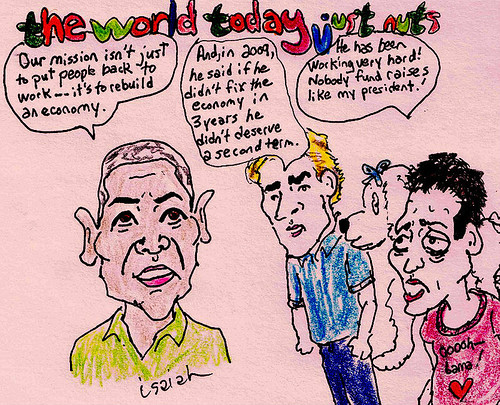
Monday, Monday.  And it's so much easier to blog on vacation.  :D  You'd think it would be harder but it's just the opposite.  First up, here's Isaiah's The World Today Just Nuts "I Want Four More Years"


I Want Four More Years

Don't you love that one?  Me too.

And what else do I love?  Sushi?  You know it.  We flew in on Sunday mainly because we had some odds and ends to tie up (into California, we're at C.I.'s) and also because Elaine and I thought our daughter needed an extra day, she had an ear infection at the start of last week.  So we got here Sunday and C.I. had a big (and fresh) sushi platter waiting for me.  You know I loved it.

 Okay, did you read the crap Tom Hayden posted at ZNet on Saturday?  He calls Dexter Filkins "the best American correspondent in Afghanistan for the past decade."  Dexy hasn't been in Afghanistan for a decade.  He spent a lot of time in Iraq.

He miscovered the assault on Falluja.  He did so intentionally.  He allowed the military to vet his copy -- his 'award winning' copy -- which is why it took so long for it to make it into print.

You know that story, right?  It's one of the first hard hitting pieces C.I. did.  In November 2004, what would become his 'award winning' crap was published and, the day it was published, it was left to C.I. to raise the important issues:

 The rah-rah piece carries the dateline "Nov. 18" in this story published in the November 21st edition. Allowing for the time needed to put together a Sunday edition, I'm still questioning that. The story was filed on the 18th (Thursday) and pops up on the 21st (Sunday). And there's the added detail, not provided in Dexter Filkins story, that Lance Cpl. William Miller died November 15th (http://icasualties.org/oif/prdDetails.aspx?hndRef=11-2004).
Perhaps we're all supposed to count the "eight days after the Americans entered the city on foot?"

If so The Guardian places that as November 8th (http://www.guardian.co.uk/Iraq/Story/0,2763,1346721,00.html) and eight days later would be the sixteenth -- well Times reporters aren't necessarily noted for their math.

The point here is that the story on today's front page (November 21, 2004) begins with a battle from November 15th without ever alerting the reader to this fact. An occurence six days prior is their front page Iraq story. (Which makes one think of Chris Hedges' comments on the nature of war correspondence.)

Was the story "cleared" -- is that the reason for the long delay in the Times reporting on events from the 15th?

Is anyone else bothered by the rah-rah nature of this report that reads like the plot to a video game? After reading the article is anyone else feeling like Filkins is a lot like Bob Dylan's "Mr. Jones" -- "Something is happening, but you don't know what it is, do you, Mr. Filkins?"


That's something Tom doesn't know because he doesn't know much of anything.

Tom gets in his attack on Hillary Clinton.  (Remember all his sexism in 2008?)  It's interesting that, in his mind, Hillary controls the war, not the man whose dick he wants to suck (Barack Obama).  Tom's drooling over a man's junk and we all know it's not the first time.

He goes on to say that Barack "found himself trapped by the Pentagon (and Hillary Clinton)" on Afghanistan.  I don't mind if people call her "Hillary."  I don't see that as disrespectful.  But he calls her "Hillary" prior to that sentence and he never calls Barack "Barack."

But then Tom wants to suck Barack Obama's cock. 


Size Queen Tommy drools:

 Thanks in small part to the anti-war movement – especially the legacy of the anti-Iraq movement – there is a great souring towards the Afghanistan war taking root amidst American public opinion. Some deride this as a new isolationism, others as crass indifference to Afghan suffering. Given the options, however, I believe this American mood should be supported and reinforced wherever possible. It is always possible for American public opinion to be manipulated and provoked into war fever again. Think Iran. Think Syria.


What an idiot.  There is no anti-war movement that Tom's a part of today.  You can't refuse to call out the person in charge of the wars (Barack) and pretend to be anti-war.  Tom and all his awful friends at United For Pathetic And Justice packed up their bags as soon as Barry got into office.

They're whores.  Cheap whores.

Tom accomplished nothing.

But isn't that the story of his life.  He cheats on Jane Fonda and fails to realize that he's just a gigolo.  And that's too bad because now he's an old and elderly man and a trick needs a lot more money than all he took Jane Fonda for in order to become something more than a trick.

Tom's a tired old whore.  He's famous for nothing.  Some will argue the (overrated) Port Huron statement.  Yeah, that was over forty years ago.  Talk about peaking early.

Tom, blow me.

At Third Sunday, the following worked on new content:


The Third Estate Sunday Review's Jim, Dona, Ty, Jess and Ava,
Rebecca of Sex and Politics and Screeds and Attitude,
Betty of Thomas Friedman Is a Great Man,
C.I. of The Common Ills and The Third Estate Sunday Review,
Kat of Kat's Korner (of The Common Ills),
Mike of Mikey Likes It!,
Elaine of Like Maria Said Paz),
Cedric of Cedric's Big Mix,
Ruth of Ruth's Report,
Wally of The Daily Jot,
Trina of Trina's Kitchen,
Marcia of SICKOFITRDLZ,
Stan of Oh Boy It Never Ends,
Isaiah of The World Today Just Nuts,
and Ann of Ann's Mega Dub.

And here's what we came up with:


Here's C.I.'s "Iraq snapshot:"

July 9, 2012.  Chaos and violence continue, Camp Ashraf is back in the news, Kurds export crude oil to Turkey, Speaker of Parliament Osama al-Nujaifi weighs in on provincial elections, and more.
 
I'd wrongly thought Tom Hayden would be wearing the dunce cap in today's snapshot.  Though he made a fool of himself, ABC News surpassed him.  Matt Negrin may have written the article (I was told he did but only by one friend at ABC News so we'll say "may have").  Whomever wrote it needs to be tested for drugs and have their resume checked.  The piece is entitled, "The Troops in Iraq: Sent Home, as Promised."
 
You really have to wonder about these whores for government who write this crap with no concern for the families of the Marines or Special-Ops and others still in Iraq.  You really have to wonder.  And today it's not just me explaining that's b.s. and the various people who e-mail the public e-mail account about their loved ones still being in Iraq.
 
No.  Today it's Rita Cook (Waxahachie Daily Light) reporting on Tim Vansyckle just returning home to Ovilla, Texas from Iraq and the joy his parents Bill and Martha Vansyckle has this weekend when they and other "family and friends gathered to cut the [yellow] ribbon on a tree that Bill says has grown during the year his son has been serving his country overseas." From Cook's report:
 
This past year was his second time in Iraq and he explains that his brigade was always there, despite the President's announcement the war in Iraq was over and U.S. troops would be returning home.  
"There were a lot of reports that every soldier left or that the last of 1st Cavalry had left," he says.  "It was pretty weird seeing stories about us being home for good when we were literally walking around Iraq."
 
It is beyond "whorish" to lie the way the media repeatedly has, it is trashy and every other term to repeatedly say "all US troops came home."  No, they damn well didn't.  And even now, US troops are in Iraq. 
 
Matt Negrin or whatever stupid moron ABC was idiot enough to hire concludes their fact-free fantasy with this:
 
In December, the last troops left, officially ending the American military presence in Iraq. However, while most of the troops returned to the United States in time for Christmas as Obama promised, about 4,000 troops in a brigade were reassigned to nearby Kuwait to complete a tour involving security and training, Stars and Stripes reported.
 
Did they report that, Moron, did they? 
 
 
Today the Senate Foreign Relations Committee released [PDF format warning] "The Gulf Security Architecture: Partnership With The Gulf Co-Operation Council." On page v., Senator John Kerry, Chair of the Senate Foreign Relations Committee, notes, "Home to more than half of the world's oil reserves and over a third of its natural gas, the stability of the Persian Gulf is critical to the global economy."  Chair John Kerry has stated of the report, "The Gulf Region is strategically important to the United States economically, politically, and for security reasons.  This is a period of historic, but turbulent change in the Middle East. We need to be clear-eyed about what these interests are and how best to promote them.  This report provides a thoughtful set of recommendations designed to do exactly that."
The report may well map out that for many.  That's not what stood out to me. The takeaway for me is US troops remain in the region, right next to Iraq in Kuwait and the Committee's recommendation is that they remain present.  (For those who don't want to read the report in full or operating systems are not PDF friendly, click here for the Committee's one page explanation of the report.) 
[. . .] 
Further into the report, we get the point AP' was emphasizing this morning. AP: "The United States is planning a significant military presence of 13,500 troops in Kuwait to give it the flexibility to respond to sudden conflicts in the region as Iraq adjusts to the withdrawal of American combat forces and the world nervously eyes Iran, according to a congressional report." Page nine of the report:
 
 
A residual American military presence in the Gulf and increased burden-sharing with GCC [Gulf Cooperation Council] states are fundamental components of such a framework. However, the United States must also carefully shape its military footprint to protect the free-flow of critical natural resources and promote regional stability while not creating a popular backlash.
 
 
Page 12:
 
 
Kuwait is especially keen to maintain a significant U.S. military presence. In fact, the Kuwaiti public perception of the United States is more positive than any other Gulf country, dating back to the U.S.-led liberation of Kuwait in 1991. Kuwait paid over $16 billion to compensate coalition efforts for costs incurred during Desert Shield and Desert Storm and $350 million for Operation Southern Watch. In 2004, the Bush Administration designated Kuwait a major non-NATO ally.
* U.S. Military Presence: A U.S.-Kuwaiti defense agreement signed in 1991 and extended in 2001 provides a framework that guards the legal rights of American troops and promotes military cooperation. When U.S. troops departed Iraq at the end of 2011, Kuwait welcomed a more enduring American footprint. Currently, there are approximately 15,000 U.S. forces in Kuwait, but the number is likely to decrease to 13,500. Kuwaiti bases such as Camp Arifjan, Ali Al Salem Air Field, and Camp Buehring offer the United States major staging hubs, training rages, and logistical support for regional operations. U.S. forces also operate Patriot missile batteries in Kuwait, which are vital to theater missile defense.
 
 
Get it?  ABC News doesn't seem to.  And Kuwait's not the only US military staging area surrounding Iraq.  ABC News has turned in campaigning, they haven't turned in reporting.  That 'report' is misleading at best and the network should be embarrassed to have posted it regardless of who wrote it.  I don't know what's more shocking, that someone was paid to write that garbage or that a professional news outlet posted it.
 
Equally stupid is Roberty Dreyfuss at The Nation but, then, he has an excuse -- he spent the bulk of his professional career writing for Lyndon LaRouche.  Showing just how worthless that 'training' is, Dreyfuss churns out an article with its own problems.  He recommends Susan Crabtree's Washington Times article and he quotes from it, "June was Iraq's second-deadliest month since U.S. troops pulled out Dec. 18, 2011 . . ." 
 
Uh, LaRouche Zombie, what was Iraq's deadliest month?
 
The United Nations counts over 400 dead in the month of June.  Are you aware of that? Apparently not and aren't we all lucky that you and The Nation decided to advertise your disinterest in All Things Iraq yet again. He agrees that violence is a problem and that there's a political crisis.  This is his conclusion: 
 
And here's what the Obama administration ought to do about violence in Iraq: Nothing.
 
You have to marvel over the intellectual decay at The Nation
 
The Obama administration ought to do nothing?
 
I guess in LaRouche Land there is only dualities and no complexities.  I thought The Nation -- the country's oldest opinion journal -- had a little bit more on the ball than that.
 
What should the administration do?  There are a host of things they should immediately be doing.  We'll throw out two.
 
1) The F-16 deal is off.  The Iraqi press in the last two weeks has been reporting that Nouri actually wants more F-16s than the deal calls for.  And, of course, they've also reported that US Vice President Joe Biden called him and told him that the ExxonMobil deal needs to go through or the F-16 deal is off. 
 
If the US government can threaten to pull the F-16 deal to help our a multi-national corporation, it can damn well use it as leverage with regards to the ongoing political crisis.
 
2)  Then there is the UN issue of Chapter VII.  Though little reported in the US press, Chapter VII is a big deal in Iraq and each year they plead with the UN to remove them from it.  Each year they just know it will happen but it hasn't so far.  The US government can ensure that it doesn't and should be doing that right now.
 
There are a host of things that the US government can do to influence the political crisis and the violence.  And the two are related, which Dreyfuss probably doesn't grasp either.  The US could pressure Nouri to follow the Erbil Agreement -- that alone would immediately effect life in Iraq. 
 
How screwed up is The Nation magazine today that they publish an article that claims the US should do nothing?  I guess I shouldn't be surprised, they've never once written a single article during any of the waves of attacks on Iraq's LGBT community.  But the reality is that there a ton of things the US government can do besides declare war or send soldiers.  How awful that The Nation now sees the US government's only power as whether or not to declare war -- how awful and how telling.
 
Violence continued in Iraq today.  AFP reports 2 Sahwa were shot dead in Samarra and a Mosul roadside bombing claimed the life of 1 Brigadier General while leaving one major general and three bystanders injured. Alsumaria reports a Diyala Province sticky bombing injured one person while a roadside bombing in Diyala Province claimed 1 life and left another person injured.  All Iraqi News reports two bodies were pulled out of the Eurphrates in Dhi Qar province while police in Nasiriyah prevented an elderly man from taking his own life.  IANS notes, "At least one person was killed and nine wounded in separate bomb attacks in Iraq's Kirkuk province Sunday, Xinhua reported."  On the topic of violence, Al Mada reports that independent MP Hassan al-Alawi has noted Iraq is now Shi'ite-led -- civilian, military, government -- and he wonders what does it say with the daily bloodshed of Shi'ite blood and when the Shi'ite regime is unable to protect the Shi'ites, how will it be able to protect any of the other communities?
 
As Nouri and company continue to flounder and flail with regards to security, Alsumaria reports that KRG President Massoud Barzani announced today the formation of the National Security Council of Kurdistan which will work to protect the people in the Kurdistan Regional Government and their  property.  Barzani hailed it as a major step in serving the people of Kurdistan.  Space permitting, we'll note the KRG in today's snapshot.  There's news out of the KRG in regards to a recent Congressional hearing we covered here.   The National Security Council of Kurdistan had just been announced when, Alsumaria reports, Nouri's State of Law began attacking it.  MP Mohammed Chihod insists that the creation of the body is an abuse of the Constitution and that the KRG is attempting to play a dual role.  I'm sure the residents of Iraq would love it if Nouri could play any role in nominating people to head the security ministries.  He was supposed to have done that in 2010.  It's 2012.  Is he just stupid or incompetent?  Possibly both but what he's been attempting is a power grab.

At Moqtada's website, MP Bahaa al-Araji calls out the paper the Reform Commission is currently floating and states that they have already made proposals -- the Sadr bloc, Iraqiya and the Kurds jointly -- in Erbil and Najaf.  Al Mada reports that the KRG's Parliament stated yesterday that the ExxonMobil deal remains part of the conflict between Erbil and Baghdad and that this is the main part of their move to withdraw confidence in Nouri -- his refusal to follow the law.
 

Tomorrow, Dar Addustour reports, the Parliament is set to resume session and will be looking at a number of bills including one on telecommunications. Adnan Hussein (Rudaw) reports, "A number of lawmakers have forwarded a draft law to the speaker of Iraqi Parliament regarding the Kurdish language in education system. A lack of teachers specializing in the Kurdish language to fill position in more than 21,000 schools is the main obstacle to implementing the law.  The draft law, which stipulates that the Kurdish language be studied from the fourth grade through college in all of Iraq, has been signed by 30 MPs."  The Speaker of Parliament is Osama al-Nujaifi and All Iraqi News notes al-Nujaifi states that the election date for provincial elections early next year must be respected and that the Independent High Electoral Commission needs to have the new appointments and that women and other minorities need to be represented in the body.  He discussed these issues today with the UN Secretary-General's Special Envoy in Iraq Martin Kobler.  KUNA adds, "A statement by the Speaker office said that Al-Nujaifi expressed pleasure for the keeness of the UN representative to engage in the formation process, noting on the ongoing discussion inside experts committee members concerning a collective meeting with all political parties involved."
 
On Friday, Moqtada al-Sadr gave a major, televised speech.  The full text of the speech is up at Moqtada's website.  We covered the bulk of it in Friday's snapshot but there are some other points to pick up on.  It was a ten point speech. The most poetic portion of the speech was when he spoke of Iraq being a lovely moasic of Shias, Sunnis, Christians, Sabians, Alayazdihs, Torkomen, Failis, Shabaks, etc. and how this moasic was Iraq and needed to be protected and maintained with an air of democracy and a spirit of tolerance. The issue of Iraqi's finances was discussed in terms of looting by the government (needs to stop) and in terms of distributing this to the people.  We noted the corruption issue on Friday -- he called for government corruption to be addressed via a vareity of forums including judicial and parliamentary committees and he added that the corrupt must be held accountable regardless of political bloc, ideology or ethnicity and that those government officials engaging in corruption should be put to death because this would be pleasing (to the people and to God) and because this would act as a deterrent to prevent others from engaging in corruption.  On corruption, Omar Sattar  (Al-Monitor) reported Saturday, "Iraq's Integrity Committee pledged to launch a full-scale investigation into major "corruption" cases involving the ministries of defense, interior and electricity and billions of dollars that were squandered from the public budget."
 
Of the ten points, only one received traction in the media and, even then, it was just one aspect of the third point.  Saturday, Al Rafidayn reported on Moqtada's call for a law limiting the three presidencies (President of Iraq, Prime Minister of Iraq and Speaker of Iraq) to two terms.  This call alarmed State of Law.  Alsumaria reports State of Law MP Haitham al-Jubouri insisted this must be done by a Constitutional amendment and not by a law.  Alsumaria notes that Kurdish MP Mohsan Saadoun insists that this is a measure that would be done by law, through Parliament.  State of Law opposes the measure (it would mean this would be Nouri al-Maliki's final term as prime minister) and they insist on a Constitutional Amendment because that's much more difficult than passing a law in Parliament.
 
He couldn't provide security and he's refused to implement Article 140 of the Constitution, but, AKnews reports, Nouri al-Maliki has ordered a census, a country-wide census . . .
of animals.  If they count jack asses, presumable, Nouri will be tallied in that category.
 
 
Benjamin's opening remarks.
 
 
AMBASSADOR BENJAMIN: Yes. Thank you very much. I wanted to talk today a bit about the situation in Iraq, where there is an impasse between the Iraqi Government and the Mujahedin-e Khalq, the MEK, over the relocation of residents from the group's paramilitary Camp Ashraf to the temporary transit facility at Camp Hurriya. The Iraqi Government and the United Nations continue to encourage the secure, humane relocation of residents to Hurriya for refugee status determinations by the United Nations High Commission on Refugees. Almost 2,000 individuals have already relocated, but the remaining 1,200 to 1,300 are holding at Ashraf until various MEK demands are met by the Iraqi Government. The last convoy of individuals, about 400 people, was on May 5th. And the patience of the Iraqi Government is wearing thin.
The MEK seems to have misinterpreted the June 1 order by the U.S. Court of Appeals for the D.C. Circuit. MEK leaders appear to believe that the Secretary has no choice now but to delist them. That conclusion is quite plainly wrong. In short, the court did not order the Secretary of State to revoke the MEK designation as a Foreign Terrorist Organization. As the Secretary has made clear, the MEK's cooperation in the successful and peaceful closure of Camp Ashraf will be a key factor in her decision regarding the MEK's FTO status. The court has told the State Department that it must act by October 1, but it did not mandate a particular result. I think that's very important to underscore. The Secretary thus retains the discretion to either maintain or revoke the designation in accordance with the law. It is past time for the MEK to recognize that Ashraf is not going to remain an MEK base in Iraq. The Iraqi Government is committed to closing it, and any plan to wait out the government in the hope that something will change is irresponsible and dangerous.
The MEK is a group whose violent history against the United States includes the bombing of U.S. companies in Iran, the assassination of seven U.S. citizens, and the provision of support for the attack, occupation, and hostage-taking at the U.S. Embassy in Tehran. The MEK is also one of the few foreign groups to attempt an attack on U.S. soil when, in 1992, it launched near simultaneous attacks in 13 countries, including against the Iranian mission to the UN in New York. Even the MEK itself has admitted to continuing violent attacks until 2001.
With such a history, cooperating fully with the UN's efforts in Iraq would be a tangible demonstration that the MEK has left its violent past behind and that it no longer retains the capability and intent to engage in acts of terrorism. This is the MEK's moment to show that it has taken on a fundamentally different character. It should act quickly and complete the relocation and close Camp Ashraf.
 
 
Kindness has it limits so we stop there.  What a bunch of collective idiots.  The State Dept?  No, the press or 'press.'  The State Dept's intent is to distort and misdirect.  That's what they do.  The press is supposed to be interested in truth and, on every level, they failed at that repeatedly.
 
The times they failed are too numerous so we'll note only one example.  CNN's Jill Dougherty wants to know, with Nouri's government saying the residents will be evicted after July 20th, what they can "legally" do if the residents are still at Camp Ashraf?  And Daniel Fried opens with, "I'm not a lawyer at all, much less an expert on Iraqi law."  The State Dept's Special Advisor on Camp Ashraf can't answer a basic legal question?  And Jill Dougherty let him get away with that.  How embarrassing.  What a cowed media we have.  On something as banal as a call-in, the media can't even do their job. 
 
On July 6th, the State Dept's Special Advisor on Camp Ashraf has no clue what options are open in less than 14 days? 
 
How embarrassing.
 
Jill Dougherty can at least assert that she did a better job in her reporting than she did in her questioning -- reading over the reports by her collegues, she's the only one who can make that claim.  Why are the remaining residents (approximately 1,400 remain at Camp Ashraf, approximately 2,000 have already moved to Camp Liberty) refusing to go?  These are there demands.
 
  1. Transfer of 300 air conditioners from Ashraf to Liberty.
  2. Transfer of all the power generators that are currently in Camp Ashraf to Camp Liberty. If there is any dispute about the ownership of the generators, they can be resolved in the future, under supervision of UN.  
  3. Transfer of 25 trucks, containing the belongings left over from the fourth and fifth convoys, and six utility vehicles about which there had already been an agreement.
  4. Transfer of five forklifts from Ashraf to Liberty for the purpose of moving the residents' belongings.
  5. Transfer of three specially-designed vehicles and six specially-designed trailers for the disabled.
  6. Transfer of 50 passenger cars from Ashraf to Liberty. It means one car for every 40 residents, which is absolutely necessary in the hot weather and for wounded and disabled residents.    
  7. Permission for construction, including the building of pavements, porches, canopies, ramps, special facilities for the disabled and green areas.  
  8. Connecting Liberty to Baghdad's water network. Alternatively, the residents should be permitted to hire Iraqi contractors to pump the water into Liberty from a nearby water canal and bringing their own water purification system from Ashraf.
  9. Allowing merchants or bidders access to Ashraf to negotiate and buy the movable properties as soon as possible and to make advanced payment and start making partial payments to the residents before the resumption of the relocation of the next convoy.
  10.  Start of negotiations between the residents and their financial representatives and the Iraqi Government to sell the immovable assets and properties, or negotiations with third parties (Iraqi Government should provide permission) to sign the necessary agreements. Partial payments should be made before the relocation. At least 200 residents would remain at Ashraf to maintain and upkeep the properties until they are sold in their entirety.  
 
 
I don't have a link for those ten, it's from a press release by The International Solidarity for Democratic Change in Iraq (press release sent to the public e-mail account for The Common Ills). From the same press release:
 
Making the delisting of the MeK conditional on relocation of the remaining residents of Ashraf to Liberty is in effect blackmailing the defenseless residents to give up their basic human rights and willingly go to a prison, ironically called Liberty, which could turn into a killing field for them. The PMOI must be delisted because there is no evidence to suggest otherwise. The safety and well-being of the Ashraf residents are much more important and must be given priority.  
 
 
This is getting ridiculous and the Obama administration is looking inept.  I'm not saying delist or don't delist the MEK here.  I'm saying whether or not a group moves from point A to point B physically does not determine whether or not they're a terrorist.  Saturday, AFP reported, "The United States on Friday again urged members of an exiled Iranian opposition group to leave their long-time base in Iraq, saying a move could facilitate their removal from a US terror blacklist." Regardless of your feelings on this issue and the residents, you should be offended that the US government -- and they're revealing this publicly -- assigns someone to the terrorist list or not on something other than whether or not the group is a terrorist.  The US goverment is saying, 'Move to Camp Liberty and the group you belong to, MEK, can be taken off the terrorist list.'
 
The US government currently has 51 groups (counting the MEK) on their designated terrorist list.  (If you've never seen the list, click here.) I'm sure others on the list -- say the Palestine Liberation Front -- would be happy to move a few miles to the east or west if it meant the US would take it off the terrorist list.
 
If the list has any meaning at all, any integrity, than whether the residents of Camp Ashraf stay at Ashraf or move to Camp Liberty should have no bearing on their designation as terrorist or not terrorist. 
 
Everyone should be offended by the line the State Dept is taking.  If the MEK is a terrorist organization (I have no idea if they are or not), then they need to be on the list.  If they're not a terrorist organization, they need to be off it.  Whether Camp Ashraf residents leave it or not should have no bearing on a terrorist designation by the US government.
 
In Friday's press conference, BBC's Bahman Kalbasi asked about the rumors of the Camp Ashraf residents being "involved with the assassination of scientists in Iran" as reported on NBC and Benjamin replied, "I can assure you that I have never said that they were involved in current assassinations in Iran.  That was a story that ran, and I have no information to confirm that, so I certainly wouldn't have said it.  What I have given you is the established record, and nothing more and nothing less."  Camp Ashraf is not on the border with Iran.  It is on the Tigris River, to the north of Baghdad.  While Iraq's border patrol is lax, Iran's able to grab three US hikers but unable to protect their borders from Camp Ashraf residents running back and forth?  Doesn't make a lot of sense. 
 
But the reporters never made any sense at the press conference.  They yammered away about the 'rights' of the government of Iraq.  I'm sorry, did I go into a coma and miss the Amnesty International alert on Camp Ashraf residents mistreating the government of Iraq?  I don't think I was in a coma.  And as I remember it, it's Nouri's goons that have twice alarmed the world as they've attacked the residents of Camp Ashraf.  Dropping back to the Feburary 23rd snapshot for the details the reporters 'forgot' in the press conference and in their write-ups -- and that does include Jill's write-up as well:
 
 July 28, 2009 Nouri launched an attack (while then-US Secretary of Defense Robert Gates was on the ground in Iraq). In a report released this summer entitled "Iraqi government must respect and protect rights of Camp Ashraf residents," Amnesty International described this assault, "Barely a month later, on 28-29 July 2009, Iraqi security forces stormed into the camp; at least nine residents were killed and many more were injured. Thirty-six residents who were detained were allegedly tortured and beaten. They were eventually released on 7 October 2009; by then they were in poor health after going on hunger strike." April 8, 2011, Nouri again ordered an assault on Camp Ashraf (then-US Secretary of Defense Robert Gates was again on the ground in Iraq when the assault took place). Amnesty International described the assault this way, "Earlier this year, on 8 April, Iraqi troops took up positions within the camp using excessive, including lethal, force against residents who tried to resist them. Troops used live ammunition and by the end of the operation some 36 residents, including eight women, were dead and more than 300 others had been wounded. Following international and other protests, the Iraqi government announced that it had appointed a committee to investigate the attack and the killings; however, as on other occasions when the government has announced investigations into allegations of serious human rights violations by its forces, the authorities have yet to disclose the outcome, prompting questions whether any investigation was, in fact, carried out." Mohammed Tawfeeq (CNN) observesthat "since 2004, the United States has considered the residents of Camp Ashraf 'noncombatants' and 'protected persons' under the Geneva Conventions."
 
If you're wondering, the 'protected persons' aspect didn't come up in the press conference or the write-ups.  It's a one-sided kind of 'reporting.'  They did make time to insist, in their write-ups, that advocates for Camp Ashraf had been paid to be advocates.  That's a baseless lie and the press needs to drop it.  If they were doing their job to begin with, they'd know damn well that the leadership on this issue isn't coming from 'former government officials' as the State Dept attempted to spin in Friday's conference.
 
 
November 15, 2011, the Senate Armed Services Committee held a hearing on Iraq. Appearing before the Committee was Secretary of Defense Leon Panetta and the then-Chair of the Joint-Chiefs of Staff General Martin Dempsy.  It was an important hearing and we covered it in several snapshot.  The November 17th snapshot emphasized the Camp Ashraf remarks:
 
"The status of the residents at Camp Ashraf from the Iranian dissident group MEK remains unresolved," Senator Carl Levin declared Tuesday. "As the December 2011 deadline approaches, the administration needs to remain vigilant that the government of Iraq lives up to its commitments to provide for the safety of the Camp Ashraf residents until a resolution of their status can be reached.  We need to make it clear to the government of Iraq that there cannot be a repeat of the deadly confrontation began last April by Iraqi security forces against Camp Ashraf residents."
 
He was speaking Tuesday morning at the Senate Armed Services Comittee hearing while delivering his opening remarks as Chair of the Committee.  Senator John McCain is Ranking Member on the Committee.  The first panel the Committee heard testimony from was composed of US Secretary of Defense Leon Panetta and the Chair of the Joint-Chiefs of Staff General Martin Dempsy.  Camp Ashraf came up in Chair Levin's opening remarks and it came up later during the first panel.
 
 
Senator Lindsey Graham: Do you think -- do you think the people in Camp Ashraf, do you think they're going to get killed? What's going to happen to them?
 
General Martin Dempsey: The, uh, as you know, Senator, the State Department is leading an effort to ensure that -- work with the Iraqi government ---
 
Senator Lindsey Graham:  Can you tell the people back here that the likelihood of their friends and family being killed has gone up greatly if there are no American forces up there policing the problem? 
 
General Martin Dempsey:  I won't say anything to those people because I'm not involved in the outcome.
 
Senator Lindsey Graham: Fair enough. 
 
 
In what was now the second round, John McCain went on to laugh with Leon Panetta and to thank him for appearing before the Comittee and putting up with pointed questions.  He brought up a request that Panetta had made to him and Senator Graham (formally, in a letter) and noted they were working on that issue (defense funding).  We're not going to excerpt that but since so much was made of the first round of questioning between Panetta and McCain, we will note that both laughed with one another in an exchange in the second round.  (The hysterical gossip corps portrayed McCain being testy as new or novel and may have left many with images of poor Leon struggling for the vapors.  Neither person was harmed by the exchange in the first round nor appeared to hold a grudge or ill will towards the other.)  Near the end of his second round, McCain did bring up the issue of Camp Ashraf.
 
Ranking Member John McCain: Could I just say finally on the Camp Ashraf issue, I know the Secretary of Defense -- I mean, Secretary of State is addressing this issue, but it is American troops that are protecting them now. I hope that you can give us some idea of what disposition is going to be because I think it's -- I think it's very clear that the lives of these people are at risk and I thank you, Mr. Secretary.
 
Secretary of Defense Leon Panetta: I appreciate that.
 
Chair Carl Levin: Well, just on that, to turn it into a question -- and, maybe, General, this needs to be addressed to you too -- what -- There's obviously a greater risk to folks there unless the Iraqis keep a commitment.  What's going to be done to make sure, to the best of our ability, that they keep that committment and what about the question of removing them from the list of -- not them, the organization from the terrorist list?
 
General Martin Dempsey:  Well, Senator --
 
Senator Carl Levin: We're all concerned about this --
 
General Martin Dempsey:  And we share your concern. [General] Lloyd Austin shares your concern.  And I know that Ambassador Jeffreys shares the concern and there is no  -- we're not sparing any diplomatic effort to encourage the Iraqis to do what we think is right in this regard to ensure the protection of those folks in Camp Ashraf.  But right now, actually, the Iraqi security forces guard Camp Ashraf with our advisory and assistance group with them.  And so the concern, when we do leave that capacity, is a real one.  And  But I actually think we've got to put the pressure on the Iraqi government diplomatically to have the outcome that we think is correct.
 
Senator Carl Levin: Just assure them if you would that there's a real strong feeling around here that if they -- if they violate a committment to protect those people -- assuming that they're still there and that they haven't been removed from the terrorist list so that they can find other locations -- that if they violate that committment to us, that is going to have a severely negative impact on the relationship with the -- I think I can speak here -- the Congress although I'm reluctant to ever say this. I think there's a lot of concern in the Congress about it and this will, I believe, in my opinion, will severely negatively impact their relationship with the Congress. Let me leave it at that.
 
Secretary Leon Panetta:  Senator, I want to assure you that Ambassador Jeffrey has made that point loud and clear, loud and clear the Iraqis.
 
Senator Carl Levin: Senator Lieberman?
 
Senator Joe Lieberman:  Thanks, Mr. Chairman. And add my voice and I think you can speak for Congress members of both parties in both houses in expressing our concern about the safety of the people in Camp Ashraf.
 
Senators Carl Levin, John McCain, Lindsey Graham and Joe Lieberman.  And, in fact, the full Senate Armed Services Committee.  Know your facts or find something else to cover.  If you're wondering why the above is not more widely known, that's because while we spent days reporting the hearing in snapshots, the press -- and Antiwar.com -- reduced the hearing to 'John McCain got testy with Leon Panetta!'  They played Gossip Girl because reporting was too damn hard for them.  It's like the recent Senate Foreign Affairs Committee report about the number of US servicemembers in Kuwait.  That created a mini-stir last month but, point of fact, Senator Kay Hagan was raising that issue in the hearing.
 
We treated the hearing seriously in this community, covering it in the November 15th "Iraq snapshot," the November 16th "Iraq snapshot," the November 17th "Iraq snapshot," by Ava in "Scott Brown questions Panetta and Dempsey (Ava)," by Wally with "The costs (Wally)," by Kat in "Who wanted what?" and, at The Third Estate Sunday Review, in "Editorial: The silences that enable and kill," "Enduring bases, staging platforms, continued war" and "Gen Dempsey talks "10 enduring" US bases in Iraq."  By contrast, with the exception of   Elisabeth Bumiller (New York Times) and Laurence Vance (LewRockwell.com), the press misreported and trivialized the hearing.
 
On the subject of Congressional hearings, the House Oversight and Government Reform Subcommittee on National Security, Homeland Defense and Foreign Operations held a hearing June 28th (we cover it in the June 29th snapshot).  From the snapshot:
 
Acting Chair Blake Farenthold:  I just have one more question so we'll just do a quick  second round of questions. Ambassador Kennedy, you mentioned the Baghdad police college annex facility as one of the facilities.  It's my understanding that the United States' taxpayers have invested more than $100 million in improvements on that site. It was intended to house the police department program -- a multi-billion dollar effort that's currently being downsized.  And as a result of the State Dept's failure to secure land use rights the entire facility is being turned over to the Iraqis at no cost.  The GAO reports 
Mission Iraq has land use agreements or leases for only 5 out of all of the sites that it operates. Can you say with confidence that those sites now operating without leases or agreements will not be turned over to Iraq for free as was the case with the police development program?  And what would the cost to the US taxpayer be if they were to lose without compensation all of those facilities?

[State Dept] Patrick Kennedy:  Thank you, Mr. Chairman.  First of all, the statement that has been -- that you were reading from about we are closing the Baghdad police development center because of a failure to have land use rights is simply factually incorrect.  We have a land use agreement for that site. As part of the program -- the police development program -- there are periodic reviews that are underway and my colleagues who do that -- it's not part of my general responsibility on the operating side of the house -- engage in reviews on a six month basis both internally and with the government of Iraq.  It was always our plan to make adjustments to the police development program  over time.  But the statement that somehow we have wasted or had everything pulled out from under us because of lack of a land use agreement is very simply false. For our other properties in Iraq we have -- we have agreements for every single property we have in Iraq except for one which is our interim facility in -- in Basra which is simply a reincarnation of a former US military there. But even in that regard we have a longterm agreement that was signed with the government of Iraq by Ambassador Negroponte in 2005 in which we swapped properties with the government of Iraq and they are committed to provide us with a ten acre facility in-in Basra of our mutal choosing. And so we are covered, sir. 
He said it.  Too bad it wasn't accurate or, for that matter, truthful.  We'll jump over to the second panel.
 

Acting Chair Blake Farenthold:  Mr. Courts, Ambassador Kennedy and I got into a 
discussion about the absence of or presence of land use agreements for the facilities we have in Iraq do you have the current status for that information from your latest report as to what facilities we do and do not have land use agreements for?
 
[Government Accountability Office] Michael Courts: What Ambassador Kennedy may have been referring to that for 13 of the 14 facilities the Iraqis have acknowledged a presence through diplomatic notes. But there's still only 5 of the 14 for which we actually have explicit title land use agreements or leases. 

Acting Chair Blake Farenthold:  Alright so I'm not -- I'm not a diplomat.  So what does that mean?  They say, "Oh, you can use it until we change our minds" -- is that basically what those are?  Or is there some force of law to those notes?

Michael Courts: Well the notes are definitely not the same thing as having an explicit agreement.  And as a matter of fact, there's already been one case where the Iraqis required us to reconfigure, downsize one of our sites.  And that was at one of the sites where we did not have a land use agreement and so obviously we're in a much more vulnerable position when there's not an explicit agreement.
 
 
The Kurdistan Regional Government really wasn't the concern there.  But Sunday the KRG announced that Foreign Relations Minister Falah Mustafa met with outgoing US Consul General Alexander Laskaris: "As his last official act in the Region, prior to the meeting Consul General Laskaris signed an agreement regarding the allocation of land for the permanent premises of the US Consulate to be built on. Commenting on this agreement, Mr Laskaris said, 'We thank the government of Kurdistan for allocating this land as part of enhancing our permanent diplomatic presence in Iraq including Baghdad, Basra and Erbil. We look forward to breaking ground and thank the leadership of the KRG for their continuing support and partnership'."
 
On the subject of the KRG, AFP reports, "Iraqi Kurdistan has begun sending oil produced in its three-province autonomous region out of the country without the express permission of the central government, an official said on Sunday."  Hassan Hafidh (Dow Jones) notes, Iraq's government Monday said crude-oil exports from the semi-autonomous northern region of Kurdistan to neighboring Turkey are 'illegal' and threatened to take 'appropriate action,' in a continuation of recent of tensions between the two." Turkey's Minister of Energey Taner Yildiz tells Hurriyet Daily News, "The main issue here is the fact that both the Iraqi central government and the Iraqi Kurdish regional administration need these revenues.  Thus, we are conducting operations [with Baghdad and Arbil] similar to those we conduct with all neighboring countries in order to meet these demands.  There is not any violation of the law."  And if it's anything like the ExxonMobil deal, it will be no clearer months from now.