Wednesday, December 30, 2015

If I pretend Ramadi is liberated . . .

. . . does that mean the US can finally leave Iraq?

Ramadi's still not liberated.

It's like calling a game a little after half-time.

There's work to be done.

But the media keeps hailing the success of liberating Ramadi.

So my question is, if I go along with the lie, does that mean US forces can leave -- and stay out of -- Iraq?

If so, I'm on board with the lie.


Here's C.I.'s "Iraq snapshot:"


Tuesday, December 29, 2015.  Chaos and violence continue, the battle for Ramadi continues, the battle for bragging rights intensifies, and much more.


Starting with this Tweet:


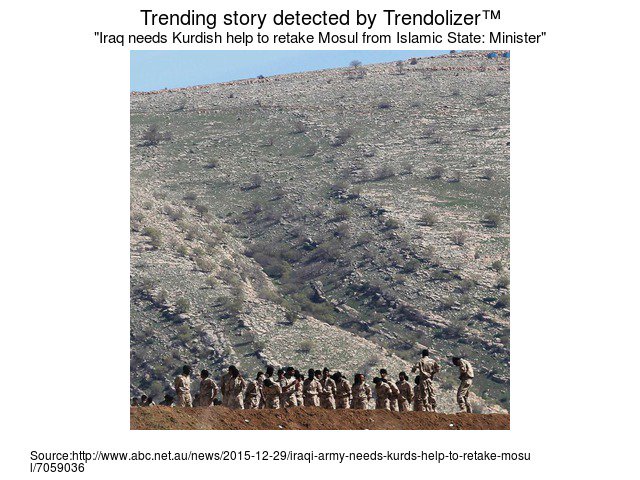
needs Kurdish help to retake from Islamic State: ...                                                                                                                                                                                                                                                                                                                                                                                                                                                      
Embedded image permalink


Mosul lies on the horizon -- immediate or distant.

The Islamic State seized control of the city on June 10, 2014.

'Liberation' of the city would come with bragging rights and the Kurds don't want to be left out of that opportunity.


Mosul lies in Nineveh Province.  Approximately 202 miles away, in Anbar Province, lies Ramadi.


Nyshka Chandran (CNBC) offers an analysis of the Ramadi effort including noting that it is an eight month battle so far -- a detail most ga-ga coverage is missing.  From the analysis:

"The capture of Ramadi isn't that much a strategic event in and of itself. The fight definitely isn't over yet," Sim Tack, director of analytical support and military analyst at Stratfor, told CNBC on Tuesday.
"They are still clearing out pockets of the city, there's going to be a long process before they can call Ramadi secure. And then, there's still the continuing threat from IS, which still holds Fallujah and other areas in Anbar."


Today, Iraq's Prime Minister Haider al-Abadi made the journey to Ramadi to proclaim victory in liberating the city from the Islamic State.

The declaration was premature as events made clear.


  • BREAKING UPDATE: Iraqi PM 's convoy comes under rocket fire during his visit in , He remained unharmed.


  • At some point this week, Ramadi may indeed be liberated -- or at least be ridded of the Islamic State.  That point has not, however, been reached yet.

    But he wants bragging rights.

    The battle for Ramadi is hailed by the media as a 'victory' and it has nothing to do with whether or not Ramadi's liberated.

    It has everything to do with propaganda and the never-ending struggle between the governments of the United States and Iran.


    It goes back to Tikrit and March of this year when the mission to run the Islamic State out of the city began.

    Iraqi forces stormed the area.

    These were Iraqi military forces and the Shi'ite militias including the extremist, thuggish Shi'ite militias.  This included the Badr Brigade led by thug Hadi al-Amiri who stood out in 2015 mainly for threatening the US Congress with violence until this month when, as Mona Alami (AL-MONITOR) notes, "Hadi al-Ameri, the powerful leader of the Badr forces in the Iraqi Popular Mobilization Units, threatened in a statement Dec. 7 to attack any new US base in Iraq."


    In Iraq and out of Iraq, Hadi al-Amiri is seen as a puppet for the government of Iran and he was seen as carrying out their orders in the efforts against Tikrit.  In addition, Iranian forces were taking part in the battle and Quds Force Commander Qassem Soeimani was in Iraq.

    The mission was a failure.

    And the US government provided limited assistance until the Iranians left.

    As a result of that departure, Shi'ite Iraqi thugs with links to Iran -- including Haid al-Amiri -- pulled back.


    It was during the pull back that the US government increased air strikes and Tikrit was freed of the Islamic State -- though overrun with Shi'ite thugs.  (When Ned Parker attempted to report this reality for REUTERS, his life was threatened and, despite nearly a decade covering Iraq for THE LOS ANGELES TIMES and REUTERS, he had to leave the country.)

    The success in removing the Islamic State from Tikrit belonged to Iraqi forces and US air power.

    In the battle for Ramadi (which remains ongoing), Iran's been left out of the party -- intentionally.

    And bragging rights are out of its reach.

    Haider used the Iraqi military and Sunni tribes and US bombings.


    The rush to proclaim Ramadi a success is about the US getting credit and Iran losing out.

    It's about Haider al-Abadi attempting to circumvent and weaken the Shi'ite militias.

    It's about a great many things.

    It is not, however, about Ramadi being liberated.

    Ramadi is the after thought.


    As Michael Knights (at the BBC website) observes, "This dynamic is important because Shia militia commanders like Abu Mahdi al-Muhandis, a US-designated global terrorist, or Hadi al-Amiri will probably seek to play key roles in the liberation of Mosul."


    Today, the US military announced:


    Strikes in Iraq
    Fighter, attack, bomber, and remotely piloted aircraft conducted 22 strikes in Iraq, coordinated with and in support of the Iraqi government:

    -- Near Fallujah, two strikes struck two separate ISIL tactical units and destroyed two ISIL fighting positions, two ISIL bunkers, two ISIL tunnel entrances, an ISIL vehicle, and an ISIL trench system.

    -- Near Kirkuk, one strike destroyed two ISIL excavators.

    -- Near Kisik, three strikes struck two separate ISIL tactical units and destroyed an ISIL fighting position and wounded two ISIL fighters.

    -- Near Mosul, five strikes struck two separate ISIL tactical units and destroyed three ISIL vehicles, 14 ISIL fighting positions, an ISIL tunnel, and three ISIL command-and-control nodes.

    -- Near Qayyarah, two strikes struck two separate ISIL tactical units and destroyed three ISIL fighting positions and an ISIL vehicle.

    -- Near Ramadi, seven strikes struck five separate ISIL tactical units and destroyed eight ISIL fighting positions, two ISIL oil tanker trucks, three ISIL heavy machine gun positions, an ISIL vehicle, an ISIL front end loader, an ISIL vehicle-borne bomb, an ISIL sniper position, an ISIL house bomb, and denied ISIL access to terrain.

    -- Near Sinjar, one strike suppressed an ISIL mortar position.

    -- Near Tal Afar, one strike destroyed an ISIL-used culvert.

    Task force officials define a strike as one or more kinetic events that occur in roughly the same geographic location to produce a single, sometimes cumulative, effect. Therefore, officials explained, a single aircraft delivering a single weapon against a lone ISIL vehicle is a strike, but so is multiple aircraft delivering dozens of weapons against buildings, vehicles and weapon systems in a compound, for example, having the cumulative effect of making those targets harder or impossible for ISIL to use. Accordingly, officials said, they do not report the number or type of aircraft employed in a strike, the number of munitions dropped in each strike, or the number of individual munition impact points against a target.


    Finally,  Janan Aljabiri and Joanne Payton (FAIR OBSERVER) report on 'compensation' marriage in Iraq -- where a woman isn't a human being, just a bargaining chip:


    These arrangements are termed al-Fusliya in Arabic and badal khueen (blood substitute) or jin be xwên (woman-for-blood) in Kurdish. Such “compensation” marriages have been recorded in Pakistan and Afghanistan and are increasingly found in modern Iraq. Here, tribes are an enduring method of social organization, in some cases predating Islam in the region, and they have become an increasingly important method of social cohesion as the state has become weak and discredited.
    In one striking case, 50 women and girls were exchanged in order to resolve a tribal feud in the Basra, al-Shawli and al-Kharamasha area at the end of May.
    Women married under such arrangements may not divorce and are required to sever any contact with their natal family. The young bride—who may well be a child for whom no other arrangement has yet been made—may be mistreated by the family in reprisal for the initial crime against their kinsman, and live as a virtual slave with none of the status or recourses of an official wife. Poor people, unable to raise blood money, are most likely to marry off their daughters in such forms of reconciliation. They are also least likely to be able to intercede in cases of marital abuse.


    Winding down their report, the writers notes that the Islamic State's crimes have "served to distract from the ongoing miseries of Iraqi women outside their territories, dealing with the aftermath of several decades of war that have eroded both the state and civil society."


    Tuesday, December 29, 2015

    Why Cynthia McKinney should be the 2016 Green Party presidential nominee

    Another week but the last one in 2015.

    2016 is about to be upon us.

    And we need a real candidate for president.

    That should be Cynthia McKinney.

    She should be the Green Party's 2016 presidential nominee.

    Doubt it?


    1. Traitors in Congress Nullify What's Left of the Constitution to permit mass warrantless spying....

    Unlike the ridiculous Jill Stein, Cynthia speaks out.

    New content at Third:


    And Dallas and the following wrote it:


    The Third Estate Sunday Review's Jim, Dona, Ty, Jess and Ava,
    Rebecca of Sex and Politics and Screeds and Attitude,
    Betty of Thomas Friedman Is a Great Man,
    C.I. of The Common Ills and The Third Estate Sunday Review,
    Kat of Kat's Korner (of The Common Ills),
    Mike of Mikey Likes It!,
    Elaine of Like Maria Said Paz),
    Cedric of Cedric's Big Mix,
    Ruth of Ruth's Report,
    Wally of The Daily Jot,
    Trina of Trina's Kitchen,
    Marcia of SICKOFITRDLZ,
    Stan of Oh Boy It Never Ends,
    Isaiah of The World Today Just Nuts,
    and Ann of Ann's Mega Dub.


    Here's C.I.'s "Iraq snapshot:"

     
    Monday, January 28, 2015.  Chaos and violence continue, Ramadi is liberated, or it is if you change the meaning and definition of liberated, even in congratulations Secretary of State John Kerry notes that Ramadi is not liberated, none of the bombings address the root causes of the Islamic State, and much more.


    Ramadi, they say, is liberated.


    As we noted this morning, any announcement of Ramadi being liberated should have come from Prime Minister Haider al-Abadi.  Instead, it came from the military underscoring how precarious Haider's position actually is.  (It was only weeks ago that US senators, in a public hearing, were wondering how much longer Haider would be able to hold on.)

    Six hours after the military announced 'liberation,' someone thought to toss Haider before the cameras.

    Stephen Kalin and Maher Chmaytelli (REUTERS) report that he declared Ramadi liberated and insisted they would be tackling Mosul in the near future.


    Yet the reporters also write:

    Baghdad has said for months that it would prove its forces' rebuilt capability by rolling back militant advances in Anbar, a mainly Sunni province encompassing the fertile Euphrates River valley from Baghdad's outskirts to the Syrian border. 


    Mosul's not in Anbar.

    Falluja is.

    Supposedly, Falluja is overrun with the Islamic State.

    When the Iraqi government began bombing Falluja in January of 2014, that was the excuse for the bombing -- excuse for the press.  See, there's no excuse for War Crimes.  Bombing Falluja was Collective Punishment which is a legally defined War Crime.

    Those bombings started under then-prime minister Nouri al-Maliki and continue under Haider al-Abadi.

    Again, Falluja is in Anbar Province.

    The distance between Ramadi and Mosul is approximately 202 miles.

    And the distance between Falluja and Ramadi?

    Roughly 28 miles.


    But Haider al-Abadi announced on state TV today that Mosul will be next.


    In all of the years the US has been training the Iraqi military, did no one explain the concept of "clear and hold"?

    Just asking.


    And it's right to ask whether or not Ramadi is liberated.


    While Haider was declaring Ramadi liberated, the AP was reporting:


    In a televised statement, military spokesman Brig. Gen. Yahya Rasool initially announced that Ramadi had been "grabbed from the hateful claws" of the Islamic State group and "fully liberated."
    But Gen. Ismail al-Mahlawi, head of military operations in Anbar, quickly clarified that government forces had only retaken a strategic government complex and that parts of the city remained under IS control. IS fighters have retreated from about 70 percent of city, but still control the rest; government forces still don't fully control many of the districts from which the IS fighters have retreated.


    And Matt Bradley and Ghassan Adnan (WALL ST. JOURNAL) reported:


    Despite the Iraqi military’s assertion that it was in control of the center and government compound and thus had liberated the city, Al-Sumeria, an Iraqi newspaper, estimated Monday that Islamic State still controlled about 20% of Ramadi, while 25% was contested.
    About 50% of the city was held by security forces, it said, based on its reporters’ visits to the city.


    And IRAQI SPRING MC reported Anbar Provincial Council was also stating Ramadi had only been 80% liberated.


    You are an unruly translucent
    A dirty windshield with a shifting view
    So many cunning running landscapes
    For my dented door to open into
    I just wanna tune out all the billboards
    Weld myself a mental shield
    I just wanna put down all the pressures
    And feel how i really feel

    Just show me a moment that is mine
    Its beauty blinding and unsurpassed
    Make me forget every moment that went by
    And left me so half-hearted
    Cuz i felt it so half-assed

    -- "Half-Assed" written by Ani DiFranco, first appears on her REPRIEVE


    Half-assed.

    Once upon a time to claim you had control of a city, you'd have to have, well, you know, control.

    But in these days of "Here's a trophy for everyone! We're all winners!" you apparently no longer have to control a city to insist that you do.


    When the press goes along with a lie -- and AP, THE WALL ST. JOURNAL and IRAQI SPRING MC are the exception to the non-stop lying since most outlets and Tweeters can't stop insisting that Ramadi is liberated -- it's because the government's going along with the lie.

    While the Iraqi government is going along with the lie, the US government wasn't so quick to hop in bed with the lie as evidenced by this statement the US State Dept issued:


    Press Statement
    John Kerry
    Washington, DC
    December 28, 2015
    We commend the Government of Iraq and the brave Iraqi forces that are displaying tremendous perseverance and courage in this fight to return the capital of Anbar province back to the Iraqi people. The Iraqi military is fighting with determination, courage, and skill to dislodge the enemy and bring closer the day when the city can be returned to families who have fled the terror of ISIL. The United States and the Global Coalition to Counter ISIL have proudly supported this effort with training, advice, and equipment, as well as precision airstrikes. That support will continue as the mission in Ramadi is completed and we prepare for post-conflict stabilization.
    As soon as Ramadi fell to ISIL last May, Iraqi Prime Minister al-Abadi developed a comprehensive plan for a counter-offensive. The Coalition met in Paris in early June, where Prime Minister al-Abadi presented his plan, and over a dozen coalition partners answered the call to support it, through training, advising, logistics, and stabilization support. The gains we saw today are a tribute to the prime minister’s strong leadership and his belief in a unified Iraq for all its citizens.
    While Ramadi is not yet fully secure and additional parts of the city still must be retaken, Iraq's national flag now flies above the provincial government center and enemy forces have suffered a major defeat. These gains attest to the growing confidence and capability of Iraqi forces who are fighting bravely against a ruthless adversary employing suicide bombers, snipers, and improvised explosive devices. We honor those among the Iraqi ranks who have made the ultimate sacrifice during this painstaking operation, and wish a speedy recovery to the wounded. We will continue to support Iraq and its security forces as they complete their work in Ramadi and move to liberate the entire country from ISIL terrorists.
    Dislodging ISIL from areas it has occupied is a central part of Iraq’s security strategy, but it is also vital to rebuild and stabilize the areas that have been liberated. In Ramadi, these efforts will be led by the Iraqi government and coordinated on the ground by Anbar Governor Sohaib al-Rawi and his team. The United States and members of the Coalition have pledged or contributed over $50 million to the UNDP stabilization fund to support these efforts. The stabilization process will be supported by thousands of local police and tribal forces, many of whom have been trained by the Coalition.
    ISIL’s defeat in Ramadi is not an isolated event. It comes after losses this year in Tikrit, Baiji, Sinjar, and across northern Syria. Working with our Iraqi and Syrian partners, the United States and our Coalition will continue to apply relentless pressure and squeeze this barbaric terrorist group across all lines of effort. We will also continue to pursue diplomatic initiatives in Syria aimed at further isolating ISIL and contributing to its ultimate defeat. ‎


    "As the mission is completed," "not yet fully secure and additional parts of the city still must be retaken . . ."


    Let's take a look at  some of the 'reports' from the Judith Miller wing of Twitter:


    Iraqi forces liberate Ramadi from IS after weeklong battle: Iraqi forces announced on Monday that they had lib...


    See iraqi soldiers liberate the city of ramadi from isis


    military liberates - flies national flag.


    Developing now: Iraqi forces scoring a MAJOR victory in city of Ramadi - reports for us now

    Hey, if Fox News said it, it must be . . . suspect.
    And let's note the Judith Miller wing also includes 'reporters' for news outlets who bury the truth -- as did Miller (see "Parody: Rudith Miller" where we noted the way she 'reported' which included burying dissenting voices and facts deep in the article).
    If you look closely,  the bulk of the outlets are lying.
    Lying by emphasis, lying by silence.
    It's not that hard to tell the truth.
    Hell, even  State Dept spokesperson Mark Toner did in today's State Dept press briefing:

    Also, of course, all of you have seen in the news today, but I wanted to note events in Ramadi and the fact that we commend, rather, the Government of Iraq and the brave Iraqi forces that have displayed such tremendous perseverance as well as courage in the fight to return Ramadi, the capital of Anbar province, back to the Iraqi people. The coalition has supported this operation every step of the way with hundreds of airstrikes and through our train, advise, and assist program and has assisted Iraqi forces to effectively maneuver and counter ISIL’s maneuvers and tactics in this very complex environment.
    While there’s still clearly a lot of work to be done to reclaim all of Ramadi – the remaining portions of Ramadi – and fully secure the city, and while these operations will take time, Iraqis’ forces gains in the city are dealing a significant blow to ISIL and exemplify the capability of Iraqi Security Forces and the effective coalition air power when working in conjunction with skilled partners on the ground. We think this is indicative of the – that the strategy we’re currently pursuing is having an effect. It is consistent with our national security interests. In order to address this problem over the long term, we need to build up the capacity of Iraqi forces who continue to battle to take back their country from the – from this barbaric organization.
    Paul McLeary makes an ass out of himself at FOREIGN POLICY because he rushes to 'impart' lessons following the 'victory.'  Next time, before the lecture on what will come, maybe he can take a little time to find out what has actually happened?


    McLeary sees the issue of post-liberation in Ramadi to be one of Sunni troops in the city.

    Sunni troops were in the city.

    That didn't stop the Islamic State from getting its toehold in Iraq.

    It got its toehold because Sunnis are persecuted by the central government out of Baghdad.

    They were persecuted when Nouri al-Maliki was prime minister and they are persecuted today.

    Before the Islamic State began seizing territory, this was known if you bothered to look.

    We stated here that this would happen.

    It started in 2010 when the US overruled Iraqi voters and Barack Obama -- via The Erbil Agreement -- gave Nouri a second term when he lost the 2010 elections.

    Nouri used The Erbil Agreement to get the second term but refused to honor it.

    Iraqiya (led by Shi'ite Ayad Allawi), the Kurds, the Sunnis (Saleh al-Mutlaq, Osama al-Nujaifi, etc), Shi'ite cleric and movement leader Moqtada al-Sadr came together to tell Nouri that if he didn't honor the agreement they would hold a no-confidence vote in the Parliament.

    The Iraqi voters -- including a large number of Sunnis -- voted to evict Nouri.

    And the US government overruled them.

    Their political leaders attempted to reign Nouri in and the US government used Jalal Talabani to derail the vote.

    You've stripped people of their vote, you've rendered their political leaders powerless.

    What' left?

    Taking to the streets.

    December 21st, 2012,  a wave or protests were launched -- protests which would go on through January of 2014 -- ended only by Nouri's attacks on the peaceful protesters  Layla Anwar (An Arab Woman Blues) explained the reasons for the protests back in February 2013:


    Protests are raging throughout Iraq...thousands upon thousands are demanding the following :

    - End of Sectarian Shia rule
    - the re-writing of the Iraqi constitution (drafted by the Americans and Iranians)
    - the end to arbitrary killings and detention, rape and torture of all detainees on basis of sect alone and their release
    - the end of discriminatory policies in employment, education, etc based on sect
    - the provision of government services to all
    - the end of corruption
    - no division between Shias and Sunnis, a one Islam for all Iraqi Muslims and a one Iraq for all Iraqis.

    The protests in Anbar, Fallujah, Sammara, Baquba,  Tikrit, Kirkuk, Mosul...and in different parts of Baghdad stress over and over 1) the spontaneous nature of the "popular revolution against oppression and injustice" 2) its peaceful nature  i.e unarmed  3) the welcoming of ALL to join the protests regardless of sect or ethnicity as ONE Iraqi people and 4) and the March to Baghdad.


    Despite the repeat attacks on the protesters, they stayed in the streets protesting.  The most infamous attack was the April 23rd massacre of a sit-in in Hawija which resulted from  Nouri's federal forces storming in.  Alsumaria noted Kirkuk's Department of Health (Hawija is in Kirkuk)  announced 50 activists have died and 110 were injured in the assault.   AFP reported 53 dead -- indicating that some of the wounded did not recover. UNICEF noted that the dead included 8 children (twelve more were injured).


    Where was your outrage then, ye who cluck and clutch the pearls over the Islamic State today and pretend that was the starting point and not a response to an abusive government?


    Of course, admitting that fact would be owning your own guilt for refusing to call out Nouri's government in real time when it mattered.


    Some of us did.


    In August of 2013, the International Crisis Group issued "Make or Break: Iraq’s Sunnis and the State:"


    As events in Syria nurtured their hopes for a political comeback, Sunni Arabs launched an unprecedented, peaceful protest movement in late 2012 in response to the arrest of bodyguards of Rafea al-Issawi, a prominent Iraqiya member. It too failed to provide answers to accumulated grievances. Instead, the demonstrations and the repression to which they gave rise further exacerbated the sense of exclusion and persecution among Sunnis.
    The government initially chose a lacklustre, technical response, forming committees to unilaterally address protesters’ demands, shunning direct negotiations and tightening security measures in Sunni-populated areas. Half-hearted, belated concessions exacerbated distrust and empowered more radical factions. After a four-month stalemate, the crisis escalated. On 23 April, government forces raided a protest camp in the city of Hawija, in Kirkuk province, killing over 50 and injuring 110. This sparked a wave of violence exceeding anything witnessed for five years. Attacks against security forces and, more ominously, civilians have revived fears of a return to all-out civil strife. The Islamic State of Iraq, al-Qaeda’s local expression, is resurgent. Shiite militias have responded against Sunnis. The government’s seeming intent to address a chiefly political issue – Sunni Arab representation in Baghdad – through tougher security measures has every chance of worsening the situation.
    Belittled, demonised and increasingly subject to a central government crackdown, the popular movement is slowly mutating into an armed struggle. In this respect, the absence of a unified Sunni leadership – to which Baghdad’s policies contributed and which Maliki might have perceived as an asset – has turned out to be a serious liability. In a showdown that is acquiring increasing sectarian undertones, the movement’s proponents look westward to Syria as the arena in which the fight against the Iraqi government and its Shiite allies will play out and eastward toward Iran as the source of all their ills.
    Under intensifying pressure from government forces and with dwindling faith in a political solution, many Sunni Arabs have concluded their only realistic option is a violent conflict increasingly framed in confessional terms. In turn, the government conveniently dismisses all opposition as a sectarian insurgency that warrants ever more stringent security measures. In the absence of a dramatic shift in approach, Iraq’s fragile polity risks breaking down, a victim of the combustible mix of its long­standing flaws and growing regional tensions.


    Anthony H. Cordesman and Sam Khazi (CSIS) noted in May of 2013:


    Iraq’s main threats, however, are self-inflicted wounds caused by its political leaders. The 2010 Iraqi elections and the ensuing political crisis divided the nation. Rather than create any form of stable democracy, the fallout pushed Iraqi Prime Minister Maliki to consolidate power and become steadily more authoritarian. Other Shi’ite leaders contributed to Iraq’s increasing sectarian and ethnic polarization – as did key Sunni and Kurdish leaders.
    Since that time, a brutal power struggle has taken place between Maliki and senior Sunni leaders, and ethnic tensions have grown between the Arab dominated central government and senior Kurdish leaders in the Kurdish Regional government (KRG). The actions of Iraq’s top political leaders have led to a steady rise in Sunni and Shi’ite violence accelerated by the spillover of the extremism caused by the Syrian civil war. This has led to a level of Shi’ite and Sunni violence that now threatens to explode into a level of civil conflict equal to – or higher than – the one that existed during the worst period of the U.S. occupation.
    This struggle has been fueled by actions of the Iraqi government that many reliable sources indicate have included broad national abuses of human rights and the misuse of Iraqi forces and the Iraqi security services in ways where the resulting repression and discrimination has empowered al-Qaeda and other extremist groups. As a result, the very forces that should help bring security and stability have become part of the threat further destabilized Iraq.


    I'm real sorry that so many didn't give a damn when it mattered.

    I'm real sorry that liars like Robin Morgan -- a figure noted for her anti-Arab views for decades now -- gets to declare war on the Sunnis as she rewrites history and WOMEN'S MEDIA CENTER -- with its diverse board that includes women of all walks of life . . . except . . . Arab women -- let's her get away with it.

    I'm sorry that so many are not only encouraged to be dumb but make the choice to be ignorant and pretend like the Islamic State sprouted for no reason.

    It was a response to the persecution of Sunnis.

    No one else stepped forward.

    The US government tolerated Nouri and his attacks on the Sunnis.

    If you are saying you were surprised that the Islamic State emerged, you're an either an idiot or a liar.

    And until the world can grasp why the Islamic State emerged, they can't fight it.

    You can bomb and you can shoot, but you won't destroy it because you haven't addressed the core problems that allowed this response to emerge.


     In other violence, the US Defense Dept announced:


    Strikes in Iraq
    Coalition forces used rocket artillery, along with fighter, attack, bomber, and remotely piloted aircraft to conduct 21 strikes in Iraq, coordinated with and in support of the Iraqi government:
    -- Near Baghdadi, a strike struck an ISIL tactical unit and destroyed an ISIL weapons cache.
    -- Near Fallujah, a strike struck a large ISIL tactical unit and destroyed an ISIL building and an ISIL bunker.
    -- Near Kisik, three strikes struck two separate ISIL tactical units and destroyed an ISIL fighting position and an ISIL bulldozer.
    -- Near Mosul, eight strikes struck six separate ISIL tactical units and destroyed three ISIL vehicles, six ISIL fighting positons, an ISIL heavy machine gun, an ISIL checkpoint, and an ISIL tactical vehicle.
    -- Near Ramadi, three strikes struck two separate ISIL tactical units, denied ISIL access to terrain, wounded 12 ISIL fighters, and destroyed seven ISIL heavy machine guns, two ISIL rocket-propelled grenade positions, an ISIL bulldozer, two ISIL buildings, an ISIL staging area and an ISIL vehicle bomb staging area.
    -- Near Sinjar, a strike struck an ISIL tactical unit and destroyed an ISIL fighting position.
    -- Near Sultan Abdallah, a strike struck an ISIL tactical unit and destroyed three ISIL fighting positions.
    -- Near Tal Afar, three strikes struck two separate ISIL tactical units and destroyed an ISIL vehicle and an ISIL assembly area.

    Task force officials define a strike as one or more kinetic events that occur in roughly the same geographic location to produce a single, sometimes cumulative, effect. Therefore, officials explained, a single aircraft delivering a single weapon against a lone ISIL vehicle is a strike, but so is multiple aircraft delivering dozens of weapons against buildings, vehicles and weapon systems in a compound, for example, having the cumulative effect of making those targets harder or impossible for ISIL to use. Accordingly, officials said, they do not report the number or type of aircraft employed in a strike, the number of munitions dropped in each strike, or the number of individual munition impact points against a target.


    Sunday, December 27, 2015

    Joni Mitchell

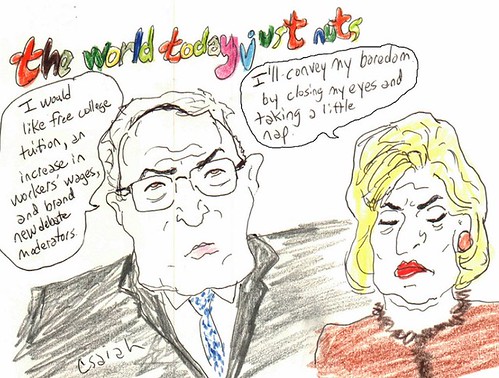
    First off, Isaiah live cartooned the debate last Saturday and here's his  "What Bernie Wants for America."


    whatberniewantsforamerica


    Now for Joni Mitchell.

    The singer-songwriter has many classic albums.

    But for me, her classic album from her sixties and seventies period has to be FOR THE ROSES.

    Yes, COURT & SPARK is amazing and brings jazz elements to rock.

    Yes, BLUE is full on confessional and heart breaking.

    LADIES OF THE CANYON  is a series of vignettes set to amazing music.

    HEJIRA is the wide open plains, a landscape painting done with music.

    But it's FOR THE ROSES that really captures everything to me.

    The hit from the album is "You Turn Me On I'm A Radio."

    I like it.

    But it's my least favorite song on the album.

    (Joni wrote it on a dare -- David Geffen apparently challenged her to write a hit song.)

    "Electricity," "BarandgGrill," "Lesson In Survival," "Let The Wind Carry Me" and especially "Woman of Heart and Mind" are just songwriting at its highest form.

    And I love the richness of the sound.

    I wish she'd done at least one other album that really emphasized piano.

    It provides a different texture.


    Here's C.I.'s "Iraq snapshot:"

     
    Friday, December 25, 2015.  Chaos and violence continue, Christmas is observed in parts of Iraq, international law is ignored by the US State Dept, and much more.


    Today, RT Tweets the following information:


    Link to headline article


    The tensions between the two governments is only increasing.


    Thursday, the Arab Leauge weighed in on a matter that's caused controversy throughout this month: Turkish troops in Iraq.  TODAY'S ZAYMAN brings everyone up to speed:


    Earlier in December Turkey sent a contingent of additional forces to bolster its military presence in the Bashiqa camp near Mosul to train local forces in the fight against the Islamic State in Iraq and the Levant (ISIL). The move prompted a backlash in Iraq, sparking a diplomatic spat between Ankara and Baghdad. Last week, the Iraqi government brought the issue to the UN Security Council to demand the unconditional and full withdrawal of Turkish troops.
    At first, Ankara said it deployed forces in coordination with the central government in Baghdad. The Iraqi authorities said they had never invited such a force and it happened without its approval and knowledge. To defuse tension, Ankara partially withdrew its forces from the camp and re-stationed them further north in the Kurdish region.
    Unsatisfied with that, Baghdad pressed for the withdrawal of all Turkish troops, a demand yet to be met.


    And yesterday?  SPUTNIK reports, "Turkey must withdraw immediately all its troops from Iraq without any preconditions, a statement unanimously adopted by members of the Arab League said Thursday."  AFP notes:

    The Turkish deployment "is an assault on Iraqi sovereignty and a threat to Arab national security," they said in an Arab League statement after meeting at the pan-Arab bloc's Cairo headquarters.
    Arab League deputy chief Ahmed Ben Heli read out the statement at a press conference, in which he added that the Turkish troops "increased tumult in the region."


    Iraq's Foreign Minister Ibrahim al-Jaafari reports SPUTNIK, told the Arab League, "We are not threatening for now. But if our security and integrity is continued to be threatened, I will use all legal means to respond to the attack. Every option is on the table."


    The issue had been raised most recently at the US State Dept's Monday briefing moderated by spokesperson John Kirby.


    QUESTION: Iraq, John? On the situation in Bashiqa. Last Friday --

    MR KIRBY: Yeah.

    QUESTION: Last Friday, the President Obama made a phone call with Turkish President Erdogan on this issue again. And according to the readout, the U.S. side urged the Turkish side to withdraw all its forces from Iraq. Do you have any update on this? Is – the withdrawal is achieved over the weekend, according to your --

    MR KIRBY: If what was achieved?

    QUESTION: The withdrawal of the Turkish forces is achieved?

    MR KIRBY: I don’t have an update on Turkish military movements. I think you should – I would refer you to the Turkish Government for specifics on that. What we have said is we’re encouraged by the dialogue between the two countries, and we’ve seen the reports of Turkey’s intent to withdraw. We welcome that, because the third point I’d say – we’ve always made this clear – is that whatever military activity is going on inside Iraq needs to be done with the approval of the sovereign Iraqi Government. And so our view is we want this worked out bilaterally between the two countries. We’re encouraged by the dialogue that they’ve had and the progress they seem to have made. But I can’t give you a up-to-date tick-tock on exactly where Turkish troops are right now. I don’t know.

    QUESTION: Yeah, but the Iraqis brought this issue to UN Security Council also. It’s not anymore a bilateral issue. So as a chairman of the council – I mean this month, U.S. – what is the U.S. position on this issue? Is there any timeframe for the withdrawal, for example, or I mean – because the Iraqis are – I mean, it’s said that – Foreign Minister Jafari – they will carry on the process until the full withdrawal is achieved.

    MR KIRBY: I understand. And they have every right to pursue their sovereign ends the way they believe they need to pursue them. Our view is that we would prefer to see this worked out bilaterally. It appears that that is what is happening, and we want to see that continue.

    QUESTION: No. If there will be no withdrawal until a specific time, there will be a condemnation from the council, for example? Any specific --

    MR KIRBY: I’m not going to speculate about an action the council hasn’t taken yet. And I don’t speak for the UN. I know we’re the president, but I speak for the State Department and for Secretary Kerry. Our view is we want this resolved bilaterally. They continue to have discussions and talk through this, and we think that’s the right approach. But as exactly where Turkish troops are right now, you’d have to talk to the Turkish Government.

    QUESTION: Yeah. Last one on this. One of the arguments that the Turks raised on this issue: If the Turks will withdraw from the region, ISIL is – will be replacing the Turkish forces in the region. Is it a reasonable argument, do you think? I mean, can ISIS, for example, fulfill the gap in the region after the withdrawal?

    MR KIRBY: As I understand it – and again, I’m not going to speak to Turkish military activities. But as I understand it, it’s a training presence that they have there. And I don’t know of any – of any training mission that ISIL’s taken on with respect to forces in northern Iraq, so I don’t see how you can compare the two. But again, you’d have to talk to Turkey about what they’re doing with their troops and on what timeframe.

    We continue to want to see the sovereign integrity of Iraq respected and for military activity inside Iraq to be done with the full approval of the Abadi government, as ours is. And we want these two countries to work this out between themselves. Again, they appear to be doing that and we’re encouraged by that. Okay?


    John Kirby lies on behalf of the State Dept -- there's no polite way to put it.

    When Turkey began bombing northern Iraq (again) this year, Iraq's government objected and the US State Dept -- and Kirby himself -- gave Turkey a pass.  They did more than that.  Kirby went on record stating Turkey had a right to bomb northern Iraq in order to 'protect' and 'defend' itself.

    That was Turkey's "right," according to Kirby and the US State Dept but Iraq does not appear to have the right to insist Turkish troops leave Iraq -- not in the eyes of the State Dept.


    This should not be a 'both sides' issue.

    Does a nation-state have the right to demand foreign troops leave its territory or not?

    If it does have that right -- and the history of law and treaties says it does -- then the only answer is for the US government to support the legal right of Iraq's government to demand that Turkish troops leave Iraq.

    This is not a gray area.

    This is established law that's been in place for centuries.


    And it seems like the US government has been bombing Iraq for centuries but the latest wave of bombings only began in August 2014.  It continues with the US Defense Dept noting yesterday:


    Strikes in Iraq
    Attack, bomber and fighter aircraft and rocket artillery conducted 18 strikes in Iraq, coordinated with and in support of Iraq’s government:

    -- Near Albu Hayat, two strikes struck an ISIL tactical unit and destroyed an ISIL vehicle, an ISIL heavy machine gun, and 24 ISIL rockets.

    -- Near Kisik, one strike struck an ISIL tactical unit and destroyed an ISIL fighting position.

    -- Near Mosul, nine strikes struck seven separate ISIL tactical units and destroyed 24 ISIL fighting positions, two ISIL vehicles, two ISIL heavy machine guns, an ISIL excavator and an ISIL assembly area.

    - Near Ramadi, five strikes struck two separate ISIL tactical units and destroyed an ISIL fighting position, five ISIL command and control nodes, an ISIL tactical vehicle, an ISIL bed-down location, an ISIL artillery site, cratered five ISIL-used roads and denied ISIL access to terrain.

    -- Near Sultan Abdallah, one strike suppressed an ISIL mortar position.


    Task force officials define a strike as one or more kinetic events that occur in roughly the same geographic location to produce a single, sometimes cumulative, effect. Therefore, officials explained, a single aircraft delivering a single weapon against a lone ISIL vehicle is one strike, but so is multiple aircraft delivering dozens of weapons against buildings, vehicles and weapon systems in a compound, for example, having the cumulative effect of making those targets harder or impossible for ISIL to use. Accordingly, officials said, they do not report the number or type of aircraft employed in a strike, the number of munitions dropped in each strike, or the number of individual munition impact points against a target.


    December 25th is Christmas, celebrated throughout the world -- including in Iraq.


    Yesterday, ALSUMARIA reported that the Chaldean Church in Kirkuk held mass.  NATIONAL IRAQI NEWS AGENCY adds that Ayad Allawi issued a statment congratulating the Iraqi people and Muslims and Christians throughout the world on the anniversary of the birth of the Prophet Mohammed and on the anniversary of the birth of Jesus Christ while hoping  that the coming year finds Iraq free of the "scourge of war" and terrorism and that the country -- and the world -- can strive towards the teachings of tolerance in Islam and Christianity.  He declared that attempts to purge the region of Christians should be seen as an attack on Muslims as well and the unity of the entire community.


    ALL IRAQ NEWS notes that Christmas services were held in Baghdad today.


    mass in the mountains of .
    Embedded image permalink


    ALSUMARIA offers a photo essay of Christmas service in Baghdad.