Not everyone feels the same.
Dave's point.
I see his point.
I want candidates that run real races. I want candidates to run to win. Howie should be making statements like that and not the 5% comments. I also get that he's running to help build a foundation for the Green Party and that's necessary as well.
I get Dave's point and I don't want to dismiss it. It's an important point. That's one reason I didn't hop on Howie at the start after Bernie dropped out. I was for Dario Hunter, or at least leaning towards him. But Dario doesn't know how to campaign.
Howie does.
He needs to be a better candidate.
We need to call him out for any statement he makes that suggests he's not a real candidate.
If I wanted a politician that I couldn't call out and had to lie for, I'd back Joe Biden.
Howie is not above criticism and he needs to be a better candidate. We need to demand that he's a better candidate.
Here's C.I.'s "Iraq snapshot:"
Wednesday, June 24, 2020. Mustafa al-Kahimi plans to visit the US in
July, Turkey continues bombing Iraq, RISING is trying to do what
exactly?, and much more.


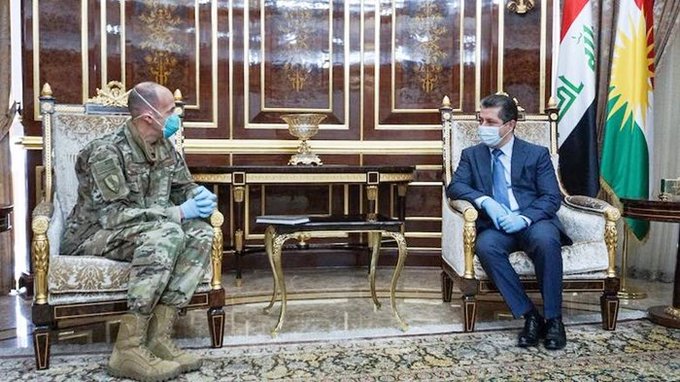
The biggest news out of Iraq today? That the prime minister is coming to the United States. Lawk Ghafuri (RUDAW) reports:
Prime Minister Mustafa al-Kadhimi will visit Washington next month to
attend high-level talks between the United States and Iraq, foreign
minister Fuad Hussein revealed on Tuesday.
Kadhimi's visit will begin the second round of strategic dialogue talks between the US and Iraq that are the first of their kind in more than a decade. They aim to put all bilateral issues on the table, including the faltering Iraqi economy and the possible withdrawal of US troops.
US Secretary of State Mike Pompeo announced on April 8 that the US and Iraq plan to hold meetings starting in mid-June to discuss several matters, including “the future presence of the United States forces in [the] country and how best to support an independent and sovereign Iraq,” Pompeo said at a Washington press briefing on April 8.
Hussein revealed the planned visit to Washington while receiving UN envoy Jeanine Hennis-Plasschaert in Baghdad on Tuesday to discuss the strategic dialogue, among other topics.
Kadhimi's visit will begin the second round of strategic dialogue talks between the US and Iraq that are the first of their kind in more than a decade. They aim to put all bilateral issues on the table, including the faltering Iraqi economy and the possible withdrawal of US troops.
US Secretary of State Mike Pompeo announced on April 8 that the US and Iraq plan to hold meetings starting in mid-June to discuss several matters, including “the future presence of the United States forces in [the] country and how best to support an independent and sovereign Iraq,” Pompeo said at a Washington press briefing on April 8.
Hussein revealed the planned visit to Washington while receiving UN envoy Jeanine Hennis-Plasschaert in Baghdad on Tuesday to discuss the strategic dialogue, among other topics.
The most
obvious issue this raises is: Optics. Iraq is struggling with the
coronavirus. Every day seems to bring a new high in the numbers of
reported cases and reported dead.
President
Donald Trump has unwisely gone around without any form of mask. Will
Mustafa wear a mask? If he doesn't, he'll be refusing to curry favor
with Donald. He'll also be sending a lousy message to the Iraqi people.
So the most interesting thing about the visit may be the photographs
which inform us whether or not Mustafa wears a mask.
Should Mustafa not wear a mask, you can expect this statement he Tweeted to be thrown in his face:
Ahmed Radhi passed away wearing the green jersey, which we all loved watching him wear.
May he rest in peace.
The life of every Iraqi is precious. Let’s adhere to health precautions to protect ourselves and our communities, until we get through this difficult time together.
5:59 AM · Jun 21, 2020
Ahmed Radhi is the football legend who passed away days ago from the coronavirus.
Second,
this is a rather quick meeting. May 7th, Mustafa became prime
minister. Two months later he'll be in DC with the President of the
United States.
Some administrations (Barack
Obama's) would wait a bit to see where the prime minister stands. But
Mustafa is supposed to be a brief prime minister so there's really not
any time to wait -- especially if you need to figure out how many US
troops you're going to leave in Iraq while claiming another
"withdrawal." The US Defense Dept refused to call the end of 2011 a
"withdrawal" because it wasn't a withdrawal. They called it a draw
down. That had to do with the reality -- which the late Senator Kay
Hagan explained in an open hearing and we reported on it in real time.
THE NEW YORK TIMES, among others, were more concerned with whether or
not John McCain had hurt Leon Panetta's feelings. Excuse me, they were
more concerned with creating a story that Leon's feelings were hurt by
John. That was not the case and that was clear by the second hour of
that hearing but if NYT couldn't lie to the American people, it wouldn't
have survived this long. (That's the really US press story -- from THE
HOUSTON POST to MCCLATCHY NEWSPAPERS, tell the truth and disappear.)
Barack
just ignored the Defense Dept's use of "drawdown." Donald's much more
confrontational. If he's using "withdrawal" and it's actually a
drawdown (meaning troops remain in Iraq and in surrounding areas like
Kuwait -- prepared to re-enter), is Donald going to start firing people?
Again,
the meeting is happening quickly. Donald's going to spend some of his
political capital on this visit and he's prepared to do so because he
wants a drawdown. (If Donald secures a withdrawal, we will gladly note
that and I will gladly credit it but too many politicians have lied
about ending the Iraq War and we'll play wait and see.) But how much is
too much to spend?
Because Mustafa's already
struggling with being perceived as weak and ineffective. It took months
for Adel Abdul Mahdi to earn that reputation but Mustafa's got it fresh
out of the gate.
First clear constitutional violation by Mustafa al-Kadhimi’s new government: the removal of the Kurdish language from official documents and papers in breach of Article 4 which declares Kurdish as an official language of Iraq

#Corruption become more dangerous and deadly, in #Iraq , with Mustafa Al-Kadhimi taking over as prime minister.
Weak personalities, easy to manipulate from Iranian militias like Hashd .
#coronavirus
Weak personalities? Mustafa has yet to call out the Turkish government for terrorizing Iraq. Why is that?
Last month, EHA NEWS' Fatih Tweeted:
Turkish President congratulates Iraq’s new Prime Minister Mustafa Al-Kadhimi.
Turkey’s National Defence Minister Hulusi Akar also talked with Kadhimi via phone according to official stament of Iraq.
*#NOTE: Turkey fully supported his efforts of becoming PM of Iraq.
Long seen by the Iranian government as a tool of the US, Mustafa also has some pretty close ties to Turkey.
The geopolitics are complex, but they are also crude. Turkey has clout; President Erdoğan has several cards to play.
Card one: refugees. Turkey is host to 3.5 million refugees, many of whom would rather go to Europe. For Erdoğan they are a weapon that can be unleashed at any time on the EU and its neighbours. The countries of Europe have domestic, populist, political imperatives for keeping migrants out that trump humanitarian (and economic) reasons for letting them in.
Card two: Turkey is a powerful member of NATO, with the second-largest army of all members and housing 50 US nuclear bombs. It’s the world’s fifth-largest buyer of arms, 60 per cent coming from the US and plenty from the UK, France, Spain and Russia.
Turkey also invests lavishly in lobbying power, spending $6.6 million on influencing the US government in 2018. It is seen as a tricky but strategic ally in the US’s so-called ‘war on terror’ – even though it is supporting jihadist militants with al-Qaeda connections.
Card three: Turkey has nation-state power. Nation states have a mutual understanding. They can have their own armies, without being called terrorists. They can lock up journalists and political opponents, and still be welcome at the table of world democracies. They can displace thousands of citizens and still be courted as a valuable trading partner.
Card one: refugees. Turkey is host to 3.5 million refugees, many of whom would rather go to Europe. For Erdoğan they are a weapon that can be unleashed at any time on the EU and its neighbours. The countries of Europe have domestic, populist, political imperatives for keeping migrants out that trump humanitarian (and economic) reasons for letting them in.
Card two: Turkey is a powerful member of NATO, with the second-largest army of all members and housing 50 US nuclear bombs. It’s the world’s fifth-largest buyer of arms, 60 per cent coming from the US and plenty from the UK, France, Spain and Russia.
Turkey also invests lavishly in lobbying power, spending $6.6 million on influencing the US government in 2018. It is seen as a tricky but strategic ally in the US’s so-called ‘war on terror’ – even though it is supporting jihadist militants with al-Qaeda connections.
Card three: Turkey has nation-state power. Nation states have a mutual understanding. They can have their own armies, without being called terrorists. They can lock up journalists and political opponents, and still be welcome at the table of world democracies. They can displace thousands of citizens and still be courted as a valuable trading partner.
Iraqi Foreign Minister Fuad Hussein on
Tuesday renewed his country's rejection and condemnation of the Turkish
attacks on targets in northern Iraq.
Hussein's
comments came during his meeting with the Special Representative of the
UN Secretary-General for Iraq Jeanine Hennis-Plasschaert in his office
in the Foreign Ministry at the edge of the Green Zone in central
Baghdad, a ministry statement said.
Hussein
underlined the need "to stop such violations by the Turkish side,
considering the attacks as violating the international covenants and
laws," the statement said.
Also on Iraq, MEMO notes:
The Iraqi government is
currently preparing for “early legislative elections” to complete the
country’s sustainable constitutional establishment, Prime Minister Mustafa Al-Kadhimi, announced yesterday.
Speaking
in a meeting with the United Nations Special Representative for Iraq,
Jeanine Hennis-Plasschaert, Al-Kadhimi said that it is “important to
have international support and cooperation in the preparation phase.”
That's
what Mustafa is supposed to preside over and why he was made prime
minister. These elections will determine not only who serves in
Parliament but also who will be prime minister.
In the US? What is the value of RISING? Watch the clip below and answer that please.
The
rolled eyes and the snarky tones from Krystal? Does she think she has a
high horse to ride? She doesn't. Why the hell are they mentioning
Philippe Reines? If there's a reason to mention that vile man, it's to
educate your audience. Reines had harassment complaints against him
when he worked under Hillary at the State Dept and Michael Hastings threw that up in his face. If you're going to talk about the priss-pot, talk about him. He's a menace and that's the only reason to mention him.
Second, this whole thing about Bernie and his supporters? What supporters?
He
betrayed them and most are gone. If you're truly a news outlet,
Krystal act like you're part of one. That means making clear that
Bernie doesn't 'own' people. There were people who supported the ideas
and the platform he ran on. Then the coward dropped out. Then the
coward endorsed Joe Biden. Bernie has nothing to command and it's
stupid to think he does.
We'll close with this news from MS. MAGAZINE:
We are so excited to announce the launch of Ms. magazine's very first podcast, On the Issues with Michele Goodwin!
You read Ms. online and in print. You follow along on social media. Now, keep up with the feminist movement and even more of Ms.’s substantive, unique reporting with your new favorite podcast.
Tune in for our premiere episode on Tuesday, June 30 on Apple Podcasts, Spotify, Stitcher, Google Podcasts or MsMagazine.com. 
Get a sneak peek of the feminist analysis, insightful conversations and exciting guests to come: a trailer is available now! We hope you’ll give it a listen, subscribe and rate the podcast.
On the Issues is a show where we report, rebel, and tell it like it is. Join host Dr. Michele Goodwin as she and special guests tackle the most compelling issues of our times, centering your concerns about rebuilding our nation and advancing the promise of equality.
Listen to a trailer for On the Issues with Michele Goodwin now — on Apple Podcasts and Spotify.
And we’d love if you help spread the word, too! The number one thing you can do to help the Ms. magazine podcast reach new listeners? Subscribe and rate the podcast on Apple. Let’s show the power of independent, feminist media!
Meet Your On the Issues Host: Dr. Michele Goodwin is a frequent contributor to Ms. magazine and on MsMagazine.com.
She is a Chancellor’s Professor at the University of California, Irvine
and also serves on the executive committee and national board of the
ACLU. Dr. Goodwin is a prolific author and an elected member of the
American Law Institute, as well as an elected Fellow of the American Bar
Foundation and the Hastings Center. Her most recent book, Policing The Womb: Invisible Women and The Criminalization of Motherhood, is described as a "must read."
Tune in Tuesday, June 30 for the first episode of On the Issues with Michele Goodwin: Police Violence — A Tale of Two Genders. Professor Goodwin and her guests will ask critical questions like: where are the women in the field of policing? And why does it matter?
You have received this e-mail because of your interest in women's issues. To unsubscribe, please click here.
1600 Wilson Boulevard, Suite 801, Arlington, VA, 22209 | 703.522.2214 | webmaster@feminist.org
1600 Wilson Boulevard, Suite 801, Arlington, VA, 22209 | 703.522.2214 | webmaster@feminist.org
New content at THIRD:
- Truest statement of the week
- Truest statement of the week II
- A note to our readers
- Editorial: Who will speak out on behalf of the Kurds?
- TV: Where's the pride?
- John Bolton is a War Criminal, he is not your friend
- 100 scariest movies
- Mail bag
- This edition's playlist
- Introducing the Ms. Podcast: On the Issues with Mi...
- Diana Ross - It's My House (Eric Kupper Remix / Au...
- #TheJimmyDoreShow Hillary Supporter demands Hillar...
- Race, Class and Anti-Imperialism in the USA w/Blac...
- #MOATS EXCLUSIVE: Green candidate Howie Hawkins sl...
- Highlights
The following sites updated: