Okay, let's get a laugh in via Isaiah's The World Today Just Nuts "It Takes A Starlet."
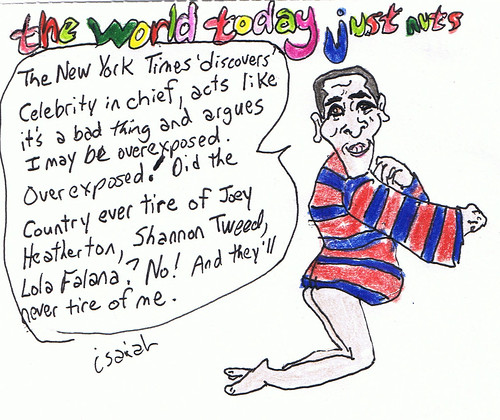
You can click here to listen to Flashpoints tonight if you missed it. KPFA's Flashpoints Radio is doing the job needed to raise awareness about the Afghanistan War and about the surge. You really can't count on many other programs. The surge was announced last week and we're stuck talking about Jean Paul Sartre on Law & Disorder? WTF?
Well sure, let's cover for Barack some more. How f**king pathetic. I'm embarrassed to be a Michael after the cowardly actions of Michael Ratner and Michael Smith. How dare they waste an hour of broadcast time by refusing to call out the surge and focus on that. Disgusting.
Let's talk Third. Okay, along with Dallas, this is who worked on the latest issue:
The Third Estate Sunday Review's Jim, Jess, and Ava,
Rebecca of Sex and Politics and Screeds and Attitude,
Betty of Thomas Friedman Is a Great Man,
C.I. of The Common Ills and The Third Estate Sunday Review,
Kat of Kat's Korner (of The Common Ills),
Cedric of Cedric's Big Mix,
Mike of Mikey Likes It!,
Elaine of Like Maria Said Paz),
Trina of Trina's Kitchen,
Ruth of Ruth's Report,
Wally of The Daily Jot,
Marcia of SICKOFITRDLZ,
Stan of Oh Boy It Never Ends
and Ann of Ann's Mega Dub.
And let's talk about what we came up with.
- Truest statement of the week-- Cindy Sheehan. She earned it.
- Truest statement of the week II-- Chris Floyd.
- Truest statement of week III-- A guy I never heard of until this statement (which is a strong one and so is his entire column).
- A note to our readers-- Jim breaks down the edition.
- Editorial: War Paint and Soft Feathers-- Jim and I talked about this editorial. We're not sure if it works or not. We talked today. We can't really make a decision. What Jim told me that was interesting about my reaction is the things I identify as good was what Ava and C.I. came up with. I didn't realize that until Jim pointed it out. When he did, I said, "Well __, why did I even work on this?" I was joking but serious. Like it would have been better if I hadn't. The editorial would have been better if I had. Jim explained, "Now you know how we felt when we were doing the TV pieces as a group piece." :D They did that at first and it was Dona who first noticed all the stuff getting e-mails was stuff Ava and C.I. wrote. Which is why before the month was up, they let Ava and C.I. write the TV articles themselves.
- TV: Oh what a difference a name change makes-- This is a masterpiece. It works as a critique of Democracy Now! and all that's wrong with that show,yes. But it also works to explain why nothing, NOTHING, is happening re: Afghanistan. I'm not talking about World Can't Wait which is out there fighting. I'm talking about the message not getting out to huge parts of the supposed left. We're not getting the message to stand up and fight, we're getting the message to sit down and take it. And it's people like Amy Goodman who are pushing that message.
- Book: The Battle of Seattle-- I like this book discussion. I think it's the best one they've done. I didn't participate. This was the gang in California plus Elaine on the phone. This is really something. And they do love the book and highly recommend it.
- Roundtable-- I participated in this. And I want to say something on this. In my remarks, I talk about the rumors that Blackwater was a CIA money laundering business. C.I. could talk about that. C.I. doesn't. (C.I. and Elaine both had my back in the roundtable and I appreciate it.) Why? What's the point? The press isn't going to do their job anyway. And read the snapshot with that in mind. Last night, C.I. basically did a walk through not just at TCI but also on the phone to multiple reporters about the deal that pushed through the Iraqi election measure. And? Nothing. No reporting yet still. You can give them (the press) an entire report and it still doesn't matter. So C.I.'s way of thinking is that somethings just aren't worth it. And I get that.
- Iraq-- Our Iraq feature.
- Wanted by the FBI: Diane Rehm and Barbara Slavin-- I like this. Dona basically figured out which illustrations to use. They did multiple illustrations. This is funny and a strong feature for the edition. And a short feature.
- Liar Supreme: Greg Mitchell-- Jess did a heavy edit on this which allowed it to make the edition. It could have been killed because the more we worked on this, the worse it got over and over. So Jess did a major edit to pull it together and bring it some focus. He really did a great job editing.
- Civil Rights Era Cold Cases-- This is a FBI release that we were asked to repost. I may post it here if I remember later in the week. There were many murders during the Civil Rights Era. What we would identify today (rightly) as hate crimes. Some of them may have new developments and the FBI is attempting to find information on next of kin to provide updates if they have any.
- Highlights-- Wally, Rebecca, Betty, Cedric, Ann, Ruth, Marcia, Stan, Kat, Elaine andI worked on this.
Here's C.I.'s "Iraq snapshot:"
Monday, December 7, 2009. Chaos and violence continue, an election measure may lead to Iraq elections (not this month or next), the Iraq Inquiry continues in England, calls for an investigation into an Iraq-related death to be reopened are made in England, and more.
Asked in Vanity Fair's Proust Questionnaire what she most dislikes, singer-songwriter Carly Simon responds, "War or anything to do with instruments of war, or war-like tendencies." Carly's latest album is Never Been Gone in which she revisist many of her best known songs (including "You're So Vain," "Anticipation," "Coming Around Again" and "Let The River Run") to find new nuances and shadings. (Kat praised the new album here.) We've got a 'heavy' snapshot so we'll open with Carly for that reason and also because friends at Van Fair have repeatedly asked for links in the past weeks and I haven't had time (for their pain). Staying with Carly for a minute more, as Kat noted Friday, Mike Ragogan (Huffington Post) interviewed her last week and here she's explaining the making of Never Been Gone:
It started in the summer of 2008, when I had been promoting This Kind Of Love which was the Starbucks album, and they had withdrawn Hear Music five days before my record was released. So I didn't have the marketing, I was riding on a horse and there was no horse under me. I was so unhappy, and it was embarrassing, and it was like, "Oh my god, what have I been doing for the last two years but writing this record, making this record, and being so proud of this record." But I was the horseless rider. So I was quite self-involved and indulgently so, and really depressed. It was the summertime and there were lots of people around my house -- Ben and his friends and a lot of musicians were up there working on a project with him. I couldn't be consoled I was so upset. Ben said to me, "Come on, let's turn this into productivity. We have all these musicians here, just sit down in the living room and play the songs the way you wrote them. Let's do an unplugged version," which you picked-up on in your review. There are no drums except for "You Belong To Me" and "No Freedom," we just didn't allow drums on the record, even on "You're So Vain" which was daunting to redo after it was my most popular song. But we did it and I really love the energy that was put into the song, and that really carries all the way through. It's got new vocal ideas, and I just think it's an inventive version.
Inventive was Barack's speech last week where he took Bully Boy's 'lyrics' and made them his own. Al Jazeera's latest Inside Iraq began airing Friday and the topic was Afghanistan and Jasim al-Azawi was joined by retired US General Richard Myers (former commander of the Joint Chiefs of Staff and current War pushed from the boards of Aon Corporation, Northrop Grumman Corporation and United Technologies Corporation) and Professor As'ad Abu Khalil of the University of California at Berkeley.
Jasim al-Azzawi: General Myers, let's call a spade a spade. In Iraq, pretty much the US army bought off those fighters from the Awakening Councils, you know, paid them salaries and said "Stop shooting at us." And overnight the fighting stopped. Are they going to do the same? Are they going to pour money at the Pashtuns?
General Richard Myers: You know, it's a good question. I don't -- I don't know what incentives will be used and how they'll be used. In that part of the world, money is often used as an incentive. But I mean, Iraq is far from being stable and far from being a sure bet that it's going to be successful. On the other hand, it's been relatively stable and we'll see if they can get through elections here -- coming in January, there's some question about that. But if they do, then I think whatever methods were used, you'll have to say, "Well those were successful."
Jasim al-Azzawi: As'ad Abu Khalil
As'ad Abu Khalil: Let me say the following. I notice that General Myers uses the word "stable" government in Iraq and this is the new lingo because of American officials. It was used by the Bush administration, it's being used by the Obama administration. Remember that we were promised an exemplary democracy in Afghanistan and in Iraq. Instead, we have created some of the most corrupt governments on the face of the earth. Don't take my word for it, look at the recent rank by Transparency International in London and you will find these two governments are literally among the most corrupt in the world. Plus, I want to take issue with the model of success by the revival council in Iraq. These are some of the most repressive, sexist and thuggish tribal councils that oppress women and want to impose traditional views on society. That is not the kind of alternative we need against the sexism and misogyny of the Taliban. Plus, he said that we are moving away from [US-installed Afghanistan 'president'] Hamid Karzai. I'm not sure that's the case. We are, in fact, using two tract policy. On the one hand, we are throwing more additional money -- taxpayers money -- to be embezzled and misused by the Hamid Karzai government and we're also, on the second tract, relying on new council like the so-called Kandahar Strike Council. That council is related to none other than the brother of Hamid Karzai. The notorious, corrupt person known as Ahmad Karzai. So it seems to me with that strategy, we are creating more corruption and we are giving more time for America's enemy to wait it out until the date of withdrawal. Obama is clearly emulating not only the policies and war actions of the Bush administration, he's even copying the rhetoric, the empty rhetoric, that is out there --
Jasim al-Azzawi: As'ad Abu Khalil, let's give the general a chance to answer this.
General Richard Myers: I -- I think that's -- I think those comments are probably -- uh, uhm -- there's a lot of hyperbole in those comments, in my view. If you look at Iraq and Afghanistan, they both adopted -- their citizens both adopted what most people consider liberal constitutions and yet -- it's not playing out, they've elected these governments. Certainly there is corruption but that's not new to that particular region and that's something that has to be worked on daily and I think the president [Barack Obama] said they were going to work on corruption. I know in my conversation with Adm [Mike] Mullens --
Jasim al-Azzawi: That being the case, General Myers, corruption is still rampant in Iraq. How you're going to prevent in Afghanistan? As'ad Abu Khalil just alluded to the president's brother who is somehow in bed with all the corrupt people not to mention trafficking in narcotics.
General Richard Meyer: Well I think, Jasim, I think that's going to be one of the focuses of the strategy in Afghanistan -- is to hold people accountable and, if there's corruption, to hold them accountable for that-that corruption. Now that's easily said, hard to do, but I think you're going to see that in the way both our military and-and the civilians. By the way, it's been little noticed but the embassy in Kabul is going to be increased from 320 staff earlier this year, in January of this year, to about 1,000 by the end of this month and a lot of those people will be deployed to the provinces and a lot of them, I think, will be trying to mentor --
Jasim al-Azzawi: Then again, General, you know the number of US officials in Baghdad was increased, I don't know how many folds. Maybe twenty, thirty. It's the biggest embassy in the world and yet corruption is rampant in Iraq.
As'ad Abu Khalil: 700 additional diplomats are not going to do the job just as 30,000 additional troops are not going to do the job. And just let me say for the record to the audience I would never refer to the government set up in Iraq as a liberal democracy. A constitution that was devised by a Grand Ayatollah who is inspired by Iran and who has not left his house except once in seven years is not a liberal democrat. And I think people in the region are clearly not impressed with whatever set-up -- sectarian, religious, traditional, and sexist government set up in both places. Again, go back to Transparency International. I take my clues from there.
The broadcast offers a look at and fact check on Barack's speech and Myers objects to the terms "colonize" and "occupation." He foolishly rejects both. For the record, it is an occupation and there was no reason for Myers to make an idiot out of himself on international television. The UN approved (after the war started) the occupation (they never approved the war), the UN mandate that was repeatedly renewed until the end of 2008.
He also expressed foolishness when he spoke of January elections when those have been off for some time. Saturday AFP reported that the Iraqi Parliament adjourned today because they did not have a quorum despite the session being called by President Jalal Talabani. Then Sunday night, ten minutes before midnight, the Parliament passed (another) election measure which still has to go before the presidency council (like the last one) and will become law only if it is not vetoed. Warren P. Strobel and Mohammed Al Dulaimy (McClatchy Newspapers) did the best job reporting on the developments. They not only provided the details of what happened just before midnight, they provide the details of what happened before and they explain, "While agreements have been reached in the past only to fall apart, there were high hopes that this one would stick. Hashimi withdrew his veto threat early Monday morning." Ned Parker and Raheem Salman (Los Angeles Times) quote Tariq al-Hashimi (Iraq's Sunni vice president) stating on satellite TV, "All of our demands have been achieved. The displaced people have been treated fairly, the value of people inside and outside Iraq are the same. I am happy because of this accomplishment and I consider it a historic day in building the modern Iraq." Mu Xuequan (Xinhua) quotes a statement issued by United Nations Secretary-General Ban Ki-moon today, "The secretary-general congratulates the Iraqi Council of Representativeson finalizing amendments to the Election Law and commends Iraqi leaders and parliamentarians for overcoming their differences and reaching a compromise. The way is now paved to hold national elections in Iraq on a date to be determined by the Iraqi Presidency Council. The secretary-general firmly believes that these elections will be an important step forward for Iraq's political and democratic process." In a sign of just how incompetent the US 'diplomatic' mission is in Iraq, Jane Arraf (Christian Science Monitor) reports today that "uncertainty over" the vote had "US Ambassador Christopher Hill rushing back from Washington" -- along with not grasping that he goes by Chris -- officially, he is Chris Hill -- Arraf doesn't grasp that this is a huge detail and instead buries it in a puff piece. (It is puff -- Barack has no pull with the KRG. It was their 45 minute phone call with Joe Biden that sealed the Kurdish agreement to the deal. And it's nice that she's been led off the trail -- nice for the White House and other interests. The following paragraph is word for word from last night.
Parker and Salman note that the Kurdish Regional Government extracted a promise from the US that a census would take place in the coming year. Presumably, the promise had some form of 'teeth' to it since the US has long promised that the Constitutionally mandated census would take place and yet, year after year, it has not. The KRG is aware of that and presumably would not fall for yet another round of pretty words. If that is indeed the case, one wonders how the press will report on this issue since Barack and Bully Boy Boy Bush both asserted Iraq was a sovereign nation -- that was the whole point of ending the UN mandate (it truly was -- as a sovereign nation, Iraq could start the tag sales on their assets that they couldn't while under UN supervision). If Iraq's a sovereign nation and since Nouri al-Maliki, the current prime minister, has been the road block to a census since 2006, what did the US government promise the KRG this time that convinced them? The tensions between Baghdad and the KRG aren't exactly secret nor is the tremendous ill will towards Nouri from the KRG a secret. So if he's the roadblock and he's hoping to be the prime minister (elected by Parliament) again after the elections, what did the US promise the KRG, how did they convince the KRG that it would be different in 2010 then it has been in the last three years?
Dorothy Parker once said you can lead a horticultural but you cannot make her think -- true as well of the press which has a huge story staring it in the face but either can't see it or is on orders to refuse to see it. I have no idea which. People often ask, in DC when the gossip is flying, "Why don't reporters report on ____?" Because they're not able to either because they're so easily distracted or because their superiors won't let them. The big story is what the US government promised the KRG. I said it last night and said it for a reason. I can lead you to the water but I'm not putting in your mouth, kids. Let's note something.
The United States welcomes the resolution adopted December 6 by Iraq's Council of Representatives regarding the election law. This legislative action will allow Iraq to hold national elections within Iraq's constitutional framework. It is a decisive moment for Iraq's democracy and we congratulate the Iraqi people and their elected representatives. As part of the ongoing U.S. dialogue with the Iraqi leadership, the President and Vice President spoke on the morning of December 6 with Kurdistan Regional Government (KRG) President Massoud Barzani. The President and the Vice President confirmed the U.S. commitment to a long-term relationship with Iraq, including the KRG.
You say, "Uh, it's the White House's official statement. And?" Click here and you go the KRG's website where that statement is posted in full. No, that is not common for the KRG's website. In fact, it's highly uncommon. You need to start using your brain because obviously you can't count on the press.
Though the press in the US has never been perfect, even as late as the 1980s, you could still count on the press to ask: What deals were made and how?
Apparently we need a sports star with a scandal or a woman willing to pose topless to get some attention to the deal that was struck. A deal was struck. Leaving aside what was all the talk in DC, we all know Barack has no pull with the KRG. We all know Joe was put in charge of Iraq -- after Barry's handpicked two-some failed (that's not a reference to Hillary, Iraq was never assigned to her) -- because the KRG trusted him and he had a solid relationship with them. Anyone who paid attention to pre-war and early war issues knows that the US used the KRG for the Iraq War and knows that the KRG agreed with the understanding that not only would Saddam Hussein be removed from office but also the KRG would stand to benefit. The Bush administration repeatedly broke key promises -- the PKK issue is what forever broke the trust the KRG had in the Bush administration. Barack, as senator or as president, has never had anything to do with the Kurdish issue and spent the bulk of his time -- on his for show trips to Iraq in 2008 and 2009 -- attempting to woo Nouri. Barack has no pull with the KRG. Joe Biden they trust. Barack spoke to them, but Barack offered pretty words and promises. It took Joe to sell them on the promises. The issue for the press should be what was promised?
"A census!" shout some. Uh, a census has been promised forever. In fact, the 2005 Iraq Constitution requires one. How did the US government convince the KRG that a census would take place in 2010? The press needs to be asking that question. Again, when sides in any conflict suddenly agree, the immediate question for a working press is always: What deals were made? That's the question that's not being asked and it's the most important question -- far more important than the elections. Iraq didn't fix its Constitutional crisis (or stop being a Failed State) by possibly passing a measure that will allow elections to take place AFTER the Constitutionally mandated deadline for them to be held. The elections had to take place at some point. And they will. Maybe with this measure, maybe with another. But to get this measure signed off on, deals were made.
The KRG feels (rightly or wrongly) that they have given and given and no one has lived up to the bargain on the other side. That is their attitude. They feel the previous administration made a ton of promises and it is the PKK issue that (still) most enrages them because it was supposed to be dealt with (by the US) in 2003. That didn't happen. They have a relationship of trust with Joe Biden but that relationship can go down the toilet if promises aren't kept. So the US public has a right to know what was promised? We have a right to know because if the promises aren't delivered what keeps being pimped by the press as "stability" in Iraq is going to get even worse.
Nouri has been the thing preventing the census. How can the US government promise the KRG that a census will take place? It hasn't thus far and it's in Iraq's Constitution. The census would especially effect Kirkuk -- a disputed territory sought by the central government in Baghdad (who asserts that it is not a predominately Kurdish population in the area) and by the KRG (who asserts that it is historically Kurdish and point out the Kurds were forced out by Saddam Hussein). Liz Sly (Los Angeles Times) reports new construction is ongoing in oil-rich Kirkuk with Kurds constructing new homes. The Kurds want Kirkuk. They may or may not deserve it and they may or not end up getting it. But when the US government discussed "census" with the KRG, you better believe the KRG representatives and president brought up Kirkuk. What was promised? More importantly, what was the KRG led to believe?
If these promises aren't backed up, if these become failed promises, Iraq's going to see a lot more trouble and, despite press claims otherwise, Iraq hasn't been stable. You take the region that's been the most stable -- by comparison -- and you anger its government? It's government that already distrusts the current Iraqi Prime Minister (Nouri) and has nothing but ill will towards most of the Baghdad ministries? It's not going to be pretty.
Did someone say violence?Bombings?Mohammed Al Dulaimy (McClatchy Newspapers) reports a Baghdad roadside bombing which wounded four people, a Baghdad sticky bombing which claimed 1 life and wounded five people and a bombing in Ali Yassir middle school which claimed the lives of 7 children and left "41 others" wounded. Reuters says the school death toll was 4 and 25 were wounded. Marc Santora and Duraid Adnan (New York Times) aren't specific on the death toll but explain, "Government officials gave contradictory school casualty figures, with the death toll varying from 1 to 15 children and the number of wounded from 41 to 56.
Shootings?
Mohammed Al Dulaimy (McClatchy Newspapers) reports 5 Sawha were shot dead at a Baghdad checkpoint.
Corpses?
Mohammed Al Dulaimy (McClatchy Newspapers) reports the corpses of 2 Sahwa were discovered in Kirkuk. Marc Santora and Duraid Adnan (New York Times) state the two Sahwa were poisoned to death by unknown persons who offered them free food which the guards ended up sharing with their dogs. Both dogs died..
In England, the Iraq Inquiry continues hearing public testimony today. PA reports Edward Chaplin has testified this morning that the US refused to fund reconstruction in Basra adequately. Chaplin was the British Ambassador to Iraq in 2004 and it's interesting how his finger pointing at the US (I'm not denying the US has done appalling on reconstruction -- even worse, what they've overfunded has been waste; however, I believe we learned some of British's lack of funding for Basra last week). Chaplin's testimony can be seen as a diversion -- it is also far, far from the reasons the Inquiry was supposed to have been created -- why did England take part in the Iraq War? Along with Chaplin, the hearing heard from Maj Gen Tim Cross and Desmond Bowen today. Click here for video and transcript options for today's witnesses. And let's stick to Nothing-Was-Our-Fault Eddie Chaplin for a moment and with some of the most offensive remarks that the commitee has thus far heard.
Committee Member Lawrence Freedman: Part of this, perhaps particularly relevant for British opinion was the start of hostage taking. So we had in this period the Kenneth Bigley and Margaret Hassan cases. How aware were you of the danger to British nationals in Baghdad?
Edward Chaplin: Very aware. And, indeed, I think if you looked at the travel advice at the time, it would be "don't come anywhere near this place". They were terrible incidents. I mean, terrible obviously for the families, but terrible for the embassy in the sense that we were very helpless. Kidnapping was widespread at the time. This was often criminals rather than political. Of course, as we have seen elsewhere, often criminal gangs will carry out kidnappings of what they think are valuable people, valuable in the sense that they can be sold on to some political group. And I don't think we know even now exactly who was behind either kidnapping. I would have to refresh my memory. I mean, they were different in the sense that Ken Bigley, we didn't even now. He hadn't even registered with the embassy, we didn't know he was there. He was working with these two Americans for a Gulf company. The first thing we knew of his existence was when the news of the kidnap came through. Margaret Hassan was different. In fact, I had met her before when I was Ambassador in Jordan because she worked for CARE Australia, a very effective NGO, one of the few working inside Iraq before and after the invasion. So I admired the work that she was doing and the embassy kept in touch. So that was, if you like, an even greater blow. But just to explain -- I don't know if you want to go into detail about this, but I probably cannot because what happens when a kidnapping of a British citizen takes place is you have set up a really discrete team because this needs 24-hours-a-day attention. So that team was led my deputy and we had a lot of support particularly coming out from London, experience negotiators and so on. So after the initial phase, my job was really to keep it in the minds of Iraqi ministers who we thought would could help, the army and the police and so on, and do whatever else I could do to help.
Commitee Member Lawrence Freedman: What sort of response did you get from --
Edward Chaplin: Very positive and, of course, this was raised all the way to Allawi himself and it was raised by ministers, but they didn't have the capacity to help very much, I don't think. And, of course, they were dealing at any one time with lots of other kidnappings.
Committee Member Lawrence Freedman: We had no evidence oursevles of who was holding her?
Edward Chaplin: I think the assumption early on was it was a criminal gang of some sort, but we never got very far in pinning down exactly who was behind it and -- let alone having contacts that might lead to some progress.
Commitee Member Lawrence Freedman: And in the aftermath of her murder, we still seemed to have been in the dark as to what had happened and, indeed, where her body was.
Edward Chaplin: Some time later some of her clothes and possessions were found. We knew her husband as well, who stayed on in Baghdad. So we would see him from time to time. I don't know what the investigation -- continued investigation showed.
It takes a lot of nerve to speak of kidnapping victims and claim that you suffered from it -- you suffered as the family did. It takes even more nerve to do that when the kidnapped victims both ended up dead. That Edward Chaplin was ever put in charge of diplomacy anywhere is a puzzler. That he's so inept goes a long way towards explaining why Italy was able to rescue kidnapping victims, the US was able to and, thus far, the UK really doesn't have a record to point to with any pride in Iraq. Long before Chaplin got to Iraq, Margaret Hassan was already there so his it's-not-my-fault-we-warned-people-not-to-come-to-Iraq excuse is b.s. For him to claim to have known her and admired her work and yet to tell the committee today that he has no idea what was or wasn't found out about her death? That makes no sense. He's lying. Margaret Hassan was the most prominent kidnapping victim the UK had. To this day. As for his attempt to farm off any responsibility to his deputy -- Chaplin was still in charge. His deputy was his responsibility. Edward Chaplin is now an international embarrassment for the UK.
David Brown (Times of London) reports that both of Margaret Hassan's sisters were present at the inquiry and hoped to hear some details about their sister. He quotes Deidre Fitzsimons explaining, "We have been waiting years for the chance to hear what happened to my sister but she was worth so little that she received just three minutes. We came to find out the truth even though we were skeptical, because we were told this would not be a cover-up. We have been betrayed. The authorities did not do one thing to help her when she was kidnapped and they are now doing nothing to find out why. As for Ken Bigley, it was almost as if he didn't matter at all [by Chaplin's testimony]. He was an innocent man who was murdered for no reason."
Moving to another witness, Cross was in Iraq up until June 2003 and held the position of joint force logistic component commander before the war started. He also worked in DC with post-war planning. Committee Member Usha Prashar asked him about his visits to CentCom [US Central Command].
Maj Gen Tim Cross: My sense was this was a very joined-up headquarters, very well commanded and led with some very capable staff. They had been in place together as a team since 11th September, just before 11th September, they had planned and executed the initial operations in Afghanistan, they were now planning for possible operations in Iraq and, I think understandably, General [Tommy] Franks and his team, recognising that they would break as a team the following summer -- because inevitably normal postings and so forth would begin to kick in -- that they were pretty keen to get on with this. They had done a lot of hard work, they had been working 18 hours a day for months on these operations. So they were very --
Commitee Member Usha Prashar: You said "these operations", they were Afghanistan or are we looking towards Iraq?
Maj Gen Tim Cross: Both. They had been working long hours for Afghanistan and then in the post -- initial operations in Afghanistan and at the same time planning for operations in Iraq. They were, I think, tired, if I'm honest, but I'm not surprised. And I sense that there was a strong desire to move quickly in terms of Iraq, and I sense too in a broader sense -- and I got more of this in Washington -- that following military operations, there would be other things linked to what was then called the Global War on Terror.
Commitee Member Usha Prashar: But at that stage CentCom, was there any concentration on post-invasion planning or not?
Maj Gen Tim Cross: I wouldn't say there was concentration on it. The major force was making sure that should be operations in Iraq, the military campaign would win, would succeed, and from a personal point of view I had no problem with that. That's the prime purpose of this headquarters: it is to fight and to make sure they win. There are no prizes for coming second on the battlefield. So that was undoubtedly their prime concern. So far as Phase 4, post-war -- whatever words we want to use -- operations were concerned, there were some discussions. They had appointed a one-star brigade general to head up a task force, looking at aspects of this, an engineer, an American engineer. But if I'm honest -- and I remember one specific occasion when there was an attempt to introduce him to the assembled large number of very senior military officers. He really was -- he was not really welcomed into the team. This was a war fighting team and as far as they were concerned, this was not their major business.
Cross also testified that he and Jay Garner went to the United Nations together before the start of the Iraq War and "eventually we did go to New York for a day. We flew up very early in the morning, we spent a day with the UN and we saw both Lousie Frechette, who was then the deputy, and I would say 20 UN officials who sat in serried ranks opposite. There were only about five of us. And they were very, very strong on saying to Garner -- the main message was, 'You need to understand the legality of what you are into here. And if you end up as the occupying power, be quite clear what that means'." Richard Norton-Taylor (Guardian) reports of Cross:
In a written statement, he said he had briefed Tony Blair at No 10 on 18 March 2003, two days before the invasion.
"We talked for about 30 minutes or so. I was as honest about the positions as I could be, essentially briefing that I did not believe postwar planning was anywhere near ready," said Cross. "I told him that there was no clarity on what was going to be needed after the military phase of the operation, nor who would provide it.
"Although I was confident that we would secure a military victory, I offered my view that we should not begin that campaign until we had a much more coherent postwar plan."
Describing his meeting with Blair in oral evidence, Cross said: "He was engaged. I gave him the background of what we had been doing. We had a very sensible conversation. At the end of it I remember saying, in so many words, I had no doubt we will win in the military. I do not believe we are ready for postwar Iraq.
"He nodded and didn't say anything particular. I didn't expect him to look me in the eye and say, 'This is terrible, we are going to pull the whole thing off.' I was just one of a number of people briefing him."
More pressing news out of England involves two Iraqi males arrested in Iraq by the British military and handed over to the US "who then took them to Afghanistan in 2004," the BBC reports. The British actively took part in partnering with the US for rendition (kidnapping). Robert Verhaik (Independent of London) reports, "In February this year the former Defence Secretary, John Hutton, admitted that UK forces had captured two men in Iraq in February 2004, and handed them to US forces. In subsequent statements to parliament, the government revealed that in March 2004, British officials had become aware of the US intention to transfer the men from Iraq to Afghanistan." Reprieve is a United Kingdom human rights group and we'll note this from their press release:Reprieve's investigation reveals the identity of one man, Amanatullah Ali, together with damning evidence that the British government misled parliament and the public on the case.In February 2008, after years of government denials that the UK had been involved in any rendition operations, then-Secretary of State for Defence John Hutton announced to parliament that UK forces had captured two men in Iraq in February 2004, and handed them to US forces. In subsequent statements to parliament, the government revealed that in March 2004, British officials had become aware of the US intention to transfer the men from Iraq to Afghanistan.The British government admitted its complicity in a crime (kidnapping, otherwise called rendition), admitted it was wrong, and appeared to apologize. Yet the government will not identify the men, which would be most basic act that the government could do in order to reunite the men with their legal rights.Indeed, the British government has apparently taken no step over the past five years to ensure that they receive legal assistance.The day after Mr Hutton's statement to the House, Reprieve wrote to the Defence Secretary, asking him to identify the two men so that Reprieve lawyers – acting pro bono as always – could help make up for the regrettable involvement by the British government in this crime by acting for the men and their families and seek to secure their release.Despite the clear urgency of the situation, it took the UK government three months to reply. The Ministry of Defence wrote that they would not reveal the prisoners' names, taking the position that doing so would violate the prisoners's rights under the Data Protection Act. It is deeply disturbing that the MoD could apologize for our country's involvement in this wrongdoing, and yet refuse to assist to put matters right. Reprieve therefore embarked on an investigation.1) Britain's Iraq renditions and the legal consequences2) How Defence Secretary Hutton misled Parliament3) How the UK violated the MoU governing transfer of prisoners4) Why Mr Amanatullah urgently needs a lawyer5) Why Bagram Internment Facility makes us all less safe6) Further questions and timeline of events1) Britain's Iraq renditions and the legal consequencesOur complicated and expensive search for the identity of the men has covered three continents over six months. It now appears that the MoD statement to the House was factually incorrect on key points.Reprieve has now identified one of the men as Amanatullah Ali, and interviewed his family in a small village in the Pakistani Punjab. In his limited, and censored communications with his family he has told them that he was detained by the British, rather than the Americans; he has asked them to pray for his safe return, and to get him help. Amanatullah Ali is a fluent Arabic speaker. We have not been able to positively identify the second man, although our interviews with other released Bagram prisoners have gleaned some facts about him. He is apparently known as "Salahuddin". Significantly, he was brought up in the Gulf states (where the primary language is Arabic). "Salahuddin" has not been able to contact his family or even reassure them that he is alive. Reprieve has been told by multiple sources that as a result of his abuse in UK and US custody, "Salahuddin" is in catastrophic mental and physical shape, and now spends most of his time in the mental health cells at Bagram.Our claim is that the men must be formally identified, along with any information that could help us find their family members, so that we can seek a next friend authorization. This issue is now moot with respect to one of the men, but not the other.Furthermore, because the UK has been mixed up in the wrong-doing, our claim is that the UK is legally obliged to help us fight their case. This issue is very much alive for both men.Because we can already prove that one man (Amanatullah) is a Shia, the notion that he was a member of Lashkar-e-Taiba (LeT) becomes effectively impossible – as LeT is a Sunni extremist group that would view a Shia as an apostate. In other news out of England, Simon Walters (Daily Mail) reports, "Shocking new evidence reveals how the Labour Government bullied the Cabinet Minister who told Tony Blair that the Iraq War was illegal. Former Defence Secretary John Reid banned the head of the Army, General Sir Mike Jackson, from taking Attorney General Lord Goldsmith to Baghdad to investigate alleged mistreatment of Iraqi civilians by British soldiers."
And, stil in England, there's a call to reopen an inquiry into an infamous death. Brendon Abbott (Daily Star) reports, "SIX doctors are taking legal action to demand the inquest into the death of weapons expert Dr David Kelly be re-opened." David Kelly was the source for many press reports including Andrew Gilligan's for the BBC that the Iraq intel had been "sexed up." David Kelly died July 17, 2003. Simon Alford (Times of London) identifies the six doctors: "Trauma surgeon David Halpin, epidemiologist Andrew Rouse, surgeon Martin Birnstingl, radiologist Stephen Frost, Chris Burns-Cox, who specialises in internal general medicine, and Michael Powers QC, a former assistant coroner, have instructed solicitors and aim to approach the Attorney General Baroness Scotland to get the case before the High Court. " Alex Watts (Sky News -- link has text and video) explains, "Lord Hutton concluded he bled to death as a result of a cut to his wrist and an overdose of painkillers. But Michael Powers QC, an expert in coroners' law, said the cut would not have caused him to bleed to death, and there was only a normal dose of co-proxamol in his body. He said that for a coroner to reach a verdict of suicide there must be evidence 'beyond reasonable doubt' that they intended to kill themselves. Dr Powers added: 'Suicide cannot be presumed, it has to be proven'." Andrew Alderson (Telegraph of London) adds: "The revelation of the move for a new inquest is embarrassing for the Government, particularly as it comes just two weeks into the inquiry chaired by Sir John Chilcot which is examining Britain's role in the invasion of Iraq and its aftermath. The doctors are applying to the Attorney General, Baroness Scotland for permission to go to the High Court for a new inquest, or the resumption of the previous inquest."
iraq
carly simon
al jazeera
inside iraq
jasim al-azzawi
mcclatchy newspaperswarren p. strobelmohammed al dulaimythe los angeles timesned parkerraheem salman
xinhuamu xuequan
brendon abbottsky newsalex wattsthe times of londonsimon alfordandrew aldersonthe telegraph of london
liz sly
the independent of londonrobert verkaikreprievethe daily mailsimon walters

