So Wednesday. I got a lot of kidding for not knowing Pacific time zone, by the way. :D It's cool. I don't know
What I was going to say. My sister was hollering for me. The folks are out tonight and I go into the kitchen and it's like there's a fire.
She was trying to make fudge. How do you end up with all that smoke from fudge?
She was melting chocolate pieces in the microwave. That's where the smoke was coming from and she hadn't opened it because she knew it was on fire.
It wasn't on fire. That smoke was from "crisp" pieces. :D
She's making that for a friend at school and I told her I would run her to the store but there's apparently not time for that. Just time to whine and moan.
So I get a spoon and pull out the burnt piece, right in the center and I scoop it out and say add sugar and double the vanilla. :D
It worked too but I'm laughing because Ma would be so surprised and happy. It's one thing to learn how to cook, she always says, it's another to learn how to fix problems. So we've got all the windows in the front of the house open to get the smoke out. That part I scooped out didn't even fill up a little spoon, I can't believe it made so much smoke.
Okay, now somehow I was going to try to tie my first paragraph in with impeachment. I think we need to impeach or we don't have even a slimmer of a working democracy. I don't care what Nancy Pelosi says. If Bully Boy walks away from all he's done, that means anyone else can. If we don't stand up and say "What you did was illegal" then we better be ready to go through this again and worse. The people want impeachment and it's the Congress' job to represent the people and to hold the executive branch in check.
So this is from Elizabeth de la Vega's "A Fraud Worse than Enron:"
Elizabeth de la Vega, appearing on behalf of the United States. That is a phrase I've uttered hundreds of times in twenty years as a federal prosecutor. I retired two years ago. So, obviously, I do not now speak for any U.S. Attorney's Office, nor do I represent the federal government. This should be apparent from the fact that I am proposing a hypothetical indictment of the President and his senior advisers -- not a smart move for any federal employee who wishes to remain employed. Lest anyone miss the import of this paragraph, let me emphasize that it is a DISCLAIMER: I am writing as a private citizen.
Obviously, as a private citizen, I cannot simply draft and file an indictment. Nor can I convene a grand jury. Instead, in the following pages I intend to present a hypothetical indictment to a hypothetical grand jury. The defendants are President George W. Bush, Vice President Richard Cheney, Secretary of Defense Donald Rumsfeld, Secretary of State Condoleezza Rice, and former Secretary of State Colin Powell. The crime is tricking the nation into war--in legal terms, conspiracy to defraud the United States. And all of you are invited to join the grand jury.
We will meet for seven days. On day one, I'll present the indictment in the morning and in the afternoon I will explain the applicable law. On days two through seven, we'll have witness testimony, presented in transcript form, with exhibits.
As is the practice in most grand jury presentations, the evidence will be presented in summary form, by federal agents -- except that these agents are hypothetical. (Any relationship to actual federal agents, living or deceased, is purely coincidental.)
On day seven, when the testimony is complete, I'll leave the room to allow the grand jury to vote.
If the indictment and grand jury are hypothetical, the evidence is not. I've prepared for this case, just as I would have done for any other case in my years as a prosecutor, by reviewing all of the available relevant information. In this case, such information consists of witness accounts, the defendants' speeches, public remarks, White House press briefings, interviews, congressional testimony, official documents, all public intelligence reports, and various summaries of intelligence, such as in the reports of the Senate Select Committee on Intelligence and the 9/11 Commission. I've discarded any evidence, however compelling, that is uncorroborated.
Then, using a sophisticated system of documents piled on every surface in my dining room, I've organized and analyzed the reliable information chronologically, by topic, and by defendant. I've compared what the President and his advisers have said publicly to what they knew and said behind the scenes. Finally, I've presented the case through testimony that will, I hope, make sense and keep everybody awake.
After analyzing this evidence in light of the applicable law, I've determined that we already have more than enough information to allow a reasonable person to conclude that the President conducted a wide-ranging effort to deceive the American people and Congress into supporting a war against Iraq. In other words, in legal terms, there is probable cause to believe that Bush, Cheney, Rumsfeld, Rice, and Powell violated Title 18, United States Code, Section 371, which prohibits conspiracies to defraud the United States. Probable cause is the standard of proof required for a grand jury to return an indictment. Consequently, we have more than sufficient evidence to warrant indictment of the President and his advisers.
Do I expect someone to promptly indict the President and his aides? No. I am aware of the political impediments and constitutional issues relating to the indictment of a sitting president. Do those impediments make this merely an empty exercise? Absolutely not.
I believe this presentation adds a singular perspective to the debate about the President's use of prewar intelligence: that of an experienced federal prosecutor. Certainly, scholars and experts such as Barbara Olshansky, David Lindorff, Michael Ratner, John Dean, and Elizabeth Holtzman have written brilliantly about the legal grounds for impeachment that arise from the President's misrepresentations about the grounds for an unprovoked invasion of Iraq. But for most Americans, the debate about White House officials' responsibility for false preinvasion statements remains fixed on, and polarized around, the wrong question: Did the President and his team lie about the grounds for war? For many, the suggestion that the President lied is heresy, more shocking than a Baptist minister announcing during vespers that he's a cross-dresser. For many others -- indeed, now the majority of Americans -- that the President lied to get his war is a given, although no less shocking.
So my goals are threefold. First, I want to explain that under the law that governs charges of conspiracy to defraud, the legal question is not whether the President lied. The question is not whether the President subjectively believed there were weapons of mass destruction in Iraq. The legal question that must be answered is far more comprehensive: Did the President and his team defraud the country? After swearing to uphold the law of the land, did our highest government officials employ the universal techniques of fraudsters -- deliberate concealment, misrepresentations, false pretenses, half-truths -- to deceive Congress and the American people?
I think that alone is more than enough but if you need more check out Elizabeth Holtzman's "The Impeachment of George W. Bush" for The Nation, Lewis Lapham's "The Case for Impeachment" (Harper's Magazine) would quickly follow, as would the Center for Constitutional Rights's Articles of Impeachment Against George W. Bush (I really love this book), David Lindorff and Barbara Olshansky's The Case for Impeachment and Holtzman's book The Impeachment of George W. Bush. Holtzman worked on the impeachment hearings against Richard Nixon when she was in Congress. Polls show people want Bully Boy impeached. de Vega, Holtzman, CCR, Dave Lindorff, Barbara Olshansky and Lewis Lapham demonstrate why it needs to be done and what grounds. This should be "do-able," but will it happen?
If it doesn't, we don't just see how weak the Democratic Party is, we also see that we don't have even a sliver of democracy these days.
Okay, I'm short tonight. I can smell the smoke so I'm going to have to spray and probably find some of Ma's sceneted candles. They're not going to care about my sister's cooking incident but they're not going to want to come home to house that smells like smoke. Check out Like Maria Said Paz for Elaine's thoughts.
Here's C.I.'s "Iraq snapshot:"
Wedensday, November 29, 2006. Chaos and violence continue in Iraq; a classified US assessment, jotted down in memo form by Stephen Hadley, finds the puppet of the occupation untrustworthy; whack-a-mole continues to be the game of choice for US military heads, and the big meet up in Jordan hits a snag right out of the box.
Starting with the memo:
We returned from Iraq convinced we need to determine if Prime Minister Maliki is both willing and able to rise above the sectarian agendas being promoted by others. Do we and Prime Minister Maliki share the same vision for Iraq? If so, is he able to curb those who seek Shia hegemony or the reassertion of Sunni power? The answers to these questions are key in determining whether we have the right strategy in Iraq.
Maliki reiterated a vision of Shia, Sunni, and Kurdish partnership, and in my one-on-one meeting with him, he impressed me as a leader who wanted to be strong but was having difficulty figuring out how to do so. Maliki pointed to incidents, such as the use of Iraqi forces in Shia Karbala, to demonstrate his even hand. Perhaps because he is frustrated over his limited ability to command Iraqi forces against terrorists and insurgents, Maliki has been trying to show strength by standing up to the coalition. Hence the public spats with us over benchmarks and the Sadr City roadblocks.
Despite Maliki's reassuring words, repeated reports from our commanders on the ground contributed to our concerns about Maliki's government. Reports of nondelivery of services to Sunni areas, intervention by the prime minister's office to stop military action against Shia targets and to encourage them against Sunni ones, removal of Iraq's most effective commanders on a sectarian basis and efforts to ensure Shia majorities in all ministries -- when combined with the escalation of Jaish al-Mahdi's (JAM) [the Arabic name for the Mahdi Army] killings -- all suggest a campaign to consolidate Shia power in Baghdad.
Michael R. Gordon (New York Times) reports that author of the memo is National Securtiy Adviser Stephen J. Hadley and that Hadley wrote the memo November 8, 2006. The memo was based on conclusions Hadley drew while visiting the Green Zone on October 30th, a visit John F. Burns and David E. Sanger (New York Times) noted was spoken of "only in the vaguest of terms". The memo's distrust of Nouri al-Maliki and its suggestions fly in the face of what Geroge W. Casey Jr. was publicly pushing immediately prior to Hadley's visit. As Amit R. Paley (Washington Post) reported the US' military commander's claims of Iraqi security forces 'success' was doubted by American troops on the ground.
The memo covers a number of topics. Mainly it attempts to chart how the puppet can be propped up if he agrees to continue to following orders from the US administration (such as "support the renewal of the UN mandate for multinational forces" -- done yesterday -- through the end of 2007 as Sandra Lupien noted on yesterday's The KPFA Evening News). If that is the case, US tax dollars can be used to prop up political parties that do not support Moktada al-Sadr and thereby sideline al-Sadr from the process. ("This bloc would not require a new election, but would rather involve a realignment of political actors within the Parliament.") Mainly the memo's concerned with appearances, ways to make it appear the puppet is independent and strong. Such as: "Encourage Zal [Zalmay Khalilzad, the American ambassador] to move into the background and let Maliki take more credit for positive developments." As noted in previous snapshots, Zalmay-Take-Me-Away is on his way out. His supposed 'success' in Afghanistan began to implode in front of the world shortly after he was shipped to Iraq to create more 'success.' Reality didn't wait and Zalmay is on the way out.
The memo offers that al-Maliki can appear 'strong' if the US administration will: "Seek ways to strengthen Maliki immediately by giving him additional control over Iraq forces, although we musr tecognize that in the immediate time frame, we would likely be able to give him more authority over existing forces, not more forces" While pushing appearances, Hadley makes it very clear that al-Maliki is extremely out of touchand that he has one self-presentation "when he talks with Americans" and another at other times. Hadley writes: "But the reality on the streets of Baghdad suggest Maliki is either ignorant of what is going on, misrepresenting his intentions, or that his capabilities are not yet sufficient to turn his good intentions into action."
The memo reveals the doubts, all the times after, that the US administration still has of their puppet. Mark Silva (Chicago Tribune) reports that Tony Snow Job issued a statement of Bully Boy's confidence in al-Maliki which should make the puppet shudder if he's aware of "Heck of a job, Brownie." [Or of November 1st, when Bully Boy was singing Rummy's praises. As Ron Hutcheson (McClatchy Newspapers) reported: "Rumsfeld's ouster came a week after Bush told a small group of reporters that he wanted the defense secretary to stay on the job until end of his presidency."]
Silva also speaks with a nameless administration official who states that the memo is about raising questions and it "doesn't mean you're casting judgment" which is either cover up or the nameless hasn't read the memo. The third step Hadley outlines that al-Maliki "should take" is to "Shake up his cabinet by appointing nonsectarian, capable technocrats in key service (and security) ministries."
For those paying attention months ago, al-Maliki's claimed that was happening. He began saying it was happening after he finally got a cabinet semi together. He missed the Constitutional deadline as well as his own appointed deadline. When he finally had a 'cabinet' it was short three positions. As soon as those were filled, al-Maliki began making repeated noises about a 'shake up' that has still not taken place. That was telling when Hadley visited in October, it was telling when Hadley wrote the memo on November 8th and, as November draws to a close, it's even more telling.
As Tony Snow Job tries to spin the memo, the US administration still attempts to deny the reality of the civil war that has been raging in Iraq. Shatha al-Awsy (McClatchy Newspapers) registers quite clearly what she has seen in the last year in the neighborhood she lived, the neighbors who left as strangers began showing up, the talk of impending attacks, the need to build a secret passage way between her home and her parents, the night when violence was only streets away, her baby crying from the mortar rounds falling and her promise to herself to leave if they made it through tomorrow.
In the face of such reality, the US administration continues to deny Iraq is in a civil war. James Coomarasamy (BBC) reports that Stephen Hadley, of all people, "has said the Iraqi government does not see it in those terms, while the president himself described the latest attacks as part of an ongoing campaign by al-Qaeda militants." The same Hadley who wrote "the reality on the streets of Baghdad suggests Maliki is either ignorant of what is going on"? Meanwhile, Diala Saadeh (Reuters) reports Colin Powell, former US Secretary of State, has stated, "I would call it a civil war. . . I have been using it (civil war) because I like to face the reality." (Like your blot?) On CBS' The Early Show, Bob Schieffer (host of Face the Nation) offered, "This is not a memo that was leaked by some Democrat in Congress. This is something that obviously came from someone within the administration itself. It shows that the situation in Iraq is the kind of chaos that has been described by others at every level, political and military. It paints a picture that is unlike what we have been hearing from the administration. We've been hearing that things are getting better and so on and so forth, that al-Maliki is doing his best. Now this memo raises questions about those statements."
As CNN reports, ahead of the Jordan meeting with Bully Boy, Nouri al-Maliki has seen "his support erode on two fronts Wednesday as a White House memo questioned his leadership and a powerful political bloc suspended participation in Iraq's government." The suspension of participation was made quite clear Friday when al-Sadr's bloc stated that if al-Maliki went to Jordan to meet with the puppet, they would be pulling their support for al-Maliki.
Thomas Wagner and Sameer N. Yacoub (AP) report that "the 30 lawmakers and six Cabinet members" in the Sadr bloc "said their boycott was necessary because the meeting" between Bully Boy and al-Maliki "constituted a 'provocation to the feelings of the Iraqi people and a violation of their constitutional rights'." As Amy Goodman noted on Democracy Now! today, the bloc announced they were boycotting because "Bush is a criminal who killed a lot of Iraqis and we do not want him to interfere in Iraq's affairs" but prefer that the puppet instead do business with the U.N. Security Council. Deb Riechmann (AP) reports that the meet up in Amman, Jordan that was due to start today (Bully Boy & puppet) has now been put off with the US administration declaring it would take place "on Thuresday."
Meanwhile the city of Baquba is "shutdown" by violence. "Shutdown"? The sequel to 'crackdown'? (Which Baghdad is still under.) AP reports bombing raids by US aircraft while "the univeristy, public schools and many stores remained closed" and the deaths of five Iraqi police officers.
Bombings?
AP reports a roadside bomb in Bahgdad left three Iraqis dead and 11 more wounded and
"[t]wo mortar rounds also exploded near the Health Ministry, wounding two soliders" in the heavily fortified Green Zone. Reuters notes: two car bombs in Iraq (one in central Baghdad, the other in southwestern Baghdad) that left two police officers dead and five Iraqis wounded;
a car bomb in Samarra that killed six police officers; a car bomb in Mosul that left one civilian dead and 23 more injured; On the car bomb in Samarra, AP notes that it was a coordinated attack using the car bomb and guns and reports that four police officers were killed and four more wounded.
Shootings?
AP reports that the Green Zone in Baghdad was ringed with gunfire "for most of the morning." AFP reports that four guards of the Pensions Department in central Baghdad were shot dead while on duty.
Corpses?
Reuters notes that the corpse "of a teacher with gunshot wounds" was discovered in Diwaniya today.
Today, the US military announced: "A Task Force Lightning Soldier assigned to 3rd Brigade Combat Team, 82nd Airborne Division, was killed when an improvised explosive device exploded near his vehicle while conducting operations in Salah ad Din Province Tuesday. A second Soldier from this unit was wounded and transported to a CoalitionForces' medical treatment facility."; and they also announced: "One Soldier assigned to Regimental Combat Team 7 died today from wounds sustained due to enemy action while operating in Al Anbar Province." Al-Anbar Province? Before we move on, let's note that the count for US troops who have died in Iraq this month thus far is 65. (Which doesn't include Major Troy L. Gilbert whose plane crashed this week and who is classified as missing by the US military while other press reports report he died in the crash or following the crash.)
We're going to flash back to the August 3rd United States Senate Armed Services Committee hearing when the following exchange took place:
Senator John McCain: So, General Abizaid, we're moving 7,500 troops into Baghdad, is that correct?
General John Abizaid: The number is closer to 3,500.[. . .]
McCain: And where are these troops coming from?
Abizaid: Uh, the troops, the Styker Brigade, is coming down from Mosul.
McCain: From Mosul? Is the situation under control in Ramadi?
Abizaid: Uh, the situation in Ramadi, is better than it was two months ago.
McCain: Is the situation under control in Ramadi?
Abizaid: I think the situation in Ramadi is workable.
McCain: And the troops from Ramadi came from Falluja, isn't that correct?
Abizaid: I can't say senator, I know that --
McCain: Well that's my information. What I worry about is we're playing a game of whack-a-mole here. We move troops from -- It flares up, we move troops there. Everybody knows we've got big problems in Ramadi and I said, "Where you gonna get the troops?" 'Well we're going to have to move them from Falluja.' Now we're going to have to move troops into Baghdad from someplace else. It's very disturbing.
Is the situation in Ramadi under control, McCain repeatedly asked?
Ramadi is in Al-Anbar and the entire province is not "under control" (nor could it be).
As Edward Wong (New York Times) reported, "American troops killed five girls, including at least one baby" on Tuesday in Al-Anbar Province. Andrew Buncombe and Nick Paton Walsh (Independent of London) report that in addition to the five dead, "Fighting broke out in the city of Ramadi, considered a stronghold of the anti-US insurgency, after a US patrol discovered a roadside bomb in the Hamaniyah section of the city."
This comes as Jonathan Karl (ABC News) reports that the "Pentagon officials are considering a major strategic shift in Iraq, to move U.S. forces out of the dangerous Sunni-dominated al-Anbar province and join the fight to secure Baghdad." Has Al-Anbar Province been 'pacified'? No (and it won't be). As the four year anniversary of the illegal war comes ever closer, the US military is still attempting to impose order on Baghdad -- the only area that's ever been 'safe,' the area that's now been under a 'crackdown' (in all its variations) since June. And nothing's stopped the chaos and violence.
So the 'answer,' for the US government, is the same 'answer' they always have, what John McCain labeled "whack-a-mole." Writing in the Guardian of London, Dilip Hiro proposes another answer: "Now, a revived proposal should have the American and British troops withdraw in stages from Iraq and hand over the stabilization task to a combined force of Muslim countries under UN command. Stationing a Muslim stabilization force in Iraq would dispel the intense alienation that exists now between Iraqis and the Anglo-American troops. The brown-skinned Muslim troops would be seen praying in the same mosques as Iraqis, and they would have an innate understanding of the social and cultural mores of the local people since they come from societies similar to that in Iraq. Unlike the Anglo-American troops, they would not be advancing an agenda like planting a Jeffersonian model of democracy or seeking preference in exploiting Iraqi oil."
Instead, Reuters reports, the 'answer' remains to 'shift' "a couple of battalions" here and there. It hasn't worked, it won't work. But the US adminstration refuses to face reality. Which is why CNN reports that "the U.S. military plans to move at least three more battalions of American soldiers into the Iraqi captial". And which is why the illegal war continues to drag on.
Remember, the Pacifica's Archives is on day two of a two-day special: Pacifica Radio Archives Presents Voices For Peace And Non-Violence. It is airing on all Pacifica stations (KPFA, KFCF, KPFT, WBAI, KPFK, WPFW), many affiliates and online. The special started today and pulls from the fifty plus years of archives. (Donations made during this two day period go to preserve the archives.) Among the voices heard since yesterday MLK, Coretta Scott King, Rosa Parks, Camilo Mejia, Medea Benjamin, Lena Horne, Fannie Lou Hamer, Gloria Steinem, Flo Kennedy, Gore Vidal, Kurt Vonnegut, Jane Fonda, Bette Davis, Ruth Gordon, Malcolm X, Angela Y. Davis, and many others.
elizabeth de la vega
like maria said paz
mikey likes it
the common ills
trinas kitchen
iraq
the new york times
john f. burns
david e. sanger
the washington post
amit r. paley
dilip hiro
the kpfa evening news
sandra lupien
edward wong
peter baker
pacifica
pacifica radio
Wednesday, November 29, 2006
Tuesday, November 28, 2006
Tom Hayden, Michael Ratner, Iraq
Tuesday and I'm not good with PST time. Blogger/Blogspot has a message about an outage tonight. Since they know my time zone (Eastern), seems like they could save me the trouble of the math. But I'm going to rush for this post, don't expect a whole lot.
C.I. mentions this in the snapshot but I wanted to give a bigger taste of it, this is from Tom Hayden's "Anti-war movement deserves some credit Some call it marginal, but organized push swayed world opinion:"
Although rarely credited, the anti-war movement has been a major factor in mobilizing a majority of the American public to oppose the occupation and killing in Iraq.
To many observers, the movement seems feckless and marginal, its rallies an incoherent bazaar of radical sloganeering. Yet according to Gallup surveys, a majority of Americans came to view Iraq as a mistake more rapidly than they came to oppose the Vietnam War more than three decades ago. So how could there be a peace majority without a peace movement?
Foreign Affairs, the journal of the foreign policy establishment, wondered about this riddle in a 2005 essay by John Mueller reporting a precipitous decline in public support for the war even though "there has not been much" of a peace movement.
In January, when congressional opinion was shifting against the war, a Washington Post analysis made eight references to "public opinion," as if it were a magical floating balloon, without any mention of organized lobbying, petitioning, protests or marches. That was consistent with a pattern beginning before the invasion, when both the New York Times and National Public Radio reported that few people attended an October 2002 rally in Washington, only to admit a week later that 100,000 had been in the streets.
It's not credited and it's not covered. He's right that the shift didn't happen on its own. It really didn't happen with reporting. This came from all of us doing the work in our cities and towns.
We can do that with the war resisters in the military too. That's why it's important to be your own media in your circle.
Calvin e-mailed about John Murtha being mentioned yesterday. He wondered why I wouldn't be all, "Well what's wrong with him?" Who cares? Seriously. I have a limited amount of time. I can get all bogged down with this Congress member or that one, or I can focus on the stuff that I think matters. For all I know, Murtha's been in Congress longer than I've been alive. I wasn't interested in covering him. He came up once and C.I. made comments that told me there was no point in getting on the bandwagon others were creating for him. So I used my time to focus on more important stuff.
When time's limited, you have to go with what you care about. I'm trying to focus on the war. And I know it makes a difference not just with Friday's study group but also with people on campus. For over a year now, one guy's been listening when we're having conversations about Iraq on campus. He never had anything much to say. Now he's usually got some news of something that just happened in Iraq. So it's important to get the word out but while you're doing that, you're also helping to create interest.
I have no idea what stuff Tony, Chad and me were talking about (it's usually us three getting together on campus) that caught this other guy's attention but I know it wasn't me giving a history lesson on John Murtha.
So we all do what we can. If Calvin's interested in John Murtha, like I said yesterday, listen to Law and Disorder because Anthony Arnove breaks it down real clear. I'll probably talk about the episode more this week but not tonight. There may not be enough time and I've also got something by one of the show's co-hosts that I want put up here. This is from "The War Crimes Case Against Rumsfeld" and it's an interview with Michael Ratner about the lawsuit against Donald Rumsfeld and others in the administration:
Question: Let's begin with the nature of this complaint and what it's designed to accomplish. Rumsfeld is a major focus, but the lawsuit seems to go well beyond him in its scope and intentions.
Michael Ratner: Well, European countries have a way of going after people in criminal cases that we're not familiar with in the U.S. They have a procedure where human rights groups and others, as well as the victims themselves, can go and ask a prosecutor to investigate someone for criminal liability. In the U.S., of course, you can knock on a prosecutor's door but then he shuts it in your face and it's all over. In Germany and other European countries, if the prosecutor shuts the door in your face you can go to court and the prosecutor must have a valid reason for not investigating. So that's a big difference. Germany also has a law, like some other European countries are beginning to have, that says certain crimes are subject to prosecution no matter where in the world they're committed, and even if there's no connection between that particular country and the alleged crime. And certain crimes are considered so serious and so heinous that every country is considered to have an interest in prosecuting them. One of those crimes involves violation of the Geneva Conventions. And these countries have universal jurisdiction, which means they can prosecute the person no matter where he or she committed the war crimes. Germany has very good law on that, and that's why we decided to go there to try to get an investigation of the key U.S. government officials who were involved in setting up and implementing what I call the torture program in the U.S. post-9/11.
Normally, you would stay in the U.S. to do that if you could, but of course there's now a complete block here. Attorney General Alberto Gonzales is on one side as the person who would have to prosecute people criminally, but he's deeply involved himself in the torture program. And on the other side there's Rumsfeld, who has resigned but is still in office at this time and is also deeply involved in the torture program. And Congress has done nothing, with neither Republicans nor Democrats issuing a complaint about this. There's also Bush, who's insisting he wants to continue to have the right to use torture. And my view, and the view of the others who have filed this complaint, is that you must have accountability on the part of those in this country who have supported torture. We still have a torture program in place and we have to do something about it.
Question: Who, exactly, are the plaintiffs and defendants in this case?
Michael Ratner: We decided to go after people high up in the chain of command, led by Donald Rumsfeld. In regard to Rumsfeld himself, we're alleging that he committed war crimes by approving various interrogation techniques. That's what he and the others call them, interrogation techniques, but they're really torture techniques--everything from stress positions, stripping, sexual humiliation, dogs, hypothermia, sleep deprivation, etc. And we have Rumsfeld approving, essentially, using these techniques, in his own handwriting. Rumsfeld has been involved, clearly, with Guantánamo and Iraq, as well as Baghram prison in Afghanistan.
And among the other named defendants we also have General Ricardo Sanchez, who was in charge of the Iraq war at the outset and authorized these torture techniques. There's also George Tenet, who was head of the CIA, and that of course involves the CIA's secret detention sites around the world, where waterboarding and other kinds of torture went on. Those are three of the people at the top who we've named as defendants. Then we have the lawyers, former Assistant Attorney General Jay Bybee and former Deputy Assistant Attorney General John Yoo in particular, who basically set up the legal framework. There was a case during the Nuremburg trials in Germany after World War 2 in which German lawyers were gone after because they implemented the Nazi program of murder. People like Bybee and Yoo argue they're just lawyers giving their legal opinions, but when you look at the context that's not what happened. What happened is that some people resisted using torture, both in the CIA and the military. They said we're not going to do this because we might get prosecuted, and therefore we want legal protection, so write us something that allows us to do this. So that's where the lawyers like Bybee and Yoo come in.
Those are the main defendants, plus a few others further down the chain who were in Iraq and responsible for carrying out the orders, like Colonel Thomas Pappas. And we have a couple of people from Rumsfeld's office, like Stephen Cambone, the Undersecretary of Defense for Intelligence, and a couple of Cheney people. There are 12 defendants in all. As plaintiffs, we have 11 Iraqi prisoners and one from Guantánamo. The Iraqis were in Abu Ghraib and other Iraqi prisons, and they tell devastating stories. For example, there was an insurgency in one village and the U.S. troops came in and targeted this particular guy's house and bombed it and went in and killed his 80-year-old father and tortured him for a week and then let him go and basically said they had the wrong guy. They never said they were sorry, just that they had the wrong guy.
With the Guantánamo prisoner, we have the most direct link to Rumsfeld, although all of the plaintiffs and what happened to them represent pretty direct links to him. But for the Guantánamo prisoner, Mohammed al-Qahtani, we have an interrogation log which, while it reads with a certain banality, describes a two-month period of 48 days in which he endured sleep deprivation, was chained to a chair, had intravenous water retention so that he was forced to urinate on himself, and was stripped and had a female straddle him and abuse him sexually. And there were things done to him that are probably even much worse that we don't yet know about for sure. For example, a fake rendition, we think, where he was put on a plane and flown around and taken back to Guantánamo, but he didn't know that and thought he was in some other country, like Egypt, where he would be tortured even further. And with this Al-Qahtani interrogation, we actually have Rumsfeld essentially approving and/or supervising it in some way. And that came out not from our papers, but from the government's own report, saying that Rumsfeld was involved in that interrogation. So Rumsfeld had very, very direct links with these people in the torture program. People in Germany, when we filed our complaint on November 14, and including the press, were no longer even disputing that the U.S. has been involved in war crimes, including torture.
The plaintiffs also include various human rights groups, and other organizations like the CCR (Center for Constitutional Rights), as well as a couple of Nobel Prize winners. And the other important factor is that we had Janis Karpinski as a witness on November 14. [Karpinski was commander of all U.S. military prisons in Iraq at the point that the torture of prisoners at Abu Ghraib was revealed.] The first time we brought the case, in 2004, we had Janis as a defendant. But this time, she actually came to Germany and spoke about the need for people to go up the chain of command, and she said she actually saw a set of interrogation procedures taped up in Abu Ghraib, and Rumsfeld had signed off on this.
That was long but it's important. Like Kat wrote last night about Rumfled the war criminal:
May that hang on his name the way it hangs on Henry Kissinger's. He'll probably walk, they usually do. But, if nothing else, he can live the rest of his days with every knowing what he did (how he degraded the country with his war crimes that destroyed people) and knowing that everyone knows it.
I hope they win the case but this is something that should follow him around and Kissinger's not in jail but he can't travel wherever he wants these days. That's a point Michael Ratner made on Monday's Law and Disorder. Hopefully, he'll be prosecuted and found guilty but he needs to be guilty, regardless, in the court of public opinion. We don't want him popping back up in a year or two as an 'expert' on TV doing more damage. Haul your butts over to Like Maria Said Paz for Elaine's thoughts. And that's it for me. It takes me forever to type and I don't know exactly when Blogger/Blogspot goes out tonight. Oh, Rebecca's grabbing Robert Parry tonight. We both like him and I just called her to tell her Blogger/Blogspot was going down. She wasn't sure what she had to write about and I told her I wanted to note Parry but didn't have time, so she's going to grab him.
Here's C.I.'s "Iraq snapshot:"
Tuesday, November 28, 2006. Chaos and violence continue in Iraq, Bully Boy plays petulant and ignorant (well . . . maybe he's not playing), freedom of speech takes another blow in Iraq, the US Air Force asks for more money, Tony Blair takes a leak in public, and who gave what orders?
Starting with children's games, the US administration remains in denial about the civil war raging in Iraq. Peter Walker (Guardian of London) reports Bully Boy says Iraq is not in a civil war. It's not, it's not, it's not, and if you don't stop saying it is, he's going to run to Big Babs and you'll be sorry. Bully Boy pins the blame on al Qaeda. He's 'assisted' by the likes of Michael R. Gordon and Dexy-Dexy "Pads a Million" Filkins (New York Times) who take dictation very well in this morning's paper as they single-source the 'news' with an anonymous source who just happens to pin the blame on "the Iranian-backed group Hezbollah." Congratulations to Gordo and Dexy for proving that the male secretary is far from a thing of the past.
While the stenogs provide cover for the Bully Boy, Patrick Cockburn (Independent of London via CounterPunch) reports: "Iraq is rending itself apart. The signs of collapse are everywhere. In Baghdad the police often pick up over 100 tortured and mutiliated bodies in a single day. Government ministries make war on each other. A new and ominoous stage in the disingration of the Iraqi state came earlier this month when police commandos from the Shia-controlled Interior Ministry kidnapped 150 people from the Sunni-run Higher Education Ministry in the hear of Baghdad. Iraq may be getting close to what Americans call 'the Saigon moment, the time when it becomes evident to all that the government is expiring." All but the stenogs.
Sunday's stoning of and jeeering and shouting at the puppet of the occupation in the Sadr City section of Baghdad demonstrates the risks of reality intruding when Nouri al-Maliki leaves the heavily fortified Green Zone. And outside of Baghdad, Dafna Linzer and Thomas E. Ricks (Washington Post) report, things are as bad if not worse. Linzer and Ricks report on a Marine Corps intelligence report, "State of Insurgency in Al-Anbar," which finds that Al-Anbar Province is beyond US control, that it's become "a failed province" and that the Sunnis in the region are fleeing.
On the subject of fleeing, The Arizona Daily Star reports that the lifting of the cufew in Baghdad on Monday resulted in "[h]undreds of Iraqi families . . . [making] a beeline for the airport, where they handed over their savings for one-way tickets to anyplace safe. Others ran for the border, with suitcases strapped to cars bound for Syria and Jordan. Families that stayed stocked up on food, kept their children home from school and waited for another round of sectarian bloodshed." IRIN reports that Human Rights Watch is calling "on Jordan to provide a Temporary Protection Regime (TPR) for the hundreds of thousands of Iraqi refugees living in its territory."
In the face of reality, Bully Boy turns a blind eye. CBS and AP quote him stating, "There's one thing I'm not going to do, I'm not going to pull our troops off the battlefield before the mission is complete." Ask him what the mission is and prepare for vague statements with no concrete markers. As Bully Boy gets pouty, Tony Blair takes a leak on Des Browne and the British public. Yesterday, England's Defense Secretary Des Browne stated, "I can tell you that by the end of next year I expect numbers of British forces in Iraq to be significantly lower -- by a matter of thousands”. Reuters reports today that Blair has declared, "We will remain there (in Iraq) in significant numbers even if there is . . . an adjustment to our role, there will still be a requirement." The promised handover of Basra will apparently change nothing. Meanwhile, AFP reports that South Korea has decided "to extend the mission for another year" in Iraq but will be cutting it's troops from 2,3000 "to around 1,200".
[Added: Andy Sullivan (Reuters) reports Bill Keller has issued a statement stating that the New York Times will call Iraq what it is, a civil war. Keller is quoted: "It's hard to argue that this war does not fit the generally accepted definition of civil war." The article notes LA Times has been doing so since October and that McClatchy Newspapers, The Christian Science Monitor, the Minneapolis Star Tribune and the Sacremento Bee have called it a civil war. Yesterday, NBC became the first network to officially call it what it was.]
Meanwhile, in Australia, Peter Tinley, former Australian soldier who served in Iraq and declared the illegal war "morally bankrupt," tells ABC's Lateline that Australian forces are maxed out: "I'm not talking about the number of troops on the ground . . . I'm talking about the span of command, the span by which the Defence Force can operate and manage the number of operations."
Can Baghdad be 'managed'? Ned Parker and Ali Hamdani (Times of London) report that
"In the war for Baghdad, mosques serve as garrisons. Sunnis use religious sanctuaries as strongholds to fight for mixed neighbourhoods. Shia extremists covert their mosques and prayer rooms, called husseiniyas, into execution chambers. As Iraq falls apart, people like [Hassan] Mahmoud are now terrified by Baghdad's places of worship, which they regard as potential gulags and gallows in the Sunni-Shiar war."
But the problem? The media. Apparently. As Sandra Lupien reported onn yesterday's The KPFA Evening News, "Iraq's parliament speaker implemented new rules banning reporters from the legislative building and imposed a thirty minute delay on broadcast of sessions This in an apparent bid to hide from the public what are increasingly bitter debates between Shi'ite and Sunni lawmakers." "Freedom" still doesn't include a free press in Iraq.
Bombings?
The BBC reports the deaths of at least four in Baghdad with at least seven wounded as a results of car bombs outside Yarmouk hospital. Reuters raises the wounded from those bombings to 40 and notes a home in Tal Afar which had been "booby-trapped with explosives" and left two police officers wounded while another two police officers were wounded in Mosul from a roadside bomb. Peter Walker (Guardian of London) reports that Kirkuk was the site of an assassination attempt on the governor of the province -- "The attacker, wearing a hidden explosives belt, tried to get inside the governor's car, but when he found the door locked he detonated his explosives, killing one civilian and wounding 17 other people, police said." AP notes three dead from a roadside bomb in Baladrooz (four more were reported wounded). And Reuters reports mortars injured 23 people in Baghdad.
Shootings?
AFP notes the shooting deaths of five in Mahmudiyah and seven people shot dead in Baquba.
Corpses?
Reuters reports thirty-six corpses were discovered in Baghdad.
The US military announced today, "One Marine assigned to 1st Brigade, 1st Armored Division died Nov. 27 from wounds sustained due to enemy action while operating in Al Anbar Province." The announcement comes as Aaron Glantz (OneWorld) reports on "a new study by the Caresey Institute" which finds that "[t]he mortality rate for soldiers from rural America is about 60 percent higher than the mortality rate for soliders from metropolitan areas." Glantz notes that the study finds that those "from rural Vermont have the highest death rate in the nation followed by Delaware, South Dakota, and Arizona."
Andrea Shalal-Esa (Reuters) reports that the United States Air Force says it needs "$33.4 billion in extra funding for fiscal 2007 to pay for the wars in Iraq and Afghanistan and costs related to the 'longer war on terror'."
Current cost of the illegal war, via counter on Tom Hayden's website, $346,000,000,000.
And all the money going to support the illegal war couldn't be used in a better way, right?
New Orleans?
Kyle Snyder: There are over 20 engineering units, there's more than 20 engineering units in the U.S. military. I was part of an engineering unit. And to see places that look worse than Iraq in my own country makes me sick, it makes me disgusted, that they're not doing any rebuilding effort for the poor, for the African-American community. It's like they just left it there. They're not even cleaning it up. It's a disaster area. It's, logistically, it's the most horrible thing I've seen because we have engineering units in Iraq when they should be here. . . . This should be first priority. . . . Start pulling troops from Iraq and rebuilding in New Orleans.
US war resister Kyle Snyder spent Thanksgiving week by joining with Iraq Veterans Against the War, Col. Ann Wright, war resister Darrell Anderson and others to protest the School of Americas in Georgia and then going to New Orleans with Iraq Veterans Against the War to work on the rebuilding. Video clips are available at Soldier Say No! and the one quoted from is also available at Google Video. Snyder self-checked out of the US military in April of 2005, moved to Canada and then returned to the US and turned himself in at Fort Knox on October 31st, only to self-check out again after discovering the military had lied yet again. Snyder is now underground and on the road.
Also traveling is CODEPINK's Medea Benjamin who was recently in South Korea and spoke with Christopher Brown (OhmyNews International): ". . . the job of the peace movement is going to be not [to] put down its guard, to really be forcing the Congress to carry out what is a mandate for radical change, and the radical change is to bring the troops home, to stop allocating money for this war and to have no permanent bases in Iraq. And I think the issue of more money for the war will come up very soon in January when the new Congress reconvenes because they are going to be asked for over a hundred billion dollars more for this war."
Benjamin and others were in South Korea to support the people objecting to US base being expanded and asking that South Korea's troops be brought home from Iraq. Other activists on the trip included Cindy Sheehan who was interviewed about it by Jennifer Veale (Time magazine). In her latest column (BuzzFlash), Sheehan considers the proposal of returning to the draft and is "100% categorically opposed to forced conscription" and outlines her reasons which include that the draft didn't stop earlier wars, the "draft will never be fair and balanced," and that "a draft will only give the war maching more of our children to consume to generate its wealth."
The peace movement includes Cindy Sheehan (who sparked it back to life), Medea Benjamin, Ann Wright, Diane Wilson, Kyle Snyder, Darrell Anderson, Camilo Mejia, Alice Walker, Aidan Delgado, Pablo Parades, Missy Comley-Beattie, Agustin Aguayo, Stephen Funk, Carl Webb, Stan Goff, David Swanson (who examines war resistance here), . . . and many more (hopefully including you).
Writing for the San Francisco Chronicle, Tom Hayden notes that "the anti-war movement has been a major factor in mobilizing a majority of the American public to oppose the occupation and killing in Iraq" and, noting the failure of media to cover the movement: "the only recourse is to prepare widespread demonstrations and ground organizing in the key presidential primary states, to make it impossible for any candidate to become president in 2008 without pledging to end the war and occupation. If there is no peace movement, there will be no peace."
What would there be instead? More abuses, probably done more openly. On Saturday, Reuters reported Janis Karpinski's statement about the letter "signed by Rumsfeld which allowed civilian contractors to use techniques such as sleep deprivation during interrogation." (Karpinski wrote about that in her book, spoke about it with Amy Goodman and Dennis Bernstein.) We can pair that with The Socialist Worker's report on British major Antony Royce's statements in the court-martial for the abuses of Iraqi prisoners where he testified that he was instructed "by Major Mark Robinson, a brigade intelligence adviser, to 'condition' prisoners. Royce said that he then checked with Major Russel Clifton, the brigade's legal adviser, and was again told that 'conditioning' and hooding were acceptable."
[Pru highlighted the article on Royce.]
Lastly, the Pacifica's Archives is presenting a two-day special: Pacifica Radio Archives Presents Voices For Peace And Non-Violence. It is airing on all Pacifica stations (KPFA, KFCF, KPFT, WBAI, KPFK, WPFW), many affiliates and online. The special started today and pulls from the fifty plus years of archives. (Donations made during this two day period go to preserve the archives.) Among the voices heard today were MLK, Coretta Scott King, Rosa Parks, Camilo Mejia, Lena Horne, Fannie Lou Hamer, Gore Vidal, Kurt Vonnegut, Jane Fonda, and many others.
like maria said paz
kats korner
sex and politics and screeds and attitude
mikey likes it
law and disorder
michael ratner
the common ills
iraq
tom hayden
kyle snyder
the new york times
dexter filkins
the washington post
dafna linzer
thomas e. ricksdavid swanson
aaron glantz
the kpfa evening news
sandra lupien
cindy sheehan
buzzflash
medea benjamin
codepink
the socialist worker
C.I. mentions this in the snapshot but I wanted to give a bigger taste of it, this is from Tom Hayden's "Anti-war movement deserves some credit Some call it marginal, but organized push swayed world opinion:"
Although rarely credited, the anti-war movement has been a major factor in mobilizing a majority of the American public to oppose the occupation and killing in Iraq.
To many observers, the movement seems feckless and marginal, its rallies an incoherent bazaar of radical sloganeering. Yet according to Gallup surveys, a majority of Americans came to view Iraq as a mistake more rapidly than they came to oppose the Vietnam War more than three decades ago. So how could there be a peace majority without a peace movement?
Foreign Affairs, the journal of the foreign policy establishment, wondered about this riddle in a 2005 essay by John Mueller reporting a precipitous decline in public support for the war even though "there has not been much" of a peace movement.
In January, when congressional opinion was shifting against the war, a Washington Post analysis made eight references to "public opinion," as if it were a magical floating balloon, without any mention of organized lobbying, petitioning, protests or marches. That was consistent with a pattern beginning before the invasion, when both the New York Times and National Public Radio reported that few people attended an October 2002 rally in Washington, only to admit a week later that 100,000 had been in the streets.
It's not credited and it's not covered. He's right that the shift didn't happen on its own. It really didn't happen with reporting. This came from all of us doing the work in our cities and towns.
We can do that with the war resisters in the military too. That's why it's important to be your own media in your circle.
Calvin e-mailed about John Murtha being mentioned yesterday. He wondered why I wouldn't be all, "Well what's wrong with him?" Who cares? Seriously. I have a limited amount of time. I can get all bogged down with this Congress member or that one, or I can focus on the stuff that I think matters. For all I know, Murtha's been in Congress longer than I've been alive. I wasn't interested in covering him. He came up once and C.I. made comments that told me there was no point in getting on the bandwagon others were creating for him. So I used my time to focus on more important stuff.
When time's limited, you have to go with what you care about. I'm trying to focus on the war. And I know it makes a difference not just with Friday's study group but also with people on campus. For over a year now, one guy's been listening when we're having conversations about Iraq on campus. He never had anything much to say. Now he's usually got some news of something that just happened in Iraq. So it's important to get the word out but while you're doing that, you're also helping to create interest.
I have no idea what stuff Tony, Chad and me were talking about (it's usually us three getting together on campus) that caught this other guy's attention but I know it wasn't me giving a history lesson on John Murtha.
So we all do what we can. If Calvin's interested in John Murtha, like I said yesterday, listen to Law and Disorder because Anthony Arnove breaks it down real clear. I'll probably talk about the episode more this week but not tonight. There may not be enough time and I've also got something by one of the show's co-hosts that I want put up here. This is from "The War Crimes Case Against Rumsfeld" and it's an interview with Michael Ratner about the lawsuit against Donald Rumsfeld and others in the administration:
Question: Let's begin with the nature of this complaint and what it's designed to accomplish. Rumsfeld is a major focus, but the lawsuit seems to go well beyond him in its scope and intentions.
Michael Ratner: Well, European countries have a way of going after people in criminal cases that we're not familiar with in the U.S. They have a procedure where human rights groups and others, as well as the victims themselves, can go and ask a prosecutor to investigate someone for criminal liability. In the U.S., of course, you can knock on a prosecutor's door but then he shuts it in your face and it's all over. In Germany and other European countries, if the prosecutor shuts the door in your face you can go to court and the prosecutor must have a valid reason for not investigating. So that's a big difference. Germany also has a law, like some other European countries are beginning to have, that says certain crimes are subject to prosecution no matter where in the world they're committed, and even if there's no connection between that particular country and the alleged crime. And certain crimes are considered so serious and so heinous that every country is considered to have an interest in prosecuting them. One of those crimes involves violation of the Geneva Conventions. And these countries have universal jurisdiction, which means they can prosecute the person no matter where he or she committed the war crimes. Germany has very good law on that, and that's why we decided to go there to try to get an investigation of the key U.S. government officials who were involved in setting up and implementing what I call the torture program in the U.S. post-9/11.
Normally, you would stay in the U.S. to do that if you could, but of course there's now a complete block here. Attorney General Alberto Gonzales is on one side as the person who would have to prosecute people criminally, but he's deeply involved himself in the torture program. And on the other side there's Rumsfeld, who has resigned but is still in office at this time and is also deeply involved in the torture program. And Congress has done nothing, with neither Republicans nor Democrats issuing a complaint about this. There's also Bush, who's insisting he wants to continue to have the right to use torture. And my view, and the view of the others who have filed this complaint, is that you must have accountability on the part of those in this country who have supported torture. We still have a torture program in place and we have to do something about it.
Question: Who, exactly, are the plaintiffs and defendants in this case?
Michael Ratner: We decided to go after people high up in the chain of command, led by Donald Rumsfeld. In regard to Rumsfeld himself, we're alleging that he committed war crimes by approving various interrogation techniques. That's what he and the others call them, interrogation techniques, but they're really torture techniques--everything from stress positions, stripping, sexual humiliation, dogs, hypothermia, sleep deprivation, etc. And we have Rumsfeld approving, essentially, using these techniques, in his own handwriting. Rumsfeld has been involved, clearly, with Guantánamo and Iraq, as well as Baghram prison in Afghanistan.
And among the other named defendants we also have General Ricardo Sanchez, who was in charge of the Iraq war at the outset and authorized these torture techniques. There's also George Tenet, who was head of the CIA, and that of course involves the CIA's secret detention sites around the world, where waterboarding and other kinds of torture went on. Those are three of the people at the top who we've named as defendants. Then we have the lawyers, former Assistant Attorney General Jay Bybee and former Deputy Assistant Attorney General John Yoo in particular, who basically set up the legal framework. There was a case during the Nuremburg trials in Germany after World War 2 in which German lawyers were gone after because they implemented the Nazi program of murder. People like Bybee and Yoo argue they're just lawyers giving their legal opinions, but when you look at the context that's not what happened. What happened is that some people resisted using torture, both in the CIA and the military. They said we're not going to do this because we might get prosecuted, and therefore we want legal protection, so write us something that allows us to do this. So that's where the lawyers like Bybee and Yoo come in.
Those are the main defendants, plus a few others further down the chain who were in Iraq and responsible for carrying out the orders, like Colonel Thomas Pappas. And we have a couple of people from Rumsfeld's office, like Stephen Cambone, the Undersecretary of Defense for Intelligence, and a couple of Cheney people. There are 12 defendants in all. As plaintiffs, we have 11 Iraqi prisoners and one from Guantánamo. The Iraqis were in Abu Ghraib and other Iraqi prisons, and they tell devastating stories. For example, there was an insurgency in one village and the U.S. troops came in and targeted this particular guy's house and bombed it and went in and killed his 80-year-old father and tortured him for a week and then let him go and basically said they had the wrong guy. They never said they were sorry, just that they had the wrong guy.
With the Guantánamo prisoner, we have the most direct link to Rumsfeld, although all of the plaintiffs and what happened to them represent pretty direct links to him. But for the Guantánamo prisoner, Mohammed al-Qahtani, we have an interrogation log which, while it reads with a certain banality, describes a two-month period of 48 days in which he endured sleep deprivation, was chained to a chair, had intravenous water retention so that he was forced to urinate on himself, and was stripped and had a female straddle him and abuse him sexually. And there were things done to him that are probably even much worse that we don't yet know about for sure. For example, a fake rendition, we think, where he was put on a plane and flown around and taken back to Guantánamo, but he didn't know that and thought he was in some other country, like Egypt, where he would be tortured even further. And with this Al-Qahtani interrogation, we actually have Rumsfeld essentially approving and/or supervising it in some way. And that came out not from our papers, but from the government's own report, saying that Rumsfeld was involved in that interrogation. So Rumsfeld had very, very direct links with these people in the torture program. People in Germany, when we filed our complaint on November 14, and including the press, were no longer even disputing that the U.S. has been involved in war crimes, including torture.
The plaintiffs also include various human rights groups, and other organizations like the CCR (Center for Constitutional Rights), as well as a couple of Nobel Prize winners. And the other important factor is that we had Janis Karpinski as a witness on November 14. [Karpinski was commander of all U.S. military prisons in Iraq at the point that the torture of prisoners at Abu Ghraib was revealed.] The first time we brought the case, in 2004, we had Janis as a defendant. But this time, she actually came to Germany and spoke about the need for people to go up the chain of command, and she said she actually saw a set of interrogation procedures taped up in Abu Ghraib, and Rumsfeld had signed off on this.
That was long but it's important. Like Kat wrote last night about Rumfled the war criminal:
May that hang on his name the way it hangs on Henry Kissinger's. He'll probably walk, they usually do. But, if nothing else, he can live the rest of his days with every knowing what he did (how he degraded the country with his war crimes that destroyed people) and knowing that everyone knows it.
I hope they win the case but this is something that should follow him around and Kissinger's not in jail but he can't travel wherever he wants these days. That's a point Michael Ratner made on Monday's Law and Disorder. Hopefully, he'll be prosecuted and found guilty but he needs to be guilty, regardless, in the court of public opinion. We don't want him popping back up in a year or two as an 'expert' on TV doing more damage. Haul your butts over to Like Maria Said Paz for Elaine's thoughts. And that's it for me. It takes me forever to type and I don't know exactly when Blogger/Blogspot goes out tonight. Oh, Rebecca's grabbing Robert Parry tonight. We both like him and I just called her to tell her Blogger/Blogspot was going down. She wasn't sure what she had to write about and I told her I wanted to note Parry but didn't have time, so she's going to grab him.
Here's C.I.'s "Iraq snapshot:"
Tuesday, November 28, 2006. Chaos and violence continue in Iraq, Bully Boy plays petulant and ignorant (well . . . maybe he's not playing), freedom of speech takes another blow in Iraq, the US Air Force asks for more money, Tony Blair takes a leak in public, and who gave what orders?
Starting with children's games, the US administration remains in denial about the civil war raging in Iraq. Peter Walker (Guardian of London) reports Bully Boy says Iraq is not in a civil war. It's not, it's not, it's not, and if you don't stop saying it is, he's going to run to Big Babs and you'll be sorry. Bully Boy pins the blame on al Qaeda. He's 'assisted' by the likes of Michael R. Gordon and Dexy-Dexy "Pads a Million" Filkins (New York Times) who take dictation very well in this morning's paper as they single-source the 'news' with an anonymous source who just happens to pin the blame on "the Iranian-backed group Hezbollah." Congratulations to Gordo and Dexy for proving that the male secretary is far from a thing of the past.
While the stenogs provide cover for the Bully Boy, Patrick Cockburn (Independent of London via CounterPunch) reports: "Iraq is rending itself apart. The signs of collapse are everywhere. In Baghdad the police often pick up over 100 tortured and mutiliated bodies in a single day. Government ministries make war on each other. A new and ominoous stage in the disingration of the Iraqi state came earlier this month when police commandos from the Shia-controlled Interior Ministry kidnapped 150 people from the Sunni-run Higher Education Ministry in the hear of Baghdad. Iraq may be getting close to what Americans call 'the Saigon moment, the time when it becomes evident to all that the government is expiring." All but the stenogs.
Sunday's stoning of and jeeering and shouting at the puppet of the occupation in the Sadr City section of Baghdad demonstrates the risks of reality intruding when Nouri al-Maliki leaves the heavily fortified Green Zone. And outside of Baghdad, Dafna Linzer and Thomas E. Ricks (Washington Post) report, things are as bad if not worse. Linzer and Ricks report on a Marine Corps intelligence report, "State of Insurgency in Al-Anbar," which finds that Al-Anbar Province is beyond US control, that it's become "a failed province" and that the Sunnis in the region are fleeing.
On the subject of fleeing, The Arizona Daily Star reports that the lifting of the cufew in Baghdad on Monday resulted in "[h]undreds of Iraqi families . . . [making] a beeline for the airport, where they handed over their savings for one-way tickets to anyplace safe. Others ran for the border, with suitcases strapped to cars bound for Syria and Jordan. Families that stayed stocked up on food, kept their children home from school and waited for another round of sectarian bloodshed." IRIN reports that Human Rights Watch is calling "on Jordan to provide a Temporary Protection Regime (TPR) for the hundreds of thousands of Iraqi refugees living in its territory."
In the face of reality, Bully Boy turns a blind eye. CBS and AP quote him stating, "There's one thing I'm not going to do, I'm not going to pull our troops off the battlefield before the mission is complete." Ask him what the mission is and prepare for vague statements with no concrete markers. As Bully Boy gets pouty, Tony Blair takes a leak on Des Browne and the British public. Yesterday, England's Defense Secretary Des Browne stated, "I can tell you that by the end of next year I expect numbers of British forces in Iraq to be significantly lower -- by a matter of thousands”. Reuters reports today that Blair has declared, "We will remain there (in Iraq) in significant numbers even if there is . . . an adjustment to our role, there will still be a requirement." The promised handover of Basra will apparently change nothing. Meanwhile, AFP reports that South Korea has decided "to extend the mission for another year" in Iraq but will be cutting it's troops from 2,3000 "to around 1,200".
[Added: Andy Sullivan (Reuters) reports Bill Keller has issued a statement stating that the New York Times will call Iraq what it is, a civil war. Keller is quoted: "It's hard to argue that this war does not fit the generally accepted definition of civil war." The article notes LA Times has been doing so since October and that McClatchy Newspapers, The Christian Science Monitor, the Minneapolis Star Tribune and the Sacremento Bee have called it a civil war. Yesterday, NBC became the first network to officially call it what it was.]
Meanwhile, in Australia, Peter Tinley, former Australian soldier who served in Iraq and declared the illegal war "morally bankrupt," tells ABC's Lateline that Australian forces are maxed out: "I'm not talking about the number of troops on the ground . . . I'm talking about the span of command, the span by which the Defence Force can operate and manage the number of operations."
Can Baghdad be 'managed'? Ned Parker and Ali Hamdani (Times of London) report that
"In the war for Baghdad, mosques serve as garrisons. Sunnis use religious sanctuaries as strongholds to fight for mixed neighbourhoods. Shia extremists covert their mosques and prayer rooms, called husseiniyas, into execution chambers. As Iraq falls apart, people like [Hassan] Mahmoud are now terrified by Baghdad's places of worship, which they regard as potential gulags and gallows in the Sunni-Shiar war."
But the problem? The media. Apparently. As Sandra Lupien reported onn yesterday's The KPFA Evening News, "Iraq's parliament speaker implemented new rules banning reporters from the legislative building and imposed a thirty minute delay on broadcast of sessions This in an apparent bid to hide from the public what are increasingly bitter debates between Shi'ite and Sunni lawmakers." "Freedom" still doesn't include a free press in Iraq.
Bombings?
The BBC reports the deaths of at least four in Baghdad with at least seven wounded as a results of car bombs outside Yarmouk hospital. Reuters raises the wounded from those bombings to 40 and notes a home in Tal Afar which had been "booby-trapped with explosives" and left two police officers wounded while another two police officers were wounded in Mosul from a roadside bomb. Peter Walker (Guardian of London) reports that Kirkuk was the site of an assassination attempt on the governor of the province -- "The attacker, wearing a hidden explosives belt, tried to get inside the governor's car, but when he found the door locked he detonated his explosives, killing one civilian and wounding 17 other people, police said." AP notes three dead from a roadside bomb in Baladrooz (four more were reported wounded). And Reuters reports mortars injured 23 people in Baghdad.
Shootings?
AFP notes the shooting deaths of five in Mahmudiyah and seven people shot dead in Baquba.
Corpses?
Reuters reports thirty-six corpses were discovered in Baghdad.
The US military announced today, "One Marine assigned to 1st Brigade, 1st Armored Division died Nov. 27 from wounds sustained due to enemy action while operating in Al Anbar Province." The announcement comes as Aaron Glantz (OneWorld) reports on "a new study by the Caresey Institute" which finds that "[t]he mortality rate for soldiers from rural America is about 60 percent higher than the mortality rate for soliders from metropolitan areas." Glantz notes that the study finds that those "from rural Vermont have the highest death rate in the nation followed by Delaware, South Dakota, and Arizona."
Andrea Shalal-Esa (Reuters) reports that the United States Air Force says it needs "$33.4 billion in extra funding for fiscal 2007 to pay for the wars in Iraq and Afghanistan and costs related to the 'longer war on terror'."
Current cost of the illegal war, via counter on Tom Hayden's website, $346,000,000,000.
And all the money going to support the illegal war couldn't be used in a better way, right?
New Orleans?
Kyle Snyder: There are over 20 engineering units, there's more than 20 engineering units in the U.S. military. I was part of an engineering unit. And to see places that look worse than Iraq in my own country makes me sick, it makes me disgusted, that they're not doing any rebuilding effort for the poor, for the African-American community. It's like they just left it there. They're not even cleaning it up. It's a disaster area. It's, logistically, it's the most horrible thing I've seen because we have engineering units in Iraq when they should be here. . . . This should be first priority. . . . Start pulling troops from Iraq and rebuilding in New Orleans.
US war resister Kyle Snyder spent Thanksgiving week by joining with Iraq Veterans Against the War, Col. Ann Wright, war resister Darrell Anderson and others to protest the School of Americas in Georgia and then going to New Orleans with Iraq Veterans Against the War to work on the rebuilding. Video clips are available at Soldier Say No! and the one quoted from is also available at Google Video. Snyder self-checked out of the US military in April of 2005, moved to Canada and then returned to the US and turned himself in at Fort Knox on October 31st, only to self-check out again after discovering the military had lied yet again. Snyder is now underground and on the road.
Also traveling is CODEPINK's Medea Benjamin who was recently in South Korea and spoke with Christopher Brown (OhmyNews International): ". . . the job of the peace movement is going to be not [to] put down its guard, to really be forcing the Congress to carry out what is a mandate for radical change, and the radical change is to bring the troops home, to stop allocating money for this war and to have no permanent bases in Iraq. And I think the issue of more money for the war will come up very soon in January when the new Congress reconvenes because they are going to be asked for over a hundred billion dollars more for this war."
Benjamin and others were in South Korea to support the people objecting to US base being expanded and asking that South Korea's troops be brought home from Iraq. Other activists on the trip included Cindy Sheehan who was interviewed about it by Jennifer Veale (Time magazine). In her latest column (BuzzFlash), Sheehan considers the proposal of returning to the draft and is "100% categorically opposed to forced conscription" and outlines her reasons which include that the draft didn't stop earlier wars, the "draft will never be fair and balanced," and that "a draft will only give the war maching more of our children to consume to generate its wealth."
The peace movement includes Cindy Sheehan (who sparked it back to life), Medea Benjamin, Ann Wright, Diane Wilson, Kyle Snyder, Darrell Anderson, Camilo Mejia, Alice Walker, Aidan Delgado, Pablo Parades, Missy Comley-Beattie, Agustin Aguayo, Stephen Funk, Carl Webb, Stan Goff, David Swanson (who examines war resistance here), . . . and many more (hopefully including you).
Writing for the San Francisco Chronicle, Tom Hayden notes that "the anti-war movement has been a major factor in mobilizing a majority of the American public to oppose the occupation and killing in Iraq" and, noting the failure of media to cover the movement: "the only recourse is to prepare widespread demonstrations and ground organizing in the key presidential primary states, to make it impossible for any candidate to become president in 2008 without pledging to end the war and occupation. If there is no peace movement, there will be no peace."
What would there be instead? More abuses, probably done more openly. On Saturday, Reuters reported Janis Karpinski's statement about the letter "signed by Rumsfeld which allowed civilian contractors to use techniques such as sleep deprivation during interrogation." (Karpinski wrote about that in her book, spoke about it with Amy Goodman and Dennis Bernstein.) We can pair that with The Socialist Worker's report on British major Antony Royce's statements in the court-martial for the abuses of Iraqi prisoners where he testified that he was instructed "by Major Mark Robinson, a brigade intelligence adviser, to 'condition' prisoners. Royce said that he then checked with Major Russel Clifton, the brigade's legal adviser, and was again told that 'conditioning' and hooding were acceptable."
[Pru highlighted the article on Royce.]
Lastly, the Pacifica's Archives is presenting a two-day special: Pacifica Radio Archives Presents Voices For Peace And Non-Violence. It is airing on all Pacifica stations (KPFA, KFCF, KPFT, WBAI, KPFK, WPFW), many affiliates and online. The special started today and pulls from the fifty plus years of archives. (Donations made during this two day period go to preserve the archives.) Among the voices heard today were MLK, Coretta Scott King, Rosa Parks, Camilo Mejia, Lena Horne, Fannie Lou Hamer, Gore Vidal, Kurt Vonnegut, Jane Fonda, and many others.
like maria said paz
kats korner
sex and politics and screeds and attitude
mikey likes it
law and disorder
michael ratner
the common ills
iraq
tom hayden
kyle snyder
the new york times
dexter filkins
the washington post
dafna linzer
thomas e. ricksdavid swanson
aaron glantz
the kpfa evening news
sandra lupien
cindy sheehan
buzzflash
medea benjamin
codepink
the socialist worker


Monday, November 27, 2006
Law and Disorder, The Third Estate Sunday Review
Monday, Monday. Running late because Ruth taped WBAI's Law and Disorder and Tracey played it over the phone to me. Whole episode. C.I. just got to hear Anthony Arnove. So let me start off with Law and Disorder.
Anthony Arnove wrote Iraq: The Logic of Withdrawal which we did a quick note on at The Third Estate Sunday Review. In fact, I can grab the scan of the cover from that. So I just added it.
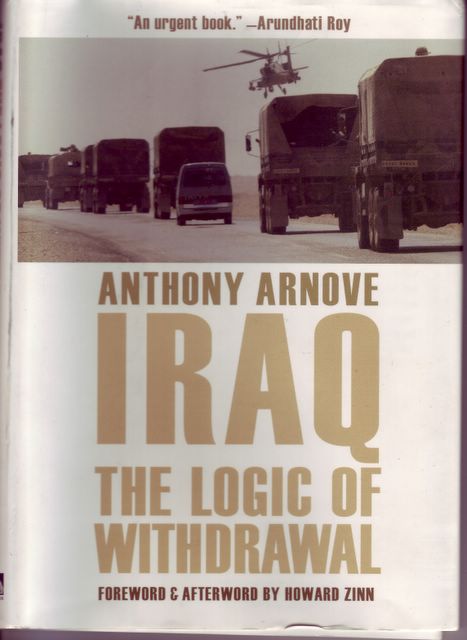 The book's either out in soft cover or about to come out in soft cover. (And there's a link in the snapshot below to it so I'm rushing and I'll just steer you to that.)
This was part four of the series the program's been doing on the police state we're becoming and on this one they're looking at how not only are things lost here but overseas too.
The Michaels (Ratner and Smith) talked about the fact that the attacks on 9-11 were crimes but were treated like a war and how responding to it like war wasn't just a mistake in terms of responding but also handed over all these powers to Bully Boy and how you can't have a democracy here and be an empire overseas.
Which is where they're looking at things for this episode and that includes military resistance and an American citizen who's about to get the death penalty in Iraq and Anthony Arnove.
So these were the notes I made while Tracey was playing the tape over the phone. Arnove was talking about the strength we have today to stop the war because now "a majority wants to see the troops come home so we're starting from . . . a very strong place." He talked about the importance of organizing and he talked about the importance of resistance within the war and was drawing similarities to Vietnam too.
He doesn't have a lot of faith in the Democratic Party doing anything and I'd agree with that. They're going to have to be forced to. He also talked about John Murtha and that went too quick for me to take notes but listen to that. Murtha's not all we're supposed to believe. He's gotten more funds from the military than anyone else in the House. (That's probably why we didn't push him at our sites. I don't usually ask for details. :D Really, I'm in a hurry and don't have time. I usually just go like thumbs up or down.) But like C.I. wrote last week: "What was the point of building up John Murtha? Apparently nothing but gas baggery because last week we saw him taken out. I'm not fond of Murtha. We didn't offer him as a savior here. But it was really amazing to see some of the same sources that spent forever pushing him suddenly turn on him."
That's the sort of thing I had time for this year. Just taking C.I.'s word (I trust C.I.) but no time to go, "Okay, give me the dirt." Arnove gives the dirt. So you can check that out.
And Michael Ratner brought up how the time is never write. He's not saying that, he's saying that's the excuse he got when he was like begging Congress to do something, anything on Guantanamo. But they were worried about this and that, not issues, elections. And that's how it's going to be with Iraq too. They'll keep pushing it off, saying it's not time. So that's why they were all talking about how we needed to apply pressure to Congress to make them deal with the war. Which won't be easy because they've pretty much said no, the Democratic leaders, to stop funding on the war. Like Michael Ratner said, if they would have cut off the funding on Guantanamo and the other prisons (some secret) by cutting off the CIA funding.
Arnove said he didn't think the Democratic Party leaders would push for change and talked about Harry Reid in the Senate calling for more money for the war.
See that's what they do, strut instead of dealing with issues.
Arnove talked aoubt how the war's cost 1.6 trillion for the US and how that money could have been used on stuff we need and I think this is where he talked about the fact that the damage from Hurricane Katrina still hadn't been fixed. That was part of the discussion and part of the topic. You can't have a democracy here and an empire overseas. All that money going over there for the war means stuff here won't be fixed.
So what we need to keep doing, Arnove said, was "demanding a withdrawal, demanding an end to the war." And he said we needed to support groups like Iraq Veterans Against the War. He talked about how the resistance in the military helped end the war in Vietnam and about the link between the civil rights movement here and the war in Vietnam, how people serving in Vietnam were able to see the demonizing going on over there and relate it to the racism here. He talked about what happened to Abeer twice but I don't think the point got made because the conversation changed both times. I really wished that they had stayed on this so we could have heard a legal opinion. What does it mean when one turns over on the others? What's the usual punishments, stuff like that. (But none of the hosts may have a background in military law. They may, I don't know. I just know The New York Times pushed the alibi/excuse of her rapists and killers -- "based on James Barker's confessions," C.I. always says put that in -- and when one confessed, they had nothing to say and haven't written one damn word.) He quoted what Barker said to the judge and I've got it from the snapshot (I can't do the quick note taking that Ava and C.I. can) so this what Barker said to the judge when pleading guilty: "I hated Iraqis, your honor."
Arnove also said he doesn't believe the nonsense about how America's just tuned out on the war "I don't believe that I think millions of people have been effected by this war around the country."
Guess what? That's it. I'm tired. I'm not a fast typist like everyone else. Real quick, here's the
latest at The Third Estate Sunday Review:
A Note to Our Readers -- Jim's note.
Editorial: The Unknown War Resister -- I really like this one. It was a bit longer but we worked on editing it down because Dona said there was so much in terms of long articles already. But I really like the message.
TV Review: Confessing to no talent -- Hilarious! :D I am so glad they left the line in. I was begging them to. I don't know if this is in my Wednesday post last week. I don't have time to check. But I was begging them to leave in that line. Ava and C.I. are hilarious. Tony asked if people were getting how much is covered in it and starts talking about it and I'm all, "Tony, I got the jokes!" :D Seriously, I need to re-read it and planned on it tonight. But no time.
Magazine Parody: The Elector -- A lot of us were going to the weekend off. Then this feature was announced and we all wanted to be there for a piece of that! :D I think it's so funny. And so true. And I was thinking about it when I was listening to Arnove today because the stuff he's saying we should be paying attention to isn't getting covered. The fact that it's not getting covered is why the parody was done.
Iraq's civil war -- C.I. pulled this as a topic from The Common Ills. There was a concern about whether we'd have enough topics this week because we'd planned to write about Danny Schechter's book again but no one had it. Tony's got mine. C.I. ended up loaning to a friend Friday. Jess, Dona, Jim, Ty and Ava all loaned theirs out, passed them on, while they were in NYC. Rebecca's is in a box (most of her stuff is because of the remodeling) and Elaine was at my place. Wally was at his grandfather's house so he didn't have his. Betty's wasn't on her shelf and she didn't know who borrowed it so we were all like, "Okay, Cedric, it's up to you." Only Three Cool Old Guys had Cedric's copy and were passing it around the nursing home. We couldn't believe no one had a copy. We quote from it in the editorial and that's C.I. doing it from memory so it's noted that it's a paraphrase and not a quote.
TV Review: Burying the living -- Ava and C.I. review two TV specials. This is the other one.
MyTV's Fascist House -- I had nothing to do with the collage, but I did help with the text. :D Me and Wally were going, "You gotta mention Fall Out Boy again!" :D
Junior wasn't all that? You don't say -- Harold Ford Jr. The loser.
Taking care of the most pressing business first -- This was a bit longer than planned. With Ava and C.I.'s review of Madonna's special and the parody, this was supposed to be a brief one but ended up longer.
Highlights -- the highlights.
That's it for me. Go check out Like Maria Said Paz for Elaine's thoughts. Here's C.I.'s "Iraq snapshot:"
Monday, November 27, 2006. Chaos and violence continue in Iraq; Nouri al-Maliki feels the "love" in Baghdad, outside of the Green Zone; a US military crashes in Falluja, the press dickers over the term "civil war" and US war resister Kyle Snyder remains underground and what's really going on between the US and Iraqi resistance?
Attending funerals of some of those killed in the Thursday slaughter (which claimed over 200 lives) in the Sadr City section of Baghdad, the puppet of the occupation was feeling the "love" or something. Mussab Al-Khairalla and Alastair Macdonald (Reuters) report that Nouri al-Maliki was "pelted with stones," jeered and greeted with shouts including: "It's all your fault!" Louise Roug (LA Times) reports that he was also greeted with "Coward!" and "Collaborator!"
The puppet has no clothes on. Which is why he's gearing up for this week's meet up with Bully Boy in Jordan (Wednesday and Thursday) despite, as Sudarsan Raghavan (Washington Post) reported, the Sadr bloc will pull their backing: "'If the prime minister does not give up his intention to meet Bush the criminal in Amman, we will suspend our membership at the council of representatives and government,' Salih al-Ighaeli, head of Sadr's bloc in parliament, told a solemn crowd gathered on the street in front of Sadr's headquarters". As noted Friday, should the Sadr block withdraw their support, the United Iraqi Alliance (the coalition backing al-Maliki) would fall from a 128 member bloc to a 98 member. If others within the bloc followed the Sadr's bloc lead, the bloc could completely disintegrate (the Democratic Patriotic Alliance of Kurdistan currently has the second largest blog with 53 members).
Covering issues that could lead to the puppet of the occupation having his strings cut, is Tom Hayden. On Wednesday of last week, Hayden offered "U.S. Retreat from Iraq? The Secret Story" and followed that with "Documents Reveal Secret Talks Between U.S. and Iraqi Armed Resistance" tracing efforts of the US administration to test the waters with feelers regarding other 'solutions' but "[i]t must be emphasized that there is no reason to believe that these US gestures are anything more than probes, in the historic spirit of divide-and conquer, before escalating the Iraq war in a Baghdad offensive."
Appearing on Democracy Now! today, Tom Hayden addressed the meetings, noting, "Well it's very murky and we'll know enough in a few days, I suppose. Over the past several years but especially in the past month since the election there have been contacts at a deniable level, but definate contacts, between representatives of the armed Iraqi national resistance and the US over the possible conditions of a cease fire and a change of regime in Baghdad."
Hayden mentioned the "possibility" of the US ditching the puppet with a "strongman" and also stressed the importance of the peace movement in continuing to press the issue. The most recent meetings, the post-US elections ones, are seen by Hayden as being influenced by the election results and elected officials want to move the issue off the table, out of the public eye, before the 2008 elections. On the feelers impact on the illegal war, Hayden also stated, "I don't think this is a plan to get out, I think this is a plan to reduce American casualties dramatically in order to stay in."
Amy Gooodman also interviewed Nir Rosen who discussed the prospect (raised by King Abdullah II of Jordan on ABC's This Week Sunday) of civil wars in the Middle East and saw it unlikely that Lebanaon's on the verge of a civil war, the effects Syria and Iran could have on Iraq -- "naive" because Iraq has it's own civil war right now. Rosen: "There's no solution. We've destroyed Iraq and we've destroyed the region. The Americans need to know this. . . . We destroyed Iraq and there was no civil war in Iraq until we got there. And there was no civil war in Iraq until we took certain steps to pit Shia and Sunnis against each other."
And in Iraq . . .
Bombings?
CNN reports that mortar rounds claimed three lives in Iraq and left 15 wounded in Baghdad. Reuters reports: "A police major was killed while trying to dismantle a roadside bomb in the oil refinery city of Baiji" and that "Mortar bombs fired by U.S. forces at insurgents wounded four Iraqi civilians, three of them boys aged six, 13 and 16".
Shootings?
In Dora, CBS and AP report that six police officers were wounded in an attack and, shortly after, "gunmen attacked an Iraqi army checkpoint, wounding four soldiers." CNN reports that, in Muqdadiya, the owner of a mobile phone store was shot dead and that, in two different areas, three police officers were shot dead in Baghdad with eleven more wounded..
Corpses?
Reuters reports that 39 corpses were discovered in Baghdad and five more "near Baghdad." AFP notes four corpses discovered in Haswa and four in Iskandiriyah.
Kidnappings?CNN reports that three guards were kidnapped "outside a Baghdad municipal building" and four brothers were kidnapped (the fifth killed) in the eastern part of the capital. Reuters notes the kidnapping of Abdul-Qadir Abbas in Baghdad and, in Dujail, eight police officers have been kidnapped (originally nine, one escaped) and that another was shot dead.
In Falluja, a US fighter jet has crashed. Reuters has the most information and that includes eye witnesses asserting that "they saw the pilot eject but that he was killed, and television footage filmed by a local journalist appeared to show the pilot dead near the crash." Earlier today the US military announced: "Three Multi-National Division- Baghdad Soldiers were killed during combat operations in the Iraqi capital at approximately 9 a.m. Nov. 26.Two other Soldiers were injured in the incident." The count at Iraq Coalition Casualty Count for US troops who have died in Iraq since the start of the illegal war is 2880.
Today in England, Des Browne, the Defence Secretary delivered his promised speech. Devika Bhat (Times of London) reports he announced that a reduction of British troops serving in Iraq would take place by year's end. No hard numbers were given and it apparently doesn't mean all troops. This as CBS and AP report that the president of Poland has announced they will put their 900 troops from Iraq "by the end of 2007".
Civil war. Iraq's been in the midst of a civil war for some time now. The mass killings on Thursday appear to be forcing the reality. Edward Wong (New York Times) posed the issue Sunday of what to do when the US administration asserts it's not a civil war but experts in the field of civil war say that it is? The piece (billed as a "new analysis") ended with no resolution. Solomon Moore (Los Angelse Times) made it clear what reporters could do -- report what they witness: "Iraq's civil war worsended Friday as Shiite and Sunni Arabs engaged in retaliatory attacks after coordinated car bombings that killed 200 people in a Shiite neighborhood the day before." Also calling what his own eyes saw was CNN's Michael Ware who declared Friday: ". . . for the people living on the streets, for Iraqis in their homes, if this is not civil war, or a form of it, then they do not want to see what one really looks like. . . . I don't want to see what a civil war looks like either if this isn't one." This morning on NBC's Today show, their news analyst (and retired general) made the call "civil war."
As Amy Goodman noted on Democracy Now!, the US administration is now refusing to use the terms "hunger" and "hungry" and instead, the US Agriculture Dept. is promoting the term "very low food security." If the use of "civil war" is any indication, don't be surprised to learn of "World Very Low Food Security" from the news outlets that can't figure out what's happening right in front of them.
This morning, WBAI's Law and Disorder wrapped up their four-part series on the police state by exploring how a democracy could exist at home and an empire abroad. Hosts Michael Ratner, Heidi Boghosian, Dalia Hashad and Michael Smith spoke with Anthony Arnove on the topic of Iraq. (Arnove's Iraq: The Logic of Withdrawal is now available in softcover.
Arnove offered strong critiques of the Democratic party and noted that US Senator Harry Reid is pushing for an additional 75 billion dollars going to the military bill and that the Democratic majority in the US Congress has little interest in using their power of the purse
to stop funding the illegal war. Arnove's opinion is that the peace movement is in a stronger position due to the fact that so many Americans are against the war and want the troops home. If you missed the broadcast you can visit the Law and Disorder website or at the WBAI archives. Mike will be discussing the broadcast at Mikey Like It! tonight. Ruth will probably highlight in a report this week as well. (And thanks to Ruth for providing the 'streaming audio' via telephone line.) (Ruth called and put her phone up to the radio speaker if anyone's confused.)
Arnove also spoke of the importance of keeping the pressure on the government to end the war and of the importance of resisters within the military.
Turning to news of US war resisters. Janet McConnaughey (AP) reports that Kyle Snyder "spent Thanksgiving week gutting houses flooded more than a year ago by Hurricane Katrina" and that he was part of "two dozen volunteers from Iraq Veterans Against the War".
Snyder, on October 31st, turned himself in at Fort Knox only to self-check out again after discovering the military had lied yet again. Since then Snyder has been underground, surfacing to speaking out against the war. He is now underground and tells McConnaughey that, these days, "I just travel" while his "lawyer has tried to contact Fort Leonard Wood like 75 times -- it's documented, 75 times -- and tried to get in touch with the military. They've avoided this entire subject."
Meanwhile, Carolyn Thompson (AP) reports that US war resister Patrick Hart has stated he has "no desire to go back." Back being the United States. Hart is among the thirty plus war resisters who are attempting to seek refugee status in Iraq. Hart tells Thompson, "Every day I wake up with my son [Rian], it just assures me I did the right thing."
Hart and Snyder are a part of war resistance within the military that also includes, among others, Ehren Watada , Joshua Key, Ivan Brobeck, Darrell Anderson, Ricky Clousing, Mark Wilkerson, Camilo Meija, Pablo Paredes, Carl Webb, Stephen Funk, David Sanders, Dan Felushko, Brandon Hughey, Jeremy Hinzman, Corey Glass, Joshua Casteel, Clifford Cornell, Agustin Aguayo, Joshua Despain, Katherine Jashinski, and Kevin Benderman. And those are only some of the names of those resisting who have gone public.
Information on war resistance within the military can be found at Center on Conscience & War, The Objector, The G.I. Rights Hotline, Soldier Say No!, the War Resisters Support Campaign, Iraq Veterans Against the War and Veterans For Peace. Courage to Resist offers information on all public war resisters. Appeal for Redress is collecting signatures of active duty service members calling on Congress to bring the troops home -- the petition will be delivered to Congress in January (on MLK day). (Jonathan Hutto was also interviewed on Law and Disorder today. Hutto is one of the organizers of Appel for Redress.)
Al Jazeera reports that Iraqi president Jalal Talabani is now in Tehran where he was supposed to be this weekend to meet with the presidents of Syria and Iran. Thursday's events led to the closing of Baghdad International and the airport in Basra. Basra's airport reopened Sunday, Baghdad's today.
Turning to Australia, the military inquiry into the April 21st Baghdad death of Jake Kovco is back in the news. The inquriy lasted much of the summer, as Conor Duffy reported to Eleanor Hall (The World Today, Australia's ABC), by September 18th, it had "been sitting for three months". On September 19th, the inquiry began wrapping up and issued a statement Eleanor Hall (ABC's The World Today) summarized as: "It wasn't suicide. In a surprise announcement this morning, the President of the Board inquiring into the death of Private Jake Kovco in Iraq interrupted an address from one of the Kovco lawyers to say that he had already ruled out that the young soldier deliberately took his own life."
Dan Box (The Australian) reported then that the results would be known within six weeks. He was off by about two weeks.
First up was a bit of news of the report. As October drew to a close, it was reported the inquiry board had turned their report to Angus Houston (Air Chief Marshal of Australia's military). On November 1st, while refusing to discuss other aspects of the report, Houston stated that the board had included Jake Kovco wasn't rushed home (that would actually be Juso Sinaovic, the Bosnian carpenter whose body was mixed up with Kovco's, that got rushed to Australia). Today, as Peter Cave noted on AM (Australia's ABC), The Australian was reporting on a leaked copy of the report.
If that seems strangely familiar, you may be remembering the report by Australia's Defence Department into the mix up of Jake Kovco and Juso Sinavoic's bodies. That report showed up in the press in May when somene left a confidiential copy on a CD-ROM in a public computer at a public airport. If you remember that, you probably remember that no one was at fault. No one was at fault for the mix up in that text equivalent of a shrug.
No one is at fault again. That's what the report from the military board of inquiry appears to 'find.' And once again, Jake Kovco's survivors learn of the findings (in this case Angus Houston has had the report for some time, Brendan Nelso got his copy last week), not from the government, but from the press. The government appears to have made a habit of avoiding the family.
The report finds that Jake Kovco shot himself and that the shooting was accidental. No one is at fault. And if you think closely about the statements made on September 19th, the board apparently knew that was their finding months ago. Conor Duffy (for AM) spoke with Judy Kovco, mother of Jake, and she responded, "Nothing surprises me with them, absolutely nothing. This was the army investigating the army. I would like to know how they came to that finding. There is no evidence that my son shot himself. There is a lot of evidence the other way but, you know, I would like to know how they came to that finding."
Interviewed by Kerry O'Brien for the 7:30 Report (ABC) in September, Judy Kovco shared her beliefs that her son did not kill himself and that she would not be surprised to find the military covering up "an accidental shooting by somebody else or a murder." Today, she told Conor Duffy that she had "applied for the Coroner's Court" and she intends to keep fighting for the truth. The Coroner's Court?
Dan Box (The Australian) reports that: "Earlier this month, staff from the military board of inquiry into Kovco's death told the NSW Coroner's Court that its policy was to dispose of evidence" but police are now requesting that this not occur. Box quotes Judy Kovco, "They (the army) want this to go away and I am not going to go away."
Box also notes that the roommates of Jake Kovco "suggested he may have placed the gun to his head as a joke, but said they did not see the fatal shot." They didn't see too damn much, did they? They offered speculation of what might have happened or what someone said probably happened or this or that but they really think the world believes that if you're in a small room with someone who is shot, you don't notice. You don't notice when the gun goes off, you don't turn around and think, "Where did that come from?"
Was the gun on the bed, on the computer, where? No one knows because apparently a gun goes off and you ignore it as you dig through the fridge thinking, "Hmm. Pepsi or Coke?" You do, however, meet up with the person whose DNA later turns up on Jake Kovco's gun (the gun that killed him) and discuss things, and when Steven Carr tells you Jake Kovco was a 'cowboy' with his gun, always playing with it, you testify to that as fact -- not that Carr told you. No, you refuse to tell where you heard it. But you slip that into your testimony.
Steven Carr is not just the one whose DNA was found on Kovco's gun, he's also a scientific genius. Or was for many days as he 'theorized' about how his DNA transferred to Jake Kovco's gun even though Carr maintains he never touched Kovco's gun. There was something really sad as that made it into print repeatedly when it was laughable on its very face. It would take expert testimony before the DNA transfer was refuted by expert witness (Michelle Franco of the NSW Department of Health's Analytical Laboratories).
No questions were answered in the laughable inquiry ("Keystone Cops," Judy Kovco's term for one witness, applies to the entire proceedings).
like maria said paz
the common ills
iraq
tom hayden
kyle snyder
patrick hart
pat hart
mikey likes it
the third estate sunday review
ruths report
law and disorder
michael ratner
heidi boghosian
michael smith
dalia hashad
anthony arnove
jake kovco
the new york times
edward wong
the washington post
sudarsan raghavan
amy goodman
democracy now
Anthony Arnove wrote Iraq: The Logic of Withdrawal which we did a quick note on at The Third Estate Sunday Review. In fact, I can grab the scan of the cover from that. So I just added it.
The book's either out in soft cover or about to come out in soft cover. (And there's a link in the snapshot below to it so I'm rushing and I'll just steer you to that.)This was part four of the series the program's been doing on the police state we're becoming and on this one they're looking at how not only are things lost here but overseas too.
The Michaels (Ratner and Smith) talked about the fact that the attacks on 9-11 were crimes but were treated like a war and how responding to it like war wasn't just a mistake in terms of responding but also handed over all these powers to Bully Boy and how you can't have a democracy here and be an empire overseas.
Which is where they're looking at things for this episode and that includes military resistance and an American citizen who's about to get the death penalty in Iraq and Anthony Arnove.
So these were the notes I made while Tracey was playing the tape over the phone. Arnove was talking about the strength we have today to stop the war because now "a majority wants to see the troops come home so we're starting from . . . a very strong place." He talked about the importance of organizing and he talked about the importance of resistance within the war and was drawing similarities to Vietnam too.
He doesn't have a lot of faith in the Democratic Party doing anything and I'd agree with that. They're going to have to be forced to. He also talked about John Murtha and that went too quick for me to take notes but listen to that. Murtha's not all we're supposed to believe. He's gotten more funds from the military than anyone else in the House. (That's probably why we didn't push him at our sites. I don't usually ask for details. :D Really, I'm in a hurry and don't have time. I usually just go like thumbs up or down.) But like C.I. wrote last week: "What was the point of building up John Murtha? Apparently nothing but gas baggery because last week we saw him taken out. I'm not fond of Murtha. We didn't offer him as a savior here. But it was really amazing to see some of the same sources that spent forever pushing him suddenly turn on him."
That's the sort of thing I had time for this year. Just taking C.I.'s word (I trust C.I.) but no time to go, "Okay, give me the dirt." Arnove gives the dirt. So you can check that out.
And Michael Ratner brought up how the time is never write. He's not saying that, he's saying that's the excuse he got when he was like begging Congress to do something, anything on Guantanamo. But they were worried about this and that, not issues, elections. And that's how it's going to be with Iraq too. They'll keep pushing it off, saying it's not time. So that's why they were all talking about how we needed to apply pressure to Congress to make them deal with the war. Which won't be easy because they've pretty much said no, the Democratic leaders, to stop funding on the war. Like Michael Ratner said, if they would have cut off the funding on Guantanamo and the other prisons (some secret) by cutting off the CIA funding.
Arnove said he didn't think the Democratic Party leaders would push for change and talked about Harry Reid in the Senate calling for more money for the war.
See that's what they do, strut instead of dealing with issues.
Arnove talked aoubt how the war's cost 1.6 trillion for the US and how that money could have been used on stuff we need and I think this is where he talked about the fact that the damage from Hurricane Katrina still hadn't been fixed. That was part of the discussion and part of the topic. You can't have a democracy here and an empire overseas. All that money going over there for the war means stuff here won't be fixed.
So what we need to keep doing, Arnove said, was "demanding a withdrawal, demanding an end to the war." And he said we needed to support groups like Iraq Veterans Against the War. He talked about how the resistance in the military helped end the war in Vietnam and about the link between the civil rights movement here and the war in Vietnam, how people serving in Vietnam were able to see the demonizing going on over there and relate it to the racism here. He talked about what happened to Abeer twice but I don't think the point got made because the conversation changed both times. I really wished that they had stayed on this so we could have heard a legal opinion. What does it mean when one turns over on the others? What's the usual punishments, stuff like that. (But none of the hosts may have a background in military law. They may, I don't know. I just know The New York Times pushed the alibi/excuse of her rapists and killers -- "based on James Barker's confessions," C.I. always says put that in -- and when one confessed, they had nothing to say and haven't written one damn word.) He quoted what Barker said to the judge and I've got it from the snapshot (I can't do the quick note taking that Ava and C.I. can) so this what Barker said to the judge when pleading guilty: "I hated Iraqis, your honor."
Arnove also said he doesn't believe the nonsense about how America's just tuned out on the war "I don't believe that I think millions of people have been effected by this war around the country."
Guess what? That's it. I'm tired. I'm not a fast typist like everyone else. Real quick, here's the
latest at The Third Estate Sunday Review:
A Note to Our Readers -- Jim's note.
Editorial: The Unknown War Resister -- I really like this one. It was a bit longer but we worked on editing it down because Dona said there was so much in terms of long articles already. But I really like the message.
TV Review: Confessing to no talent -- Hilarious! :D I am so glad they left the line in. I was begging them to. I don't know if this is in my Wednesday post last week. I don't have time to check. But I was begging them to leave in that line. Ava and C.I. are hilarious. Tony asked if people were getting how much is covered in it and starts talking about it and I'm all, "Tony, I got the jokes!" :D Seriously, I need to re-read it and planned on it tonight. But no time.
Magazine Parody: The Elector -- A lot of us were going to the weekend off. Then this feature was announced and we all wanted to be there for a piece of that! :D I think it's so funny. And so true. And I was thinking about it when I was listening to Arnove today because the stuff he's saying we should be paying attention to isn't getting covered. The fact that it's not getting covered is why the parody was done.
Iraq's civil war -- C.I. pulled this as a topic from The Common Ills. There was a concern about whether we'd have enough topics this week because we'd planned to write about Danny Schechter's book again but no one had it. Tony's got mine. C.I. ended up loaning to a friend Friday. Jess, Dona, Jim, Ty and Ava all loaned theirs out, passed them on, while they were in NYC. Rebecca's is in a box (most of her stuff is because of the remodeling) and Elaine was at my place. Wally was at his grandfather's house so he didn't have his. Betty's wasn't on her shelf and she didn't know who borrowed it so we were all like, "Okay, Cedric, it's up to you." Only Three Cool Old Guys had Cedric's copy and were passing it around the nursing home. We couldn't believe no one had a copy. We quote from it in the editorial and that's C.I. doing it from memory so it's noted that it's a paraphrase and not a quote.
TV Review: Burying the living -- Ava and C.I. review two TV specials. This is the other one.
MyTV's Fascist House -- I had nothing to do with the collage, but I did help with the text. :D Me and Wally were going, "You gotta mention Fall Out Boy again!" :D
Junior wasn't all that? You don't say -- Harold Ford Jr. The loser.
Taking care of the most pressing business first -- This was a bit longer than planned. With Ava and C.I.'s review of Madonna's special and the parody, this was supposed to be a brief one but ended up longer.
Highlights -- the highlights.
That's it for me. Go check out Like Maria Said Paz for Elaine's thoughts. Here's C.I.'s "Iraq snapshot:"
Monday, November 27, 2006. Chaos and violence continue in Iraq; Nouri al-Maliki feels the "love" in Baghdad, outside of the Green Zone; a US military crashes in Falluja, the press dickers over the term "civil war" and US war resister Kyle Snyder remains underground and what's really going on between the US and Iraqi resistance?
Attending funerals of some of those killed in the Thursday slaughter (which claimed over 200 lives) in the Sadr City section of Baghdad, the puppet of the occupation was feeling the "love" or something. Mussab Al-Khairalla and Alastair Macdonald (Reuters) report that Nouri al-Maliki was "pelted with stones," jeered and greeted with shouts including: "It's all your fault!" Louise Roug (LA Times) reports that he was also greeted with "Coward!" and "Collaborator!"
The puppet has no clothes on. Which is why he's gearing up for this week's meet up with Bully Boy in Jordan (Wednesday and Thursday) despite, as Sudarsan Raghavan (Washington Post) reported, the Sadr bloc will pull their backing: "'If the prime minister does not give up his intention to meet Bush the criminal in Amman, we will suspend our membership at the council of representatives and government,' Salih al-Ighaeli, head of Sadr's bloc in parliament, told a solemn crowd gathered on the street in front of Sadr's headquarters". As noted Friday, should the Sadr block withdraw their support, the United Iraqi Alliance (the coalition backing al-Maliki) would fall from a 128 member bloc to a 98 member. If others within the bloc followed the Sadr's bloc lead, the bloc could completely disintegrate (the Democratic Patriotic Alliance of Kurdistan currently has the second largest blog with 53 members).
Covering issues that could lead to the puppet of the occupation having his strings cut, is Tom Hayden. On Wednesday of last week, Hayden offered "U.S. Retreat from Iraq? The Secret Story" and followed that with "Documents Reveal Secret Talks Between U.S. and Iraqi Armed Resistance" tracing efforts of the US administration to test the waters with feelers regarding other 'solutions' but "[i]t must be emphasized that there is no reason to believe that these US gestures are anything more than probes, in the historic spirit of divide-and conquer, before escalating the Iraq war in a Baghdad offensive."
Appearing on Democracy Now! today, Tom Hayden addressed the meetings, noting, "Well it's very murky and we'll know enough in a few days, I suppose. Over the past several years but especially in the past month since the election there have been contacts at a deniable level, but definate contacts, between representatives of the armed Iraqi national resistance and the US over the possible conditions of a cease fire and a change of regime in Baghdad."
Hayden mentioned the "possibility" of the US ditching the puppet with a "strongman" and also stressed the importance of the peace movement in continuing to press the issue. The most recent meetings, the post-US elections ones, are seen by Hayden as being influenced by the election results and elected officials want to move the issue off the table, out of the public eye, before the 2008 elections. On the feelers impact on the illegal war, Hayden also stated, "I don't think this is a plan to get out, I think this is a plan to reduce American casualties dramatically in order to stay in."
Amy Gooodman also interviewed Nir Rosen who discussed the prospect (raised by King Abdullah II of Jordan on ABC's This Week Sunday) of civil wars in the Middle East and saw it unlikely that Lebanaon's on the verge of a civil war, the effects Syria and Iran could have on Iraq -- "naive" because Iraq has it's own civil war right now. Rosen: "There's no solution. We've destroyed Iraq and we've destroyed the region. The Americans need to know this. . . . We destroyed Iraq and there was no civil war in Iraq until we got there. And there was no civil war in Iraq until we took certain steps to pit Shia and Sunnis against each other."
And in Iraq . . .
Bombings?
CNN reports that mortar rounds claimed three lives in Iraq and left 15 wounded in Baghdad. Reuters reports: "A police major was killed while trying to dismantle a roadside bomb in the oil refinery city of Baiji" and that "Mortar bombs fired by U.S. forces at insurgents wounded four Iraqi civilians, three of them boys aged six, 13 and 16".
Shootings?
In Dora, CBS and AP report that six police officers were wounded in an attack and, shortly after, "gunmen attacked an Iraqi army checkpoint, wounding four soldiers." CNN reports that, in Muqdadiya, the owner of a mobile phone store was shot dead and that, in two different areas, three police officers were shot dead in Baghdad with eleven more wounded..
Corpses?
Reuters reports that 39 corpses were discovered in Baghdad and five more "near Baghdad." AFP notes four corpses discovered in Haswa and four in Iskandiriyah.
Kidnappings?CNN reports that three guards were kidnapped "outside a Baghdad municipal building" and four brothers were kidnapped (the fifth killed) in the eastern part of the capital. Reuters notes the kidnapping of Abdul-Qadir Abbas in Baghdad and, in Dujail, eight police officers have been kidnapped (originally nine, one escaped) and that another was shot dead.
In Falluja, a US fighter jet has crashed. Reuters has the most information and that includes eye witnesses asserting that "they saw the pilot eject but that he was killed, and television footage filmed by a local journalist appeared to show the pilot dead near the crash." Earlier today the US military announced: "Three Multi-National Division- Baghdad Soldiers were killed during combat operations in the Iraqi capital at approximately 9 a.m. Nov. 26.Two other Soldiers were injured in the incident." The count at Iraq Coalition Casualty Count for US troops who have died in Iraq since the start of the illegal war is 2880.
Today in England, Des Browne, the Defence Secretary delivered his promised speech. Devika Bhat (Times of London) reports he announced that a reduction of British troops serving in Iraq would take place by year's end. No hard numbers were given and it apparently doesn't mean all troops. This as CBS and AP report that the president of Poland has announced they will put their 900 troops from Iraq "by the end of 2007".
Civil war. Iraq's been in the midst of a civil war for some time now. The mass killings on Thursday appear to be forcing the reality. Edward Wong (New York Times) posed the issue Sunday of what to do when the US administration asserts it's not a civil war but experts in the field of civil war say that it is? The piece (billed as a "new analysis") ended with no resolution. Solomon Moore (Los Angelse Times) made it clear what reporters could do -- report what they witness: "Iraq's civil war worsended Friday as Shiite and Sunni Arabs engaged in retaliatory attacks after coordinated car bombings that killed 200 people in a Shiite neighborhood the day before." Also calling what his own eyes saw was CNN's Michael Ware who declared Friday: ". . . for the people living on the streets, for Iraqis in their homes, if this is not civil war, or a form of it, then they do not want to see what one really looks like. . . . I don't want to see what a civil war looks like either if this isn't one." This morning on NBC's Today show, their news analyst (and retired general) made the call "civil war."
As Amy Goodman noted on Democracy Now!, the US administration is now refusing to use the terms "hunger" and "hungry" and instead, the US Agriculture Dept. is promoting the term "very low food security." If the use of "civil war" is any indication, don't be surprised to learn of "World Very Low Food Security" from the news outlets that can't figure out what's happening right in front of them.
This morning, WBAI's Law and Disorder wrapped up their four-part series on the police state by exploring how a democracy could exist at home and an empire abroad. Hosts Michael Ratner, Heidi Boghosian, Dalia Hashad and Michael Smith spoke with Anthony Arnove on the topic of Iraq. (Arnove's Iraq: The Logic of Withdrawal is now available in softcover.
Arnove offered strong critiques of the Democratic party and noted that US Senator Harry Reid is pushing for an additional 75 billion dollars going to the military bill and that the Democratic majority in the US Congress has little interest in using their power of the purse
to stop funding the illegal war. Arnove's opinion is that the peace movement is in a stronger position due to the fact that so many Americans are against the war and want the troops home. If you missed the broadcast you can visit the Law and Disorder website or at the WBAI archives. Mike will be discussing the broadcast at Mikey Like It! tonight. Ruth will probably highlight in a report this week as well. (And thanks to Ruth for providing the 'streaming audio' via telephone line.) (Ruth called and put her phone up to the radio speaker if anyone's confused.)
Arnove also spoke of the importance of keeping the pressure on the government to end the war and of the importance of resisters within the military.
Turning to news of US war resisters. Janet McConnaughey (AP) reports that Kyle Snyder "spent Thanksgiving week gutting houses flooded more than a year ago by Hurricane Katrina" and that he was part of "two dozen volunteers from Iraq Veterans Against the War".
Snyder, on October 31st, turned himself in at Fort Knox only to self-check out again after discovering the military had lied yet again. Since then Snyder has been underground, surfacing to speaking out against the war. He is now underground and tells McConnaughey that, these days, "I just travel" while his "lawyer has tried to contact Fort Leonard Wood like 75 times -- it's documented, 75 times -- and tried to get in touch with the military. They've avoided this entire subject."
Meanwhile, Carolyn Thompson (AP) reports that US war resister Patrick Hart has stated he has "no desire to go back." Back being the United States. Hart is among the thirty plus war resisters who are attempting to seek refugee status in Iraq. Hart tells Thompson, "Every day I wake up with my son [Rian], it just assures me I did the right thing."
Hart and Snyder are a part of war resistance within the military that also includes, among others, Ehren Watada , Joshua Key, Ivan Brobeck, Darrell Anderson, Ricky Clousing, Mark Wilkerson, Camilo Meija, Pablo Paredes, Carl Webb, Stephen Funk, David Sanders, Dan Felushko, Brandon Hughey, Jeremy Hinzman, Corey Glass, Joshua Casteel, Clifford Cornell, Agustin Aguayo, Joshua Despain, Katherine Jashinski, and Kevin Benderman. And those are only some of the names of those resisting who have gone public.
Information on war resistance within the military can be found at Center on Conscience & War, The Objector, The G.I. Rights Hotline, Soldier Say No!, the War Resisters Support Campaign, Iraq Veterans Against the War and Veterans For Peace. Courage to Resist offers information on all public war resisters. Appeal for Redress is collecting signatures of active duty service members calling on Congress to bring the troops home -- the petition will be delivered to Congress in January (on MLK day). (Jonathan Hutto was also interviewed on Law and Disorder today. Hutto is one of the organizers of Appel for Redress.)
Al Jazeera reports that Iraqi president Jalal Talabani is now in Tehran where he was supposed to be this weekend to meet with the presidents of Syria and Iran. Thursday's events led to the closing of Baghdad International and the airport in Basra. Basra's airport reopened Sunday, Baghdad's today.
Turning to Australia, the military inquiry into the April 21st Baghdad death of Jake Kovco is back in the news. The inquriy lasted much of the summer, as Conor Duffy reported to Eleanor Hall (The World Today, Australia's ABC), by September 18th, it had "been sitting for three months". On September 19th, the inquiry began wrapping up and issued a statement Eleanor Hall (ABC's The World Today) summarized as: "It wasn't suicide. In a surprise announcement this morning, the President of the Board inquiring into the death of Private Jake Kovco in Iraq interrupted an address from one of the Kovco lawyers to say that he had already ruled out that the young soldier deliberately took his own life."
Dan Box (The Australian) reported then that the results would be known within six weeks. He was off by about two weeks.
First up was a bit of news of the report. As October drew to a close, it was reported the inquiry board had turned their report to Angus Houston (Air Chief Marshal of Australia's military). On November 1st, while refusing to discuss other aspects of the report, Houston stated that the board had included Jake Kovco wasn't rushed home (that would actually be Juso Sinaovic, the Bosnian carpenter whose body was mixed up with Kovco's, that got rushed to Australia). Today, as Peter Cave noted on AM (Australia's ABC), The Australian was reporting on a leaked copy of the report.
If that seems strangely familiar, you may be remembering the report by Australia's Defence Department into the mix up of Jake Kovco and Juso Sinavoic's bodies. That report showed up in the press in May when somene left a confidiential copy on a CD-ROM in a public computer at a public airport. If you remember that, you probably remember that no one was at fault. No one was at fault for the mix up in that text equivalent of a shrug.
No one is at fault again. That's what the report from the military board of inquiry appears to 'find.' And once again, Jake Kovco's survivors learn of the findings (in this case Angus Houston has had the report for some time, Brendan Nelso got his copy last week), not from the government, but from the press. The government appears to have made a habit of avoiding the family.
The report finds that Jake Kovco shot himself and that the shooting was accidental. No one is at fault. And if you think closely about the statements made on September 19th, the board apparently knew that was their finding months ago. Conor Duffy (for AM) spoke with Judy Kovco, mother of Jake, and she responded, "Nothing surprises me with them, absolutely nothing. This was the army investigating the army. I would like to know how they came to that finding. There is no evidence that my son shot himself. There is a lot of evidence the other way but, you know, I would like to know how they came to that finding."
Interviewed by Kerry O'Brien for the 7:30 Report (ABC) in September, Judy Kovco shared her beliefs that her son did not kill himself and that she would not be surprised to find the military covering up "an accidental shooting by somebody else or a murder." Today, she told Conor Duffy that she had "applied for the Coroner's Court" and she intends to keep fighting for the truth. The Coroner's Court?
Dan Box (The Australian) reports that: "Earlier this month, staff from the military board of inquiry into Kovco's death told the NSW Coroner's Court that its policy was to dispose of evidence" but police are now requesting that this not occur. Box quotes Judy Kovco, "They (the army) want this to go away and I am not going to go away."
Box also notes that the roommates of Jake Kovco "suggested he may have placed the gun to his head as a joke, but said they did not see the fatal shot." They didn't see too damn much, did they? They offered speculation of what might have happened or what someone said probably happened or this or that but they really think the world believes that if you're in a small room with someone who is shot, you don't notice. You don't notice when the gun goes off, you don't turn around and think, "Where did that come from?"
Was the gun on the bed, on the computer, where? No one knows because apparently a gun goes off and you ignore it as you dig through the fridge thinking, "Hmm. Pepsi or Coke?" You do, however, meet up with the person whose DNA later turns up on Jake Kovco's gun (the gun that killed him) and discuss things, and when Steven Carr tells you Jake Kovco was a 'cowboy' with his gun, always playing with it, you testify to that as fact -- not that Carr told you. No, you refuse to tell where you heard it. But you slip that into your testimony.
Steven Carr is not just the one whose DNA was found on Kovco's gun, he's also a scientific genius. Or was for many days as he 'theorized' about how his DNA transferred to Jake Kovco's gun even though Carr maintains he never touched Kovco's gun. There was something really sad as that made it into print repeatedly when it was laughable on its very face. It would take expert testimony before the DNA transfer was refuted by expert witness (Michelle Franco of the NSW Department of Health's Analytical Laboratories).
No questions were answered in the laughable inquiry ("Keystone Cops," Judy Kovco's term for one witness, applies to the entire proceedings).
like maria said paz
the common ills
iraq
tom hayden
kyle snyder
patrick hart
pat hart
mikey likes it
the third estate sunday review
ruths report
law and disorder
michael ratner
heidi boghosian
michael smith
dalia hashad
anthony arnove
jake kovco
the new york times
edward wong
the washington post
sudarsan raghavan
amy goodman
democracy now
Subscribe to:
Posts (Atom)