Okay, before I go further, this is Debra Sweet's "Resistance Events this Week:"
Tuesday, 28 April 2009 06:57
Thursday, April 30 in DC
Two hundred-fifty prisoners remain detained in Guantanamo, including many already cleared for release, Bagram prison is expanding. Indefinite detention is continuing. Witness Against Torture is calling for people to join, on the 100th Day of the Obama presidency, April 30, for a procession in orange jump suits and a nonviolent direct action at the White House
April 30th Action: 10:00am- Gather at the Capital Reflecting Pool http://www.100dayscampaign.org/a30
Saturday May 2, activists from around the east coast are converging on suburban Philadelphia at the "Army Experience Center" (AEC). The AEC gives kids as young as 13 a chance to play extremely violent video games, as well as sit inside Apache helicopters, tanks & humvees mounted with M-16 assault rifles. The youth are enticed to jump on board and kill the "hadjis." Right next door is a large indoor skateboard park. Kids can be seen going from having fun skateboarding to playing bloody "war games" sanctioned by the US Army. This center is the first of its kind and if recruitment is successful, others will be built. We must say NO! Hundreds will gather in the parking lot at St. Luke's United Church of Christ, 11080 Knights Road in Philadelphia, at 1:00 PM. A coalition of 30 groups will march along Knights Road to the mall's entrance with signs reading "War Is Not A Game" and "Shut Down the AEC."
Protesters will attempt to serve a criminal complaint on the Army Experience Center as well as the mall owners, Simon Property Group, which states, in part, "the Army Experience Center is therefore involved in the "Criminal Solicitation of Minors" - soliciting underage persons to act in a violent manner and thereby promoting and supporting criminal and corrupt behavior?"
For more information see www.shutdowntheaec.net, or contact
elainebrower@aol.com
Join WarCriminalsWatch on Facebook
Debra Sweet, Director, The World Can't Wait
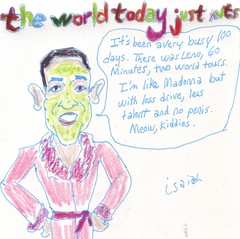
I put in the whole thing because it's two days away and it's an event that needs to have the word put out on it. I'm sure a lot of people would like to take part in that if they know ahead of time it's coming up. And now . . . Illustration by Kat, Betty's three kids and Wally,

Do not adjust your TV set!
:D
The illustration is on NBC's Monday night line up. I'm covering Chuck.
Let's start with the negatives of Monday's season finale: Ana was barely on. I think she had one scene where she had a line. Ana's too funny not to use her more.
Okay, the intersect is out of Chuck's head and bad guy Chevy Chase is enroute to Ellie's wedding. Ellie's Chuck's sister. That's from last week. Monday night Chuck's at the wedding and he and Sarah are on the outs. She's joining Bryce for a new assignment. Chuck -- not knowing Sarah was going to be working on it -- turned down the general's offer to work on the new intersect. So he's upset and feels he's lost her.
And she's leaving after the wedding and the party. So he's really bummed and then he goes off to drink and he's moving his legs under the table or something, feels something, looks under and there are two dead bodies (this is in the reception area). And then Chevy Chase walks up to him and tells him get the new intersect and give it to him in 40 minutes or Ellie's dead.
So he calls Casey (who's already on his next assignment but gave him a card to call if there was an emergency "and your fingers better be on fire when you dial, Bartowsky!"). He also tells Morgan to tell Sarah he forgot Ellie and Devin's rings. Sarah knows that's not true because Chuck had showed them to her so she gets that it's code and looks around and sees Chevy. So she's in the reception area now, behind the gift table and pulling them down one at a time looking for something that can be a weapon.
Chuck goes for the intersect but it's gone. Chuck tells Bryce what's going on and Bryce says they can't get the intersect but they can turn him (Bryce) over to Chevy. So they go there and they go to the reception area.
And Morgan's stalling the wedding because he thinks the ring story is true. He's got Jeff and Lester performing Mr. Robato onstage.
And Chevy says they're killing Chuck. Sarah finds knives as one wedding gift and starts throwing them and knocking out bad guys. She runs out knives, Bryce runs out of bullets and they get captured. And they're all going to die.
And what's the shadow over the skyline?
It's Casey and his new team parachuting in.
They save the day and capture Chevy.
But onstage, Jeff and Lester end their performance with a roman candle or something and it sets off the fire alarms and sprinklers and ruins the whole thing.
Ellie's wedding's ruined. Chuck and Casey and Sarah are talking about it and Chuck has a HUGE check from the government. Since he just left, the general paid him for two years' worth of work he'd been doing. He decides to use the check to give his sister a wedding on the beach and Casey and Sarah and everyone pitches in and it's an amazing wedding.
Bryce is off to the side and he radios Sarah (who is a brides maid but has an ear piece) saying she's not leaving with him, is she? And she shakes her head no. Because she's staying with Chuck.
So she and Chuck are dancing and Chuck is wasting time telling the I'm-going-to-miss-you story when she's trying to tell him that's she's staying, that's she's quitting the CIA and that she loves him. And you're waiting for Chuck to shut up already.
Meanwhile the CIA handler arrives to pick up Bryce. Chuck's dad (who designed the intersect, remember) says goodbye to Bryce and then looks at the CIA agent and flashes.
He goes running to Sarah and Chuck to tell them that man's not CIA and is actually declared dead.
Meanwhile one of Casey's guys just shot and killed Chevy in his cell and then goes to kill Casey's other guys and to kill Casey but decides Casey saved his life once so he just knocks him out.
Casey and Sarah are ready to go after the bad guys. Chuck's dad gives him his computer arm thing (that sleeve that allows him to know which exits to take and who is where). So Chuck says he's going and they end up agreeing. They get to the where Bryce is right after Bryce has locked himself in with the intersect but not before he's been shot.
Chuck's giving directions using the sleeve and then they end up being shot at and Sarah and Casey tell Chuck to go. Chuck starts down the hall and ends up with another way to get into where Bryce is. He gets in and sees Bryce is bleeding to death. Bryce tells him the new computer and the intersect are too much and to destroy them. He gives Chuck a thing to slide into the computer. Then he dies.
Chuck is thinking about all his time (mainly with Sarah) and he goes to the computer but before he destroys it, he downloads this new intersect. Yes, he puts the intersect back into his head. And then, after, while he's twitching and flinchy, he just manages to get the thing in the computer. It shorts everything out including the locks on the doors so now the bad guys enter.
They see the computer's destroyed and they're going to kill Chuck, Sarah and Casey. Chuck goes into a spasm and the bad guys realize he's got the intersect. They have no time to react because Chuck begins fighting them all at once and, as he says at the end, "Guys, I think I know Kung-Fu." Apparently due to the new intersect.
And that's the end.
It was really good. And I can't wait to see next fall. (If they repeat over the summer, I will watch the repeats. They need to repeat over the summer.) Heroes? Didn't like it.
Here's C.I.'s "Iraq snapshot:"
Tuesday, April 28, 2009. Chaos and violence continue, the Senate discusses proposed changes to the War Powers Resolution of 1973, James Baker thought it was a Costume Ball and showed up as Titus Semple, talk of overthrowing Nouri al-Maliki who is more focused on demanding an apology, Steven D. Green's 'nutty' defense, and more.
Starting with war resistance, Iraq War resister Cliff Cornell faced a court-martial this afternoon at Fort Stewart in Georgia where he entered a guilty plea to desertion.
Today the Senate Foreign Relations Committee held a hearing on declaring war and the biggest concern appeared to be whether or not the creation of a joint-committee might usurp their own committee. While the turf war raged, Senator Russ Feingold appeared to be the only one who'd read the proposal in terms of how it might actually impact the issue of going to war.
Appearing before the committee as witnesses were BFFs James Baker and Lee Hamilton, packing enough 'bi-partisan' scandals between themselves to rock a Jackie Collins look at DC. The panel was rounded out by Warren Christopher whose service can be traced back to the LBJ years. Senator John Kerry chairs the committee and he called it to order and skipped any messy realities about the three to instead note that "they are here to discuss one of the most vital questions that comes before our democracy: The question of how America goes to war?"
Kerry noted that the reason for the hearing was the "fundamental tension in how America goes to war. The president is commander-in-chief of the Armed Forces while Congress has the power to declare war." Hamilton, Baker and Christopher sat on the National War Powers Commission. No, no election was held to elevate those three to a commission on such an important issue. No, their tinkering around with the law -- and, yes, with the Constitution, is not how things are supposed to be changed per the Constitution. But if DC didn't have cronyism, no one ever be seated for a meal at Marcel's. So three elderly men -- at 78, Lee Hamilton's the baby in the trio -- that few would trust with a bank deposit slip have been put in charge of recommending changes in war powers. As Phil Ochs once sang, "It's always the old to lead us to the war, always the young to fall" ("I Ain't Marching Anymore") and the LiverSpots Trio demonstrated that and then some.
If there was anything more distressing than the absence of senators -- this was a full committee hearing even though the full committee elected to skip it -- it was most likely the huge absence of the press. If changes are being made in how the United States goes to war shouldn't the press be present? Where were they? And while the Real Press was largely absent, where were the beggars of Panhandle Media? Possibly encamped on the White House lawn hoping to get a shot of Bo doing his business.
Their own business apparently did not include fact checking the chair. John Kerry declared in his opening remarks, "What is clear to all is that the 1973 War Powers Resolution has simply not functioned as intended?" Really? Is that what's going on? No, Congress has refused to do what the War Powers Resolution gives them the power to. Equally true is that some aspects have been skirted by presidents. Kerry's starting from a false premise and begging the panel to snow job him.
What Baker, Christopher and Hamilton are proposing is repealing the War Powers Act of 1973 and replacing it with something different. This would be a major change and, again, where was the press?
Baker noted in his opening remarks [PDF format warning, click here], "Two years ago, Chris [Warren Christopher] and I were approached by the Miller Center at the University of Virginia to co-chair an independent bi-partisan commission to consider an issue that has bedeviled legal experts and government officials since the Constitution was framed -- the question of how our nation makes a decision to go to war." If Baker is an example of those "experts" and "officials," no wonder they're "bedeviled." The Constitution is very clear that Congress, and only Congress, can declare war.
Warren Christopher followed and he gulped water throughout the hearing which appeared to be taxing him. A sure sign that he shouldn't have co-chaired the panel, let alone served on it. He tried to open with a joke but it flopped. Of Baker he declared, "Without going on about it, let me just say that it is a lot more fun working with Secretary Baker than working against him." Again, the joke flopped. He then almost immediately made a case for Kerry to bring down the gavel and end the hearing. Christopher was speaking of the tension between the executive and legislative branches [PDF format warning, click here] and the issue over declaring war when he stated, "Only a Constitutional amendment or decisive Supreme Court opinion will resolve the debate; neither is likely forthcoming anytime soon, and courts have turned down war powers cases filed by as many as 100 members of Congress." The response to that should be: "Well if only a Constitutional amendment or a Supreme Court verdict can decide the issue then why the hell are we listening to you?"
And that is the thing. What they're proposing resolves nothing. It does, however, weaken Congress' powers. On the plus side, as John Kerry pointed out, it's better to address this now than in the lead-up to a war, "While the nation's attention is not focused on this issue today and while the kleig lights and the hot breath of the media is not as intense here at this moment, everybody in this room and particularly at the table understand the implications and how important it is to be here now trying to figure out the best path through this rather than the middle of a crisis." We're going to zoom in on the most pertinent discussion which took place shortly after Senator Russ Feingold joined the hearing and as he began speaking.
Senator Russ Feingold: I'd like to use some of my time to make a statement and then ask a couple of questions. As we continue to grapple with the profound costs of rushing into a misguided war, it is essential that we review how Congress' War Powers have been weakened over the last few decades and how they can be restored. The war in Iraq has led to the deaths of thousands of Americans and the wounding of tens of thousands and will likely end up costing us a trillion dollars. What if we had had more open and honest debate before going to war? What if all the questions about the administration's assertions
had been fully and, to the extent appropriate, been publicly aired? So clearly any reforms of the War Powers Resolution must incorporate these lessons and foster more deliberations and more open and honest public dialogue before any decision to go to war.
I appreciate that attention is being drawn to this critically important issue which, of course, goes to the core of our Constitutional structure, its' a conversation that we need to continue to have. But I am concerned that the proposals made by the Baker - Christopher commission cede too much authority to the executive branch in the decision to go to war. Under the Constitution, Congress has the power "to declare war." It is not ambiguous in any way. The 1973 War Powers Resolution is an imperfect solution; however, it does retain Congress' critical role in this decision making process. The commission's proposal on the other hand would require Congress to pass a resolution of disapproval by a veto proof margin if it were unhappy with the president's decision to send our troops into hostilities. That means in effect that the president would need only one-third of the members plus one additional member of either house to continue a war that was started unilaterally by the president. Now that cannot be what the framers intended when they gave the Congress the power to declare war. Since the War Powers Resolution was enacted, several presidents have introduced troops into battle without obtaining the prior approval of the Congress. Campaigns in Grenada and Panama are a few examples. None of these cases involved eminent threats to the United States that justified the use of military force without the prior approval of Congress. A simple solution to this problem would be for the president to honor the Constitution and seek the prior approval of Congress in such scenarios in the future. And while the consultation required by the War Powers Resolution is far from perfect, I think it is preferable to the commission's proposal to establish a consultation committee. If this bill had been in place before the war in Iraq, President Bush could have begun the war after consulting with a gang of 12 members of Congress thereby depriving most of the senators in this room of the ability to participate in
those consultations as we did in the run up to the Iraq War. The decision to go to war is perhaps the most profound ever made by our government. Our Constitutional system rightly places this decision in the branch of government that most closely reflects the will of the people. History teaches that we must have the support of the American people if we are to successfully prosecute our military operations. The requirement of prior Congressional authorization helps to ensure that such public debate occurs and tempers the potential for rash judgment. Congress failed to live up to its responsibility with respect to the decision to go to war in Iraq. And we should be taking steps to ensure it does not make this mistake again. We should be restoring this Constitutional system not further undermining it. Mr Baker, part of the premise of the commission's finding, is that several presidents have refused to acknowledge the Constitutionality of the War Powers Resolution, I know that of course in practice, most do honor the Resolution. In your view, does the president's commander-in-chief authority give him the authority to ignore duly enacted statutes?
James Baker: Duly enacted statues? Not in -- not in my view. On the other hand, there have been -- you said most presidents, Senator Feingold, all presidents have refused to acknowledge the -- all presidents have questioned the Constitutionality of the War Powers Resolution.
Russ Feingold: Right.
James Baker: Both Democrat and Republican.
Russ Feingold: Right. I simply said several presidents.
James Baker: Right.
Russ Feingold: But most have honored the resolution in practice.
James Baker: Well that's really not quite accurate, sir. They send -- they file reports "in keeping with," the language is "in keeping with," but never has one president filed a report "pursuant to" the War Powers Resolution.
Russ Feingold: Well, nonetheless, I appreciate your answer to the basic question. It seems to me that much of the ambiguity you attribute to the War Powers Resolution would be resolved if future presidents simply abided by the Resolution -- that would help solve the ambiguity. Mr. Hamilton, before the Iraq War, every senator had the opportunity to at least review the intelligence assessments on Iraq -- particularly the October 2002 NIE. I concluded that there was insufficient evidence to justify the decision to go to war Under your bill, wouldn't the full Congress have even less access to the intelligence supporting the decision to go to war ? Wouldn't that intelligence be limited to the gang of members on the consultation committee?
Lee Hamilton: With the consultative committee, I think you expand the number of members that would be brought into the discussions involving the highest level of intelligence. In other words, you'd have more members involved under our proposal than you do now. Because you --
Russ Feingold: I was a relatively middle - junior member of the Foreign Relations Committee. I was not at that time a member of the Intelligence Committee. At some point I was afforded the opportunity to go down to a secure room and to hear directly from the CIA people whether they felt the same thing we were hearing publicly. And I got to tell you, their tone when they were trying to express these arguments the president was making was rather tepid and it gave me a feeling that something was wrong here. And I would apparently, under this scenario, not have been a part of that process. I'm not saying my role was critical but I did end up being one of the people who went to the floor immediately and said 'I'm not buying this al Qaeda connection, I'm not buying the notion that Saddam Hussein is likely or ready to attack the United States.' It appears that somehow somebody in my situation would not necessarily be able to be a part of that pre-military operation process. Mr. Hamilton?
Lee Hamilton: Well I think under the law today the president doesn't even have to consult with members of Congress before he takes you into war because the provisions in the War Powers Resolution are very vague with regard to consultation. We expand greatly the number of members who would be involved in that consultative process here.
Russ Feingold: It appeared though in this circumstance of Iraq that this was part of the consultative process. That our access to the people from the president's CIA was pursuant to a discussion that led to a vote of the full Senate --
Lee Hamilton: Well the ---
Russ Fiengold: how the process worked. All members -- well perhaps not all. But at least members of the Foreign Relations Committee were given the opportunity to participate in that kind of a set up --
Lee Hamilton: And the proposal that we're putting before you, members of Congress are required to vote on it.
John Kerry: Senator --
Lee Hamilton:You don't have that requirement under present law.
John Kerry: There is no requirement. under present law. What happened is we did it under the prerogatives of each of the committees because the committee chairs and ranking members understood that this was part of the responsibilities Nothing in here -- and we discussed this before you [Feingold] came here -- about this consultative component in fulfillment of the requirement that the president let us know what he's thinking about doing so that those Committees, that's why they're part of it. The Intelligence Committee, the Armed Services Committee, the Foreign Relations Committee, would then go about their normal business involving all of their members. I mean, but there's no statute that required that for you either.
Russ Feingold: I'd like to believe that, Mr Chairman, but it strikes me that this provides an opportunity, that the president doesn't currently have, to say, "Look. I went through this consultative process that's provided by this new statute so I have even less a need to go through a formal vote which, as we just talked about, most presidents have decided -- President [George H.W.] Bush on the first Gulf War, even though he may not have taken the view that he had to do it, he went ahead and did it. I think this creates a process that could end run the feeling on the part of a president that he needs to go through a process that would actually involve participation but I'm not saying that this doesn't literally require it --
James Baker: Senator --
Russ Feingold: Yes, Mr. Baker?
James Baker: We require a vote within 30 days so the president is going to be facing a vote of the Congress. If the vote is a resolution disapproval, that is going to very adverse impacts on the president's ability to
Russ Feingold: But in the case of Iraq of course [shrugs, throws up hands]
James Baker: Well that of course -- I mean
Russ Feingold: 30 days after wouldn't have been not too helpful.
James Baker: That's -- that's true. But the president -- both presidents went to the Congress to get approval and actually obtained approval. Back to . Back to the point you made about the c-- about the observance a statute duly enacted and whether a president can question it's Constitutionality. There's all -- there's always been the ability of presidents to question Constitutionality and in this area it has consistently been questioned by both Democratic and Republican presidents. Presidents have sent troops abroad, Mr. Feingold, 264 times -- during which period the Congress has declared war 5 times. So faced with the situation, we expressly -- I think before you arrived, we made it -- we had a dialogue here about the fact that we have expressly preserved the rights of Congress to make the argument that I think you are making and the right of the president to make the argument presidents have made since the War Powers Resolution was passed that the Constitution gives either (A) the Congress or (B) the president the authority. Expressly reserve those Constitutional arguments, put them to the side, they are not going to be solved in the absence of a Constitutional amendment or a Supreme Court opinion. So we don't prejudice either branch. What we're trying to do is find a workable solution here that will improve the relationship and the consultation that takes place between the president and Congress when the nation's going to war.
Russ Feingold: I respect the effort and I respect the intent and it may well work that way. My concern -- and I know my time's up, Mr. Chairman
John Kerry: No, take [more] time, no problem.
Russ Feingold: Is that I witnessed as a non-senator the excellent debate that was held on the floor of the United States Senate prior to the first Gulf War, I also was involved in the truncated and unfortunately weak debate prior to the Iraq War. But any process that could make a president feel that he somehow did not need to go through that process prior to such a major action would trouble me. So that's how I need to review this. Could this lead to that practical effect as opposed to the literal effort you have made to avoid such a consequence. These are my concerns.
James Baker: I don't think so. Let me just quickly answer. I don't believe so because the president has the power today. So we're not -- this effort -- I don't see this as giving the president something he doesn't have today.
Russ Feingold: Thank you, Mr. Chairman.
John Kerry: Thank you Senator Feingold. Those are important inquiries and I think worth examining the sort of Iraq experience in terms of the vote up front versus late.
Kerry entered the commission's entire report into the record at the start of the hearing and noted, at the end of the hearing, that the record would remain open for a week to include any additional responses from the panel.
Before Feingold joined the hearing, there were no strong objections from Democrats. In fact, Kerry and others accepted premises that they probably shouuldn't do without speaking to their constituents if they want to at least pretend to represent anyone other than the beltway. For example, there are many people (put my name on the list) who do not believe that pre-emptive war and pre-emtive attacks are illegal (and it is illegal by the doctrine of just wars) so it was really something to hear John Kerry, who damn well knows better, accept the committee's working premise that the president had the right to do those without Congressional authority. For those confused, international bodies say those actions are wrong. Who the hell were these three crooked thieves bouncing between commerce and politics to accept as legal things that are still open to debate?
That and eliminating Congressional authority for war -- currently written into the Constitution -- seemed the main purpose of the Baker-Christopher commission. Some might say, "Well the Court would rule against it if it's wrong!" The Supreme Court is going to decide that Congress shouldn't have surrendered a contested power? No. They've consistently refused to rule on this terrain and were Congress to adopt this craziness the Court would either ignore it or rule that Congress didn't have the power stripped from them, they voted to give it away. This is a very serious issue and Russ Feingold was the only one who appeared to grasp that.
Baker kept talking about "bi-partisanship" and he looked so oily throughout that only two words captured him: Titus Semple. You found yourself longing for Lane Bellamy to show up and explain what they did to out of control elephants in the circus. At one point, he sprayed himself with snake oil and did his best Eddie Haskell grin while declaring the problem was with two political parties, it was between branches of government.
"The problem" James Baker sees is in reality the checks and balances set up in the Constitution and if he has a problem with those maybe he should take his autum years to another damn country. This is not someone who doesn't know better, this is a mad elephant on a rampage, determined to trample everything in his path. As Lane says in Flamingo Road, "You know sheriff, we had an elephant in our carnival with a memory like that. He went after a keeper that he'd held a grudge against for almost 15 years. Had to be shot. You just wouldn't believe how much trouble it is to dispose of a dead elephant."
Richard Lugar's the ranking member. We'll quote in when he manages to finish a sentence as opposed to pretending to ask a question that's nothing but multiple half-sentences strung together for over six minutes. Somewhere in his tape reel of Libyia, the evening news, Ronald Reagan and more he declared "what all you people in Congress need to understand . . ." Who was he speaking to? Presumably every senator on the panel understood their duties. While Edward Kaufman is new (the only one persent who is), Kaufman's run Joe Biden's Senate office for decades. Somewhere around the six minute mark, Lugar finally came up for air.
Or as Warren Christopher put it in one of the panel's most honest responses, "Senator Lugar talked quite a lot". He then went into Section 4a of the statute (committee recomendation) and rushed to assure that "we certainly don't mean to pre-empt the jurisdiction of this committee or other committees." Kerry wanted to know about 3c and how it speaks of the consultation committee make up. Was it an ongoing committee? Baker said Congress could determine that. The back and forth was pointless.
Senator Edward Kaufman compared the War Powers Act to a game of ruby football, noting how it's "been kicked around" and he stated he would feel derelict in his duty if he didn't raise the issue of Declaration of War. Warren Christopher dismissed it as no longer used so nothing to worry about ("The Congress has decided apparently to go the route of authorization . . ."). Kaufman should have pursued that further but, in fairness to him, there was no support for it among his fellow senators (Feingold was not yet present) and the panel played dumb. Kaufman was right to raise the issue and just because Congress uses one tool today or even in the last few decades does not mean it surrenders another one for all time.
Slimy Jim Baker wanted to grin while telling Feingold he missed things discussed earlier. No, he didn't. It wasn't discussed. But he did miss out on Warren Christopher saying the proposals were to help the president "speak to all the members of Congress" and Lee Hamilton adding that 535 members of Congress is just too much and "presidents today do not know with whom to consult." Hamilton explained this would limit who the president spoke to in Congress to a small number which would then spread out the word and, as a result, no member of either house could "complain, 'I wasn't consulted'." Actually, they could. Their remarks were exactly what they would deny when Feingold pursued his line of questioning. They had already established that the committee would be the one to address it and that the members not on that committee would need to get info from the committee (Hamilton: "This provides a president with a focal point for consultation.")
On the Republican side, Bob Corker was the only Republican senator other than Richard Lugar. Corker actually had a few points to make and pointed out that the proposal really doesn't resolve any of the limitations with the War Powers Resolution. Baker agreed but said you'd need a Constitutional amendment or a Supreme Court decision for that. So can someone explain why the Congress should nullify the War Powers Resolution and put in its place something that resolves nothing (but limits Congress' power and scope)? Corker labeled the proposal nothing but a "sort of . . . code of conduct. . . . It's really not going to have the effect of law." Baker shot back, "Oh, it would have the effect of law." Pause. "I think." Corker also disputed some of the exceptions the proposals recommend such as "the safety of the troops." Corker said that out would be there in any action, allowing the president to overrule Congress, because once troops are deployed "the safety of our troops would always be an issue." Baker agreed. ("That's correct. I think that's correct.") This hearing should have had a ton of reporters present. If anything is changed, if the War Powers Resolution is trashed, it will have longterm effects. For the record, the War Powers Resolution? Covered by NPR, Pacifica and all three broadcast networks back in the day.
It's amazing that anyone wants to listen to James Baker regarding war. But others are rehabilitated all the time. Betty noted Bob Somerby calling out non-journalist Rachel Maddow's latest on-air clowning:
But on last Friday's program, Maddow's interview with Lawrence Wilkerson was, in our view, much worse.
Who the heck is Larry Wilkerson? As Maddow explained in her introduction, he was "chief of staff to Secretary of State Colin Powell from 2002 to 2005." As such, he played a key role in the way the United States went to war in Iraq. In particular, Wilkerson was in charge of the preparation of Powell's UN presentation in February 2003--the presentation which sealed elite opinion in favor of war.
[. . .]
According to Wilkerson, he and Powell were babes in the woods, thumb-sucking innocents who managed to get themselves "snowed" and "used" by others. Powell had even complained to David Frost about the fact that those in the know never came to him with the truth: "What really upset me more than anything else was that there were people in the intelligence community that had doubts about some of this sourcing, but those doubts never surfaced up to us."
No one came to Powell with the facts! Quite correctly, Tim Russert was ridiculed when he made a similar, keister-covering statement to Bill Moyers. And yet, when Wilkerson grandly presented himself on our "progressive" news program last Friday, he received no questions of any kind about this crucial episode. You see, he was willing to call Dick Cheney names! For that reason, he was allowed to gild his own lily and, by extension, Powell's.
Increasingly, this seems to be the peculiar function of Maddow's "progressive" program.
Rachel Maddow was a War Hawk throughout 2004 and 2005. Only when public opinion hugely shifted did she ever stop saying the US had to stay in Iraq. Listeners of Unfiltered damn well remember her constant praise of Colin Powell and her repeatedly getting it wrong about the Pottery Barn analogy -- the Pottery Barn does not have a policy of you-broke-it-you-bought-it. Rachel would drool on air over Colin back in those days. People have this idea that because she's a lesbian she's somehow hugely progressive. She's not. She's a centrist and, most importantly, she will and has sold out everyone to get where she is today -- on basic cable with, as Rebecca pointed out, very few viewers. She's a media created 'star.' Like a plethora of Vanity Fair cover boys and girls in the 90s who were movie 'stars' because Van Fair told you they were. The box office loudly disagreed. (When's the last time you spotted 'star' Julia Ormond?) Rachel Maddow gets soft and easy press for a number of reasons -- one she uses her friends who are in the closet (hey, she protected her closet case friend who wrote the Ann Coulter Time magazine cover story -- Liar Rachel refused to discuss that story -- a big left story -- or call out Time or the writer and she refused to tell listeners of her show that she was friends with the author); MSNBC needs a female face and 'jock' like Rachel isn't too 'girly' so she doesn't threaten anyone; and, most importantly, she doesn't threaten the power structure. She is a little suck-up who sucks up like crazy. But if those MSNBC ratings keep dropping, this isn't Air America. Her father leading a 'save-Rachel's job!' campaign won't work and will get her laughed off the chat & chew circuit. Rachel worships Colin Powell and will never ask him a tough question and she'll never ask his little buddy one either.
In Iraq, a Sunday attack in Kut continues to make the news. The pre-dawn raid resulted in two deaths and condemnation from Nouri al-Maliki. Caroline Alexander (Bloomberg News) reports that the Iraqi Council of Ministers is stating that the assault was "an unnaceptable breach of the withdrawal of forces agreement between the parties" which would be the thing more popularly known as the Status of Forces Agreement and that it was breached by a military operation being carried out without a warrant or without Iraqi consent (allegedly without Iraqi consent). No alleged on the warrant because if there was a warrant, the US would have waived it around by now. Instead you have US Col Richard Francey running to the BBC to express US forces are "deeply saddened" by the "terrible tragedy." That did not appease the Iraqi government. Waleed Ibrahim (Reuters) reports they are demanding "an official apology". The SOFA was never carved in stone despite all the bad reports insisting it was. Amy Goodman (Democratcy Now!) noted that the US is now planning to stay in some Iraqi cities beyond June 30th. Of the treaty masquerading as a SOFA, Jeremey Scahill (at CounterPunch) notes:
Of course, the celebrations were and remain unwarranted. Obama's Iraq plan is virtually identical to the one on Bush's table on January 19, 2009. Obama has just rebranded the occupation, sold it to liberals and dropped the term "Global War on Terror" while, for all practical purposes, continuing the Bush era policy (that's why leading Republicans praised Obama's plan). In the real world, US military commanders have said they are preparing for an Iraq presence for another 15-20 years, the US embassy is the size of Vatican City, there is no official plan for the withdrawal of contractors and new corporate mercenary contracts are being awarded. The SoFA Agreement between the US and Iraq gives the US the right to extend the occupation indefinitely and to continue intervening militarily in Iraq ad infinitum. All it takes is for the puppets in Baghdad to ask nicely…
Independent journalist Dahr Jamail (at Pacific Free Press) observes:
Make no mistake about it - there is a war on. The floodgates of hell have once again been opened, largely as the result of US unwillingness to pressure the Maliki government to back off its ongoing attacks against the US-created Sahwa, which have led to the Sahwa walking off their security posts in many areas, which has been a green light for al-Qaeda to resume its operations in Iraq. In addition, many of the Sahwa forces, weary of not being paid promised wages from the government, as well as broken promises by the occupiers of their country, have resumed attacks against US forces. Again, there doesn't appear to be anything in the short term to indicate these trends will stop.
Sahwa, "Awakenings" and "Sons Of Iraq" are all the same group. Ned Parker (Los Angeles Times) notes the targeting of Sahwa and asks the following of the government's intentions:
Is it reaching out to former Sunni insurgents such as Abu Azzam in the true spirit of "national reconciliation," or in hopes of splintering the movement? And will the government's campaign against men such as Abu Maarouf succeed in snuffing out potential rivals? Or is it planting seeds for a long-term Sunni revolt? The crackdown also points to a significant change in the U.S. forces' onetime policy of nurturing and protecting the Sons of Iraq. As the Iraqi government has arrested some of the movement's leaders, forced others into exile and failed to deliver jobs for rank-and-file fighters, the Americans have regularly deferred to Baghdad's wishes as they hand over responsibility for the country's security.
Don't expect answer to any questions from al-Maliki's government, however they are insisting upon one thing: They captured Abu Omar al Baghdadi. Corinne Reilly (McClatchy Newspapers) notes, "Iraqi officials have touted the arrest of Baghdadi several time before, and each time the claims have turned out to be false. But they said this time was different." When originally trumpeting this arrest last Thursday, the officials were saying they'd have DNA proof. They still fail to mention DNA. Reilly observes, "Officials may be using the arrest to try to bolster confidence in Iraq's security forces ahead of an upcoming drawdown in U.S. troops here. There's widespread fear among Iraqis that violence will increase when Americans leave Iraqi cities at the end of June, a timeline mandated by an agreement signed last year between Washington and Baghdad." While Baghdad insists it's the 'terrorist,' the US has refused to say so since Thursday. AFP reports the US Defense Dept sticks to asseting they can't confirm it. Sam Dagher and Atheer Kakan (New York Times) note, "The government has not provided proof of his capture since announcing the arrest on Thursday, beyond showing a photograph of a man with a trimmed beard wearing a black T-shirt." al-Maliki might try paying attention to other things. Liz Sly (LAT's Bablyon & Beyond) reports Sheik Ali Hatem Sulaiman "has been trying to rally the support of tribes across Iraq for a tribal conference whose goal, he says, will be to replace the government of Prime Minister Nouri Maliki unless certain, as yet unspecified demands are met."
Sahar Issa (McClatchy Newspapers) reports "the father of two policemen" was brutally murdered in Mosul today.
Turning to legal news, Abeer Qassim Hamza al-Janabi is the 14-year-old Iraqi girl who was gang-raped and murdered March 12, 2006. James Barker is among those who confessed. The Guardian of London summarized Barker's written testimony, ". . . Green dragged the father, mother and younger sister into a bedroom, while Abeer was left in the living room. . . . Barker said [Paul] Cortez appeared to rape the girl [Abeer], and he followed. He said he heard gunshots and Mr. Green came out of the bedroom, saying he had killed the family, before raping the girl and shooting her with an AK-47."That's what Barker confessed to, Cortez' confession matched it. No need to say "alleged" with regards to them. No need to say it with regards to Steven D. Green. His attorneys are not disputing the statements that he was the ringleader, that he murdered four people, that he took part in the gang-rape or any of it. They're arguing 'yes, but not guilty'. He's being tried in a Kentucky federal court and his trial began yesterday. The ambulance chasing public defenders representing Green are the Keystone Cops of the legal field as they make one offensive argument after another. The case they presented yesterday was, "Yes, he did it, but think about what he went through and think about the fact that some US service members died in Iraq and think about . . ."Think about this, that's as offensive as the argument the judge disallowed. The judge's refused to allow Green's attorneys to argue to the federal court jury, the civilian jury, that they can't judge Green because they weren't in Iraq. The defense offered yesterday is as offensive because it continues one of the threads which is: "This is normal behavior." It is not normal behavior. Were it normal behavior, every US soldier in Iraq would be doing what Green did. The defense is arguing that this is normal behavior and a normal response and it's not and that insults everyone who's served in Iraq or any other war zone.The defense argues it was a normal response (murder and gang-rape) and that Steven D. Green is the victim here because he had problems. No question he had problems. He joined the military because he'd been arrested AGAIN. He joined the military to get out of being tossed into prison. He joined the military from jail. He couldn't get it together, no question.But when you don't dispute the charges and when the charges are multiple murders and gang-rape, when your client could get the death penalty, you don't argue "normal" reaction. You argue that your client is mentally ill and was exhibiting those signs early on.Green was unfit for entry in the military. There's no question of that. To get him, he required a 'moral' waiver. That's your case.When the defense starts asking the jury to feel sorry for Green because it's "normal," they're running off the jury. The argument for this line of defense should be, "Yes, he did this. He did it because he's got huge problems and that's why you need to sentence him to a medical institution."But when the defense wants to claim this is 'normal,' it's offensive. It's offensive to the society we live in. It's offensive to the military. And it also says, "Put him to death." That's what the defense is accidently arguing. If they're arguing this is 'normal' -- and it's not -- the jury's looking at Green and thinking, "Normal for him." Meaning it's incumbent upon them to ensure that he never has the option of doing anything like that again.Does Green qualify for an insanity plea? I don't personally know. But that's all the defense has to argue because everyone else involved confessed to his actions and their own, because he was observed leering at Abeer and stroking her face and doing other things that made her uncomfortable (he was at a checkpoint in her neighborhood and harassed her repeatedly when she would have to pass through). If you're going for the insanity plea, you're asking the jury to consider your client out of control.If you're client's 'out of control' is also, you argue, 'normal' then don't be surprised if a jury decides they're dealing with a rabid dog that needs to be put down.It is very doubtful Green looks sympathetic or will come off as such. The strongest defense is that Green is f**ked up and that this was ignored by every institution and outlet he came before, repeatedly ignored so the jury is the last chance for him to receive help. That might get him institutionalized as opposed to put to death. But the arguments the defense is making currently or more likely to piss of the jury because, again, they're not disputing the charges.Andrew Wolfson (Louisville Courier-Journal) reports Abeer's cousin Abu Farras testified that seeing the corpses, "I thought it had to be terrorists. This was a massacre, not a crime. I thought no American would do such a thing." Abeer's brother Mohammed al-Janabi also testified stating he was coming home when he saw the smoke and had no idea it was his home. (From when Abeer's body was set on fire.) Alsumaria reports, "A relative of the victim's family in Baghdad, Rashid Hamza, said that two family members attended the trial in the United States. He wished the US solider accused of this atrocity be executed." AFP provides this context: 3 soldiers are serving life sentences for their actions and a fourth "was sentenced to 27 months in jail." Steven Robrahn (Reuters) quotes one of Green's attorneys, Patrick Bouldin, telling the jury, "You have to understand the background that leads up to this perfect storm of insanity." AP's Brett Barrouquere has covered this story for almost three years now. He reports on yesterday's proceedings and notes Brian Skaret, one of the prosecutors, explaining that Green and the others had a card game and whiskey, talked about sex and Abeer's name came up, they invaded her home, Green shot her sister and and parents, took part in the gang-rape and then "Steven Green went over to the wall and picked up a gun and he shot her in the face again and again."
Lastly on Iraq, Deborah Haynes (Times of London) did some outstanding reporting the last years in Baghdad. We called her out here once (a blog post about riding in a jeep) and we're not here to award gold stars. Translation, criticized once (or twenty times in one year) is nothing. Haynes did an outstanding job and uncovered many stories (hospitals, pregnancies, exclusive interview with Gen Ray Odierno) that no one else managed to. She's posted her last blog post at her paper's Inside Iraq and notes what she'll miss about Baghdad and what she won't. She also files a brief report on Camp Cropper (US prison in Iraq) and notes that over 12,350 prisoners remain there currently.
iraq
brett barrouquere
caroline alexanderbloomberg newsbbc news
waleed ibrahim
dahr jamail
the los angeles timesned parker
liz sly
andrew wolfsonsteve robrahndemocracy now
the new york timessam dagher
deborah haynes
jeremy scahill