Okay, it's Wednesday theme post. I'm doing an explanation and I may be the only one offering a lengthy explanation. But I suggested the theme after an e-mail was sent to me by a Panhandle Media type saying that Ava and C.I. trashed Seth MacFarlane and American Dad in "TV: Animated Blackface" so we're all going to be hating on Seth. And it's all about Palin!!!!!
Ava and C.I. held him accountable and did so amazing well. They could have been much harsher. Their argument is not a new one. In that review, they argue that the quality of American Dad has suffered this year. It has. And they noted last spring that it likely would suffer because MacFarlane would no longer be responsible for two shows, he'd now be responsible for three weekly shows. So we all watch American Dad and we're just giving our thoughts -- theme post -- on the season thus far. There is American Dad and there is Archer. (I love Archer!)
American Dad this season sucks. It's had two okay episodes. Roger as Caitlin Miracle (the twin who survived after she and her sister were born with a shared anus) and Roger trying to get his own place.
Otherwise the show has sucked. Big time.
Last May, it ended with the strongest episode of the series, where Roger and Hayley were competing for a guy's attention. It was a funny episode that moved quickly. This year it's as if it wants to be like that awful episode of The Simpsons which moralizes (Homer meets God). It has just sucked.
Take the Christmas special this year. Armageddon. Not everyone believes in that. And those who do, do they want it turned into a feel-good episode?
Probably not. That episode really made me sick to my stomach, I'm not joking. And half the time, it actually seemed to be advocating for End of Timers which goes to the lack of a clear point of view. I think Family Guy has suffered with all the time spent on the sequel (Cleveland Show) but I think American Dad is just in the toilet. I wish that wasn't the case. I love Roger, Hayley, Stan and Francine.
But it's just been off all season long.
Those are my thoughts, check with other people for their thoughts.
Quickly (theme posts are supposed to mean easy posting night), my mother posted "Roberts calls out Barack" last night. I agree. I called that nonsense out in real time. At CBS News, Jan Crawford has an INCREDIBLE column. I wish I could repost it in full but I'll link and give you the opening and you really need to read the entire thing:
For the life of me, I just don't get why the White House continues to try to pick a fight with the Supreme Court. I've suggested before that perhaps it's a sign President Obama intends to tap an outsider when John Paul Stevens retires, so he can beat the drum that the Court is out of touch with everyday Americans.
But after Chief Justice John Roberts made some entirely reasonable remarks yesterday -- and White House Press Secretary Robert Gibbs just had to respond -- it's now getting ridiculous.
Whether the White House has a short-term or long-term strategy or no strategy at all, it's flat-out absurd and ill-advised for the administration to think it should always have the last word. It's like my 6-year-old: "I don't LIKE your idea. I like MY idea."
It wasn't enough that Mr. Obama, for the first time in modern history, took a direct shot at the Supreme Court in his State of the Union address, when he slammed the justices for their recent campaign finance reform decision. Six of them looked on -- including the author of the opinion, key swing vote Anthony Kennedy -- while Democrats jumped up to whoop and holler.
Here's C.I.'s "Iraq snapshot:"
Wednesday, March 10, 2010. Chaos and violence continue, the US military announces deaths, counting ballots continues in Iraq, Iraqi widows face huge problems, the US Congress hears about issues facing the children of parents deployed in foreign countries, and more.
Starting with yesterday evening's US House Armed Services subcommittee hearing. The Military Personnel Subcommittee held a hearing chaired by US House Rep Susan Davis on the issue of military children. At the start of the hearing, Chair Davis explained, "Given the limited legislative calendar available to the committee, today we are embarking on a different hearing structure. This hearing will focus on a specific topic: the effects of deployment on military children and will only last approximately one hour, prior to our votes at six-thirty [p.m.]."
It is an important topic. Hopefully, the topic will be addressed again in the future and, if so, we can see some real independence in the witnesses. We need to see clinical social workers, we need to see child psychiatrists and pscyhologists and family practioners and more testifying. If the children are our focus. If it's not just, "This is how we make the military brass happy." Which is a lot of what we heard: How to make the military brass happy.
I want to stress before we go further that if you are the mother or father raising the child (or children) while you're spouse is away (or the grandparent or legal guardian raising the child), you know best what to do. You are with the child. If there's a problem, you know that and you know you need to address it and seek out help available. But some of the stuff that follows, I want to be very clear, you do not need to be guilted into anything. Your primary concern is the child.
Two witnesses appeared before the subcommittee: Anita Chandra (RAND Corporation) and Leonard Wong (US Army War College). Ranking Member Joe Wilson's opening remarks included, "Finally, I would like to know how else we could help these incredible children who have to be strong beyond their years while their parent is away." Wong presented that his study found children ages eleven through teens spoke of less stress when a parent deployed if the parent had already been on at least two other deployments.
Chair Susan Davis: Let me just start with you, Dr. Wong, because I found that interesting in terms of the adolescents and one of things I wondered about is you are able to separate those young people who were living in a more confined military base versus those who were living in the public domain essentially -- attending public school versus a military, on-base school? What differences did you see?
Leonard Wong: That's a good question and we did ask both of those. We asked, "Did you live on base?" -- versus off post. And we also asked, "Did you go to a DoD school or a public school?" What we discovered is that there's really only in this age group -- age eleven to seventeen -- there are only two DoD high schools anyway. So that question sort of went away. So as far as the on-post, off-post, we did not find a difference. Why is that? It could be because some place like Fort Carson where off post there is a huge variance in what off-post experience is. There are some that are far away and they're very civilianized, but there are some that are very close and they're very military. What we think we heard from the anecdotal evidence we picked up in the interviews was how much the family participated in the post activities as opposed to where they lived was a bigger factor.
Chair Susan Davis: Mm-hmm. And so if they participated heavily in post advitivites, there was a higher level --
Leonard Wong: Exactly. As opposed to -- and then when they lived off post, they took the time to take advantage of activities.
Chair Susan Davis: Alright. Yeah.
Leonard Wong: Interestingly during deployment, you reduce the persons available to drive-to activities by 50%.
Chair Susan Davis: Mm-hmm. Dr. Chandra -- and I think, Dr. Wong, you can weigh in on this as well -- while there were certainly differences in your studies, one of the things that was similar is that if the non-deployed parent, the extant or the well being of that parent particularly or provider as it relates to their own mental health. Was their anything particular that you found that was quite supportive of that non-deployed parent? That, you know, jumped out a little bit, that was more unusual, whether or not they actually accessed services, family support centers, etc. Did you learn anything about what kind of programs perhaps that that non-deployed parent took advantage of?
Anita Chandra: For this study, we didn't look at the services that non-deployed care givers access. We are looking at that issue in follow up analysis. But certainly, we had a very strong relationship between the care giver's mental health and their ability to cope as well as the ability for their children to handle some of the deployment stressors.
Leonard Wong: For our study, we did ask the spouse how they handled deployments and that was a very significant factor. From the interviews, what we discovered was that the -- a key factor in the spouse's dealing with deployment is the family readiness group and-and that is a strong factor and you could almost tell in the children how active the parents were and the children saw that as -- as a nondeployed spouses role during the deployment.
Chair Susan Davis: Mm-hmm. Were there any particular gaps that you picked up in speaking with them? Something that would have been helpful? One of the things actually that I picked up over a number of contacts with military families is the lack of tutoring assistance. That the non-deployed parent has sort of lost that extension in terms of helping out with school. And they said, "If we only had more ability to access tutors or get some help because I," as one of the parents would say, "I can't -- I've got three kids, I can't help them all at one time."
Leonard Wong: We didn't pick up anything like that. What we heard was a lot of spouses just want someone to listen to and chat with and talk about things, to feel like they're not alone. As far as specific tutoring programs? We didn't pick up that.
Anita Chandra: For this part of the study we focused specifically on the types of challenges that children are facing during and after deployment. So what we found is that there were things that they endorsed as highly difficult -- both from the care giver perspective as well as children. And these were things like missing school activities, finding out that people in the community really didn't understand what life was like for them. So they definitely articulated some of those things that you're referencing as more common challenges -- particularly during the deployment.
Chair Susan Davis: Mm-hmm. What do you think should be done to assist military families?
Anita Chandra: Well I think our studies -- both of our studies -- really point to the needs of older youth and as we reference in our work there's certainly been a lot more attention on younger children -- younger than 12. For which we know that there are a lot of child development and support programs on base and off. So what we hope from this work is that it starts to identify some of the needs of older youth and teenagers so that we can look at the programs that we currently have and try and figure out, "Are we alinging our programs with those needs? Particularly of adolescents and, particularly, those oler adolescents.
Leonard Wong: What our study showed was also a similar focus but what I liked about our study was the surprising findings that there are some obvious, easy things like sports activities. The kids need to be busy to keep them distracted. Strong families. Oh that's a hard one. And yet it's very intutitive to all of us that you need a strong family. That starts long before deployment and it starts maybe even before the soldier comes into the army. But how do you influence -- because we found that the factors of the child's beliefs -- what they feel about the army, what they feel about the nation makes a difference. And they'll see through propaganda. So how do you influence a child's beliefs?
We'll cut him off there. How do you influence a child's belief? You don't. Their parents or care givers can. We jumped in on that and I want to stress, if you're the parent raising the child while your spouse is deployed, you do what works for you. Not what some expert tells you. Don't be guilted into doing anything. If participating in base activities is your thing, that's great and participate. But you may have any number of reasons for not participating. Including work but I'm thinking of a base where there's a high ranking male that a number of wives see as a predator. The easiest way to deal with it -- while their husbands were deployed -- was to avoid the base. If that's you, avoid the base. You're doing what you need to do to take care of yourself and your children. No one knows better how to do that than you because you're the one, hands on, there every day.
Also remember that Susan Davis called them "doctors." I did not. I will call a medical doctor a "doctor" and I will call a psychologist a "doctor." I do not call a behavioral scientist with a PhD a doctor. And behavioral scientists working for certain outlets are not doing research on children for children, they're doing it to make the larger wheel -- in this case, the military -- run smoother. In other words, your child -- whether you're a mother or a father -- is your primary concern. That is not always the case with behavioral scientists working for the military.
And let's go back to "distraction." Wong said "distraction." I raised kids via distraction. I'm all for distraction. I distract them from this with that. But he said sports were a good distraction and that's a red flag for many parents because their children don't participate in sports and they're left with: Can this apply to me? Or else with, "I've got to force the kid to play sports." Wong explained later that he also looked at whether they were in band and/or drama club and boys and girls clubs like Boy Scouts and Girl Scouts. Really?
When I was studying piano (and I studied from before I entered school through college), I practiced an average of three hours a day. If I had been a child in their study, I wouldn't have qualified for 'sports." (I would have for other activites but sports weren't that big for women in my childhood days.) I question any study that leaves out something like piano or guitar or any individual instrument (music is so much more helpful -- in terms of mathematics and other skills than many of the things Wong's study included). There are many other activities not included in Wong's study -- that includes drawing and painting. The study is a bunch of the usual macho b.s. you'd expect from the Army War College.
In response to US House Rep Vic Snyder's question about the number of children being talked about, Anita Chandra said it was "1.8 to 2 million children." That's a large number of children. Dr. Snyder (we can call him that, he is one) also emphasized that Wong's study was reduced to only those who are active duty and not to the reserve. Why was that done? "To keep the survey short enough for an eleven-year-old to fill it out," Wong replied. (The children were simplified by Wong's study, as was the survey.) Snyder noted that base activities really wouldn't apply to the reserve children.
US House Rep Vic Snyder: I want to ask about special-needs kids. Did either of your studies look at special-needs kids and how this might impact on them? Because that's a problem that we have in the military even when everybody's home.
Anita Chandra: Unfortunately we didn't include questions about this in this study but we are hoping to include this in follow up work because I think the Exceptional Family Member Program and other services that are available to special-needs families are an important consideration.
Leonard Wong: Our study did not address special-needs specifically but during the interview portion of our study we did have special-needs children arriving for interviews and we took their comments --
US House Rep Vic Snyder: Their thoughts?
Leonard Wong: -- into consideration
US House Rep Vic Snyder: I think, Ms. Davis has heard me talk about this before but -- I don't know, three or four years ago? -- at the LIttle Rock Airforce Base, I had them arrange a meeting with family members of kids with autism. And they had to work at it a little bit because of medical privacy -- so they extended that, we finally ended up with a group -- I can't remember, maybe six to eight parent families were represented there and the most striking thing about it was that they didn't know each other. That it was like, you know, a God's send for them that they finally had other parents on the base -- the Little Rock Air Force Base is supposedly a small base -- but it was their first opportunity to -- we've gotten so protective of people's privacy that there wasn't ability to get people together. So I actually recommended -- I'm told that this has been done by some bases around the country -- that once every so often that the base commander needs to have kind of like Special-Needs Parents Day and get everybody in there for coffee at eight o'clock in the morning and then, at eight-thirty, say, you know, "That's autism corner, that's asthma corner, that's diabetes corner," -- however you want to do it but just to get people -- instruct parents and get parents going because I think this must be a tremendous deployment -- a tremendous potential burden on those families that really have difficulties anyway with a child with either some emotional or physical health issues.
And those were very good points that Snyder raised. The study Wong discussed appeared to especially be geared towards what was easiest -- easiest to count (which is why reserve children were not included), easiest to stereotype, easiest to ask, easy, easy, easy.
Yesterday the US military announced: "CONTINGENCY OPERATING STATION KALSU, Iraq – Two U.S. Soldiers died yesterday of non-combat related injuries resulting from a vehicle accident. Two other Soldiers were injured in the same accident that is currently being investigated. The names of the deceased are being withheld pending notification of next of kin and release by the Department of Defense.The names of service members are announced through the U.S. Department of Defense official website at http://www.defenselink.mil/releases/. The announcements are made on the Web site no earlier than 24 hours after notification of the service member's primary next of kin.The incident is under investigation." The announcement brings ICCC's count of the number of US service members killed in the Iraq War to 4382. Last night, Mike observed, "And you realize that if all US troops had been pulled out of Iraq, those two would be alive, right? So those are the first two for this month. And two more reasons why the Iraq War needs to end now. Two more reasons why you need to participate in the March 20th demonstrations calling for an end to the wars." A wide range of groups will be participating and we'll have more on that later in the snapshot.
But meanwhile families in Iraq also suffer. In February of last year, Timothy Williams (New York Times) reported on Iraqi widows and noted that the was an "estimated 740,000 widows" in the country. Michael Gisick (Stars and Stripes) reports today that the Iraqi government estimates the number of widows in Iraq to be 900,000 and Gisick notes, "Government assistance programs, which pay widows as little as $50 a month plus $13 per child, depending upon the husbands' jobs, are plagued by corruption and waiting lists that can stretch for years, aid officials and some in the government say." Shata al-Qaysi states, "Right now, the government is just sitting quietly and doing nothing to help. So if a widow is lucky, she will get some help from her family or a charity, which happens to about one in 1,000. The other options are she can be a beggar, she can sell plastic bags, she can be a servant or she can be a prostitute." And how is that any different from 2006? In July of 2006, Joshua Partlow (Washington Post) was reporting on the problems and quoting the Labor and Social Affairs Ministry's Isma Talib Mohammed stating, "The money is not sufficient. The time is not sufficient. Our lives are not sufficient at this point. Many women cannot even come here to ask for money because the security situation does not allow it." As Partlow noted, there was also a problem with corruption. (Check his figures, over $300 million to distribute that year for programs with 500,000 enrolled? Every Iraqi on public assistance could have been a millionaire.) As Mike Sergeant (BBC News) noted last year, widows have to result to begging and the US equivalent of one dollar a day that were supposed to receive isn't received for most ("a survey by the charity Oxfam has discovered that less than a quarter actually get the money"). Last October, Aadel Rashid (ABC News) noted the Parliament's Women and Child Committee head, Samira al-Musawi, put the number of widows at over one million -- this was the same person responsible for 'pimp the widows' -- the program that may provide them with an initial payment (or not) for remarrying but it does take them off the government assistance payroll -- which may be the whole point of the government pressuring them to remarry. Six months ago, quoting Muslim Aid Acting CEO, Hamid Azad, OXFAM stated Iraq had "5 million orphans and 2 milliion widows [who] are living in desperate conditions."
A year ago (March 9th), Oxfam issued [PDF format warning] "In Her Own Words: Iraqi women talka bout their greatest concerns and challenges" which found 76% of Iraq's widows recieved no pensions while a third of all Iraqi women (not just women) stated they "had received no humanitarian assistance since 2003". Dr. Rajaa H. Dhaher al-Khuzai is the president of Iraqi Widows' Organization and she has said:
Only one-sixth of Iraqi widows receive federal aid, amounting to between $34 and $81 a month. In order to receive such benefits a widow must be well-connected or enter into a "temporary marriage" based on sex with one of the bureaucrats who distribute the funds. Even then, this paltry amount does not come close to covering a family's needs, so many widows are forced to work as servants, beg, or ask their families for help. Some have become prostitutes, while others have joined the insurgency in exchange for money.
Turning to some of the violence reported today . . .
Reuters notes an armed clash in Baghdad Tuesday in which 1 police officer and 1 assailant were killed with two suspects being injured. Xinhua reports (link has text and audio) a Tuesday Anbar Province roadside bombing which claimed the lives of 3 police officers.
And today, the vote totals were released for the Parliamentary elections and . . . Oh, wait. They weren't released. Charles Levinson (Wall St. Journal) reports, "Election officials on Wednesday delayed for a second straight day the announcement of preliminary results in Iraq's parliamentary vote, but the back-room wheeling and dealing to form the country's next government has already begun." And then he's off to the horse races and we're not interested. But it was the second straight day of promises. Which is why you shouldn't take promises as anything more than press releases -- and those aren't supposed to be considered news. For more on that topic, see this morning's entry. And what follows is a press release from the Ahrar Party:
Intimidation, violence and vote tampering rife within Iraq's recent election
"The delays in announcing the recent election results are extremely concerning," Ayad Jamal Aldin, leader of the Ahrar Party, told reporters today in Baghdad.
"The international community has been hesitant to become involved due to fear of being seen as interfering with the elections. This is understandable. Everyone wants to portray the impression that Iraq is now capable of fending for itself. But this is not the case. American Vice-President Joe Biden glossed over these very real problems facing the Iraqi electorate on his recent trip to Baghdad. If evidence of vote tampering is uncovered - as is highly likely - the United Nations should use all means necessary to hold those responsible accountable."
The speculation of vote fixing comes after several acts of international violence and intimidation being reported against the electorate and station commanders.
In Fallujah, a member of the Anbar Provincial Council arrived at the polling station with heavily armed guards, and attacked the station commander before removing nine bundles of pre-marked ballot papers and inserting them in the ballot box. Similar stories are common across the country.
Even internationally, violence has marred these elections. In London, a group of Ahrar supporters were attacked and prevented from voting by supporters of al-Maliki. Violence amongst voters has also been reported in Beiruit, Dubai and even the USA.
For further information, contact:
Ahrar Media Bureau Tel: +964 (0)790 157 4478 / +964 (0)790 157 4479 / +964 (0)771 275 2942 press@ahrarparty.com
About Ayad Jamal Aldin:
Ayad Jamal Aldin is a cleric, best known for his consistent campaigning for a new, secular Iraq. He first rose to prominence at the Nasiriyah conference in March 2003, shortly before the fall of Saddam, where he called for a state free of religion, the turban and other theological symbols. In 2005, he was elected as one of the 25 MPs on the Iraqi National List, but withdrew in 2009 after becoming disenchanted with Iyad Allawi's overtures to Iran. He wants complete independence from Iranian interference in Iraq. He now leads the Ahrar party for the 2010 election to the Council of Representatives, to clean up corruption and create a strong, secure and liberated Iraq for the future.
That's a press release. It speaks for the Ahrar Party. Nothing wrong with a press release. But a press release is not reporting and neither is repeatedly turning in copy which states, "Tomorrow the election results will be released!" Sticking with actual reporting, Ernesto Londono and Leila Fadel (Washington Post) explain that Ahmed Chalabi and boy-pal Ali al-Lami were feeling frisky so they actually banned another 55 candidates via their Justice and Accountability Commission (an extra-legal body -- and the same one that earlier barred 500 candidates from the elections) -- charged with being 'Ba'athist' the night before the Sunday vote. These candidates were not taken off the lists and supposedly the votes for them will be counted. The reporters explain, "If the votes for the newly barred candidates are annulled, it could give the Iraqiya coalition powerful ammunition to allege vote-rigging by rival politicians, including some in the Shiite-led camp of Prime Minister Nouri al-Maliki. "
In the US, strong efforts at revising history by the right-wing are taking place. Karl Rove's alleged book is part of the revisonary work. Allison Kilkenny (True/Slant) calls out the latest attempts at revisionary history, "I know liberals like to think Dubya and his crew were so evil no one will ever, ever forget the lessons learned during the Bush years, but this kind of revisionist bulls**t has a way of slowly seeping into the populace's subconscious. After enough hours of hearing Liz Cheney talk about how rad her dad is, and reading enough of Friedo's disgusting columns, people will start to believe this crap." And they will -- especially when the response is silence.
In veterans news, Lauren Collins (NECN) reports on Iraq War veteran Aaron Lee Marshall who returned to the US with a Purple Heart and difficulties re-adjusting to civilian life. With the support and encouragement of his mother, Aaron Lee Marshall focused on music and recorded Now Maybe leading him to state, "I feel like I'm coming out of a fog." Collins notes, "Aaron's album Now Maybe is available at Bull Moose Record stores in Maine and New Hampshire, and on iTunes. His concert at the Rochester Opera House is June 10th." Click here for Aaron Lee Marshall on iTunes. Click here for his MySpace page which does allow you to stream some songs from the album.
March 20th, many organizations, groups and individuals will be participating in the march for peace in DC, San Francisco and Los Angeles. The Party for Socialism and Liberation will be participating and they announce:
March 20 is the seventh anniversary of the invasion and continuing criminal occupation of Iraq. Meanwhile, the Pentagon is escalating its war in Afghanistan and Pakistan. More than a million lives have been lost and countless more destroyed through the U.S. aggression. While we're told that there's no money for education, health-care and jobs, next year's real military budget will exceed $1.4 trillion. On that day massive demonstrations will take place in Washington, D.C., Los Angeles and San Francisco to demand:
No colonial-type wars and occupations in Iraq, Afghanistan, Pakistan, Palestine, Haiti and more.
Money for jobs, education, health-care, housing; not for wars and bank bailouts.
Join us for analysis and discussion on:
The wars and the war budget.
The plan of action on March 20 in San Francisco and around the country.
A report-back from the March 4 day of action against education cuts and the protests across California and other states. 2489 Mission St. Rm. 28, San Francisco $3 - $5 donation requested, no one turned away for lack of funds. (Refreshments served. Cross street 21st. Near 24th St. BART. MUNI #14, 49, 26. Parking garage located one block west on 21st. St. btwn. Mission & Valencia, parking cost $2/hr.) For more info, or to reserve free childcare (please call at least one day in advance if you would like childcare) contact PSL at 415-821-6171. Check out our website: http://www.pslweb.org/
World Can't Wait is another organization which will be participating and this is from WCW's Debra Sweet:
"Peace of the Action" starts Monday, March 15 near the Washington Monument as an ongoing protest to demand that the occupations of Iraq & Afghanistan end. Cindy Sheehan was in New York recently with Chelsea Neighbors for Peace, calling on people to participate in its first action, Camp OUT NOW. I will be speaking there on Wednesday March 17, with David Swanson on the need for prosecution of war crimes.
Cindy's new book, Myth America II is online. She includes World Can't Wait in acknowledgements as a group that has made her life easier over this past year and thanks "Debra Sweet from World Can't Wait for being the unwavering moral backbone of this movement and my support 'group' when I was at my all-time Obama-lowest."
Cindy and the thousands of people protesting Saturday, March 20 against Obama's wars, including World Can't Wait, are pushing to make history and change the disastrous direction the U.S. government is pursuing. Find flyers & post your event. Actions in Washington DC, Chicago, Charlottesville VA, San Francisco, Seattle, Los Angeles. Sign up on Facebook.
The World Can't Wait's sustainer fund drive runs through March 15. We can and must fulfill our goal of reaching monthly expenses to strengthen the national resistance to the crimes of our government. You can sign up here at any level you choose.
Lastly, TV note. NOW on PBS begins airing Friday on most PBS stations (check local listings):
Two men on a remarkable journey high in the Himalayas investigate threats to global water and food supply. Next on NOW change will cause some of the world's largest glaciers to completely melt by 2030. What effect will this have on our daily lives, especially our water and food supply? With global warming falling low on a national list of American concerns, it's time to take a deeper look at what could be a global calamity in the making. On Friday, March 12 at 8:30 pm (check local listings), David Brancaccioand environmentalist Conrad Anker -- one of the world's leading high altitude climbers - trek to the Gangotri Glacier in the Himalayan Mountains, the source of the Ganges River, to witness the great melt and its dire consequences first-hand. The two also visit Montana's Glacier National Park to see the striking effects of global warming closer to home and learn how melting glaciers across the world can have a direct impact on food prices in the U.S. Along the way, Brancaccio and Anker bathe in the River Ganges, view a water shortage calamity in India, and see with their own eyes and cameras the tangible costs of climate change. "We can't take climate change and put it on the back burner," warns Anker. "If we don't address climate change, we won't be around as humans." Visit http://www.pbs.org/now/shows/516/ right now to watch an extended hour-long version of the program, and to access David's 12-day photo-filled travel journal from their trek.
iraq
timothy williamsthe new york times
the washington postjoshua partlow
ernesto londonoleila fadel
lauren collins
true/slant allison kilkenny
the world cant waitdebra sweet
pbsnow on pbs
Wednesday, March 10, 2010
Tuesday, March 09, 2010
2 US soldiers announced dead
Tuesday. Okay. Redoing my start. C.I. just called and asked if I include something? Of course.
Tonight the US military announced: "CONTINGENCY OPERATING STATION KALSU, Iraq – Two U.S. Soldiers died yesterday of non-combat related injuries resulting from a vehicle accident. Two other Soldiers were injured in the same accident that is currently being investigated. The names of the deceased are being withheld pending notification of next of kin and release by the Department of Defense.The names of service members are announced through the U.S. Department of Defense official website at http://www.defenselink.mil/releases/. The announcements are made on the Web site no earlier than 24 hours after notification of the service member’s primary next of kin.The incident is under investigation."
That's bad news. And you realize that if all US troops had been pulled out of Iraq, those two would be alive, right?
So those are the first two for this month. And two more reasons why the Iraq War needs to end now. Two more reasons why you need to participate in the March 20th demonstrations calling for an end to the wars.
Okay, there's a disturbing article today entitled "Shocking birth defects in Fallujah:"
Children in the Iraqi city of Fallujah are still being born with severe birth defects.
BBC journalists visited a hospital in Fallujah last week. They found babies born with three heads and children suffering paralysis.
Eyewitness Dr Salam Ismael exposed in Socialist Worker how the US flattened the city in 2004, using shells containing depleted uranium (» The truth at last).
The US claims it is unaware of any official figures for deformities in Fallujah. That’s because no official reports exist—doctors and other specialists are scared to speak out.
The Iraqi government says there are only one or two cases a year above the national average in Fallujah.
But Dr Samira al-Ani, who works in the Fallujah general hospital, says she sees two or three new cases every day.
Socialist Worker reported on the high levels of birth defects in June 2008 » Silent killer stalks streets of Fallujah).
This is the true legacy of imperialism.
The following should be read alongside this article: » Inquiry into torture claims begins
© Socialist Worker (unless otherwise stated). You may republish if you include an active link to the original.
Share this story on:
Delicious Digg reddit Facebook StumbleUpon
If you found this article useful please help us maintain SW by » making a donation.
» comment on article » email article » printable version
C.I. covered that last week and some last month but I haven't made a point to include it here though I should have. Do you realize how many children are being born with birth defects because of the way Iraq's been polluted with chemicals from all the US weapons? There's no clean up. There won't be. The government (US) won't even admit what weapons were used. Won't even admit that the stuff is life threatening.
And this is going to continue. It's going to get into the soil and into the water. And it's just going to continue to make Iraqis sick, one generation after another.
Meanwhile, check out this from AP David Germain's review of Green Zone:
Their thriller about the futile search for weapons of mass destruction in Iraq is a visual and visceral knockout that's utterly deflated by a story as common, coarse and unappetizing as Army field rations.
The movie pales further by arriving in theaters just days after the Academy Awards triumph of the vastly superior Iraq war story "The Hurt Locker," a film many people have yet to see. For the price of a couple of tickets to "Green Zone," you can own the DVD of a truly great war film in "The Hurt Locker."
I love that. C.I. said Green Zone was a turkey that would get bad reviews and she wasn't lying. You need to use the link to really enjoy it.
And we're all so damn sick of George Clooney -- with his Ellen Degeneres hair -- and his homoerotic posse that goes around making gay 'jokes' to the point that you have to wonder are they trying to confess?
I just need Matt Damon to go do a CSI or Law & Order and stop boring us with his bad movies.
And Green Zone may be what he needs to send him on his way. This is from Rex Reed's review:
A Superman epic masquerading as a political exposé The Green Zone is one of those crypto-technical thrillers I usually have to consult a 10-year-old child to explain to me. This time, with The Green Zone riding on the bare-bottomed Oscar backside of The Hurt Locker, nothing could be simpler. It’s a deeply flawed fictionalization of events widely believed to be true (but still unproven) about the political corruption of the U.S. military, which, in backroom collusion with the alleged lies and greed of the George Bush administration, plunged us into an illegal war in Iraq we can’t get out of. Shot by Barry Ackroyd, the same cinematographer who filmed The Hurt Locker, and using the same camera techniques, this movie looks like outtakes from a much better film. The battle footage and the chaos of war seem like the work of a rewind button. Paul Greengrass, who turned the Jason Bourne series into sharp but incoherent political hash, gets the horror and confusion of disoriented kids meeting death in the streets of Baghdad, but Kathryn Bigelow got there first.
Iraq, 2003. Matt Damon, looking like the shortstop from a high-school baseball team, plays Roy Miller, a junior crusader and patriotic chief warrant officer dispatched to search for nonexistent weapons of mass destruction (hereafter referred to as “WMDs”), yelling, “This is a disaster!” He must have read the script.
Are you loving it? Me too! :D Here's C.I.'s "Iraq snapshot:"
Tuesday, March 9, 2010. Chaos and violence continue, ballot counting continues, a new Inquiry begins in London, March 20th is a day for action in the US, and more.
Sunday Iraq held Parliamentary elections. Yesterday on The NewsHour (PBS link has text, video and audio options), Gwen Ifill spoke with the Christian Science Monitor's Jane Arraf about the elections.
Gwen Ifill: Jane, it took 156 days to negotiate a new government in 2005, when the outcome was close as this one is expected to be. Is similar instability feared this time as well?
Jane Arraf: There is actually quite a lot of concern, Gwen. In fact, that's probably the major concern, because, really, what we're looking at is a very closely fought race, in which it's not clear who is going to emerge the winner. But what is clear is that whoever it is doesn't have the power to actually form a government by themselves. So, that means we're looking at weeks, if not several months, of jockeying for position and bargaining to actually form a government. And that's really what a lot of US, as well as Iraqi officials are worried about. What happens in between, in between the time that this parliament actually phases out and the new one is set to come in? There are some safeguards that have been put in place. But, certainly, it's a worry as to who actually holds the reins of power and what happens if there's an emergency.
Yesterday on the radio program The Takeaway, Iraq was discussed at length. We'll note this section.
Miles O'Brien: Alright, Phebe, this sets the clock or starts the clock on the withdrawal of US combat forces. What role does the US play at this point?
Phebe Marr (Middle East Institute): Well it plays, I think, and increasing less role -- less of a role. It's-it's muscle, of course, gets less. As we know, we're to have 50,000 there until the following year and then all troops are set to be out. But I would like to put one caution in. If things don't go so well or violence tends to flare up, say in the Kurdish area, we could possibly configure a slow-down of that withdrawal although nothing at the present moment suggests that's going to happen. I personally think that there's a possibility after the election gets settled and a new government comes in that we may actually be asked to keep a small contingent there because we're rely -- we're expected under the strategic agreement to be training, supplying, equipping, there'll be logistics and so forth for the Iraqi and all of that might require some troops -- not, perhaps, combat troops -- on the ground. And, of course, we have a huge diplomatic mission and the Iraqis are going to have to turn to us for a number of things including the debt and elimination of many US restrictions and so on. So they're still going to be a behind-the-scenes, definite role for the United States. Perhaps as a discreet mediator in some of these disputes.
Also on the program was Anthony Shadid (the New York Times is one of the producers of The Takeaway) and he spoke of how fraud was expected in the election and had been a part of the previous post-war election and how the question many are asking is how much fraud is allowable. Iraq was placed under 'crack-down' for several days due to Sunday's elections. Shaalan Juburi, Li Laifang, Jamal Ahmed and Zhang Xiang (Xinhua) report that government ministries and schools reopened today and Abu Ahmed thinks the election process was fine "but he told Xinhua that he is afraid of any fraud in the counting of ballots." Many outlets are reporting that the race is between A and B. Votes are still being counted. Not only are they still be counted but the plan to release a preliminary count today has been aborted. We're not going to make the snapshots about who may be in the lead or who it may be between. The 2000 US election was about controlling the press when the vote was unknown with both the Al Gore camp and the Bully Boy Bush camp attempting to win the day's news cycle. We're not playing that game here. Nouri has been courting the press. Last week, Hannah Allem (McClatchy's Middle East Diary) noted that Nouri threw a luncheon for -- not at -- the press. Even that was apparently too much for Nouri:
At the lunch before the news conference, journalists sat at banquet tables as sharply dressed waiters served us the grilled Iraqi fish known as mazkouf, trays of lamb, several kinds of rice and honey-soaked pastries from Baghdad's best confectionary. Everyone was hungry, but we were advised not to start until "the host" arrived. Until that moment, nobody had realized Maliki would be dining with us, which is rare for a man whose administration has had a testy and often combative relationship with the media.
Maliki swept into the dining area in a navy suit and tie. He didn't work the room, he didn't greet journalists with anything more than a cursory nod and mumbled "As salamu alaikum," followed by an order for everyone to sit. Aloof and somber, he had a hangdog look about him, and none of the charm of, say, an Ayad Allawi or Ahmad Chalabi.
It was a bit awkward, honestly, to be tucking into a delicious Iraqi meal a table over from the prime minister, who was technically our host but barely acknowledged his guests' presence. I sneaked a few glances at him and found him picking at a small piece of lamb, sipping a Diet Pepsi and trying only a forkful of the rich dessert. He indulged in an after-meal chai and then slipped away to prepare for the press conference.
We will quote Robert Dreyfuss (The Nation) observing, "Facts are scarce, and spin is everywhere, in the aftermath of Iraq's election"
Some initial thoughts: voter turnout was 62 percent, according to initial reports from Iraq. That's down from about 75 percent in the 2005 election. In Baghdad, the key province with 70 seats in parliament at stake, turnout was the lowest in Iraq, at 53 percent. It isn't clear, yet, if that total includes any or all of the hundreds of thousands of Iraqis who fled Baghdad during the sectarian purge of 2005-2007, mostly Sunni voters who either fled to Syria and Jordan or to safer provinces in western Iraq. According to initial reports, again, election officials at polling places were ill-equipped to handle displaced voters, meaning that many internally displaced persons didn't get to vote. If the election is close, and perhaps even if it isn't, the disputes over the votes of refugees and displaced persons will be bitter and explosive.
Today at the New York Times' At War Blog, many correspondents contribute to an entry on voting in Iraq and we'll note the following Iraqi voices from Sam Dagher's section on Kirkuk:
Jabbar Mohammed, 45, North Oil Company employee
Mr. Mohammed, a Sunni Arab, said he would vote for a candidate within Ayad Allawi's coalition.
"He is a well-spoken man, educated and has previous experience in parliament," he said. "We want to change the situation. I hope Kirkuk becomes an Iraqi city again. We boycotted the last elections but these elections are different."
Karwan Hamid, 19
Mr. Hamid said he and his friends voted for the Kurdistan Alliance. Asked why he did not vote for the new reformist group Gorran Mr. Hamid said "They did not even assume power and already they cut deals with Baathists and enemies of Kurds."
Kamal Fares, 57 Oil driller
A Turkmen, he voted for a candidate on Ayad Allawi's slate. "He's like me, a Turkmen."
The United Nations was an international organization in Iraq observing the voting -- and they are observing the counting of ballots. They issued the following from Ad Merlkert, the Special Representative of the Secretary General for Iraq (SRSG):
I congratulate the more than 12 million Iraqis who went to the polls, some braving insecurity to cast ballots for a better future, marking the historic character of election day. This turnout was beyond the expectations of many. I commend the IHEC Board of Commissioners and the more than 300,000 Iraqis engaged by IHEC, for their efforts to conduct elections in a well organized and professional fashion. UNAMI is proud to have supported their work.
I congratulate the Iraqi Security forces, who were solely responsible for all security on eleciton-day for safeguarding the electoral process, despite effots by some to deter Iraqis from voting. There can be nod obut that the Iraqi people stand together in their wish that reason prevails over confrontation and violence.
UNAM visited polling centers in Anbar, Ninewa, Kirkuk, Erbil, Najaf, Sulaimania, Salahadin, Diyala, Basra, Dohuk and Baghdad. We were pleased with the conduct of the vote and the evident enthusiasm for the elections among the different Iraqi communities. I join Iraqi and international leaders in the call for patience and restraint as the results are counted and tabulated. I also encourage political agents and observers to continue to monitor the process, and to direct any complaints to the IHED in accordance with the law. Only IHEC can announce the official results of these elections, which will be certified by the Federal Supreme Court.
The most crucial moment will arrive when the results are announced. The UN calls on all candidates and parties to unite in accepting the results. This will set an example for a culture of democracy that requires commitment beyond elections. The UN also calls on all those newly elected to move resolutely to seat parliament and form the new government so that political, economic and social progress is not delayed.
On the topic of the UN and the Iraqi elections, Matthew Russell Lee (Inner City Press) reports:While there is much to be said about the Iraqi elections just held, the UN can't seem to get it act together on what to say, or even what it should be talking about. Top UN envoy to Iraq Ad Melkert spoke for the second time in a month to correspondents at UN headquarters Monday, this time by video, and painted a rosy picture of the election. Inner City Press asked about the sample complaints of Ayad Allawi, about irregularities and confusion at polling stations, and his call for an investigation. We are aware of points of various candidates, Melkert said. It is is not my task to comment on particular statements. Video here, from Minute 10:42. But how could Melkert's rosy assessment not be seen as an implicit rejection of Allawi's complaints, Inner City Press asked. Video here, from Minute 11:52. It is not my task or UNAMI's task, Melkert replied, to assess complaints. I did not refer to fair elections, only that turn out was good, that it was a big day, Melkert said. "You cannot attribute to me any assessment."
Along with the UN, the US had observers. Among them were members of the National Foundation of Women Legislators who issued "U.S. Elected Women Observe Iraqi Elections; Witness Fearless Determination" yesterday:
(WASHINGTON, DC) -- A delegation of U.S. elected women from across the nation selected by the National Foundation for Women Legislators (NFWL) in conjunction with the U.S. Department of State served as official Election Observers in Baghdad yesterday.
The NFWL Delegation released the following statement:
We were honored to bear witness to the Iraqi People's fearless determination to exercise their right to vote, even in the wake of violence and bombs aimed at disrupting the election. We met a brave woman who assured us, "I voted today as a challenge to the terrorists!" She told us that violent attempts to scare Iraqis would only encourage more people like her to get out and vote. We witnessed a determined man named Ahmed bring his wife and 2 daughters ages 2 and 4 to vote. He was eager to tell us that, "For 30 years, we lived under Saddam's dictatorship without the freedoms we're voting for today. Even though there are bombs and violence, and people will die trying to vote today, the people of Iraq will vote because we see it as a tax for freedom that we are willing to pay for with our lives. We are on a train to freedom and my family and I will do our part in making sure we don't come off that freedom track." In the face of death and violence, today [March 7th] the National Foundation for Women Legislators proudly stood with courageous Iraqi voters as they cast their votes for democracy.
· State Representative Debbie Riddle (R-Houston, Texas), Chairman Elect NFWL
· State Representative Maria Chappelle-Nadal (D-St. Louis, Missouri)
· State Representative Bette Grande (R-Fargo, North Dakota)
· State Representative Gayle Harrell (R-Port St. Lucie, Florida)
· State Representative Helene Keeley (D-Wilmington, Delaware)
· State Representative Susana A. Mendoza (D-Chicago, Illinois)
· State Representative Diane Winston (R-Covington, Louisiana)
NFWL is one of only two groups of Americans that were invited to oversee Iraq's election on March 7th. The other group includes former Members of Congress.
NFWL has been asked to participate in the Iraqi elections due to the unique status of women in Iraq. There are over one million widows in Iraq, many very highly educated, and there is a requirement that 25% of the candidates on the ballot be women. NFWL is charged with bringing a calm and credible presence to the elections, and women leaders such as the hearty band of 7 women leaders representing NFWL recognize the importance of free and fair elections to the stability of Iraq and the United States' national security.
The women leaders were invited to join this delegation to lend their integrity and experience to a process that is new to the citizens of Iraq, and graciously answered the call.
"These incredible women have shown themselves to be strong leaders through NFWL and I know their presence in Iraq during this historic time will ensure the Iraqi people have a real chance at Democracy," stated Robin Read, NFWL's President and CEO.
NFWL has been invited by the U.S. Department of State and foreign nations to bring delegations of elected women together to monitor elections, mentor women leaders across the globe, and participate in important dialogues concerning free trade and other vital issues on several occasions starting in 1993.
"There is a sense expressed by our elected women that Iraq is an incredibly important place to reach out, not only because of the United States' current relationship with the country but also due to women in Iraq traditionally having enjoyed a unique level of education and public visibility." stated Read. "We see a wonderful opportunity to empower and support women in public leadership in Iraq."
About the National Foundation for Women Legislators, Inc. (NFWL)
Through annual educational and networking events, the National Foundation for Women Legislators supports elected women from all levels of governance. As a non-profit, non-partisan organization, NFWL does not take ideological positions on public policy issues, but rather serves as a forum for women legislators to be empowered through information and experience. www.womenlegislators.org
Along with who won, what the elections mean or meant is still unknown. Paul McGeough (Sydney Morning Herald) observes, "As Iraqis voted on Sunday, a message emanating from the White House was that the elections and its aftermath were now 'in the hands of the Iraqis.' But the visit of a leading Kurdish politician to Washington this year and direct intervention by Barack Obama in settling the pre-election stand-off suggest a continuing hands-on role. And if American hands are on the Iraqi levers, others can be expected to grasp for them, too -- particularly neighbouring Iran, which sees Iraq as a proxy theatre of engagement with the US."
Violence continues in Iraq . . . .
Reuters notes 1 person shot dead at a Mosul bus terminal, an armed Mosul clash resulted in 1 police officer and 1 assailant being shot dead, Iraqi police wounded a 'suspect,' in Kirkuk the district police chief's convoy was targeted injuring two bodyguards and, dropping back to Monday, 2 people were shot dead in Falluja (another was injured).
Amy Goodman and Anjali Kamat (Democracy Now -- link has video, audio and transcript) addressed the violence of the Iraq War today with guest Wafaa Bilal who lost his brother Haji in 2004 when a US missile hit their Kufa home six years ago. In memory of his brother and other Iraqis who have died in the illegal war, Wafaa Bilal is getting tattoos. He's using the more accepted number of 100,000 dead Iraqis (one million was estimated some time ago) and he explains:
"... And Counting" is a new project I'm doing, which is using a tattoo as a medium and playing with the idea of visible-invisible issue. You have 5,000 American deaths in Iraq, and you have 100,000 Iraqi deaths, as the consequences of this war. And what I'm trying to do, I'm trying to create something as an engagement. I'm trying to create a platform, a virtual and physical platform, one people could come and even just, as a start, acknowledge the number. The number is just staggering. And when I was invited by the Elizabeth Foundation of the Arts to talk about the Iraq issues and the death, I didn't know -- or I didn't want to create another physical monument that's going to be abandoned after a few years or few months, few days maybe. And how do you remember human being that's been killed by an aggression? And what I wanted to do, I wanted to create that monument, when I could carry it with me. And what I'm doing is, the entire product is three stages. Stage one, I lay down the Iraqi cities, Iraqi map with no border. Then I am putting 100,000 dots, one dot for each Iraqi, in an invisible ink. It's not going to be visible unless you have a UV light. And stage three is the 5,000 American deaths going to be on top of the 100,000. So, at the first glance, on my back, you are going to see the Iraqi cities in Arabic and the 5,000 dots that represent American death. And there are different circumstances when you have a UV light. You are going to see the 100,000 dots come to life. And that is examining the issue of Iraqi death is not being visible, is not being acknowledged. And the number, it's so high we cannot even comprehend. With that project, a place and a dot, for each dot, we are -- people donating one dollar for Rally for Iraq organization to raise a scholarship money for Iraqi children who lost their parents during this war. And this is just an objective of leaving something tangible, not just the art piece on my back, but also something that's practical, something that gives hope to the Iraqi generation under this war.
Meanwhile, in England, there's a new inquiry, the al-Sweady Public Inquiry. What's going on? In the face of claims that following a 2004 battle (which the British dubbed "Danny Boy"), British forces violated the human rights of Iraqis and via mistreatment and at least one alleged killing, the inquiry was set up "to seek to establish the facts as required by its terms of reference. The Chairman will make appropriate recommendations in light of his findings in fact." Great Britain's Socialist Worker states, "Evidence of torture includes close-range bullet wounds, the removal of eyes and stab wounds." David Sapsted (UAE's The National Newspaper) reports that the assertion is that at least "20 Iraqis were unlawfully killed" and Hamid al-Sweady was a 19-year-old who died during "Danny Boy."
Thayne Forbes is charing in the inquiry -- among other things, his past achievements inclduing presiding over many courts as a judge. Lee Hugehs of the UK Ministry of Justice is sitting on the inquiry. Jillian Glass, Jonathan Acton Davis, Jason Beer and Emma Gargitter are all attorneys -- all four -- four more than sit on the Iraq Inquiry
Yesterday, we covered David Miliband's testimony to the Inquiry and the announced plan was to follow that in the next snapshot with critical press examination of his testimony. The press decided to avoid calling David out in the UK. Iran's Press TV offers a critique:Miliband also claimed that the UK is now in a "stronger position," believing that UK decisions on Iraq have not "undermined our relationships or our ability to do business" in the region. The top official meanwhile alleged that "many Iraqis" view Britain as having been instrumental in "freeing the country from a tyranny that is bitterly remembered."This is while according to polls conducted by The Arab American Institute and the Pew Global Attitudes Project in 2007 and 2006, the majority of people in the Middle East and Europe viewed the war negatively and believed that the world was safer before the Iraq War and the toppling of Saddam Hussein.
In peace news, protests and marches are being planned for March 20th. Among the organizers is A.N.S.W.E.R. who notes:
On Saturday, March 20, 2010, there will be a massive National March & Rally in D.C. A day of action and outreach in Washington, D.C., will take place on Friday, March 19, preceding the Saturday march.There will be coinciding mass marches on March 20 in San Francisco and Los Angeles.The national actions are initiated by a large number of organizations and prominent individuals. To see a list of the initiators, click this link. We will march together to say "No Colonial-type Wars and Occupations in Afghanistan, Iraq, Palestine, Haiti!" We will march together to say "No War or Sanctions Against Iran!" We will march together to say "No War for Empire Anywhere!" Instead of war, we will demand funds so that every person can have a job, free and universal health care, decent schools, and affordable housing. March 20 is the seventh anniversary of the criminal war of aggression launched by Bush and Cheney against Iraq. One million or more Iraqis have died. Tens of thousands of U.S. troops have lost their lives or been maimed, and continue to suffer a whole host of enduring problems from this terrible war. This is the time for united action. The slogans on banners may differ, but all those who carry them should be marching shoulder to shoulder. Click here to become an endorser.
Meanwhile Military Families Speak Out issued the following last month:
As we face the 1,000th troop death, the next horrific milestone in the Afghanistan War, Military Families Speak Out (MFSO), an organization of over 4,000 military families opposed to the wars in Iraq and Afghanistan, calls on the 111th Congress to honor the fallen and prevent further deaths by taking action to end the wars in Iraq and Afghanistan.
Members of Military Families Speak Out (MFSO), and their chapter Gold Star Families Speak Out (GSFSO), will be participating in nationwide vigils to commemorate the 1,000th U.S. troop death.
On March 20, 2010 MFSO and GSFSO members will travel to Washington, D.C. to call on the incoming 111th Congress to act decisively to curtail more deaths and any more horrific milestones by de-funding and ending the wars in Iraq and Afghanistan.
How many more lost lives will it take before our Congressional leaders will demonstrate the kind of courage our loved ones in the military show every day? When will Congress stop thinking about political posturing, show the courage to end the war, to put a stop to further unnecessary death?
Across the nation, members of Military Families Speak Out will honor the more than 1,000 troops who have lost their lives and mourn the countless Afghan children, women and men who will die daily until Congress uses its "power of the purse" to fully fund the safe and orderly withdrawal of our troops from Iraq and Afghanistan and de-fund the war.
iraq
pbsthe newshour
the christian science monitorjane arrafthe nationrobert dreyfussthe new york timessam dagher
mcclatchy newspapers
hannah allam
the inner city pressmatthew russell lee
press tvthe takeaway
Tonight the US military announced: "CONTINGENCY OPERATING STATION KALSU, Iraq – Two U.S. Soldiers died yesterday of non-combat related injuries resulting from a vehicle accident. Two other Soldiers were injured in the same accident that is currently being investigated. The names of the deceased are being withheld pending notification of next of kin and release by the Department of Defense.The names of service members are announced through the U.S. Department of Defense official website at http://www.defenselink.mil/releases/. The announcements are made on the Web site no earlier than 24 hours after notification of the service member’s primary next of kin.The incident is under investigation."
That's bad news. And you realize that if all US troops had been pulled out of Iraq, those two would be alive, right?
So those are the first two for this month. And two more reasons why the Iraq War needs to end now. Two more reasons why you need to participate in the March 20th demonstrations calling for an end to the wars.
Okay, there's a disturbing article today entitled "Shocking birth defects in Fallujah:"
Children in the Iraqi city of Fallujah are still being born with severe birth defects.
BBC journalists visited a hospital in Fallujah last week. They found babies born with three heads and children suffering paralysis.
Eyewitness Dr Salam Ismael exposed in Socialist Worker how the US flattened the city in 2004, using shells containing depleted uranium (» The truth at last).
The US claims it is unaware of any official figures for deformities in Fallujah. That’s because no official reports exist—doctors and other specialists are scared to speak out.
The Iraqi government says there are only one or two cases a year above the national average in Fallujah.
But Dr Samira al-Ani, who works in the Fallujah general hospital, says she sees two or three new cases every day.
Socialist Worker reported on the high levels of birth defects in June 2008 » Silent killer stalks streets of Fallujah).
This is the true legacy of imperialism.
The following should be read alongside this article: » Inquiry into torture claims begins
© Socialist Worker (unless otherwise stated). You may republish if you include an active link to the original.
Share this story on:
Delicious Digg reddit Facebook StumbleUpon
If you found this article useful please help us maintain SW by » making a donation.
» comment on article » email article » printable version
C.I. covered that last week and some last month but I haven't made a point to include it here though I should have. Do you realize how many children are being born with birth defects because of the way Iraq's been polluted with chemicals from all the US weapons? There's no clean up. There won't be. The government (US) won't even admit what weapons were used. Won't even admit that the stuff is life threatening.
And this is going to continue. It's going to get into the soil and into the water. And it's just going to continue to make Iraqis sick, one generation after another.
Meanwhile, check out this from AP David Germain's review of Green Zone:
Their thriller about the futile search for weapons of mass destruction in Iraq is a visual and visceral knockout that's utterly deflated by a story as common, coarse and unappetizing as Army field rations.
The movie pales further by arriving in theaters just days after the Academy Awards triumph of the vastly superior Iraq war story "The Hurt Locker," a film many people have yet to see. For the price of a couple of tickets to "Green Zone," you can own the DVD of a truly great war film in "The Hurt Locker."
I love that. C.I. said Green Zone was a turkey that would get bad reviews and she wasn't lying. You need to use the link to really enjoy it.
And we're all so damn sick of George Clooney -- with his Ellen Degeneres hair -- and his homoerotic posse that goes around making gay 'jokes' to the point that you have to wonder are they trying to confess?
I just need Matt Damon to go do a CSI or Law & Order and stop boring us with his bad movies.
And Green Zone may be what he needs to send him on his way. This is from Rex Reed's review:
A Superman epic masquerading as a political exposé The Green Zone is one of those crypto-technical thrillers I usually have to consult a 10-year-old child to explain to me. This time, with The Green Zone riding on the bare-bottomed Oscar backside of The Hurt Locker, nothing could be simpler. It’s a deeply flawed fictionalization of events widely believed to be true (but still unproven) about the political corruption of the U.S. military, which, in backroom collusion with the alleged lies and greed of the George Bush administration, plunged us into an illegal war in Iraq we can’t get out of. Shot by Barry Ackroyd, the same cinematographer who filmed The Hurt Locker, and using the same camera techniques, this movie looks like outtakes from a much better film. The battle footage and the chaos of war seem like the work of a rewind button. Paul Greengrass, who turned the Jason Bourne series into sharp but incoherent political hash, gets the horror and confusion of disoriented kids meeting death in the streets of Baghdad, but Kathryn Bigelow got there first.
Iraq, 2003. Matt Damon, looking like the shortstop from a high-school baseball team, plays Roy Miller, a junior crusader and patriotic chief warrant officer dispatched to search for nonexistent weapons of mass destruction (hereafter referred to as “WMDs”), yelling, “This is a disaster!” He must have read the script.
Are you loving it? Me too! :D Here's C.I.'s "Iraq snapshot:"
Tuesday, March 9, 2010. Chaos and violence continue, ballot counting continues, a new Inquiry begins in London, March 20th is a day for action in the US, and more.
Sunday Iraq held Parliamentary elections. Yesterday on The NewsHour (PBS link has text, video and audio options), Gwen Ifill spoke with the Christian Science Monitor's Jane Arraf about the elections.
Gwen Ifill: Jane, it took 156 days to negotiate a new government in 2005, when the outcome was close as this one is expected to be. Is similar instability feared this time as well?
Jane Arraf: There is actually quite a lot of concern, Gwen. In fact, that's probably the major concern, because, really, what we're looking at is a very closely fought race, in which it's not clear who is going to emerge the winner. But what is clear is that whoever it is doesn't have the power to actually form a government by themselves. So, that means we're looking at weeks, if not several months, of jockeying for position and bargaining to actually form a government. And that's really what a lot of US, as well as Iraqi officials are worried about. What happens in between, in between the time that this parliament actually phases out and the new one is set to come in? There are some safeguards that have been put in place. But, certainly, it's a worry as to who actually holds the reins of power and what happens if there's an emergency.
Yesterday on the radio program The Takeaway, Iraq was discussed at length. We'll note this section.
Miles O'Brien: Alright, Phebe, this sets the clock or starts the clock on the withdrawal of US combat forces. What role does the US play at this point?
Phebe Marr (Middle East Institute): Well it plays, I think, and increasing less role -- less of a role. It's-it's muscle, of course, gets less. As we know, we're to have 50,000 there until the following year and then all troops are set to be out. But I would like to put one caution in. If things don't go so well or violence tends to flare up, say in the Kurdish area, we could possibly configure a slow-down of that withdrawal although nothing at the present moment suggests that's going to happen. I personally think that there's a possibility after the election gets settled and a new government comes in that we may actually be asked to keep a small contingent there because we're rely -- we're expected under the strategic agreement to be training, supplying, equipping, there'll be logistics and so forth for the Iraqi and all of that might require some troops -- not, perhaps, combat troops -- on the ground. And, of course, we have a huge diplomatic mission and the Iraqis are going to have to turn to us for a number of things including the debt and elimination of many US restrictions and so on. So they're still going to be a behind-the-scenes, definite role for the United States. Perhaps as a discreet mediator in some of these disputes.
Also on the program was Anthony Shadid (the New York Times is one of the producers of The Takeaway) and he spoke of how fraud was expected in the election and had been a part of the previous post-war election and how the question many are asking is how much fraud is allowable. Iraq was placed under 'crack-down' for several days due to Sunday's elections. Shaalan Juburi, Li Laifang, Jamal Ahmed and Zhang Xiang (Xinhua) report that government ministries and schools reopened today and Abu Ahmed thinks the election process was fine "but he told Xinhua that he is afraid of any fraud in the counting of ballots." Many outlets are reporting that the race is between A and B. Votes are still being counted. Not only are they still be counted but the plan to release a preliminary count today has been aborted. We're not going to make the snapshots about who may be in the lead or who it may be between. The 2000 US election was about controlling the press when the vote was unknown with both the Al Gore camp and the Bully Boy Bush camp attempting to win the day's news cycle. We're not playing that game here. Nouri has been courting the press. Last week, Hannah Allem (McClatchy's Middle East Diary) noted that Nouri threw a luncheon for -- not at -- the press. Even that was apparently too much for Nouri:
At the lunch before the news conference, journalists sat at banquet tables as sharply dressed waiters served us the grilled Iraqi fish known as mazkouf, trays of lamb, several kinds of rice and honey-soaked pastries from Baghdad's best confectionary. Everyone was hungry, but we were advised not to start until "the host" arrived. Until that moment, nobody had realized Maliki would be dining with us, which is rare for a man whose administration has had a testy and often combative relationship with the media.
Maliki swept into the dining area in a navy suit and tie. He didn't work the room, he didn't greet journalists with anything more than a cursory nod and mumbled "As salamu alaikum," followed by an order for everyone to sit. Aloof and somber, he had a hangdog look about him, and none of the charm of, say, an Ayad Allawi or Ahmad Chalabi.
It was a bit awkward, honestly, to be tucking into a delicious Iraqi meal a table over from the prime minister, who was technically our host but barely acknowledged his guests' presence. I sneaked a few glances at him and found him picking at a small piece of lamb, sipping a Diet Pepsi and trying only a forkful of the rich dessert. He indulged in an after-meal chai and then slipped away to prepare for the press conference.
We will quote Robert Dreyfuss (The Nation) observing, "Facts are scarce, and spin is everywhere, in the aftermath of Iraq's election"
Some initial thoughts: voter turnout was 62 percent, according to initial reports from Iraq. That's down from about 75 percent in the 2005 election. In Baghdad, the key province with 70 seats in parliament at stake, turnout was the lowest in Iraq, at 53 percent. It isn't clear, yet, if that total includes any or all of the hundreds of thousands of Iraqis who fled Baghdad during the sectarian purge of 2005-2007, mostly Sunni voters who either fled to Syria and Jordan or to safer provinces in western Iraq. According to initial reports, again, election officials at polling places were ill-equipped to handle displaced voters, meaning that many internally displaced persons didn't get to vote. If the election is close, and perhaps even if it isn't, the disputes over the votes of refugees and displaced persons will be bitter and explosive.
Today at the New York Times' At War Blog, many correspondents contribute to an entry on voting in Iraq and we'll note the following Iraqi voices from Sam Dagher's section on Kirkuk:
Jabbar Mohammed, 45, North Oil Company employee
Mr. Mohammed, a Sunni Arab, said he would vote for a candidate within Ayad Allawi's coalition.
"He is a well-spoken man, educated and has previous experience in parliament," he said. "We want to change the situation. I hope Kirkuk becomes an Iraqi city again. We boycotted the last elections but these elections are different."
Karwan Hamid, 19
Mr. Hamid said he and his friends voted for the Kurdistan Alliance. Asked why he did not vote for the new reformist group Gorran Mr. Hamid said "They did not even assume power and already they cut deals with Baathists and enemies of Kurds."
Kamal Fares, 57 Oil driller
A Turkmen, he voted for a candidate on Ayad Allawi's slate. "He's like me, a Turkmen."
The United Nations was an international organization in Iraq observing the voting -- and they are observing the counting of ballots. They issued the following from Ad Merlkert, the Special Representative of the Secretary General for Iraq (SRSG):
I congratulate the more than 12 million Iraqis who went to the polls, some braving insecurity to cast ballots for a better future, marking the historic character of election day. This turnout was beyond the expectations of many. I commend the IHEC Board of Commissioners and the more than 300,000 Iraqis engaged by IHEC, for their efforts to conduct elections in a well organized and professional fashion. UNAMI is proud to have supported their work.
I congratulate the Iraqi Security forces, who were solely responsible for all security on eleciton-day for safeguarding the electoral process, despite effots by some to deter Iraqis from voting. There can be nod obut that the Iraqi people stand together in their wish that reason prevails over confrontation and violence.
UNAM visited polling centers in Anbar, Ninewa, Kirkuk, Erbil, Najaf, Sulaimania, Salahadin, Diyala, Basra, Dohuk and Baghdad. We were pleased with the conduct of the vote and the evident enthusiasm for the elections among the different Iraqi communities. I join Iraqi and international leaders in the call for patience and restraint as the results are counted and tabulated. I also encourage political agents and observers to continue to monitor the process, and to direct any complaints to the IHED in accordance with the law. Only IHEC can announce the official results of these elections, which will be certified by the Federal Supreme Court.
The most crucial moment will arrive when the results are announced. The UN calls on all candidates and parties to unite in accepting the results. This will set an example for a culture of democracy that requires commitment beyond elections. The UN also calls on all those newly elected to move resolutely to seat parliament and form the new government so that political, economic and social progress is not delayed.
On the topic of the UN and the Iraqi elections, Matthew Russell Lee (Inner City Press) reports:While there is much to be said about the Iraqi elections just held, the UN can't seem to get it act together on what to say, or even what it should be talking about. Top UN envoy to Iraq Ad Melkert spoke for the second time in a month to correspondents at UN headquarters Monday, this time by video, and painted a rosy picture of the election. Inner City Press asked about the sample complaints of Ayad Allawi, about irregularities and confusion at polling stations, and his call for an investigation. We are aware of points of various candidates, Melkert said. It is is not my task to comment on particular statements. Video here, from Minute 10:42. But how could Melkert's rosy assessment not be seen as an implicit rejection of Allawi's complaints, Inner City Press asked. Video here, from Minute 11:52. It is not my task or UNAMI's task, Melkert replied, to assess complaints. I did not refer to fair elections, only that turn out was good, that it was a big day, Melkert said. "You cannot attribute to me any assessment."
Along with the UN, the US had observers. Among them were members of the National Foundation of Women Legislators who issued "U.S. Elected Women Observe Iraqi Elections; Witness Fearless Determination" yesterday:
(WASHINGTON, DC) -- A delegation of U.S. elected women from across the nation selected by the National Foundation for Women Legislators (NFWL) in conjunction with the U.S. Department of State served as official Election Observers in Baghdad yesterday.
The NFWL Delegation released the following statement:
We were honored to bear witness to the Iraqi People's fearless determination to exercise their right to vote, even in the wake of violence and bombs aimed at disrupting the election. We met a brave woman who assured us, "I voted today as a challenge to the terrorists!" She told us that violent attempts to scare Iraqis would only encourage more people like her to get out and vote. We witnessed a determined man named Ahmed bring his wife and 2 daughters ages 2 and 4 to vote. He was eager to tell us that, "For 30 years, we lived under Saddam's dictatorship without the freedoms we're voting for today. Even though there are bombs and violence, and people will die trying to vote today, the people of Iraq will vote because we see it as a tax for freedom that we are willing to pay for with our lives. We are on a train to freedom and my family and I will do our part in making sure we don't come off that freedom track." In the face of death and violence, today [March 7th] the National Foundation for Women Legislators proudly stood with courageous Iraqi voters as they cast their votes for democracy.
· State Representative Debbie Riddle (R-Houston, Texas), Chairman Elect NFWL
· State Representative Maria Chappelle-Nadal (D-St. Louis, Missouri)
· State Representative Bette Grande (R-Fargo, North Dakota)
· State Representative Gayle Harrell (R-Port St. Lucie, Florida)
· State Representative Helene Keeley (D-Wilmington, Delaware)
· State Representative Susana A. Mendoza (D-Chicago, Illinois)
· State Representative Diane Winston (R-Covington, Louisiana)
NFWL is one of only two groups of Americans that were invited to oversee Iraq's election on March 7th. The other group includes former Members of Congress.
NFWL has been asked to participate in the Iraqi elections due to the unique status of women in Iraq. There are over one million widows in Iraq, many very highly educated, and there is a requirement that 25% of the candidates on the ballot be women. NFWL is charged with bringing a calm and credible presence to the elections, and women leaders such as the hearty band of 7 women leaders representing NFWL recognize the importance of free and fair elections to the stability of Iraq and the United States' national security.
The women leaders were invited to join this delegation to lend their integrity and experience to a process that is new to the citizens of Iraq, and graciously answered the call.
"These incredible women have shown themselves to be strong leaders through NFWL and I know their presence in Iraq during this historic time will ensure the Iraqi people have a real chance at Democracy," stated Robin Read, NFWL's President and CEO.
NFWL has been invited by the U.S. Department of State and foreign nations to bring delegations of elected women together to monitor elections, mentor women leaders across the globe, and participate in important dialogues concerning free trade and other vital issues on several occasions starting in 1993.
"There is a sense expressed by our elected women that Iraq is an incredibly important place to reach out, not only because of the United States' current relationship with the country but also due to women in Iraq traditionally having enjoyed a unique level of education and public visibility." stated Read. "We see a wonderful opportunity to empower and support women in public leadership in Iraq."
About the National Foundation for Women Legislators, Inc. (NFWL)
Through annual educational and networking events, the National Foundation for Women Legislators supports elected women from all levels of governance. As a non-profit, non-partisan organization, NFWL does not take ideological positions on public policy issues, but rather serves as a forum for women legislators to be empowered through information and experience. www.womenlegislators.org
Along with who won, what the elections mean or meant is still unknown. Paul McGeough (Sydney Morning Herald) observes, "As Iraqis voted on Sunday, a message emanating from the White House was that the elections and its aftermath were now 'in the hands of the Iraqis.' But the visit of a leading Kurdish politician to Washington this year and direct intervention by Barack Obama in settling the pre-election stand-off suggest a continuing hands-on role. And if American hands are on the Iraqi levers, others can be expected to grasp for them, too -- particularly neighbouring Iran, which sees Iraq as a proxy theatre of engagement with the US."
Violence continues in Iraq . . . .
Reuters notes 1 person shot dead at a Mosul bus terminal, an armed Mosul clash resulted in 1 police officer and 1 assailant being shot dead, Iraqi police wounded a 'suspect,' in Kirkuk the district police chief's convoy was targeted injuring two bodyguards and, dropping back to Monday, 2 people were shot dead in Falluja (another was injured).
Amy Goodman and Anjali Kamat (Democracy Now -- link has video, audio and transcript) addressed the violence of the Iraq War today with guest Wafaa Bilal who lost his brother Haji in 2004 when a US missile hit their Kufa home six years ago. In memory of his brother and other Iraqis who have died in the illegal war, Wafaa Bilal is getting tattoos. He's using the more accepted number of 100,000 dead Iraqis (one million was estimated some time ago) and he explains:
"... And Counting" is a new project I'm doing, which is using a tattoo as a medium and playing with the idea of visible-invisible issue. You have 5,000 American deaths in Iraq, and you have 100,000 Iraqi deaths, as the consequences of this war. And what I'm trying to do, I'm trying to create something as an engagement. I'm trying to create a platform, a virtual and physical platform, one people could come and even just, as a start, acknowledge the number. The number is just staggering. And when I was invited by the Elizabeth Foundation of the Arts to talk about the Iraq issues and the death, I didn't know -- or I didn't want to create another physical monument that's going to be abandoned after a few years or few months, few days maybe. And how do you remember human being that's been killed by an aggression? And what I wanted to do, I wanted to create that monument, when I could carry it with me. And what I'm doing is, the entire product is three stages. Stage one, I lay down the Iraqi cities, Iraqi map with no border. Then I am putting 100,000 dots, one dot for each Iraqi, in an invisible ink. It's not going to be visible unless you have a UV light. And stage three is the 5,000 American deaths going to be on top of the 100,000. So, at the first glance, on my back, you are going to see the Iraqi cities in Arabic and the 5,000 dots that represent American death. And there are different circumstances when you have a UV light. You are going to see the 100,000 dots come to life. And that is examining the issue of Iraqi death is not being visible, is not being acknowledged. And the number, it's so high we cannot even comprehend. With that project, a place and a dot, for each dot, we are -- people donating one dollar for Rally for Iraq organization to raise a scholarship money for Iraqi children who lost their parents during this war. And this is just an objective of leaving something tangible, not just the art piece on my back, but also something that's practical, something that gives hope to the Iraqi generation under this war.
Meanwhile, in England, there's a new inquiry, the al-Sweady Public Inquiry. What's going on? In the face of claims that following a 2004 battle (which the British dubbed "Danny Boy"), British forces violated the human rights of Iraqis and via mistreatment and at least one alleged killing, the inquiry was set up "to seek to establish the facts as required by its terms of reference. The Chairman will make appropriate recommendations in light of his findings in fact." Great Britain's Socialist Worker states, "Evidence of torture includes close-range bullet wounds, the removal of eyes and stab wounds." David Sapsted (UAE's The National Newspaper) reports that the assertion is that at least "20 Iraqis were unlawfully killed" and Hamid al-Sweady was a 19-year-old who died during "Danny Boy."
Thayne Forbes is charing in the inquiry -- among other things, his past achievements inclduing presiding over many courts as a judge. Lee Hugehs of the UK Ministry of Justice is sitting on the inquiry. Jillian Glass, Jonathan Acton Davis, Jason Beer and Emma Gargitter are all attorneys -- all four -- four more than sit on the Iraq Inquiry
Yesterday, we covered David Miliband's testimony to the Inquiry and the announced plan was to follow that in the next snapshot with critical press examination of his testimony. The press decided to avoid calling David out in the UK. Iran's Press TV offers a critique:Miliband also claimed that the UK is now in a "stronger position," believing that UK decisions on Iraq have not "undermined our relationships or our ability to do business" in the region. The top official meanwhile alleged that "many Iraqis" view Britain as having been instrumental in "freeing the country from a tyranny that is bitterly remembered."This is while according to polls conducted by The Arab American Institute and the Pew Global Attitudes Project in 2007 and 2006, the majority of people in the Middle East and Europe viewed the war negatively and believed that the world was safer before the Iraq War and the toppling of Saddam Hussein.
In peace news, protests and marches are being planned for March 20th. Among the organizers is A.N.S.W.E.R. who notes:
On Saturday, March 20, 2010, there will be a massive National March & Rally in D.C. A day of action and outreach in Washington, D.C., will take place on Friday, March 19, preceding the Saturday march.There will be coinciding mass marches on March 20 in San Francisco and Los Angeles.The national actions are initiated by a large number of organizations and prominent individuals. To see a list of the initiators, click this link. We will march together to say "No Colonial-type Wars and Occupations in Afghanistan, Iraq, Palestine, Haiti!" We will march together to say "No War or Sanctions Against Iran!" We will march together to say "No War for Empire Anywhere!" Instead of war, we will demand funds so that every person can have a job, free and universal health care, decent schools, and affordable housing. March 20 is the seventh anniversary of the criminal war of aggression launched by Bush and Cheney against Iraq. One million or more Iraqis have died. Tens of thousands of U.S. troops have lost their lives or been maimed, and continue to suffer a whole host of enduring problems from this terrible war. This is the time for united action. The slogans on banners may differ, but all those who carry them should be marching shoulder to shoulder. Click here to become an endorser.
Meanwhile Military Families Speak Out issued the following last month:
As we face the 1,000th troop death, the next horrific milestone in the Afghanistan War, Military Families Speak Out (MFSO), an organization of over 4,000 military families opposed to the wars in Iraq and Afghanistan, calls on the 111th Congress to honor the fallen and prevent further deaths by taking action to end the wars in Iraq and Afghanistan.
Members of Military Families Speak Out (MFSO), and their chapter Gold Star Families Speak Out (GSFSO), will be participating in nationwide vigils to commemorate the 1,000th U.S. troop death.
On March 20, 2010 MFSO and GSFSO members will travel to Washington, D.C. to call on the incoming 111th Congress to act decisively to curtail more deaths and any more horrific milestones by de-funding and ending the wars in Iraq and Afghanistan.
How many more lost lives will it take before our Congressional leaders will demonstrate the kind of courage our loved ones in the military show every day? When will Congress stop thinking about political posturing, show the courage to end the war, to put a stop to further unnecessary death?
Across the nation, members of Military Families Speak Out will honor the more than 1,000 troops who have lost their lives and mourn the countless Afghan children, women and men who will die daily until Congress uses its "power of the purse" to fully fund the safe and orderly withdrawal of our troops from Iraq and Afghanistan and de-fund the war.
iraq
pbsthe newshour
the christian science monitorjane arrafthe nationrobert dreyfussthe new york timessam dagher
mcclatchy newspapers
hannah allam
the inner city pressmatthew russell lee
press tvthe takeaway


Monday, March 08, 2010
Comic, Third, Massa
Monday, Monday. I hate it when the weekend seems to only last six hours. :( Okay, this is
Isaiah's The World Today Just Nuts "War Hawk Youth Mentor"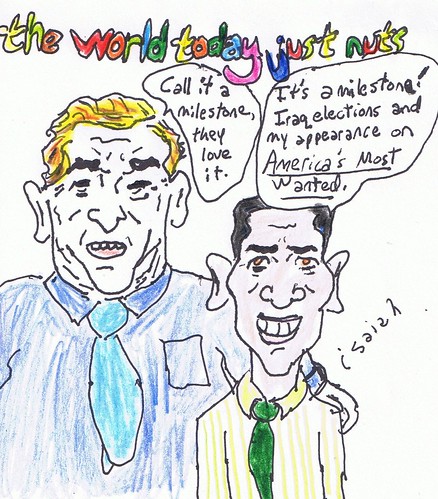
Last week I was writing about Eric Massa who is leaving Congress. And there's some same-sex sexual harassment claim. He said yesterday that it was a remark at a wedding when he had been admittedly drinking and that it was intended as a joke. If that's all it is, the matter's over for me. But he's going to be in the news for a bit longer. Raymond Hernandez (New York Times) reports of Eric Massa stepping down:
Mr. Massa, a freshman member of Congress, said he had had a turbulent relationship with Mr. Emanuel since his early days in Congress. He said they had an argument in the House gym over Mr. Massa’s refusal to support President Obama’s budget proposal.
“I am sitting there showering, naked as a jaybird, and here comes Rahm Emanuel, not even with a towel,” Mr. Massa said, adding that Mr. Emanuel poked “his finger in my chest, yelling at me at me because I wasn’t going to vote for the president’s budget.”
“You know how awkward it is to have a political argument with a naked man?” he continued.
“I am sitting there showering, naked as a jaybird, and here comes Rahm Emanuel, not even with a towel,” Mr. Massa said, adding that Mr. Emanuel poked “his finger in my chest, yelling at me at me because I wasn’t going to vote for the president’s budget.”
“You know how awkward it is to have a political argument with a naked man?” he continued.
OMG. Go. Watch. This. Episode. Of. Archer. While. It. Is. Still. Up. :D It's Rahm and Massa! Head and shaft!!!! It's the episode Ava and C.I. praised in this review. Their review is why I checked it out on Hulu and Archer is so funny.
The Third Estate Sunday Review's Jim, Dona, Ty, Jess, and Ava,
Rebecca of Sex and Politics and Screeds and Attitude,
Betty of Thomas Friedman Is a Great Man,
C.I. of The Common Ills and The Third Estate Sunday Review,
Cedric of Cedric's Big Mix,
Mike of Mikey Likes It!,
Elaine of Like Maria Said Paz),
Trina of Trina's Kitchen,
Ruth of Ruth's Report,
Wally of The Daily Jot,
Marcia of SICKOFITRDLZ,
Stan of Oh Boy It Never Ends,
Isaiah of The World Today Just Nuts,
and Ann of Ann's Mega Dub.
And we came up with?
Truest statement of the week -- This was Jason Ditz.
Truest statment of the Week ii -- and this was a guy at the Washington Times. "ii"? Ava and C.I. do a lot of the typing at Third and they typed nothing this weekend. :D
A note to our readers -- Jim breaks down the edition.
Editorial: March 20th -- This is basically . . . basic. This is what a lot of our editorials look like in their original draft and then we work and work and work. And we didn't have that kind of time this week. But it achieves its purpose which is to draw your attention the March 20th protests.
TV: Why? -- Ava and C.I. wrote this and address the new TV show Parenthood and they address Iraq.
Melissa Silverstein: Gender Reassignment Required -- Elaine, Betty, Dona, Ava and C.I. wrote this and it's hugely popular. This was planned as a group effort but we didn't have the time. In part because Ava and C.I. had to be done by 4:00 a.m. to get some sleep before they had to get ready for attending the Oscars.
Roundtable -- This was to round out the edition on Dona's recommendation because she thought we had a lot of long pieces and thought a transcript piece would go well with them.
Political mags -- One of the long pieces. Ava and C.I. and Elaine and Betty and Dona are working on this until the Katha Pollitt part ends, I think.
Comic themes -- Another of the long pieces and this was a lot of fun to write. Check out the comic book covers in this.
ETAN on Indonesia's special forces -- ETAN repost.
HerStory -- An FYI.
Highlights -- Rebecca, Betty, Kat, Ruth, Marcia, Stan, Cedric, Ann, Wally, Elaine and I wrote this.
And that's what we got.
Truest statement of the week -- This was Jason Ditz.
Truest statment of the Week ii -- and this was a guy at the Washington Times. "ii"? Ava and C.I. do a lot of the typing at Third and they typed nothing this weekend. :D
A note to our readers -- Jim breaks down the edition.
Editorial: March 20th -- This is basically . . . basic. This is what a lot of our editorials look like in their original draft and then we work and work and work. And we didn't have that kind of time this week. But it achieves its purpose which is to draw your attention the March 20th protests.
TV: Why? -- Ava and C.I. wrote this and address the new TV show Parenthood and they address Iraq.
Melissa Silverstein: Gender Reassignment Required -- Elaine, Betty, Dona, Ava and C.I. wrote this and it's hugely popular. This was planned as a group effort but we didn't have the time. In part because Ava and C.I. had to be done by 4:00 a.m. to get some sleep before they had to get ready for attending the Oscars.
Roundtable -- This was to round out the edition on Dona's recommendation because she thought we had a lot of long pieces and thought a transcript piece would go well with them.
Political mags -- One of the long pieces. Ava and C.I. and Elaine and Betty and Dona are working on this until the Katha Pollitt part ends, I think.
Comic themes -- Another of the long pieces and this was a lot of fun to write. Check out the comic book covers in this.
ETAN on Indonesia's special forces -- ETAN repost.
HerStory -- An FYI.
Highlights -- Rebecca, Betty, Kat, Ruth, Marcia, Stan, Cedric, Ann, Wally, Elaine and I wrote this.
And that's what we got.
Here's C.I.'s "Iraq snapshot:"
Monday, March 10, 2010. Chaos and violence continue, counting the votes continues, the US military continues to attempt to punish a soldier for the 'crime' of rapping, and more.
Iraq completed elections over the weekend. The latest episode of Inside Iraq (Al Jazeera) began airing Friday. Jasim al-Azawi interviewed Iyad Allawi.
Jasim al-Azawi: I am delighted now to welcome from Baghdad, Iraq's former prime minister and the leader of the National Iraq Movement, Iyad Allawi. Iyad Allawi, welcome to Inside Iraq.
Iyad Allawi: Thank you.
Jasim al-Azawi: Let me ask you about the description and the adjective that have been used for this election. "This is going to be decisive. This is going to be historical. This is going to change the destiny of Iraq." That is exactly what they said about the 2005 election. So why should we believe that this election is going to change the misery of Iraqis?
Iyad Allawi: We hope it will change the misery of Iraqis. This election is going to be a milestone. And the -- and the movement of Iraq forward in history. And I think the withdrawal of the American forces, the draw-down which is starting soon, the Constitutional issues that need to be discussed, which are quite hot now on disputed areas and territories and certain provinces in Iraq. The overall situation in the Middle East as a whole is not encouraging. Those are some indications why this election is going to be an important and significant election for this country.
Jasim al-Azawi: Yet cynics say, "The players are the same. The Constitution remains the same. The political game is the same." So why should we believe there is a possibility for a movement forward?
Iyad Allawi: The United States is -- as you know -- going to-to start the drawdown. It's going to be ready for the pulling out of Iraq. And indeed the Iraqis need to co-exist and they need to create a government which is worthy of Iraq and can implement the security and have the security prevail, can provide services to the people that have been denied the proper services for a -- for a human beings and to increase the revenues of the Iraqi family. And a very wealthy nation, we'll have millions of Iraqi refugees outside and millions are displaced and so we hope that these elections will bring government that can undertake these important steps taking Iraq forward.
Jasim al-Azawi: Let us talk about you, Iyad Allawi. For the past five years, you've been working very hard to build this powerful coalition that is challenging the current prime minister Nouri al-Maliki. You are secular. You believe in modern liberalism. You don't believe in sectarian politics. You managed to pull many people from different parts of life representing many different ideologies. What you have right now, is it enough to beat al-Maliki?
Iyad Allawi: Well it's not a matter of beating al-Maliki. There is nothing personal with al-Maliki or anybody else. We have clashes with programs. We think that the only way for Iraq to proceed forward is to get away from sectarianism. It's to build national reconciliation. It's to move in a modern way of management and to have Iraq for all Iraqis -- regardless of their ethnic, their religious, their sects, their background. And that's where we differ with some -- with some groups including the group on the slate of Mr. al-Maliki. And we hope that we can achieve our goals because we have been witnessing a withdrawal of people from sectarianism, more people are embarking on national reconciliation and they cannot tolerate anymore politicizing of religion in this country. Religion is sacred and is respected and we respect religion. It's part of our identity. But to politicize the sects and the religion is not acceptable. That's why we hope that we will defeat other groups who believe in sectarianism and do not believe in national reconciliation.
[. . .]
Jasim al-Azawi: In the last two minutes left to me, I'm going to ask you two questions. First, how fearful are you that the election will be riddled with fraud? You -- you are on record saying that if you come to the conclusion that fraud has reached a certain level, that you are going to boycott the entire political process.
Iyad Allawi: Well, you know, Jasim, we have seen fraudulent elections last time. Now the environment is not encouraging -- the political environment. There are already problems, by the way, in the elections which have started abroad. There is reduction of the polling stations which is not compatible with the number of Iraqis willing to vote. This has occurred in Syria, this has occurred in the UAE and it is unacceptable measure. However, we are willing to accept a little bit of fraud in the elections because people trying to hang to power will try to make whatever is necessary, whatever it takes. But if this becomes out of proportion, we will go back to the report of the Security Council which was produced two weeks ago.
Jasim al-Azawi: Yes.
Iyad Allawi: About calling for inclusive, fraud free elections in Iraq and we are going to decide in the Iraqiya what the position is going to be because we cannot have democracy raped in the way it is being. We cannot have the political process being diverted.
Jasim al-Azawi: Final ---
Iyad Allawi: And we will strive and do our best.
Jasim al-Azawi: Final question Iyad Allawi, the Iraqi vice president in an interview with al Hayat newspaper, he said, "If al-Maliki loses and he loses big, he just might engineer a miltary coup d'etat. Do you share his concern?
Iyad Allawi: All the indications are not comfortable -- are not making us feel comfortable. And I think my brother Tareq al-Hamashi does have some concerns -- which I share some of his concerns. But I will tell you this: that the Iraqi people are not going to allow anybody to-to take their world and to take their destiny and the Iraqi people are going to be proud of this. They have been proud of their history. And they are and they will ensure that nobody is going to steal them from their right and from their freedom. Whoever this person may be. Whether it's me or anybody else. Iraq is for Iraqis. No doubt about this. Maybe we are now passing through a difficult stage but I'm sure that the Iraqi people will victor again ["one day" or "at the end of the day"].
Omar Chatriwala (Voices From Iraq, Al Jazeera) offers video of Iraqis sharing their thoughts on the elections and we'll note the following (there are more speakers than we're noting -- we are noting every woman in the videos).
Iraqi Man: I have been here since five o'clock in the morning. I have not been able to find my name on the list. I've come back a few times but still can't find my name. Yes, my vote counts. Many voters have left without casting their vote. Why is my voice not heard?
Iraqi Woman: We look forward to seeing more freedoms and democracy in Iraq and we hope the right man is put in the right place I supported and voted for the Iraq bloc led by Iyad Allawi. He's a secular politician and is serving the country. Religious blocs are no longer popular in Iraq. Iyad Allawi is a popular politician who loves his country.
Iraqi Boy (under ten years old): I hope that the previous government will not come back. I look forward to a new one. I look for a change. I want stability and security. We wish to see things we did not see before. All the previous politicians did not deliver. The open list allows the voters to elect the candidates that they trust
Iraqi Woman (holding young child): I will not vote. The previous government did not deliver anything. What should I expect from the coming one. I do not think that we would benefit if we elect any candidate. We look for employment. I have been working for three years on temporary contracts and was promised a permanent job with the last election.
Iraqi Woman: We hope that Iraqi people will be able to live in comfort and security. Simply speaking, we the Iraqis in general have never felt safe or secure.
Young Iraqi Man: No, I will not vote in the coming elections. I've been living in a block of flats owned by the state. I've been unemployed with no job for years I have applied many times to join the National Guard. I cannot accept that Iraq is rich in oil but we work as servants to the Americans and others. Where is the Iraqi president? What is he offering? What has he delivered to us?
Martin Chulov (Guardian) also offered some Iraqi voices:
"We got up at 7am and were planning to vote. Next thing. I was digging my wife out of the rubble. She is eight months pregnant and both her legs are broken. My children are not badly wounded but look at their eyes. We don't have a future, we want to leave. We need to go somewhere else to secure anything like a future. I hope my family can stay in the hospital. This is the only place we have."
--Zuhair Hikmat, 40, at the Yarmuk hospital in central Baghdad
"I left my house to go to the election centre at 7am. I walked near a pile of rubbish and the bomb went off. I think this situation will deteriorate again. I am unemployed and they were going to pay me for one day's work. Now I have nothing." --Salim Turki Najim, 45, from the west Baghdad neighbourhood of al-Hurriya
Voting ended in Iraq yesterday. Early voting took place prior to Sunday. Sahar Issa (McClatchy Newspapers) reported on Sunday, "More than one hundred attacks upon civilians with small home made bombs and 13 roadside bombs exploded in Baghdad alone, Sunday that resulted in at least 38 civilians killed and around 90 others injured on Elections Day, March 7." Reuters added a Falljua mortar attack which left six people injured, a Mahmudiya mortar attack claimed 1 life and left eleven people injured, a Yusufiya mortar attack that injured one person, a Mosul roadside bombing which left two people injured, a Mosul grenade attack which left seven people injured, and a combination of Iraqi forces, US forces and Kurdish peshmerga shot a Mosul council member and two bodyguards with the shooting being termed "a misunderstanding." This is what US Preisdent Barack Obama calls "a milestone"? It gets worse. Anne Gearan (AP) reports US Secretary of Defense Robert Gates stated of Sunday, "All in all, a good day for the Iraqis and for all of us." Including the dead? Far more common sense was shown by the top US Commander in Iraq. AFP reports that he was shown a new cover of Newsweek featuring George W. Bush with the "MISSION ACCOMPLISHED" banner and he replied, "I don't think we'll know whether we were successful or not in Iraq until three to five or 10 years down the road." Meanwhile China Daily notes that "the American military presence so prominent in 2005 was limited on election day to helicopters buzzing over head as a massive deployment of Iraqi forces took the lead on the ground."
There are no results yet and the only 'poll' on voting is a poll commissioned by Nouri al-Maliki's government which really doesn't go to "independence." Andrew Lee Butters (Time magazine) explains, "With thousands of polling places using paper ballots, and a ban on vehicle travel and other security measures for election day itself, the exact figures on voter turnout, as well as the results themselves, won't be known for days." Here's another example, Elizabeth Palmer CBS News (link has text and video) explains it will be days before results are known and that there were 10,000 polling stations in Iraq. Ben Knight (Australia's ABC) adds, "Voting in Iraq's parliamentary election has finished and as the long process of counting the votes begins, Iraqis have celebrated their national elections. Counting of the votes is already underway and it is expected to be some days before official results are announced, but there is still danger that the militants who tried to derail yesterday's vote will attack again." Caroline Alexander and Daniel Williams (Bloomberg News)also note, "Vote-counting is under way in Iraq, where citizens defied bombs and mortar shells to get to the polls in yesterday's national parliamentary election. They probably will face months of haggling by fractious leaders over the formation of a coalition government." Not only are votes still to be counted, Karen Brown (CBS News -- link has text and video) reports that the UN "says ballots will be counted twice and any polling station with significant discrepancies will be audited immediately." Rather basic but Quil Lawrence and Steve Inskeep (NPR's Morning Edition) have made it necessary that we be very remedial on this topic. Marc Lynch (Foreign Policy) offers some advice NPR should consider heeding:
First, don't rush to speculate on who won or what it means. All the Iraqi lists are loudly claiming victory, but the truth is that no official (or even unofficial) results yet seem to exist. The anecdotal evidence still points to the pre-election speculation -- Maliki on top, Allawi a strong second, the ISCI/Sadrist Shi'a list fading -- but it's only anecdotal. It does make a difference who comes out on top, and who becomes Prime Minister - Maliki and Allawi, for instance, would have very different styles, as would Chalabi or some such. But at the same time, there's almost certainly going to be a coalition of some kind (fully inclusive or otherwise) and the differences probably won't be as stark as some people expect.
McClatchy live blogged the elections (also click here). RTT News reports that the percentage of non-police, non-defense, non-hospitalized and non-imprisoned Iraqis voting in Iraq "has been officially confirmed as 62.5." This would mean that, as Free Speech Radio News pointed out today, the percentage voting was "lower than the 76 percent that turned out in 2005."
Reuters drops back to yesterday to note 1 Iraqi woman killed and thirty-six people injured in Mosul and six injured in Kirkuk. These are Sunday deaths and injuries in addition to the ones reported yesterday.
In London today, the Iraq Inquiry continues with Bill Jeffrey (MOD Permanent Secretary from 2005 to 2009) and David Miliband testifying. As disclosed before, I know and like David. In April of 1999, then-prime minister Tony Blair gave what was considered to be one of the defining speeches of his career, one that would be billed as "The Blair Doctrine." The NewsHour (PBS) covered it and reproduced it in whole and, from it, we'll note:
We are all internationalists now, whether we like it or not We cannot refuse to participate in global markets if we want to prosper. We cannot ignore new political ideas in other counties if we want to innovate. We cannot turn our backs on conflicts and the violation of human rights within other countries if we want still to be secure.
On the eve of a new Millennium we are now in a new world. We need new rules for international co-operation and new ways of organising our international institutions.
After World War II, we developed a series of international institutions to cope with the strains of rebuilding a devastated world: Bretton Woods, the United Nations, NATO, the FU. Even then, it was clear that the world was becoming increasingly interdependent. The doctrine of isolationism had been a casualty of a world war, where the United States and others finally realised standing aside was not an option.
Today the impulse towards interdependence is immeasurably greater. We are witnessing the beginnings of a new doctrine of international community. By this I mean the explicit recognition that today more than ever before we are mutually dependent, that national interest is to a significant extent governed by international collaboration and that we need a clear and coherent debate as to the direction this doctrine takes us in each field of international endeavour. Just as within domestic politics, the notion of community - the belief that partnership and co-operation are essential to advance self-interest - is coming into its own; so it needs to find its own international echo. Global financial markets, the global environment, global security and disarmament issues: none of these can he solved without intense international co-operation.
In that speech, you can find the basis for many of David Miliband's statements today -- such as these following.
David Miliband: There is an argument about whether or not medium-seized countries should think of themselves as global palyers and I think it is an argument that is going to become more and more pressing in the months and years ahead, because of the temptations for politicians, never mind those concerned with the finances, to rein us in, and I think that ask a lot of those whom we put into harm's way, and I think that the way in which the Prime Minister [Gordon Brown's testimony last week] summed up the -- not just the gratitude but the respect and the sadness, the profound sadness that is felt by people in government, was absolutely right.
But, equally, we mustn't be a country that turns our back on the world, because, if we do, because of the hard decisions that are faced with, we will be much poorer in all senses of that term.
Nearly three-fourths of the way into his testimony, David Miliband declared:
I can honestly say to you, thirdly, that in the Arab world today, I don't believe that the Iraq decisions have undermined our relationships and our abilities to do business. Actually, some of our ambassadors say that we are in a strong position in various ways at the moment.
And we're going to pair that with another section which In The News reported on earlier today:Mr Miliband, who was a junior minister at the time of the invasion, said: "The authority of the UN, I think, would have been severely dented if the hypothetical case that you are putting - that we had marched to the top of the hill of pressure and then walked down again without disarming Saddam - then I think that would have been really quite damaging for any of the multilateral aims that we have that need to be pursued through the UN."The fact that the argument was made very clearly, notably in this country, that feeble follow-through undermines strong words, I think, is significant." That's nonsense and laughable. For the purposes of this discussion, people need to leave their opinions of George W. Bush and others at the door. (I loathe Bully Boy Bush.) David Miliband is making a case that can be tosses around in poli sci, especially in international relations courses. During the Cold War, the global system was thought to be bi-polar -- not a medical diagnosis. It was thought that the US and the USSR were the two centers of power, the poles, and that all others went to one or the other poll (or was neutral). The USSR collapsed and what some thought might emerge was a multi-polar system but what a number believe (especially many in the US) is that a uni-polar system developed with the US as the only power/pole.
If you follow that, let's bring Bully Boy Bush into the equation. He made the infamous "Axis of Evil" speech prior to the Iraq War and statements of 'you're either with or us against us,' and dozens and dozens of other bellicose remarks. As many in the US felt, he looked nuts. He looked crazy. He looked irrational.
An actor on the international stage who appears irrational (regardless of whether they are irrational or not) keeps the system of balance, keeps everyone guessing and can have a sort of power. He or she can frighten others. The fear factor can result in his/her country getting its way. Muammar al-Gaddafi (Libya) is someone often labeled as an "irrational actor" and he's worked that for years. To his benefit in some cases but, as past air strikes also demonstrate, to his (and his country's) misfortune. Because when they don't know what you will do and won't do, when you're that 'irrational,' often times "reason" isn't something they want to try with you.
The danger in Bully Boy Bush was not only the wars he started but that other countries might begin to worry that he truly was crazy (and maybe he was) and feel that they needed to 'address' the problem. Because he was the leader of the United States, that day didn't come. But this "He's mad! He's crazy!" fear can result in a level of respect. It's not necessarily earned respect and it's not necessarily something that helps bring about peace, but everyone wants to avoid angering Crazy.
So US diplomats might observe that some foreign powers -- due to Bush's insantiy -- interact easier these days. That may be the case. I don't know that it is, I don't know that it's not. But we're talking political theory here on the balance of powers and the actors involved.
That's Bush. That's not Blair. There is no way in the world (and I say that as someone who knows David) that Miliband meant what he said. He's too smart for that. Blair was not seen as the 'crazy.' He was seen as "The Poodle." That's not an empowering name. Nor did England's actions look impressive on the fear scale. What the world saw was that if George W. Bush took some form of action (starting an illegal war, in this case), The Poodle would "tag along."
The "tag along" is not a power position. Not only is it not a "power position," it is, in fact, a weak position. Bush is playing the Bully and Blair's playing The Poodle and you want to strike back at the West. Do you with go after Crazy, Insane? You might. But often you will feel safer going after the "tag along." You're striking them -- the perceived weaker of the two parties -- and, due to their being an ally with Crazy, you're getting to strike Crazy via proximity.
Point (and I'm oversimplifying the theory to get it across), England is actually in a worse position globally then it was before the start of the Iraq War if you buy the balance of powers arguments and that power is a zero sum game and all the other little beliefs that go with those war lord theories. Why? Because England stuck by the Big Bully but England didn't prove itself to be a Big Bully. If the theory is true (I'm not promoting the theory -- but David is promoting a version of the theory -- one that he knows is incorrect) then England is at greater risk today than it's ever been. (And that's even more true with Labour still in charge of the UK government. The US Bully is gone. Replaced with someone from the opposition party. That may -- or may not -- dilute some of the world hatred.) That would mean that the Iraq War -- if the theory holds -- has made the British more apt to be kidnapped and targeted outside their own country.
Kidnapped. A large number of British citizens have been kidnapped during the Iraq War. When the British government got involved, the kidnapped tended to turn into corpses. The governments of Italy, Spain, the US and others were often able to strike bargains of some form or another. Not so with England. (Don't confuse, for example, the work of the Telegraph of London to free one of their reporters with the work of the British government. That was the newspaper's work, not the government's.)
Committee Member Usha Prashar: My final question is about hostages, because a particular challenge has been the risk to UK nationals in Iraq being taken as hostages. Looking back, are there lessons to be learned as to how we deal with hostages.
David Miliband: Look, I'm very glad you mentioned that, because I notice at the end of all these sessions you say, "Is there anything else you'd like to say?" and I was going to raise this issue. So I do thank you for raising this. I think all of the witnesses have paid tribute to the work of our armed forces, and the devastation for the nearly 200 families who have lost a loved one here [No, David, you are incorrect, all the witnesses did not do that], never mind been injured, is profound, and all of us think about that, never mind the very significant number of Iraqis who have lost their lives, but there is also the case of the five hostages, which has weighed significantly on me in terms of time and effort, but not one hundredth or thousandth as much as it has weighed on the families. You know the situation, that one of the five hostages has returned, thankfully alive, but three have been killed, and there is the continuing agony in respect of Alan McMenemy, and that is something I think it is important that it is on the record in a case like this. I know that Foreign Office staff, but also staff from other government departments, never mind Iraqis, have really strained every sinew in trying to get a successful rescue or release of these five innocent people and it is the human cases in a way that bring out the -- some of the big discussions that one can have about this. We have a very, very clear policy, that we will not make substantive concessions to hostage-takers and I don't think that a -- any lesson of this affair should be that we should change that policy. I think that we have worked very, very hard in terms of our engagment with all those -- and Imphasise all those -- who might have a way of helping exert pressure or incentive for release, and tragically, in three, I think four, of the cases it has not been successful.
Let's stop him. (Prashar will in a moment, anyway.) Alec Maclachlan, Jason Crewswell, Alan McMenemy, Peter Moore and Jason Swindelhurst were kidnapped in Baghdad May 29, 2007. Only Peter Moore has been returned alive. The other three were returned in corpse state and what's happened to Alan McMenemy remains unknown. To get the release of Moore (and the corpses), the US had to let the leader of the League of the Righteous out of US prison in Iraq, release his brother as well. When this took place -- and David denied the deal publicly at the time -- the UK 'secured' the release of Moore. David wants to insist that they don't make concessions? Okay, I guess he meant that they just ask their allies to?
Prashar stops him to point out she hasn't heard one word from him on a lesson learned. He replied that it was never difficult to figure out who took a hostage, just where the hostage was kept. Prashar noted he claimed that his office kept in touch with the families of hostages, "but when we have talked to the families of hostages, they have complained to us about the lack of information in the context of the FCO. Have you any comments on that?" David Miliband wanted details and went on to say that if those family members "have ideas or complaints, then we want to know about them" (the quote continues, we're not interested) which may have been the most laughable moment. Will anyone notice that he rested on the (US) success and avoided mentioning anyone like Margaret Hassan who was kidnapped and murdered?
And I wonder what her family thought of his ignoring her. Margaret Hassan's kidnapping was a worldwide event. Her loss unimaginable to anyone but her family but the news of her kidnapping was shocking and the entire world watched.
In the US, Ms. magazine is increasing their online presence by starting a new blog:
Ms. Magazine Launches the New Ms. Blog
On this International Women's Day, March 8th, Ms. magazine - the flagship feminist publication - launches the Ms. Blog, showcasing the sharp writing and informed opinions of a community of feminist bloggers from around the nation and the globe.
The Ms. Blog will be a hub for exchange, collaboration and discussion, introducing fresh perspectives on national and global politics, culture, media, health, law and life.
The range, diversity and quality of bloggers is already exceptional: In the months leading up to this historic launch, Ms. was inundated with blogging offers from academics, activists and journalists. There are contributors from seven countries and counting, and the overall contributors' roster ranges from well-known names to up-and-coming writers and thinkers. We at Ms. are thrilled about the prospects of intercultural and intergenerational exchange.
Among the bloggers who have signed on to this exciting new project are novelist Diana Abu-Jaber, sexuality author Hanne Blank, L.A. journalist and scholar Lynell George, health activist/author Paula Kamen, masculinity critic/scholar Michael Kimmel, environmental journalist Sonia Shah, feminist writer Deborah Siegel, sociologist Shira Tarrant, media scholar Ebony Utley, memoirist Aimee Liu, Chicana activist and "mommyblogger" Veronica Arreola, Moroccan feminist scholar Fatima Sadiqi, gender and global development expert Lina Abirafeh (reporting from Haiti), Iraqi activist Yanar Mohammed, Muslim feminist Melody Moezzi, Chicana author Michele Serros and law professor Pamela Bridgewater.
Recognizing that no aspect of life is immune from gender politics, the Ms. Blog will address the intersectionality of gender with race, class, nationality and sexuality. And although there will be personal talk on the Ms. Blog, it will always be with the recognition that the personal is political.
Ms. executive editor Katherine Spillar is available for interviews about the new Ms. blog.
Contact: Jessica Stites
P. 310-556-2515 Email: jstites@msmagazine.com
We last noted Marc Hall in the March 3rd snapshot. He was being held in jail and due to be transported to Iraq for an Article 32 hearing and a court-martial. By holding the hearings in Iraq, the military will deprive Marc of many of the witnesses he needs to make his case. For those who don't know the story, Marc is facing punishment, possible imprisonment and worse for the 'crime' of rapping. Iraq Veterans Against the War has posted a letter from Marc:
IVAW is partnering with Courage to Resist to raise awareness and funds for Marc Hall.
Please donate now: https://co.clickandpledge.com/sp/d1/default.aspx?wid=30624
Letter from Army SPC Marc Hall, February 20, 1010:
I never thought that I would join the Army only to one day be incarcerated by the Army. I have never been to jail in my life, until now. The Army is charging me with Article 134 of the Uniform Code of Military Justice, "communicating threats" towards my chain of command. Yet I was only communicating how I felt about what I have experienced in the Army and how I felt about the Army's "Stop-loss" policy. That policy meant that I could not leave the Army when I was supposed to, and after I had already served in Iraq for 14 months.
I guess this all started with a hardcore "rap" song I made about the Army's very unpopular "Stop-loss" policy back in July 2009. Like any "rap" or rock song, I was expressing my freedom of expression under the US Constitution. Being that the Army's "Stop-loss" policy was a Pentagon decision from what I had heard on the news, I decided to send a copy of my song directly to the Pentagon.
I don't know if anyone at the Pentagon listened to my song, but somebody in Washington DC mailed the package back to my chain of command. My First Sergeant called me in to his office to discuss it. I explained that the rap was a freedom of expression thing. And that it was not a physical threat, nor any kind of threat whatsoever. I explained that it was just hip hop. He told me that he kind of liked the song, that it sounded good.
iraq
al jazeera
inside iraq
jasim al-azzawi
time magazineandrew lee buttersalsumaria tvcbs newselizabeth palmerabcben knightbloomberg newscaroline alexanderdaniel williamskaren brown
the guardian
martin chulov
ms.ms. magazine
iraq veterans against the war
Subscribe to:
Posts (Atom)