Tuesday, June 17, 2014

Where are troops going?

Monday, Monday.  Let's start with a cartoon, Isaiah's The World Today Just Nuts "He wins again!"


From laughter to outrage, AP reports, "The US is urgently deploying several hundred armed troops in and around Iraq and considering sending an additional contingent of special forces soldiers as Baghdad struggles to repel a rampant insurgency."

Thanks sack of s**t Barack.

Thanks for being such a liar and such a War Hawk and such a tool.

If we get the president we deserve, Obama's two terms say nothing kind about this country or its people.

Barack is a fake, a charade, a thin one at that.

He was a liar when he ran for office, he's still one now.

Maybe the Cult of St. Barack will finally see its membership drop to zero?


Okay, Third.  Here's the new content:


And Dallas and the following worked on the edition:


The Third Estate Sunday Review's Jim, Dona, Ty, Jess and Ava,
Rebecca of Sex and Politics and Screeds and Attitude,
Betty of Thomas Friedman Is a Great Man,
C.I. of The Common Ills and The Third Estate Sunday Review,
Kat of Kat's Korner (of The Common Ills),
Mike of Mikey Likes It!,
Elaine of Like Maria Said Paz),
Cedric of Cedric's Big Mix,
Ruth of Ruth's Report,
Wally of The Daily Jot,
Trina of Trina's Kitchen,
Marcia of SICKOFITRDLZ,
Stan of Oh Boy It Never Ends,
Isaiah of The World Today Just Nuts,
and Ann of Ann's Mega Dub.


Here's C.I.'s "Iraq snapshot:"

 
Monday, June 16, 2014.  Chaos and violence continue, another city in Iraq falls to rebels, whores come out to pretend like The Erbil Agreement never happened (they're trying to cover for Barack), John Kerry floats the US and Iranian governments working together, and much more.

It wasn't that long ago, Marc A. Thiessen (Washington Post) reminds, that the White House was hailing the 'success' of Iraq, "In 2011, the situation in Iraq was so good that the Obama administration was actually trying to take credit for it, with Vice President Joe Biden declaring that Iraq 'could be one of the great achievements of this administration'.”

Why stop with Joe Biden?  It was US President Barack Obama who spoke at Fort Bragg December 14, 2011 and declared, "Now, Iraq is not a perfect place.  It has many challenges ahead.  But we’re leaving behind a sovereign, stable and self-reliant Iraq, with a representative government that was elected by its people."

Or how about we go more current?

Remember this?
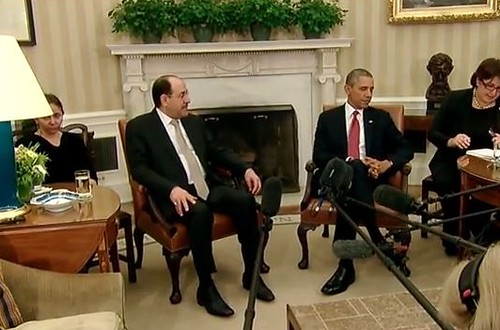
bnm.3JPG

Remember that?

Maybe this will jog memories.  After the meet-up above took place,  Former US Ambassador Marc Ginsberg pointed out at The Huffington Post:


By most accounts Iraq is heading toward an unchecked meltdown, and Maliki would like us to believe he deserves a red carpet welcome as the innocent plaintiff in the upheavals he created, not as the felonious defendant he should be adjudged.
And to top off his disastrous management of Iraq, he wants Washington to legitimate his charade by endorsing his bid for re-election in Iraq's crucial 2014 elections.


Ginsberg served in the Carter administration and the Clinton administration.  Grasp that when Barack had his last face-to-face with Nouri al-Maliki, November 1, 2013, seven months ago, Nouri's actions were well known.  Ahead of that meet-up, Human Rights Watch issued a press release which noted:

Iraq’s crackdown on peaceful government critics and an epidemic of executions should be top agenda items during the prime minister’s state visit to Washington, Human Rights Watch said today in a letter to President Barack Obama. Prime Minister Nuri al-Maliki is scheduled to meet with Obama on November 1, 2013.
Iraqi officials say that Maliki’s priority will be to accelerate US provision of arms, intelligence, and other counterterrorism support, including the immediate delivery of drones and F-16 fighter jets. But Obama should make clear that his administration will prohibit security aid, especially arms, equipment, and training for security forces, unless the Iraqi government ends its widespread use of torture.
“Iraq is plagued by terrorist attacks that are killing civilians in record numbers, but relying on torture and executions after unfair trials only makes the situation worse,” said Joe Stork, deputy Middle East director. “Obama needs to send a clear message to Maliki that the US will not support his assault on human rights.”

There was all of that and so much more going on.

And yet Barack met with Nouri and made nice.

Let's note some of what Barack said after the meeting:

And we appreciate Prime Minister Maliki’s commitment to honoring that sacrifice by ensuring a strong, prosperous, inclusive and democratic Iraq.
[. . .]
I emphasized the ambition of continuing counterterrorism support and partnership, that we were encouraged by the work that Prime Minister Maliki has done in the past to ensure that all people inside of Iraq -- Sunni, Shia and Kurd -- feel that they have a voice in their government.  And one of the most important expressions of that will be elections next year.  I encouraged that Iraq pass an election law and that that moves forward so that people understand that when they have differences they can express them politically, as opposed to through violence.


What a bunch of lies.  Nouri was attacking Sunni protesters, Iraqiya had walked out of the government, Nouri was at war with the Kurds and yet Barack lied.

A strong, prosperous, inclusive and democratic Iraq?

Yes, it's an obvious lie now.  It was an obvious lie then if you were paying attention.

Days before the meet-up, US Senators Carl Levin, John McCain, Robert Menendez, Lindsey Graham, Bob Corker and James M. Inhofe released an open letter to President Barack Obama which noted:


It is essential that you urge Prime Minister Maliki to adopt a strategy to address Iraq’s serious problems of governance. Such a strategy should unite Iraqis of every sect and ethnicity in a reformed constitutional order, based on the rule of law, which can give Iraqis a real stake in their nation’s progress, marginalize Al-Qaeda in Iraq and other violent extremists, and bring lasting peace to the country. To be effective, an Iraqi political strategy should involve sharing greater national power and revenue with Sunni Iraqis, reconciling with Sunni leaders, and ending de-Baathification and other policies of blanket retribution. It should include agreements with the Kurdistan Regional Government to share hydrocarbon revenues and resolve territorial disputes. And it requires a clear commitment that the elections scheduled for next year will happen freely, fairly, and inclusively in all parts of Iraq, and that the necessary preparations will be taken.
If Prime Minister Maliki were to take actions such as these, he could cement his legacy as the leader who safeguarded his country's sovereignty and laid the foundation for the new Iraq. In this endeavor, Prime Minister Maliki and our other Iraqi partners would have our support, including appropriate security assistance, and we would encourage you to provide U.S. diplomatic support at the highest levels to help Iraqis reach the necessary political agreements before the 2014 elections. However, if Prime Minister Maliki continues to marginalize the Kurds, alienate many Shia, and treat large numbers of Sunnis as terrorists, no amount of security assistance will be able to bring stability and security to Iraq. That is not a legacy we want for Prime Minister Maliki, and that is not an outcome that would serve America’s national interests.


Nouri met, that week, with members of the US Congress.  On The NewsHour (PBS -- link is video, audio and text), Margaret Warner reported that meet-up did not go well:


JUDY WOODRUFF: So, Maliki did spend time on the Hill?


MARGARET WARNER: Mm-hmm.


JUDY WOODRUFF: And how much progress did he make there? What happened?


MARGARET WARNER: It went very badly.

The key meetings yesterday were with Senator McCain and -- excuse me -- Wednesday -- and then with Corker and Menendez. And I'm told that that latter meeting was particularly contentious. They laid out all their concerns. He sort of sat impassively and, according to the aides present, he simply repeated platitudes about how he's governing by the constitution.
And, finally, Menendez got so -- I don't know if it's angry, but certainly peeved, that he looked at him and he said: Look, I feel you're just glossing over our concerns. And you need to know you're not getting any of this without our OK.
And Senator Corker came out afterwards and said: We felt he was completely dismissive of our concerns.


JUDY WOODRUFF: And it's known that one of the things they feel strongly about is he needs to share power.


Yeah, that was a known.

And he didn't.

And look where things stand today.

It's cute to watch partisan whores try to spin this.  'It's Bully Boy Bush's fault' a lot of stooges insist.

Fareed Zakaria (Washington Post) agrees Nouri's problematic but wants to distract and deceive:

But how did Maliki come to be prime minister of Iraq? He was the product of a series of momentous decisions made by the Bush administration. 


I'm not in the mood for damn liars.

Nouri got a first term (2006) because Bully Boy Bush insisted on it.

But he got a second term -- despite losing to Ayad Allawi in the March 2010 elections -- because of Barack.  What the Iraqi Constitution couldn't give Nouri, what the Iraqi people refused to give Nouri, Barack did.  He ordered US officials to negotiate a contract (The Erbil Agreement) to give Nouri a second term.  This contract -- signed by Nouri and the heads of all of Iraq's major political blocs -- found the leaders agreeing to a second term for Nouri in exchange for things they wanted (the Kurds wanted Nouri to implement Article 140 of the Constitution -- which resolves disputed Kirkuk, Iraqiya wanted an independent security council to be headed by Ayad Allawi, etc).

Fareed, stop lying, stop whoring.

If you think it was bad for the Iraqi MPs in 2006 to agree to giving Nouri a term as prime minister, it was even worse in 2010 when voters rejected Nouri and Barack spat on the most basic principle in a democracy (voting) to keep Nouri on for a second term.

November 10, 2010 a power sharing deal resulted in the Parliament meeting for the second time since the March 2010 vote and this was only possible due to The Erbil Agreement.  At that meeting,  Iraqiya felt double crossed on the deal and the bulk of their members stormed out of the Parliament. David Ignatius (Washington Post) explained, "The fragility of the coalition was dramatically obvious Thursday as members of the Iraqiya party, which represents Sunnis, walked out of Parliament, claiming that they were already being double-crossed by Maliki. Iraqi politics is always an exercise in brinkmanship, and the compromises unfortunately remain of the save-your-neck variety, rather than reflecting a deeper accord. "

How long does Fareed intend to lie and whore?

In November 2010,  Karen DeYoung (Washington Post) reported:

Vice President Biden made numerous calls to senior Iraqi leaders over the past several months and U.S. officials directly participated in top-level negotiating sessions that lasted until just moments before the Iraqi parliament finally convened to approve a new power-sharing government Thursday, a senior Obama administration official said Friday.
Hoping to rebut criticism that it had lost influence in Iraq and was too passive over the eight months since the March election there, or that its efforts were designed to keep Prime Minister Nouri al-Maliki in power, the administration offered a detailed written account of previously unreported meetings, visits and calls it said Biden and others had made.

The negotiated power-sharing deal DeYoung is writing about is The Erbil Agreement.  Back then, Michael Jansen (Gulf Today) observed, "The deal making that produced last Thursday’s session of parliament is nothing to boast about." She then goes on to note:

It is not clear why Iraqiya thought Maliki -- a sectarian Shiite whose Dawa party was a bitter enemy of the Baath -- would implement this pledge. Maliki has also failed to carry out solemn promises to recruit into the security forces or find civil service jobs for fighters of the Sunni Awakening Councils -- or Sons of Iraq movement -- who helped US and government forces curb Al Qaeda in 2007-08. Maliki has shown himself to have absolutely no intention of sharing power with Sunnis and certainly not with secular politicians like Allawi who represents the "old Iraq" where politics was non-sectarian.
In spite of Obama's declaration that an "inclusive" government formula had been found after months of wrangling, Maliki is not interested in including Sunnis, secularists, former Baathists and others who do not subscribe to the ethno-sectarian system imposed on Iraq by the previous Bush administration.

And Farred wants to whore and lie?

What Fareed hides, The Erbil Agreement, Barack made a statement about Novemeber 12, 2010:
 

Before I discuss the G20, I want to briefly comment on the agreement in Iraq that's taken place on the framework for a new government.  There's still challenges to overcome, but all indications are that the government will be representative, inclusive, and reflect the will of the Iraqi people who cast their ballots in the last election. This agreement marks another milestone in the history of modern Iraq.  Once again, Iraqis are showing their determination to unify Iraq and build its future and that those impulses are far stronger than those who want Iraq to descend into sectarian war and terror. For the last several months, the United States has worked closely with our Iraqi partners to promote a broad-based government -- one whose leaders share a commitment to serving all Iraqis as equal citizens.  Now, Iraq's leaders must finish the job of forming their government so that they can meet the challenges that a diverse coalition will inevitably face.  And going forward, we will support the Iraqi people as they strengthen their democracy, resolve political disputes, resettle those displaced by war, and build ties of commerce and cooperation with the United States, the region and the world.

And Barack did far more than make a statement that week.  Let's drop back to the November 11, 2010 snapshot to note what happened when The Erbil Agreement wasn't being implemented right away (in fact, it never would be) and Iraqiya walked out of Parliament in protest:


Martin Chulov (Guardian) reports one hiccup in the process today involved Ayad Allawi who US President Barack Obama phoned asking/pleading that he accept the deal because "his rejection of post would be a vote of no confidence". Ben Lando, Sam Dagher and Margaret Coker (Wall St. Journal) confirm the phone call via two sources and state Allawi will take the post -- newly created -- of chair of the National Council On Higher Policy: "Mr. Obama, in his phone call to Mr. Allawi on Thursday, promised to throw U.S. weight behind the process and guarantee that the council would retain meaningful and legal power, according to the two officials with knowledge of the phone call." 

But Fareed wants to whore and lie and pretend he can get away with it, that he can rewrite history and tell lies and no one will be the wiser.  Patrick Martin (WSWS) notes it was Bully Boy Bush and Barack both who installed and kept Nouri the prime minister of Iraq:

Who installed Maliki? His regime was the culmination of the supposed transformation of Iraq into a “democracy.” His election was hailed as a great success, first by George W. Bush, who launched the war, and then by Obama, who completed it on the schedule laid down by his predecessor.


In 2006, the Parliament wanted to give Ibrahim al-Jafaari a second term as prime minister.  The Bully Boy Bush White House did not trust al-Jafaari for a number of reasons and one of their fears was a second term for anyone so early in Iraq's new 'democracy' stage would risk setting up a new dictator.  They insisted on Nouri and got their way.

That was bad.

But in 2010, the voters made clear that they preferred Iraqiya over Nouri's State of Law.  That should have been the end of it.  But Barack ensured that Nouri got a second term he didn't earn.

Fareed damn well knows that the second term to Nouri was far worse for Iraq than the first term.

Fareed needs to stop lying and stop whoring.

And, hopefully, he will.  Too many others have nothing to offer but lying and whoring.  So we'll just ignore them for today.

The Erbil Agreement is not minor. Ann, in the comments, rightly notes in a comment on James Coogan's WSWS 'analysis' which ignores The Erbil Agreement, "I'm sorry but I don't take seriously any 'analysis' that doesn't point out the 2010 elections were decided by The Erbil Agreement, a legal contract the US pushed to give Nouri a second term."

David Ignatius (Washington Post via Real Clear Politics) points out:

Maliki's failure has been increasingly obvious since the elections of 2010, when the Iraqi people in their wisdom elected a broader, less-sectarian coalition. But the Obama administration, bizarrely working in tandem with Iran, brokered a deal that allowed Maliki to continue and has worked with him as an ally against al-Qaeda. Maliki's coalition triumphed in April's elections, but the balloting was boycotted by Sunnis.
Given Maliki's sectarian and authoritarian style, a growing number of Iraq experts are questioning why the Obama administration continues to provide him billions in military aid -- and is said to be weighing his plea for lethal Predator drones. The skeptics include some who were once among Maliki's champions.
 
Iraq's on fire today because Nouri didn't honor The Erbil Agreement and instead attacked Sunni politicians and protesters, because he refused to nominate people to head the Ministries of Defense, Interior and National Security in order to steal control of those ministries.  As the head of the Minister of the Interior, he was responsible for sending the MoI employees into schools to demonize Iraqi gays and lesbians, to encourage students to attack and kill those they suspected of being gay, to lie and state that they sucked blood as vampires did, that they deserved to be killed and much more.  Nouri, of course, denied such claims were made.  However, Alsumaria and Al Mada got ahold of handouts MoI employees passed out at their school presentations proving that they were making these smears in an attempt to incite violence against Iraq's gay and lesbian population (and those who might be perceived as such).  Gay men (and men thought to be gay) were killed with bricks, they were killed via torture, they were killed in so many ways and this took place on Nouri's orders.

So for those dirty, nasty whores -- Katrina vanden Heuvel, step up -- who cover for Nouri today?  You're homophobic trash and you threaten the safety of not just gays and lesbians but of minorities around the world.  You should be ashamed of yourselves and, honestly, shut your mouths and hang your heads in shame.  [If you're interested in some of the people who got it wrong and some of the people who got it right last week, see "The media rediscovers Iraq (Ava and C.I.)."]

Today, Iraq is in crisis.

Martin Chulov (Guardian) reports, "The northern Iraqi city of Tal Afar is in the hands of jihadists after a two-day battle with security forces – the third major centre to fall to the insurgents in less than a week.  The loss of the mixed Sunni and Shia town is another setback to the Iraqi government's attempts to establish control over the country's north and centre, which is now a centre of gravity for the Islamic State in Iraq and the Levant (Isis) and a potential launching pad for its plans to push south to Baghdad."  Patrick Cockburn (Independent via ICH) notes, "Early on Monday the mayor of the northern town of Tal Afar said it had become the latest landmark settlement to fall to Sunni militants.  Abdulal Abdoul told reporters his town of some 200,000 people, 260 miles (420 kilometres) northwest of Baghdad, was taken just before dawn."  Aryn Baker (Time) offers, "But ISIS's blitzkreig to Baghdad isn't based on military prowess alone.  Many of the Sunni tribes in the areas around Mosul and Tikrit, which ISIS captured a day after taking Mosul, backed the militants out of a deep-seated resentment for the Shi'ite-dominated government of Prime Minister Nouri Maliki.  In fact, many Iraqis say that ISIS played a relatively minor role, and that without Sunni support they wouldn't have been able to gain any traction at all."  Falah Alwan (ICH) offers this:

The media, especially that which is allied with the Iraqi government and western states, has been focusing on the Islamic State in Iraq and the Levant/Syria (ISIS) and its control over several Iraqi cities, provoking its audiences against the militant group. Indeed, ISIS terrorist groupings do exist among armed groups there and its influence in the recent events is clear. However, it is also true that Iraqis generally reject ISIS, whether in the central or southern regions of Iraq or in parts of the country that are no longer under government control: the so-called “Sunni” areas or the “Sunni Triangle”, a term that intelligence services, particularly the US Central Intelligence Agency (CIA), devised as part of a plan to engineer sectarianism in Iraq. At the same time, Iraqis generally reject Maliki’s regime and its policies, built as they are on an ethno-sectarian basis. This is especially the case in urban areas where sectarian discrimination is most concentrated, wherein the government treats ordinary people as political enemies.

The fall of several Iraqi cities in the hands of armed groups does not represent the dreams of the people who live there. Their demands to be rid of sectarianism are clear and direct. They expressed them through nonviolent sit-ins, but armed terrorist groups took advantage of this environment to take power. The people’s demands against discrimination and sectarianism are just and fair, whereas Maliki’s policies are reactionary and discriminatory, and are therefore rejected. In the meantime, ISIS’ control of cities and people poses a serious threat to everyday life and to society.


Patrick Cockburn (Independent via CounterPunch) frets, "One unverified statement from Isis militants on Twitter says that it has executed 1,700 prisoners. Pictures show killings at half a dozen places. Isis has posted pictures that appear to show prisoners being loaded on to flatbed trucks by masked gunmen and later forced to lie face down in a shallow ditch with their arms tied behind their backs."  Oh goodness.  The horror.  Like CNN, Cockburn's failed to report  when Nouri started killing civilians in Falluja.

Never forget that.

At the start of the year, Nouri began bombing residential areas of Falluja -- a legally defined War Crime -- killing and wounding civilians.

It has gone on for six months.

Where's the CNN anchor expressing outrage over those actions?  When does Cockburn intend to note the War Crimes?


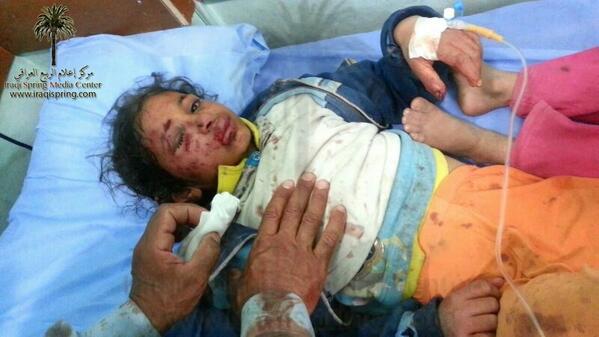
نموذج لأهداف جيش المالكي الارهابي في حربه على الشعب: .


That's one of the many children who've been wounded from the War Crimes of thug Nouri al-Maliki.

And CNN (on American airwaves) and Patrick Cockburn in his many 'reports' have never bothered to express horror over the many dead and wounded.


But they're both bothered -- CNN and Cockburn -- that the rebels aren't practicing some Catch & Release program but are instead killing Iraqi soldiers.

A) This is a war.

B) For months now, Nouri's forces have been killing suspects.  Not arresting people and putting them on trial but killing them.  And often, as you can see all over YouTube and have been able to see for months, they're not shooting them dead.  They're not beheading them either.  They are burning suspects to death.  Setting them on fire and burning them to death.

We've covered that here but Patrick Cockburn and CNN Television haven't been interested in the topic.

Now I'm sorry that anyone anywhere is killed (unless they're a War Criminal) but I'm not going to play stupid like Cockburn and CNN.  These same Iraqi forces are guilty of murder and rape.  There was a huge issue about rapes in the provinces and governors insisting on the right to prosecute Iraqi soldiers who raped in their provinces.  Nouri wouldn't even turn over a rapist from his forces.  These same Iraqi forces are guilty of killing innocent people.

I'm not going to play stupid and act like recent history didn't take place.

The Pacifica Evening News is an hourly newscast (Monday through Friday) produced by Pacifica Radio's KPFA, KCFC and KPFK.  This evening, Maryam Labib explored recent history with a number of people including McClatchy Newspapers' Mohammed Al Dulaimy and Reuters' Ned Parker.

Maryam Labib: Mohammed Al Dulaimy, an Iraqi journalist who reported for  Iraq for years and is now seeking US asylum, and now he fears for his safety when he returns says that the Shi'ite Iraqi government, put in place by the US, has fueled the Sunni extremist groups.

Mohammed Al Dulaimy: Mister Maliki has failed to build an Iraqi military that will respect human rights.  Fanatics, Islamists, feed on such human rights breaches.  It helps them to further their cause and to win more recruits.  This is what is happening in Iraq.  And you can see the videos of how the Iraqi army dealt with demonstrators in Hawija, how they killed men carrying sticks -- only iron sticks -- or sometimes nothing.  All of us should speaking loudly to stop pushing ordinary people towards fanatics -- to join their lines just to defend themselves against an army that is willing to kill them all. 

Maryam Labib: Al Dulaimy also says that Maliki refused to disarm Iranian-backed Shi'ite militias like Asaib Ahl al-Haq [League of Righteous].  Ned Parker, the Reuters bureau chief in Baghdad, says factions of sectearian militais  are playing a significant role in pushing Iraq towards extremism.

Ned Parker: Asa'ib Ahl al-Haq which is a breakaway faction from the Sadr movement that is supported by Iran, that has been active, that has been fighting outside of Baghdad for months now since the fighting started in January.  So we have seen militia style fighting and killings and fighting.  Asa'ib Ahl al-Haq and another group called Kata'ib Hezbollah, they have had their fighters alongside Iraqi forces they actually follow under an Iraqi government  chain  command now.  It shows the power of sectarian passions right now and the danger that the more you see Sunni extremism, it breeds Shi'ite extremism and it cancels out the space for moderation and it impels Iraq towards the  danger of a new sectarian conflict. 


In other news, Barack moves towards aiding Nouri.  Zack Beauchamp (Vox!) declares, "It's official: President Barack Obama is sending American troops back to Iraq." What's he talking about?  Well not just the fact that the USS George H.W. Bush now floats just off the coast of Iraq and more US personnel are arriving in Iraq.  Not the fact that Mohammed Tawfeeq, Yousif Basil, Ashley Fantz and Mark Morgenstein (CNN) report, "Between 50 and 100 U.S. Marines and U.S. Army personnel have arrived at the U.S. Embassy in Baghdad, a U.S. official told CNN on Sunday.  A U.S official acknowledged to CNN that the additional embassy security personnel being added include U.S. Marines who specialize in embassy protection during high-threat conditions."  Mitchell Prothero (McClatchy Newspapers) calls the move "a tacit acknowledgment that the situation in the Iraqi capital had become unpredictable and that violence seemed likely."

But what  Beauchamp is talking about the announcement the White House made today:

Statement by the Press Secretary on the War Powers Resolution Report for Iraq


Today, consistent with the War Powers Resolution, the President transmitted a report notifying the Congress that up to approximately 275 U.S. military personnel are deploying to Iraq to provide support and security for U.S. personnel and the U.S. Embassy in Baghdad.  The personnel will provide assistance to the Department of State in connection with the temporary relocation of some staff from the U.S. Embassy in Baghdad to the U.S. Consulates General in Basra and Erbil and to the Iraq Support Unit in Amman.  These U.S. military personnel are entering Iraq with the consent of the Government of Iraq.  The U.S. Embassy in Baghdad remains open, and a substantial majority of the U.S. Embassy presence in Iraq will remain in place and the embassy will be fully equipped to carry out its national security mission. 


Yes, last week Barack insisted no boots on the ground.  That was last week.

Jennifer Collins, Gilgamesh Nabeel, Ammar Al Shamary and Oren Dorell (USA Today) report,  "President Obama notified Congress on Monday that about 275 U.S. military personnel are deploying to Iraq to provide support and security for U.S. personnel and the U.S. Embassy in Baghdad. Obama also said the troops are equipped for combat and will remain in Iraq until the security situation becomes such that they are no longer needed."   Zaid al-Sanjary and Arshad Mohammed (Reuters) add, "Obama, who was being presented with recommendations from his top national security advisers on Monday evening, has made U.S. action contingent on Iraqi Prime Minister Nuri al-Maliki's taking steps to broaden his Shi'ite-dominated government."

When does Nouri have to take those steps?

Apparently after Barack provides Nouri with US military cover.  And this despite objections from members of Congress and many others.  Mohamed Salman (McClatchy Newspapers) reports:


A former Qatari ambassador to the United States offered up a warning to the Obama administration Monday that any military intervention on behalf of the government of Iraqi Prime Minister Nouri al Maliki would be seen as an act of “war” on the entire community of Sunni Arabs.
Sheikh Nasser bin Hamad al Khalifa also warned against the United States working with Iran to repulse the advance by the radical Sunni group the Islamic State of Iraq and Syria, something that Secretary of State John Kerry said Monday the United States would be willing to consider.

Read more here: http://www.mcclatchydc.com/2014/06/16/230512/qatari-us-intervention-in-iraq.html#storylink=cpy


Matthew Lee (AP) notes US Secretary of State John Kerry has been tasked with floating the trial balloon on talks between the governments of the US and Iran.

The trial balloon needs to be floated because (a) the US government has repeatedly portrayed the Iranian government as terrorists, devils and a world wide threat, (b) Barack's tanking in the polls, (c) the lack of trial balloon on the recent Taliban swap caught the American people off guard and is part of the reason for the anger and/or shock over the surrendering of five Talbian and (d) it's important that it come from Kerry and not Barack who's already a lame duck president and who, with any further erosion of public support, will be weaker than any recent US president in his final two years of his last term.

There are those in the US who will rejoice because of their desire for improved relations between the two governments.  They might want to temper that long enough to ask themselves if the answer for Iraq is to have Iranian troops on the ground?

The Iraq - Iran war may be nothing to many Americans -- some of whom will not even be aware it took place.  But it's still known in Iraq and why any ruler of Iraq has to a dance between showing warmth towards the Iranian government -- a neighbor which shares a border -- while also demonstrating public independence from that government.  That show of independence?  It's why Nouri's National Security Advisor Falih al-Fayadh held a press conference -- held a press conference -- yesterday to insist that the government was denying entry to any and all Iranian forces and insisted that reports otherwise were "groundless."

So what is Kerry floating?


He sat down this morning with Katie Couric (Yahoo News with Katie Couric) and she raised the issue of Iran.


Katie Couric:  Will you reach out to Iran and how can that country be helpful?  Or is that like entering into a hornet's nest because --

Secretary John Kerry: Well we're open to -- Look, we're open to discussions if there's something constructive that can be contributed by Iran, if Iran is prepared to do something that is going to respect the integrity and sovereignty of Iraq and the ability of the government to reform, uh,  --

Katie Couric:  Can you see cooperating with Iran militarily?

Secretary John Kerry:  I, uh, at this moment, I think we need to step-by-step and see what, in fact, might be a reality.  But I wouldn't rule out anything that would be constructive to providing real stability, a respect for the Constitution, a respect for the election process and a respect for the ability of the Iraqi people to form a government that represents all of the interests of Iraq -- not one sectarian group over another.  It has to be inclusive.  And that has been one of the great problems of the last few years.

Katie Couric: If Iran recognizes that, would you be willing to work with that country?

Secretary John Kerry:  Let's see what Iran might or might not be willing to do before we start making any pronouncements.  I think we are open to any constructive process here that could minimize the violence, hold Iraq together -- the integrity of the country, and eliminate the presence of outside terrorist forces that are ripping it apart.


On violence, 2610 is the number of Iraqis who've been killed in violence so far this month (through yesterday) according to Iraq Body Count.

That makes it the deadliest month in Iraq since July 2007 when IBC counted 2690 deaths.  But 2690 is the number killed in the full month of July 2007 -- right now, we're only at the half-way point of June.


martin chulov
david ignatius


Saturday, June 14, 2014

Idiot of the week

The choice for Idiot of the week this week is rather obvious.

Barack Obama.

And just for Iraq.

Iraq's in flames and it's his fault.

He's the one who demanded Nouri al-Maliki get a second term as prime minister.  The voters didn't want him.  Other political blocs didn't want him.

So Barack had the US officials in Iraq negotiate a contract called The Erbil Agreement that gave Nouri a second term in exchange for Nouri promising (in writing) various concessions.

Nouri never honored the contract that got him a second term.

And the White House acted like they'd never heard of The Erbil Agreement.

That's what's destroyed Iraq -- Nouri's second term, the refusal to honor the contract, etc.

Barack is responsible for Iraq's current crisis.

Shamus Cooke is an idiot.

For example, the U.S. has never trusted the Iraqi government. Ever since the Iraqi elections brought a Shia-dominated government to power, the Bush and Obama administrations have looked at Iraq as an untrustworthy pawn of Iran


What an idiot.

Bully Boy Bush installed Nouri in 2006, Barack demanded he get a second term in 2010 (when the true winner should have been Ayad Allawi).

But Cooke is only a runner up because Barack's destroying his own legacy with his gross incompetence and top of that list has been his backing Nouri over and over.


Here's C.I.'s "Iraq snapshot:"

 
Friday, June 13, 2014.  Chaos and violence continue, Barack talks Iraq, Nouri kills social media in Iraq, Nouri arrests students in Baghdad, Angelina Jolie talks refugees, more people realize Nouri is the problem in Iraq, and much more.


Iraq continues to unravel.  Erin Cunningham Tweets about an important piece this week on Iraq:


"Iraq now seems to be inexorably if unintentionally breaking apart," by WaPo's &


On the White House;s South Lawn this afternoon, en route to boarding a helicopter, US President Barack Obama stopped to make a few comments on Iraq:


Yesterday, I convened a meeting with my National Security Council to discuss the situation there, and this morning I received an update from my team.  Over the last several days, we’ve seen significant gains made by ISIL, a terrorist organization that operates in both Iraq and in Syria.  In the face of a terrorist offensive, Iraqi security forces have proven unable to defend a number of cities, which has allowed the terrorists to overrun a part of Iraq’s territory.  And this poses a danger to Iraq and its people.  And given the nature of these terrorists, it could pose a threat eventually to American interests as well.

Now, this threat is not brand new.  Over the last year, we’ve been steadily ramping up our security assistance to the Iraqi government with increased training, equipping and intelligence.  Now, Iraq needs additional support to break the momentum of extremist groups and bolster the capabilities of Iraqi security forces.  We will not be sending U.S. troops back into combat in Iraq, but I have asked my national security team to prepare a range of other options that could help support Iraqi security forces, and I’ll be reviewing those options in the days ahead.
I do want to be clear though, this is not solely or even primarily a military challenge.  Over the past decade, American troops have made extraordinary sacrifices to give Iraqis an opportunity to claim their own future.  Unfortunately, Iraq’s leaders have been unable to overcome too often the mistrust and sectarian differences that have long been simmering there, and that’s created vulnerabilities within the Iraqi government as well as their security forces.
So any action that we may take to provide assistance to Iraqi security forces has to be joined by a serious and sincere effort by Iraq’s leaders to set aside sectarian differences, to promote stability, and account for the legitimate interests of all of Iraq’s communities, and to continue to build the capacity of an effective security force.  We can’t do it for them.  And in the absence of this type of political effort, short-term military action, including any assistance we might provide, won’t succeed. 
So this should be a wake-up call.  Iraq’s leaders have to demonstrate a willingness to make hard decisions and compromises on behalf of the Iraqi people in order to bring the country together.  In that effort, they will have the support of the United States and our friends and our allies. 
Now, Iraq’s neighbors also have some responsibilities to support this process.  Nobody has an interest in seeing terrorists gain a foothold inside of Iraq, and nobody is going to benefit from seeing Iraq descend into chaos.  So the United States will do our part, but understand that ultimately it’s up to the Iraqis, as a sovereign nation, to solve their problems.
Indeed, across the region we have redoubled our efforts to help build more capable counterterrorism forces so that groups like ISIL can’t establish a safe haven.  And we’ll continue that effort through our support of the moderate opposition in Syria, our support for Iraq and its security forces, and our partnership with other countries across the region. 
We’re also going to pursue intensive diplomacy throughout this period both inside of Iraq and across the region, because there’s never going to be stability in Iraq or the broader region unless there are political outcomes that allow people to resolve their differences peacefully without resorting to war or relying on the United States military. 

We’ll be monitoring the situation in Iraq very carefully over the next several days.  Our top priority will remain being vigilant against any threats to our personnel serving overseas.  We will consult closely with Congress as we make determinations about appropriate action, and we’ll continue to keep the American people fully informed as we make decisions about the way forward. 


He took a few questions and we'll note this response: "And obviously, our troops and the American people and the American taxpayers made huge investments and sacrifices in order to give Iraqis the opportunity to chart a better course, a better destiny.  But ultimately, they're going to have to seize it.  As I said before, we are not going to be able to do it for them.  And given the very difficult history that we’ve seen in Iraq, I think that any objective observer would recognize that in the absence of accommodation among the various factions inside of Iraq, various military actions by the United States, by any outside nation, are not going to solve those problems over the long term and not going to deliver the kind of stability that we need."


AFP's WG Dunlop offered this observation on Barack's comments.


Immediately after Barack's remarks were aired live, Andrea Mitchell Reports (MSNBC -- link is video) went to a pre-recorded interview with Senator John McCain.

Senator John McCain:  Well our Director of National Intelligence, General [James] Clapper, has already said what is happening in this area of Syria - Iraq has now been dramatically expanded and also has enriched does post a threat for attacks to be planned on the United States of America.  That is the opinion of our Director of National Intelligence.  And I share it.

Andrea Mitchell:  What should the president do?  He says he's only ruled out ground troops.  So he is considering military options.  We're expecting decisions. What would you advise him to do?

Senator John McCain: Andrea, I think that -- I think the national security team should be replaced. But that's not going to happen.  So then, he should bring in other individuals such as General [Jack] Keane, the architect of the surge which succeeded and we had it won, people like the Kagans at  the Institute for the Study of War  [Kimberly Kagan and Fred Kagan], other -- and Ambassador Ryan Crocker.  I think I would put [former top US commander in Iraq] David Petraeus on a plane to Baghdad right now and try to sort all this out.  And, also, Maliki has got to be more inclusive.  He's got to completely change, the way he's treated the Sunni and it may be too late, I don't know.  Maybe it needs to be somebody else?   But now we need to move forward. We've got to plan not only on the military side of it but on the political side of it as well because it's clear that the Sunnis have been alienated completely by Maliki and the way he's handled his leadership in Iraq. 


A few things on the above.

James Clapper?  Could Clapper be right?

Clapper lied to Congress.  The matter should have immediately been turned over to the Justice Dept and Barack should have asked for a resignation.

That didn't happen.

So Clapper has no standing now.  McCain can cite him all he wants but Clapper is a known liar who went before the Congress and lied.  When an official does that, they need to resign.

Clapper could be 100% right that this group of people -- whatever you term them -- are or will plan attacks on the US.  But he's a liar who's disgraced his name and few are going to rush to believe him.

McCain may have seen information -- I'm sure he has -- independently that makes him believe Clapper's assertion.

I don't believe the assertion.  There's no support being presented to the public for it.

There's also no common sense argument for it.

This group allegedly wants to take over not just Iraq but Syria as well.  They're also going to expand to attacks on the US?

No.

Should they take over Iraq, if they also want to take over Syria, that would be their goal.

And if they achieved that?  They'd go for the region.

I don't see where they -- as Clapper believes -- would be making one advance after another in the region and suddenly decide to focus on the US.

It doesn't make sense.

Doing so would slow their attempted march to take over the region.

Doing so would also unleash a response (and hatred and anger) aimed at them from the US and it would mean a full out war.

So I don't see how they'd want to court that anger and the combat response that would follow.

They might.

But thus far, we have allegations only and we have common sense.  And common sense does not back up the allegations.

That McCain would suggest a group that includes the neocon Kagan family (which also includes Barack advisor Robert Kagan and his wife Victoria Nuland who's with the State Dept) isn't surprising (he is right-wing).  But due to other comments by McCain in the past, we should note that he made clear he was not calling for US troops back into Iraq. ("I do not envision a scenario where ground troops are on the ground [. . .] I would not commit to putting American boots on the ground in order to achieve that in deference to that weariness that you so accurately describe.")


The Lead with Jake Tapper (CNN -- link is text and video) notes today:


Hillary Clinton told the BBC Thursday that she is against air strikes in Iraq.
"I agree with the White House's rejection and reluctance to do the kind of military activities that the Maliki government is requesting, namely fighter aircraft to provide close support for the Army and also to go after targets. That is not a role for the United States," Clinton said.


All the hawks are avoiding calling for troops in Iraq because the American people have spoken.  And the Republicans saw that marching into an illegal war harmed their party while Democrats posing as against the war managed to put them back in power.  The peace movement can take a well deserved bow right now for their part in opposing the illegal war and for their part in helping influence popular opinion by speaking out.


We'll note this exchange from Andrea's interview with McCain:


Andrea Mitchell:  So far we have spent years trying to get Maliki to be more  democratic, not be oppressive and exclusionary to the Sunnis.  We've basically driven these Sunnis into the arms of the radicals.  So what make us think that with American help, American airstrikes, more military equipment from the US that he'll change at all.

Senator John McCain:  Well he has to or he has to be changed.  One of the two.  It is an unacceptable situation

I agree with McCain on that.  (I agree with another point he made so much that I'm carrying it over to Third and will nominate it for a 'truest statement of the week.')  Nouri is the problem.  Nouri has attacked Sunnis.  He's run off the vice president, he's attacked a Sunni member's home at dawn leading to the death of many including the Sunni politician's brother.  He's attacked Sunni protesters.  He's attacked the Sunni population at large.

Nouri has bred the violence in Iraq.  Brookings Institute Ken Pollack appeared this afternoon on MSNBC's The Cycle.  Excerpt.


Abby Huntsman:  You even warned the Obama administration years ago that this was coming.  Did they not listen or did they not take you seriously?

Kenneth Pollack: The administration had a different narrative about Iraq, they had a different view about what was going to happen there. And myself and numerous other people were basing our warnings on not just Iraq itself but lots of other civil wars like this over the course of history and what we've seen happen there.  And I think if you look at what was happening there, it was pretty obvious that this was the course that things wanted to go to but the administration wanted to think about Iraq in a as the narrative that they stuck to.  But I think you're right, Abby, that we've got to concentrate on moving forward, on dealing with the situation that we have.  You know, we'll leave it to the historians to sort out, you know, who shot John and under what circumstances. 

Luke Russert: Ken, Luke Russert here in Washington, and one thing I found fascinating from talking to my sources on the Hill, is the degree to which this is Sunni versus Shia and how Sunnis are so just fed up with al-Maliki.  You're not actually seeing remnants of Sadam's old army joining forces with the ISIS.  How much of a problem is that for the US moving forward because this is a very organized, militant group that had military training and knows the country inside and out.

Ken Pollack:  Luke, you put your finger on the critical thing that's going on here, alright.  We can't think of this as just being ISIS -- a group of Iraqis and Syrians out of Syria who've invaded Iraq and it has nothing to do with Iraqi politics.  It's all Iraqi politics. First, as I said, ISIS has a very heavy Iraqi component and, as you said, they are now joining  up with all of these Sunni militias inside of Iraq and that is the force that together is advancing on Baghdad.  And what it speaks to is the complete alienation of Iraq's Sunni community as a result of Maliki's treatment of them over the last two, three, four years.  And it's why  if we're going to deal with the problem, if we're actually solve the situation, pull Iraq out of this civil war, it can't be about military operations, it can't be just about bombing stuff because the fundamental problem is political and we're going to have to deal with that and that's even harder than the military one.  [. . .]  The bottom line here is somebody has got to convince Maliki to change his ways.  He's got to change his way of doing things or else has got to  help the Iraqis bring about a new political leadership that will bring the Sunnis back in [to the government, to the process],  that will deal with the problems in the Iraqi military, that will curb the powers of the prime minister so that all Iraqi ethnic groups aren't frightened of another prime minister like Maliki.  And at the end of the day, I think the military component -- the most useful piece of it is, the Iraqis, in particular, the Shia, are desperate for it so that becomes the leverage we have And I think that the President actually put it the right way.  That, if they want our military support, the price for it is that they're going to have to reform their politics.  Because if they don't reform their politics, there's no point in giving them that military system because the problems are not going to abate. 


Ned Parker has broken many important stories from Iraq -- most notably his work exposing the secret prisons.  He appeared Thursday on Democracy Now! (link is audio, video and text):

NED PARKER: Right. I think one of the great tragedies about the United States’ relationship with Iraq, both inside Iraq and here, is that the matter is so politicized that it’s hard to have a real conversation about what needs to happen now in Iraq so that it can be stabilized. The American involvement happened. And what I wrote two years ago, for instance, was talking about, in the time of the Obama administration, the neglect, if you will, of trying to build upon the chances for success after so much bloodshed and, you know, horror during the Bush years. And there was a chance for stability in Iraq in 2010. The decision to withdraw troops on the ground from Iraq, it’s debatable whether that was a right decision or a wrong decision, but I think the core issue is matters of soft power, that don’t necessarily have anything to do with U.S. military troops. That’s—so it’s about building consensus, trying to help strengthen the foundations of democracy.
Really, the Obama administration looked for many, you know, understandable, pragmatic reasons to want to end the troop presence, because of the cost of money, the cost to soldiers’ lives, but in doing that, in disengaging—and the U.S. military, you know, praised Obama for having a responsible withdrawal timeline; they said he did the right thing there. But what he didn’t do was try to fortify a workable coalition that could govern Iraq over these past four years or to preserve the—you know, these issues that Mohammed al Dulaimy was talking about, human rights abuses. Iraq actually had a decent human rights ministry, not perfect but one that exposed secret prisons by—that were run by Prime Minister Maliki’s military. And in the government formation process in 2011, that ministry was gutted and turned into a wing basically of Prime Minister Maliki’s party. And people who had been encouraged, Iraqis, to expose these abuses by the Americans had to flee the country.

So, I think when we talk about Iraq and the failures of the Obama administration in Iraq—and I think that Iraq for America is a bipartisan failure, and it’s not about troops staying or going. It’s about these core issues that are democratic values. The Obama administration looked at how does Iraq—how does the United States get out, and how does Iraq stay stable? And what they chose was Prime Minister Maliki as their guy. And at the time they made that decision, it wasn’t necessarily a wrong choice, but they focused on personalities, and not values and building the foundations of a government that could work. And that’s a large reason of why we are where we are today, both the United States and Iraq, in terms of the implosion we are seeing.


Are you beginning to grasp the problem?  At CNN, Derek Harvey and Michael Pregent ask, "Who's to blame for Iraq crisis"? Their answer includes:


For more than five years, Prime Minister Nuri al-Maliki and his ministers have presided over the packing of the Iraqi military and police with Shiite loyalists -- in both the general officer ranks and the rank and file -- while sidelining many effective commanders who led Iraqi troops in the battlefield gains of 2007-2010, a period during which al Qaeda in Iraq (the forerunner of the Islamic State of Iraq and Syria) was brought to the brink of extinction.
Al-Maliki's "Shiafication" of the Iraqi security forces has been less about the security of Iraq than the security of Baghdad and his regime. Even before the end of the U.S.-led "surge" in 2008, al-Maliki began a concerted effort to replace effective Sunni and Kurdish commanders and intelligence officers in the key mixed-sect areas of Baghdad, Diyala and Salaheddin provinces to ensure that Iraqi units focused on fighting Sunni insurgents while leaving loyal Shiite militias alone -- and to alleviate al-Maliki's irrational fears of a military coup against his government.
In 2008, al-Maliki began replacing effective Kurdish commanders and soldiers in Mosul and Tal Afar with Shiite loyalists from Baghdad and the Prime Minister's Dawa Party, and even Shiite militia members from the south. A number of nonloyalist commanders were forced to resign in the face of trumped up charges or reassigned to desk jobs and replaced with al-Maliki loyalists. The moves were made to marginalize Sunnis and Kurds in the north and entrench al-Maliki's regime and the Dawa Party ahead of provincial and national elections in 2009, 2010 and 2013.


Rebecca Kaplan (CBS News -- link is text and video) covers several hypotheses as to how Iraq ended up in its current crisis and Jake Tapper (CNN's The Lead with Jake Tapper) explores the current crisis with administration officials.

Iraq is finally getting serious attention from the MSM and I'm trying to be nice.  I was nice to Kenneth Pollack in yesterday's snapshot because I genuinely believed, from his writing, that he was sincere in his suggestions.  But that was with him.  With the media, I've tried to be nice.

I've tried to be so nice that I've ignored so much this week.  For example, if you're doing a discussion on Iraq and bringing up Nouri al-Maliki, I'm sorry but you're an idiot if you're calling him "president" of Iraq.  Especially if you do repeatedly.  I was kind.  I just ignored you.  I was kind to the TV network that couldn't find their own ass.  But I'm not a nice person and don't pretend to be.  And even in the "thank goodness they're noting Iraq," I can only take so much.

RT reports or 'reports:"

Even before the latest outbreak of violence and chaos in Iraq, the United States was flying secret drone missions in the country in an attempt to gather intelligence on the movements of Al-Qaeda-linked militants.

According to the Wall Street Journal, the clandestine surveillance missions have been going on since last year with the consent of the Iraqi government. Senior White House officials said the program was expanded as concerns over the possibility of a rebellion grew, but they acknowledged the activity provided little useful information for both the US and Iraq. 

I ignored the Wall St. Journal article because I was trying to be nice and also because few people would see it (the paper has a high circulation but in the online world they've cut themselves off with their paywall).  But now RT is grabbing the article which means many on the left now know about it or soon will.

And what they know?

Garbage.

The Wall St. Journal may have broken a hip (Do they shoot newspapers?) but it didn't break news.  It did flash ignorance.

We've long covered the use of US drones in Iraq.

Let's offer just one example.  From the January 31, 2012 snapshot:

Meanwhile AFP reports on US President Barack Obama's YouTube fest yesterday and his assertion that there was nothing wrong with the drones flying over Iraq. He is quoted declaring, "The truth of the matter is we're not engaging in a bunch of drone attacks inside of Iraq. There's some surveillance to make sure that our embassy compound is protected." 


Do you get it?

Wall St. Journal reported that drones were being used by the US in Iraq! Wall St. Journal reported it this week!

But two years ago, Barack spoke publicly about drones being used in Iraq.

So the big 'scoop' was really nothing.

It does reveal, however, how little attention people pay to Iraq -- including reporters covering it.


Alsumaria reports that Ahmed Chalabi, leader of the Iraqi National Congress, declared today that failures of leadership and wrong-headed policies are responsible for the desertion of military forces when rebels storm an area.  As if to proved Ahmed's point about leadership failures, the spokesperson for Nouri al-Maliki's State of Law declared today that the governments of Turkey and Saudi Arabia are paying people to attack Iraq. So lost in his lies, Nouri can't even focus on the problems at hand.

Which would include the bombing of Saad bin Maad Mosque in Muqdadiyah.  Iraq Spring MC reports 25 corpses (burned alive) were discovered in Diayla village (killed by Nouri's forces), Nouri's forces bombed a mosque in Baijia leaving 13 people dead and twenty injured, and rebels shot down 2 helicopters in Baiji, sectarian militias kidnapped 2 people in Baiji.  NINA adds that 6 Joint Operations Command announced they killed 6 rebels in Ramadi.

Mitchell Prothero (McClatchy Newspaper) reports:


The likely breakup of Iraq into feuding ethnic and sectarian bastions accelerated Friday as Iraq’s senior Shiite Muslim cleric broke years of support for the central government and decreed that every able-bodied Shiite man had a religious obligation to defend the sect’s holy sites from rebellious Sunni Muslims led by fighters from the extremist Islamic State of Iraq and Syria.

Read more here: http://www.mcclatchydc.com/2014/06/13/230280/shiites-rally-in-iraq-as-top-cleric.html#storylink=cpy

Global Research's Tony Cartalucci argues the US is planning to break up Iraq into a federation with three regions.

Meanwhile, Jasper Hamill (Register) reports Nouri's government is blocking Twitter and Facebook:


A Kuwaiti news agency suggested that the Iraqi government's Ministry of Communications has closed off access to the sites to hamper the rebel's communications. Pornographic sites have also been closed down.
We logged on to several Iraqi proxy servers and were unable to access the social networks, while still getting normal access to other sites. However, we did not see the image below, which is being circulated on Twitter. It appears to show that one of Iraq's biggest ISPs has been told to block Twitter and Facebook.

AFP's WG Dunlop Tweeted:


Iraqi Spring MC reports that today Nouri's forces arrested all the student protesters who lived in Baghdad's Adhamiya.  Is this the 'leadership' Barack wants Nouri to demonstrate.


As the situation in Iraq worsens, some are called on to leave.  Alsumaria reports Lockheed Martin is evacuating 25 employees.  All Iraq News reports that the government of Germany is calling for its citizens "to leave Anbar, Nineveh and Salah il-Din provinces and temporarily Baghdad due to the security breaches." ABC News Radio reports, "Americans are being evacuated from an air base in Iraq on Thursday as militants storm toward the area. Several hundred contractors from the northern facility in Balad are being evacuated to Baghdad, a Defense official confirms."  All Iraq News notes:

The United States rushed Thursday to evacuate hundreds of Americans from Iraq and was desperately making plans to rescue thousands of others as advancing al Qaeda-inspired forces vowed to attack Baghdad and topple the government.
There are about 5,000 American contractors remaining in the increasingly dangerous country, including a team that was bailed out Thursday from a base in Balad, an hour north of the threatened capital.

The three plane loads of Americans were mostly civilians who were part of one of the largest training programs for the Iraqi military — which so far has been largely impotent in the fight against bloodthirsty rebels.


Iraq's refugee problem was most noted around 2007 but it's been huge throughout the war.  The violence started off relatively low when Nouri assumed his second term as prime minister.  It quickly began rising and refugees began to climb in numbers as well.  By June 2013, Matthew Woodcraft (BBC World Service -- link is audio) was reporting on the issue:

Matthew Woodcraft: ____ explained how he was new to Amman having decided to make the move from his home city of Baghdad to seek refuge in Jordan just a few weeks ago. "Iraq, she is beautiful," ____ said before exhaling a plume of smoke as he rolled the dice across the board.  "Well, she was," he added, "but we cannot be there anymore.  The religions, it's dangerous. More men arrived sounding lively, with shouts of "Salam alaikum, habibi" -- "hello, my good man" -- and handshakes all around.  Amman is witnessing a new wave of Iraqi refugees as the almost daily bombings across Iraq become ever more bloody.  As the click-clack of dice on wood continued, I spoke with **** one of the organizers of the backgammon evening, in a room away from the other men.  I asked him about the new influx of Iraqis.  This initially jocular man grew serious as he explained, "There are many who are still coming and they cannot work.  They live hand to mouth," he said. going on to tell me how the new arrivals are fleeing with little and in desperate need of help.


Today on Ronan Farrow Daily (MSNBC -- link is video) actress and United Nations High Commissioner for Refugees special envoy Angelina Jolie raised the issue of Iraqi refugees.


Angelina Jolie: It really is quite terrifying as a humanitarian to think of all these people and to see what's happening in Iraq now. All the displacement.  All of the displacement. I've met people from the first Iraq War in Syria -- who then were displaced again back to Iraq -- who will now be displaced again for the fourth time. For the fourth time.

Ronan Farrow:  And 500,000 people on the run, it's a terrifying situation.  Do you in general terms feel that the US should do more?

Angelina Jolie:  That's probably -- Do I -- Yes.  Yes.  But, you know, I'm not here to -- I think it's what we -- I think it's a bigger discussion.  I think it's a bigger discussion about leadership in the world.  And I think it's -- I think it's not to point a finger at a particular person or a particular administration, but to say we are lacking in leadership in the world in general.  I don't think there is a perfect example of extraordinary leadership that is going to break through the stalemate of what is happening in the world today when it comes to intervening, assisting innocent people.  It is a much bigger situation.

The refugee situation was already a problem.  This month it has only gotten worse.  UNHCR notes today:

The UN refugee agency on Friday reported that a shortage of shelter is emerging as a key challenge for many of the hundreds of thousands of Iraqis who have fled this week's violence in the northern city of Mosul to seek shelter in Iraq's Kurdistan region.
Local authorities say 300,000 people have sought safety in the Erbil and Duhok governorates and UNHCR monitoring teams report that many arrived with little more than the clothes they were wearing. Many people have no money, and nowhere to go. While some stay with relatives, others are temporarily in hotels where they are exhausting what funds they have. Many families in Duhok are also sheltering in schools, mosques, churches and unfinished buildings.

The UN World Food Programme notes:

The United Nations World Food Programme (WFP) is launching an initial emergency operation to provide food assistance to 42,000 of the most vulnerable people displaced by conflict this week in Iraq.
WFP has deployed emergency and logistics staff to Erbil in the Kurdistan region to determine further food needs on the ground following the displacement of hundreds of thousands of people from Mosul to Erbil and neighbouring areas over the past two days.

In its initial response, WFP will deliver approximately 550 metric tons of food a month support the operation, at a cost of $1.5 million. An airlift of emergency food and other supplies is planned from the WFP-run UN Humanitarian Response Depot (UNHRD) in Dubai and another flight with non-food assistance is planned from Brindisi, in Italy.


Nouri has failed in many things and broken many promises.  For example, he was supposed to implement Article 140 of the Constitution to resolve the issue of Kirkuk.  Oil-rich Kirkuk is claimed by the Kurdistan Regional Government and by the central government out of Baghdad.  Article 140 calls for a census and referendum to resolve who can claim Kirkuk.  That failed promise may not matter because, this week, the KRG took control of Kirkuk.  Fazel Hawramy (Guardian) reports:

Kirkuk was under new management on Friday. No one was quite sure how long it would last. For Kurds, it represented a historic moment: finally in charge of the city and its surrounding areas after the Iraqi army abandoned its positions in the face of the Isis Sunni onslaught. And even for some Arabs there was a sense that security under the Kurds was better than mayhem under someone else.
Mohammad, a Sunni Arab, was six years old when his father, a civil servant, was persuaded by the government to move to Kirkuk from Baghdad. "I am happy for the [Kurdish military] peshmerga forces to stay in Kirkuk if they can bring security to the residents," he said, blaming the government of the prime minister, Nouri al-Maliki, for the lack of security in the country. "Maliki has filled the prisons with Sunnis and intensified the sectarian tendencies in the society."
In the Iskan and Rahim Awa districts of the city, Kurdish security forces are visible everywhere and have erected new road blocks every few hundred metres.


Finally, David Bacon's latest book is Illegal People -- How Globalization Creates Migration and Criminalizes Immigrants (Beacon Press) which won the CLR James Award.  We'll close with this from Bacon's "Recycling Workers In Their Own Words" (San Francisco Bay Guardian):


  Today:  Recycling Workers in Their Own Words:  Two recycling workers speak out
Yesterday:  Invisible No More:  Threatened by immigration and paid illegally low wages, East Bay recycling workers did the unthinkable: They fought back.

I first applied for a job at the Select agency in 2000.  I'd just arrived from Mexico, and a friend explained to me about the agencies, that they'll quickly send you out to work.   They sent me to some other places before ACI.  Then I was out of work for awhile, and I went down to the agency to ask them for another job.  They said the only job they had for me was in the garbage.

A lot of people had told me that this job was really bad.  The woman at the agency told me, go try it for a day, and if you don't like it you can come back here.  So I went.  At first they put me on the cardboard line.  That didn't seem so bad because it's not so dirty.  It's just that the cardboard stacks up so fast.  But then they put me on the trash line, which was a lot dirtier.  But the thing is, I needed the job.  So I worked hard, and the years passed, and I was still there.

All day every day the trucks arrive, they unload and a machine starts pushing the trash onto the line.  Down below, we start sorting it.  The line brings all the trash past the place we're standing, and first we separate out the cardboard.  The next line takes out the plastic.  Then the metal and aluminum gets taken out on another line. 


the washington post
liz sly