I was hoping this wasn't a one-off but a sign that he was returning to the important work he used to do in the B.B.O. era (before Barack Obama).
And he has another column that I can link to:
June 16, 2015 "Information Clearing House" - "Consortium News" - Propaganda and genocide almost always go hand in hand, with the would-be aggressor stirring up resentment often by assuming the pose of a victim simply acting in self-defense and then righteously inflicting violence on the targeted group.
U.S. Ambassador to the United Nations Samantha Power understands this dynamic having written about the 1994 genocide in Rwanda where talk radio played a key role in getting Hutus to kill Tutsis. Yet, Power is now leading propaganda campaigns laying the groundwork for two potential ethnic slaughters: against the Alawites, Shiites, Christians and other minorities in Syria and against the ethnic Russians of eastern Ukraine.
Though Power is a big promoter of the “responsibility to protect” – or “R2P” – she operates with glaring selectivity in deciding who deserves protection as she advances a neocon/liberal interventionist agenda. She is turning “human rights” into an excuse not to resolve conflicts but rather to make them bloodier.
Thus, in Power’s view, the overthrow and punishment of Syria’s President Bashar al-Assad takes precedence over shielding Alawites and other minorities from the likely consequence of Sunni-extremist vengeance. And she has sided with the ethnic Ukrainians in their slaughter of ethnic Russians in eastern Ukraine.
In both cases, Power spurns pragmatic negotiations that could avert worsening violence as she asserts a black-and-white depiction of these crises. More significantly, her strident positions appear to have won the day with President Barack Obama, who has relied on Power as a foreign policy adviser since his 2008 campaign.
My only criticism on the above?
That C.I. was calling out War Hawk Samantha Power in 2007 and 2008 while so many painted her as a woman of peace.
Other than noting that we could have really used this column back then, I have no negative critique to offer.
Here's C.I.'s "Iraq snapshot:"
Wednesday, June 17, 2015. Chaos and violence continue, the US plan for continued war on Iraq is addressed in Congress, Congress refuses to demand US forces leave Iraq, the State Dept thinks they can rewrite vocabulary when reality doesn't go there way, and much more.
"I would hope," US House Rep Adam Smith declared this morning, "that we would have learned over the course of the last 14 years of having a substantial presence in both Iraq and Afghanistan that the west showing up in the Muslim world and saying 'we're here solve your problems' isn't going to get it done."
He was speaking at the House Armed Services Committee hearing. Smith is the Ranking Member on the Committee, US House Rep Mac Thornberry is the Chair and today they were hearing testimony from Defense Secretary Ash Carter and Gen Martin Dempsey (Chair of the Joint-Chiefs of Staff).
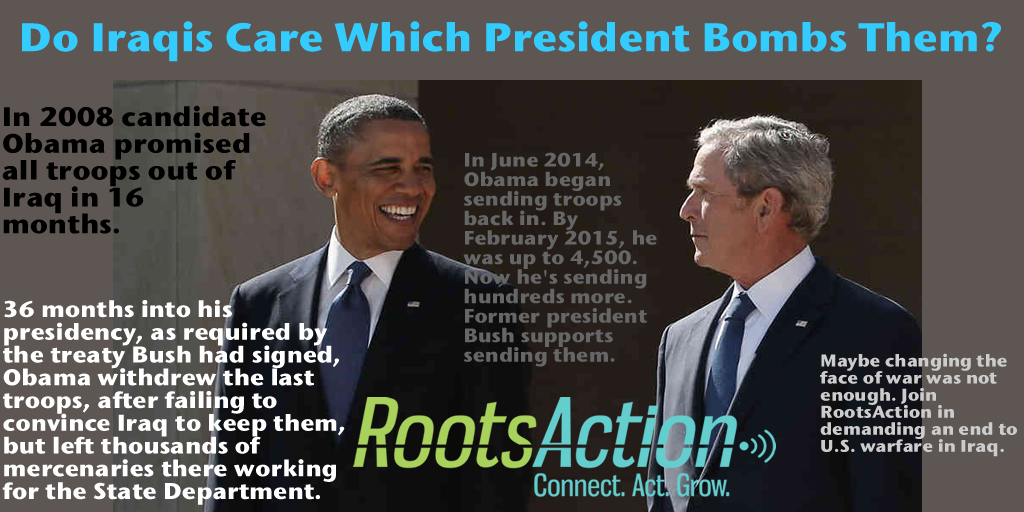
Thornberry had questions regarding US President Barack Obama's decision to send 450 more US troops into Iraq and to set them up at a base in Anbar Province.
This decision has had many vocal critics.
Such as Daniel Wagner (Huffington Post) who observed:
Mr. Obama apparently believes that being seen to be doing something is better than doing nothing, but he is wrong. The U.S. tried a war, installing a prime minister, and implementing a post-war counter-insurgency strategy. None of them worked for a reason: The Iraqi government is the wrong partner.
It took a long time for the U.S. to acknowledge that continuing to back Nouri al-Maliki for as long as it did was a big mistake, but by the time it did, it was really too late to salvage the situation. Iran is running the government and a feckless military. Trying to support the government or the military now is based on an alternate reality that 'could' have become true a dozen years ago, but bears little resemblance to the reality today. What will it take for the U.S. government to admit that what it is doing isn't working?
The editorial board of the Baltimore Sun pointed out Tuesday:, "Sending a few hundred troops merely gives the impression that he is taking action while really just kicking the can down the road for the next American president to contend with." From the May 21st snapshot:
And what's especially sad is he went on and on while campaigning for president (the first time) about how the answer wasn't to play "kick the can." He was, he insisted, someone who took action and made decisions.
But his Iraq action is nothing but kick the can.
Every day, you can picture him praying, "Just semi-hold together until January 2017, just semi-hold together until January 2017."
The whole point of his (minimum) three year action on Iraq that he started in mid 2014 was that he wouldn't be the one left holding the bag at the end.
So he grits his teeth and lies, "I don't think we're losing."
Aamer al-Qaisi (World Meets Us) observes:
Those are only a few of the critics of Barack's announcement last week.
The announcement was more of the same -- announcing to continue the same actions begun back in August of last year.
The actions have not produced any visible successes.
And when people note that reality, the White House responds that this is not something which can succeed overnight and that this is something which will require years.
That stalling tactic is used as an attempt to silence criticism and to shirk oversight.
Which is why this moment during the hearing is so important:
Chair Mac Thornberry: So what's the reasonable time period for us to check back and see whether this is working as we hope?
Secretary Ash Carter: I honestly think it's-it's reasonable for you to ask in-in weeks, uh, because, uh, I -- we're already getting an inflow of, uh, Sunni fighters. We'll put them through the training program. We have the capacity to do that.
That was one of two key moments in the hearing.
We'll note more of the hearing tomorrow but today we're focusing on the above and one other moment.
In the above exchange, Carter is stating clearly that in weeks, not years, it will be possible to render a judgment of success or failure.
A year ago, Barack told the world that the only answer to Iraq's crises was a political solution. He stressed a military solution was not going to solve the deeper problems.
And yet he's tasked the entire administration -- even the State Dept -- with working on the military aspect.
Why is that?
We offered that he was using the State Dept not just to get 'coalition' partners who could join in the air bombing campaign but also to get other countries to send in troops.
The Iraq War is not ending.
And the second big moment in the hearing covered that.
Ranking Member Adam Smith: The Chairman and I met last week with the Sunni leader of the Iraqi Parliament [Salim al-Jabouri] and one of the things he said during our meeting that surprised me a little bit as we were talking about the difficulty of getting support from the Baghdad government and sort of shifting focus to where could the Sunnis in that path sort of from Anbar up into Syria where ISIL is most dominant and he expressed disappointment, frankly, that the other Gulf states -- Saudi Arabia, UAE -- or even Turkey, to go up north. It did not seem to really be willing to provide much support -- uhm, even Jordan as well -- uhm, for the Sunnis in that area. Uhm, number one is do you agree with that assessment? I tend to take this guy at his word. Uhm, and number two, why? Uhm, it would seem to me that defeating ISIL is something that would be very important to Saudi Arabia -- amongst the others there. Why aren't they doing more, uh, to help those groups that want to resist ISIS in that part of Iraq and Syria?
Secretary Ash Carter: That's a critical question and it goes back to something that you said in your opening statement about other Sunnis and Arab forces countering ISIL. And I too met with Mr. Jabouri last-last week who said the same thing and I think he was speaking on behalf of a number of the Sunni forces -- political forces in western Iraq who would like to see more support and recognize -- as I think you noted and the Chairman noted in the operning statements -- that Americans and westerners are, uh -- can lead and enable but if they get too high a profile that becomes a problem in its own right.
Ranking Member Adam Smith: Exactly.
Secretary Ash Carter: Therefore all the more reason to get others uh, uh involved -- Sunnis involved in the fight. Now the-the head -- one thing I'll note is the heads of state of the GCC were here in Washington and we went to Camp David -- about three weeks ago. And I would say that this was one of the major themes of our conversation with them. The other one being, to get them back to what the Chairman said checking Iranian malign influence which they're also concerned about. Their concern about ISIL is genuine but their actions, I think, can be greatly strengthened. And that was one of the principle things that we talked about, getting - leading them in the train and equip program --
Ranking Member Adam Smith: But again --
Secretary Ash Carter: Sorry?
Ranking Member Adam Smith: Yeah, I got all that. But why? Why isn't -- What, in your opinion, having worked with these people, why isn't it happening?
Secretary Ash Carter: Well one reason is that they simply lack the capacity and so we talked a lot about building special operations forces that had counter -- as opposed to air forces. We have enough air forces. We're looking for ground forces.
We're looking for ground forces.
Let it sink in.
The American pubic will not stomach a large US military presence in Iraq.
That's why Barack's slowly -- generally by the 500s -- increased the US military presence in Iraq.
But it's also why the State Dept has been tasked with urging other countries to send their militaries into Iraq.
Canada did.
And they've already seen a body count.
Others may as well.
But "We're looking for ground forces."
And this is not about ending a war, this is about prolonging it, about getting others to fight it.
In other words, Barack won a Nobel Peace Prize for lying.
The Iraq War is not ending and that was made clear in the US House of Representatives today. Reuters reports that 288 members voted against a bill which "would have forced President Barack Obama to pull all U.S. troops from Iraq and Syria as soon as one month from now, but nearly one-third of the chamber voted for the measure." Only 139 members voted for it.
The two incidents above were key in the hearing. The plan is to note more of the hearing in the next snapshot.
This go round, we'll note the root cause, as discussed in the hearing and one other thing.
Ranking Member Adam Smith: . . . we are still relying on the Baghdad government. It is our hope that there will be an Iraqi government that is sufficiently inclusive so that Sunnis will be willing to fight for it. I just don't see that happening. Starting with [Nouri] al-Maliki, they set up a very sectarian, separatist government that did everything to shove the Sunnis into the arms of ISIS. Now I've not met [Haider] al-Abadi , uh, but I've heard that he has a desire to change that. The trouble is the people below him have no desire to change that and he does not have the power simply to make them -- the Minister of Defense, the Minister of the Interior, the various Shia militias, Iran change their minds. So as we continue to try to do that, I fear that strategy won't work. Now I know why we do it: Because what's the alternative? How do we offer the Sunnis a reasonable place to be if they don't have some support from Baghdad? But I think we need to start thinking about it.
I don't get this belief that Haider's got some desire to change anything.
He's done nothing since being installed as prime minister.
And why would he?
He's not only part of Nouri al-Maliki's Dawa party (a terrorist organization that attacked the US -- just FYI, since the White House is all about fighting terrorists -- or at least about fighting people they don't like that they label 'terrorist'), he's also part of Nouri's State of Law.
Dawa alone?
Fine, it's a political party in Iraq.
But State of Law was the organization Nouri created to avoid running on Dawa's platform and to try to take control of the Shi'ite political map.
When you're a member of both, you're a little too close to Nouri to ever make a real break from the sectarian ways that brought Iraq to brink of collapse.
Along with the root cause of the problems in Iraq today, we'll note Ramadi from the hearing. Ramadi fell to the Islamic State last April. The administration attempted to down play it. Secretary of Defense Ash Carter was slammed by Haider al-Abadi, among others, for noting the failure of the Iraqi military.
US Vice President Joe Biden jumped into the fray to try to kiss Haider's boo boos and soothe his hurt feelings.
But Carter was speaking plainly and owed no apology for that.
In his prepared remarks at today's hearing, Carter raised the issue of Ramadi:
What we saw in Ramadi last month was deeply disappointing -- and illustrated the importance of a capable and motivated Iraqi ground force. In the days that followed, all of us on the President’s national security team, at his direction, took another hard look at our campaign across all the lines of effort. At DoD, I convened my team before, during, and after my trip to the Asia-Pacific to examine our execution of DoD's lines of effort, and to prepare options for the President if his approval was required for any enhancements we identified. In our meetings at both the Pentagon and the White House, we determined that while we have the right strategic framework, execution of the campaign can and should be strengthened…especially on the ground. We determined that our training efforts could be enhanced and thus are now focusing on increasing participation in and throughput of our training efforts, working closely with the Iraqi government and stressing the focus on drawing in Sunni forces, which are underrepresented in the Iraqi Security Forces. We also determined that our equipping of the Iraqi Security Forces had proceeded too slowly. This process was earlier sometimes delayed by bureaucracy in Baghdad, but occasionally also in Washington. That is why we are now expediting delivery of essential equipment and materiel, like anti-tank capabilities and counter-IED equipment, to the Iraqi security forces -- including Kurdish and Sunni tribal forces. We also determined that we could enable Iraqi Security Forces with more tailored advice and assistance, including with critical outreach to local Sunni communities. That is why on advice from Chairman Dempsey and General Austin, and at my recommendation, last week President Obama authorized the deployment of 450 personnel to Iraq’s Taqqadum military base in Anbar Province to establish an additional site where we could advise and assist the Iraqi security forces. Situated between Ramadi and Fallujah, Taqqadum is a key location for engaging Sunni tribes, and Prime Minister Abadi, Iraqi military officials, and Sunni leaders have all committed to using Taqqadum to reinvigorate and expedite the recruitment of Sunni fighters.
The poorly planned and executed 'liberation' of Tikrit was suppose to give the Iraqi forces a boost -- a tiny win was supposed to improve morale.
But Tikrit didn't end up looking or feeling like a win and took far too many weeks to uplift spirits.
To be followed by the fall of Ramadi was a cruel blow for morale.
And Ramadi is not fading. AFP reports:
Islamic State took over the city of Ramadi because an Iraqi commander unnecessarily ordered his forces to withdraw, a senior officer in the US-led anti-jihadi coalition has said.
“Ramadi was lost because the Iraqi commander in Ramadi elected to withdraw. In other words, if he had elected to stay, he would still be there today,” the British army’s Brigadier Christopher Ghika told journalists in Baghdad on Wednesday.
“Ramadi was not a Daesh victory – Daesh did not win Ramadi, Daesh did not fight and defeat the Iraqi army in Ramadi,” Ghika said, using an Arabic acronym for the jihadi group that overran large parts of Iraq last year.
Meanwhile, Margaret Griffis (Antiwar.com) counts 195 violent deaths across Iraq today.
This as Press TV reports that Iraqi Prime Minister Haider al-Abadi arrived in Tehran today:
During his short visit to Iran, the Iraqi premier is scheduled to sit down with Iranian officials, including President Hassan Rouhani, to exchange views on different issues, including anti-terrorism campaign.
The Iraqi premier will also discuss mutual relations with Iranian officials during his stay in Tehran.
Iran’s Ambassador to Iraq Hassan Danaifar said Monday that Abadi’s visit to Iran comes at the invitation of Iranian First Vice President Es’haq Jahangiri.
This is Abasi’s second visit to Iran since he took office in September 2014.
He can go to Iran because he's motivated the Parliament to vote this week.
No, not on a national guard -- that's what the White House has been pushing for -- pushing for it for about a year now.
But the Parliament did vote on the very important and pressing issue of a new national anthem.
So don't say Haider's accomplished nothing.
In the US this week, the Senate voted on an amendment to arm the Kurds directly (the effort for this was led by Senators Barbra Boxer and Joni Ernst). The measure failed in a close vote.
This vote was noted in today's State Dept press briefing moderated by John Kirby.
QUESTION: On Iraq, on the consequences of the Senate refusal to directly arm Peshmerga, have you got any concern from the KRG side on that, especially when Secretary Kerry sent a letter to the Senate and discouraging them to go forward and change the amendment that made in the House?
MR KIRBY: So let me just talk more broadly. We do continue to arm and equip the Peshmerga, and we do it in coordination and through the Iraqi Government in Baghdad. So any suggestion that they’re not getting arms and equipment and things they need is just simply not true. It’s being done through the government in Baghdad, who has been very responsive in making sure that they aren’t stopping or hindering the flow of that equipment. And it’s been quite a bit: coalition-wide, over 95 airlift missions, 8 million pounds of donated ammunition and equipment, and more keeps coming. So I’m not going to speak specifically to action on the Hill, but I can tell you that the Pesh continue to get what they need and we continue to look at ways to get them more.
QUESTION: But have you got any concern from the KRG side to the State Department? (Inaudible.)
MR KIRBY: Have I heard of any concerns from the KRG side to the State Department?
QUESTION: Yeah.
MR KIRBY: I’m not aware of anything. I think they’ve made their – I think they – in the past, they’ve regularly made their concerns known, and they’ve stated that.
QUESTION: But on this issue --
MR KIRBY: But they continue to get, we believe – and I can – can show that they’re continuing to get arms and equipment and materiel and that will continue to flow.
QUESTION: But the Senate amendment would have given you the authority to give them directly heavy weapons, like tanks and maybe rocket launchers and perhaps helicopters and so on. Will that – is that issue now put to rest? You don’t --
MR KIRBY: I’m not going to talk about pending legislation here or the status of it. It is – it’s our policy, of Secretary Kerry, the policy that we’re executing, to work through the Baghdad government to provide this materiel and assistance, and it is getting to them. I mean, the policy, as being executed, is working.
QUESTION: Now, on the issue of troops on the ground, seeing that – from last week, seeing that U.S. troops now in Iraq are at the brigade level, maybe 4,000 people, how is that not mission creep? How is that not going up incrementally?
MR KIRBY: Well, mission creep is when the mission changes --
QUESTION: Okay.
MR KIRBY: -- and the mission expands and grows. The mission is not changing. The mission, with respect to advise and assist, is exactly the same as it’s been since when we started it months ago.
QUESTION: So you could --
MR KIRBY: Go ahead.
QUESTION: You could conceivably have a division in there and the mission will not change?
MR KIRBY: Well, I’m not going to – I don’t think it’s kind of very useful to get into hypothetical estimates of what – of how many more troops there’s going to be. This isn’t about numbers of troops; it’s about what they’re doing. And the “what” hasn’t changed at all. Part and parcel of this strategy is assisting the Iraqi Security Forces, improving their competence and battlefield capability, and that’s what this extra – additional, I should say, additional 450 troops are going to do there in Anbar province.
Actually, Kirby's redefining "mission creep" and I don't think he gets to set the terms for everyone anymore than he gets to rewrite the dictionary on behalf of the American people.
Yet still he tries to do so.
QUESTION: Okay. And then secondly, on Iraq, is Iraq today a quagmire? Is it a stalemate in which no side can win and the U.S. is just sinking its resources?
MR KIRBY: Are these your words that you want to apply to Iraq or are you reading from somebody else’s commentary?
QUESTION: I mean, do you have a response?
MR KIRBY: I think what we’re dealing with in Iraq is a very dangerous, lethal group, and it’s not just from their perspective, Iraq. It’s Iraq and Syria. And this is a fight that the Iraqis need to lead. It’s their fight. This is their strategy we’re helping them execute. And I would add that though it’s going to be a long slog and though it continues to be dangerous, and though this group continues to be quite lethal and determined, there has been progress made across almost all the lines of effort.
So nobody said this is going to be easy. We’ve long said three to five years, and I think we still hold to that.
iraq
antiwar.com
margaret griffis
"I would hope," US House Rep Adam Smith declared this morning, "that we would have learned over the course of the last 14 years of having a substantial presence in both Iraq and Afghanistan that the west showing up in the Muslim world and saying 'we're here solve your problems' isn't going to get it done."
He was speaking at the House Armed Services Committee hearing. Smith is the Ranking Member on the Committee, US House Rep Mac Thornberry is the Chair and today they were hearing testimony from Defense Secretary Ash Carter and Gen Martin Dempsey (Chair of the Joint-Chiefs of Staff).
Thornberry had questions regarding US President Barack Obama's decision to send 450 more US troops into Iraq and to set them up at a base in Anbar Province.
This decision has had many vocal critics.
Such as Daniel Wagner (Huffington Post) who observed:
Mr. Obama apparently believes that being seen to be doing something is better than doing nothing, but he is wrong. The U.S. tried a war, installing a prime minister, and implementing a post-war counter-insurgency strategy. None of them worked for a reason: The Iraqi government is the wrong partner.
It took a long time for the U.S. to acknowledge that continuing to back Nouri al-Maliki for as long as it did was a big mistake, but by the time it did, it was really too late to salvage the situation. Iran is running the government and a feckless military. Trying to support the government or the military now is based on an alternate reality that 'could' have become true a dozen years ago, but bears little resemblance to the reality today. What will it take for the U.S. government to admit that what it is doing isn't working?
The editorial board of the Baltimore Sun pointed out Tuesday:, "Sending a few hundred troops merely gives the impression that he is taking action while really just kicking the can down the road for the next American president to contend with." From the May 21st snapshot:
And what's especially sad is he went on and on while campaigning for president (the first time) about how the answer wasn't to play "kick the can." He was, he insisted, someone who took action and made decisions.
But his Iraq action is nothing but kick the can.
Every day, you can picture him praying, "Just semi-hold together until January 2017, just semi-hold together until January 2017."
The whole point of his (minimum) three year action on Iraq that he started in mid 2014 was that he wouldn't be the one left holding the bag at the end.
So he grits his teeth and lies, "I don't think we're losing."
Aamer al-Qaisi (World Meets Us) observes:
There is nothing new in what the Americans have to say. On the tenth of June last year when Mosul fell, the Americans told us to expect a long war that could take three years. Only now - a year after Mosul's fall, it has become five years. We know nothing about the most recent projections of the American administration after it altered its strategy from merely encouraging the arming of various warring factions and the Peshmerga to now accepting the participation of the Popular Mobilization Forces [Shiite militias] in efforts to liberate occupied cities from Daesh!
Amid all the "creative chaos" of the American approach, we stand a year out from the fall of Mosul, four million people have fled, there is a waterfall of blood and the political cracks are deepening by the day – free gifts for Daesh, which it uses to extend its aggression and hatred toward everything human in this country ...
Posted By Worldmeets.US
The truth we must courageously face up to is that we are fighting Daesh without any kind of strategy – political or military. We are in fact in the heart of the chaos. Politically, our wonderful politicians continue to exchange insults and accusations while brandishing slogans of reconciliation, national unity and Iraqi brotherhood. That is all for internal consumption – and we're fed up with it. Militarily, we continue to lack united leadership and a military strategy that could serve as a compass for all those fighting Daesh. Our military victories lack purpose and depth in terms of returning displaced people to their homes and restoring social peace in liberated cities that have been destroyed by war!
Those are only a few of the critics of Barack's announcement last week.
The announcement was more of the same -- announcing to continue the same actions begun back in August of last year.
The actions have not produced any visible successes.
And when people note that reality, the White House responds that this is not something which can succeed overnight and that this is something which will require years.
That stalling tactic is used as an attempt to silence criticism and to shirk oversight.
Which is why this moment during the hearing is so important:
Chair Mac Thornberry: So what's the reasonable time period for us to check back and see whether this is working as we hope?
Secretary Ash Carter: I honestly think it's-it's reasonable for you to ask in-in weeks, uh, because, uh, I -- we're already getting an inflow of, uh, Sunni fighters. We'll put them through the training program. We have the capacity to do that.
That was one of two key moments in the hearing.
We'll note more of the hearing tomorrow but today we're focusing on the above and one other moment.
In the above exchange, Carter is stating clearly that in weeks, not years, it will be possible to render a judgment of success or failure.
A year ago, Barack told the world that the only answer to Iraq's crises was a political solution. He stressed a military solution was not going to solve the deeper problems.
And yet he's tasked the entire administration -- even the State Dept -- with working on the military aspect.
Why is that?
We offered that he was using the State Dept not just to get 'coalition' partners who could join in the air bombing campaign but also to get other countries to send in troops.
The Iraq War is not ending.
And the second big moment in the hearing covered that.
Ranking Member Adam Smith: The Chairman and I met last week with the Sunni leader of the Iraqi Parliament [Salim al-Jabouri] and one of the things he said during our meeting that surprised me a little bit as we were talking about the difficulty of getting support from the Baghdad government and sort of shifting focus to where could the Sunnis in that path sort of from Anbar up into Syria where ISIL is most dominant and he expressed disappointment, frankly, that the other Gulf states -- Saudi Arabia, UAE -- or even Turkey, to go up north. It did not seem to really be willing to provide much support -- uhm, even Jordan as well -- uhm, for the Sunnis in that area. Uhm, number one is do you agree with that assessment? I tend to take this guy at his word. Uhm, and number two, why? Uhm, it would seem to me that defeating ISIL is something that would be very important to Saudi Arabia -- amongst the others there. Why aren't they doing more, uh, to help those groups that want to resist ISIS in that part of Iraq and Syria?
Secretary Ash Carter: That's a critical question and it goes back to something that you said in your opening statement about other Sunnis and Arab forces countering ISIL. And I too met with Mr. Jabouri last-last week who said the same thing and I think he was speaking on behalf of a number of the Sunni forces -- political forces in western Iraq who would like to see more support and recognize -- as I think you noted and the Chairman noted in the operning statements -- that Americans and westerners are, uh -- can lead and enable but if they get too high a profile that becomes a problem in its own right.
Ranking Member Adam Smith: Exactly.
Secretary Ash Carter: Therefore all the more reason to get others uh, uh involved -- Sunnis involved in the fight. Now the-the head -- one thing I'll note is the heads of state of the GCC were here in Washington and we went to Camp David -- about three weeks ago. And I would say that this was one of the major themes of our conversation with them. The other one being, to get them back to what the Chairman said checking Iranian malign influence which they're also concerned about. Their concern about ISIL is genuine but their actions, I think, can be greatly strengthened. And that was one of the principle things that we talked about, getting - leading them in the train and equip program --
Ranking Member Adam Smith: But again --
Secretary Ash Carter: Sorry?
Ranking Member Adam Smith: Yeah, I got all that. But why? Why isn't -- What, in your opinion, having worked with these people, why isn't it happening?
Secretary Ash Carter: Well one reason is that they simply lack the capacity and so we talked a lot about building special operations forces that had counter -- as opposed to air forces. We have enough air forces. We're looking for ground forces.
We're looking for ground forces.
Let it sink in.
The American pubic will not stomach a large US military presence in Iraq.
That's why Barack's slowly -- generally by the 500s -- increased the US military presence in Iraq.
But it's also why the State Dept has been tasked with urging other countries to send their militaries into Iraq.
Canada did.
And they've already seen a body count.
Others may as well.
But "We're looking for ground forces."
And this is not about ending a war, this is about prolonging it, about getting others to fight it.
In other words, Barack won a Nobel Peace Prize for lying.
The Iraq War is not ending and that was made clear in the US House of Representatives today. Reuters reports that 288 members voted against a bill which "would have forced President Barack Obama to pull all U.S. troops from Iraq and Syria as soon as one month from now, but nearly one-third of the chamber voted for the measure." Only 139 members voted for it.
The two incidents above were key in the hearing. The plan is to note more of the hearing in the next snapshot.
This go round, we'll note the root cause, as discussed in the hearing and one other thing.
Ranking Member Adam Smith: . . . we are still relying on the Baghdad government. It is our hope that there will be an Iraqi government that is sufficiently inclusive so that Sunnis will be willing to fight for it. I just don't see that happening. Starting with [Nouri] al-Maliki, they set up a very sectarian, separatist government that did everything to shove the Sunnis into the arms of ISIS. Now I've not met [Haider] al-Abadi , uh, but I've heard that he has a desire to change that. The trouble is the people below him have no desire to change that and he does not have the power simply to make them -- the Minister of Defense, the Minister of the Interior, the various Shia militias, Iran change their minds. So as we continue to try to do that, I fear that strategy won't work. Now I know why we do it: Because what's the alternative? How do we offer the Sunnis a reasonable place to be if they don't have some support from Baghdad? But I think we need to start thinking about it.
I don't get this belief that Haider's got some desire to change anything.
He's done nothing since being installed as prime minister.
And why would he?
He's not only part of Nouri al-Maliki's Dawa party (a terrorist organization that attacked the US -- just FYI, since the White House is all about fighting terrorists -- or at least about fighting people they don't like that they label 'terrorist'), he's also part of Nouri's State of Law.
Dawa alone?
Fine, it's a political party in Iraq.
But State of Law was the organization Nouri created to avoid running on Dawa's platform and to try to take control of the Shi'ite political map.
When you're a member of both, you're a little too close to Nouri to ever make a real break from the sectarian ways that brought Iraq to brink of collapse.
Along with the root cause of the problems in Iraq today, we'll note Ramadi from the hearing. Ramadi fell to the Islamic State last April. The administration attempted to down play it. Secretary of Defense Ash Carter was slammed by Haider al-Abadi, among others, for noting the failure of the Iraqi military.
US Vice President Joe Biden jumped into the fray to try to kiss Haider's boo boos and soothe his hurt feelings.
But Carter was speaking plainly and owed no apology for that.
In his prepared remarks at today's hearing, Carter raised the issue of Ramadi:
What we saw in Ramadi last month was deeply disappointing -- and illustrated the importance of a capable and motivated Iraqi ground force. In the days that followed, all of us on the President’s national security team, at his direction, took another hard look at our campaign across all the lines of effort. At DoD, I convened my team before, during, and after my trip to the Asia-Pacific to examine our execution of DoD's lines of effort, and to prepare options for the President if his approval was required for any enhancements we identified. In our meetings at both the Pentagon and the White House, we determined that while we have the right strategic framework, execution of the campaign can and should be strengthened…especially on the ground. We determined that our training efforts could be enhanced and thus are now focusing on increasing participation in and throughput of our training efforts, working closely with the Iraqi government and stressing the focus on drawing in Sunni forces, which are underrepresented in the Iraqi Security Forces. We also determined that our equipping of the Iraqi Security Forces had proceeded too slowly. This process was earlier sometimes delayed by bureaucracy in Baghdad, but occasionally also in Washington. That is why we are now expediting delivery of essential equipment and materiel, like anti-tank capabilities and counter-IED equipment, to the Iraqi security forces -- including Kurdish and Sunni tribal forces. We also determined that we could enable Iraqi Security Forces with more tailored advice and assistance, including with critical outreach to local Sunni communities. That is why on advice from Chairman Dempsey and General Austin, and at my recommendation, last week President Obama authorized the deployment of 450 personnel to Iraq’s Taqqadum military base in Anbar Province to establish an additional site where we could advise and assist the Iraqi security forces. Situated between Ramadi and Fallujah, Taqqadum is a key location for engaging Sunni tribes, and Prime Minister Abadi, Iraqi military officials, and Sunni leaders have all committed to using Taqqadum to reinvigorate and expedite the recruitment of Sunni fighters.
The poorly planned and executed 'liberation' of Tikrit was suppose to give the Iraqi forces a boost -- a tiny win was supposed to improve morale.
But Tikrit didn't end up looking or feeling like a win and took far too many weeks to uplift spirits.
To be followed by the fall of Ramadi was a cruel blow for morale.
And Ramadi is not fading. AFP reports:
Islamic State took over the city of Ramadi because an Iraqi commander unnecessarily ordered his forces to withdraw, a senior officer in the US-led anti-jihadi coalition has said.
“Ramadi was lost because the Iraqi commander in Ramadi elected to withdraw. In other words, if he had elected to stay, he would still be there today,” the British army’s Brigadier Christopher Ghika told journalists in Baghdad on Wednesday.
“Ramadi was not a Daesh victory – Daesh did not win Ramadi, Daesh did not fight and defeat the Iraqi army in Ramadi,” Ghika said, using an Arabic acronym for the jihadi group that overran large parts of Iraq last year.
Meanwhile, Margaret Griffis (Antiwar.com) counts 195 violent deaths across Iraq today.
This as Press TV reports that Iraqi Prime Minister Haider al-Abadi arrived in Tehran today:
During his short visit to Iran, the Iraqi premier is scheduled to sit down with Iranian officials, including President Hassan Rouhani, to exchange views on different issues, including anti-terrorism campaign.
The Iraqi premier will also discuss mutual relations with Iranian officials during his stay in Tehran.
Iran’s Ambassador to Iraq Hassan Danaifar said Monday that Abadi’s visit to Iran comes at the invitation of Iranian First Vice President Es’haq Jahangiri.
This is Abasi’s second visit to Iran since he took office in September 2014.
He can go to Iran because he's motivated the Parliament to vote this week.
No, not on a national guard -- that's what the White House has been pushing for -- pushing for it for about a year now.
But the Parliament did vote on the very important and pressing issue of a new national anthem.
So don't say Haider's accomplished nothing.
In the US this week, the Senate voted on an amendment to arm the Kurds directly (the effort for this was led by Senators Barbra Boxer and Joni Ernst). The measure failed in a close vote.
This vote was noted in today's State Dept press briefing moderated by John Kirby.
QUESTION: On Iraq, on the consequences of the Senate refusal to directly arm Peshmerga, have you got any concern from the KRG side on that, especially when Secretary Kerry sent a letter to the Senate and discouraging them to go forward and change the amendment that made in the House?
MR KIRBY: So let me just talk more broadly. We do continue to arm and equip the Peshmerga, and we do it in coordination and through the Iraqi Government in Baghdad. So any suggestion that they’re not getting arms and equipment and things they need is just simply not true. It’s being done through the government in Baghdad, who has been very responsive in making sure that they aren’t stopping or hindering the flow of that equipment. And it’s been quite a bit: coalition-wide, over 95 airlift missions, 8 million pounds of donated ammunition and equipment, and more keeps coming. So I’m not going to speak specifically to action on the Hill, but I can tell you that the Pesh continue to get what they need and we continue to look at ways to get them more.
QUESTION: But have you got any concern from the KRG side to the State Department? (Inaudible.)
MR KIRBY: Have I heard of any concerns from the KRG side to the State Department?
QUESTION: Yeah.
MR KIRBY: I’m not aware of anything. I think they’ve made their – I think they – in the past, they’ve regularly made their concerns known, and they’ve stated that.
QUESTION: But on this issue --
MR KIRBY: But they continue to get, we believe – and I can – can show that they’re continuing to get arms and equipment and materiel and that will continue to flow.
QUESTION: But the Senate amendment would have given you the authority to give them directly heavy weapons, like tanks and maybe rocket launchers and perhaps helicopters and so on. Will that – is that issue now put to rest? You don’t --
MR KIRBY: I’m not going to talk about pending legislation here or the status of it. It is – it’s our policy, of Secretary Kerry, the policy that we’re executing, to work through the Baghdad government to provide this materiel and assistance, and it is getting to them. I mean, the policy, as being executed, is working.
QUESTION: Now, on the issue of troops on the ground, seeing that – from last week, seeing that U.S. troops now in Iraq are at the brigade level, maybe 4,000 people, how is that not mission creep? How is that not going up incrementally?
MR KIRBY: Well, mission creep is when the mission changes --
QUESTION: Okay.
MR KIRBY: -- and the mission expands and grows. The mission is not changing. The mission, with respect to advise and assist, is exactly the same as it’s been since when we started it months ago.
QUESTION: So you could --
MR KIRBY: Go ahead.
QUESTION: You could conceivably have a division in there and the mission will not change?
MR KIRBY: Well, I’m not going to – I don’t think it’s kind of very useful to get into hypothetical estimates of what – of how many more troops there’s going to be. This isn’t about numbers of troops; it’s about what they’re doing. And the “what” hasn’t changed at all. Part and parcel of this strategy is assisting the Iraqi Security Forces, improving their competence and battlefield capability, and that’s what this extra – additional, I should say, additional 450 troops are going to do there in Anbar province.
Actually, Kirby's redefining "mission creep" and I don't think he gets to set the terms for everyone anymore than he gets to rewrite the dictionary on behalf of the American people.
Yet still he tries to do so.
QUESTION: Okay. And then secondly, on Iraq, is Iraq today a quagmire? Is it a stalemate in which no side can win and the U.S. is just sinking its resources?
MR KIRBY: Are these your words that you want to apply to Iraq or are you reading from somebody else’s commentary?
QUESTION: I mean, do you have a response?
MR KIRBY: I think what we’re dealing with in Iraq is a very dangerous, lethal group, and it’s not just from their perspective, Iraq. It’s Iraq and Syria. And this is a fight that the Iraqis need to lead. It’s their fight. This is their strategy we’re helping them execute. And I would add that though it’s going to be a long slog and though it continues to be dangerous, and though this group continues to be quite lethal and determined, there has been progress made across almost all the lines of effort.
So nobody said this is going to be easy. We’ve long said three to five years, and I think we still hold to that.
iraq
antiwar.com
margaret griffis


 #IRAQ شمرية العراق

 Beyond The Levant
 Karen Pogosyan