Tuesday, May 18, 2010

Those elections

Tuesday. Need to start by noting my state's Green Party in some way because I keep forgetting to do that. Okay, this is from the page of the four candidates they're running in Big Mass:


Jill Stein for Governor
"This is the year we the people regain control of our Commonwealth and our common future. It's time for a Commonwealth that listens to the people, works for the people, and answers to the people. It's time to bring the voices of ordinary people into this election and into the halls of power. It's time to break the stranglehold of lobbyists and insiders, and get Beacon Hill back to work for the families and communities of the Commonwealth. It's time to start building the healthy, secure green future we so urgently need, richly deserve, and that is within our reach.
My name is Jill Stein, and that's why I'm running for governor."
— Jill Stein, January 2010
For more information about Jill Stein's candidacy, as well as ways to contribute to and volunteer for her campaign, please visit
jillstein.org.

Where possible, I'm voting Green. I'm more than willing to give them a chance after wasting so much time on the Democrats. I see this as a test run for 2012. I'll be watching to see if they run real campaigns or play like the Dems' kid sister. If it's the latter, I'll walk away from them. But this cycle, they get my vote.


Rand Paul, the first-time candidate for elective office who has emerged as a symbol of the national tea party’s clout in Republican politics, appears to have clinched the GOP’s nomination for this state’s open Senate seat – in a victory certain to jolt the political order in Kentucky and across the country.
The 47-year-old Bowling Green ophthalmologist – who until last year was best known for being the son of Rep. Ron Paul (R-Texas), whose staunch libertarian views have spawned a national grassroots following – knocked off Trey Grayson, the Kentucky secretary of state who had been the favorite of this state’s political heavyweights, most notably Senate Minority Leader Mitch McConnell.


I'm happy about that one. Rand Paul's father was against the Iraq War and didn't play at it like Barack. He was really against it. And Paul isn't afraid to take on his party. So hopefully his son is like that as well.

If you can't tel, my party's on its own this year. The Dems need to learn a lesson. They've not closed Guantanamo, they've not ended the Iraq War, they've not ended the Afghanistan War, they've not provided universal health care, they've not tossed out the Patriot Act. And when you turn it around to what they've done, it gets even worse: ObamaCare, expanding the war into Pakistan, attacking Miranda, go down the list. So I'll be rooting for a lot of people this year. Very few will be Dems.

Here's C.I.'s "Iraq snapshot:"


Tuesday, May 18, 2010. Chaos and violence continue, persecution continues, silence continues, Francis A. Boyle calls out Elana Kagan's 'record' (or lack of), and more.

Because he just didn't get it. Gordon Brown is the former prime minister of England. He's former because he never got it.
Poodle Tony Blair's crimes became Gordon's because Gordon had nothing to offer. Take the Iraq Inquiry where he had one last chance to draw a line between himself and Tony Blair (Blair was prime minister prior to Brown). Instead, he attempted to echo Blair's testimony and, as Labour's own polling indicated, that was it for Brown. He never recovered from that moment (and his poll numbers had already been dangerously low). He was forever dishonest, forever lying. Gordon Brown killed Labour.

Right before the elections,
Brown answered questions for Pink News that readers sent in on LGBT issues. Simon Reader asked about the targeting of Iraq's LGBT community:

Life in Iraq is now much worse for gay people than it was under Saddam Hussein. As architects of the political situation in Iraq do you consider your government morally obliged to extend asylum more actively and with less bureaucracy to gay Iraqis who are in danger as a direct consequence of UK intervention in their country?

Most people can read that question and reply in an honest manner. Not so for the anchor around the neck of the Labour Party. Gordon Brown wanted to lie, he always wanted to lie:

I unreservedly condemn abuses of gay rights, wherever in the world they happen, including in Iraq. But I'm sorry I can't agree that this is a result of military intervention. Saddam's was a brutal regime which mistreated a wide range of minorities inside Iraq including LGBT people. Whatever people's views about the military intervention -- and I have made clear that I think the international community had no choice given Saddam's repeated flouting of international resolutions as well as his abuses of his own people -- I hope they will acknowledge that in almost all respects Iraq is a better place, and the Middle East a better and safer place, with him no longer in power. Iraq is now an emerging democracy -- definitely still with many flaws, but a strengthening democracy with the recent elections. We must continue to press the Iraqi government to improve their record on tolerance and human rights as we do with other countries in the region and the world. I believe that human rights are universal, and that it is the job of mature democracies like Britain to support the development of free societies everywhere. I think Iraq now has a better chance of becoming a free society that genuinely respects human rights than it did under Saddam. As to your question on whether there is something we could do for gay asylum seekers from Iraq as a group, it is a fundamental principle of our asylum system that each cases is assessed fairly, separately, and on its merits.

No, life was not worse for Iraq's LGBT community before the 2003 invasion. Life was far from perfect for them -- for all women, for Christians, for Jews, for academics, for doctors, for aetheists -- but it was better (for all categories) than it is today. That's because Iraq was a secular nation. And the US and the UK governments invaded and wanted to establish 'order' quickly so they selected brutal people to work with -- fundamentalists and/or exiles with a grudge they wanted to avenge. Iraq is not a secular state today. And all women, gay men, men who may appear to others as gay (for various reasons including, yes, wishful thinking on the acuser's part), Jews, Christians, academics have it much, much harder than they did prior to the 2003 invasion. Gordon Brown lied and, in doing so, in defending that illegal war, he merged completely with Tony Blair at a time when the only thing that could have saved him was proving he was not Blair II. With regards to Iraq's LGBT community,
Ashley Byrne (BBC News) was reporting in July of last year on the various members of the LGBT community who were able to give testimony that life under Saddam Hussein was better than what has followed:

All the LGBT Iraqis interviewed for Gay Life After Saddam maintained that life was easier for them when Saddam Hussein was in power, from 1979 to 2003.
Some spoke fondly of an underground gay culture that flourished before the war in Baghdad.
But it was unclear exactly what Saddam's view on homosexuality was, and there has been some evidence to suggest that the former dictator was acting to clamp down on sexual minorities in the latter years of his reign.

A month later, August 2009, Human Rights Watch released their report [PDF format warning] "
They Want Us Exterminated: Murder, Torture, Sexual Orientation and Gender in Iraq." The report features the narratives of many Iraqis. Hamid shares this story:

It was late one night in early April, and they came to take my partner at his parent's home. Four armed men barged into the house, masked and wearing black. They asked fo rhim by name; they insulted him and took him in front of his parents. All that, I heard about later from his family.
He was found in the neighborhood the day after. They had thrown his corpse in the garbage. His genitals were cut off and a piece of his throat was ripped out.
Since then, I've been unable to speak properly. I feel as if my life is pointless now. I don't have friends other than those you see; for years it has just been my boyfriend and myself in that little bubble, by ourselves. I have no family now -- I cannot go back to them. I have a death warrant on me. I feel the best thing to do is just to kill myself. In Iraq, murderers and thieves are respected more than gay people.
Their measuring rod to judge people is who they have sex with. It is not by their conscience, it is not by their conduct or their values, it is who they have sex with. The cheapest thing in Iraq is a human being, a human life. It is cheaper than an animal, than a pair of used-up batteries you buy on the street. Especially people like us.

Tariq is another Iraqi detailing the new realities in 'democratic' Iraq:

At the end of March, I started to hear from friends that the Mahdi Army was killing gays. The newspapers also reported there was an increase in the "third sex" in Iraq, also known as "puppies" [jarawi]. Then on April 4, I found out that two of my gay friends, Mohammed and Mazen, had been killed. I think those were their names; within a gay group, gays rarely give out their real names. We were friends, we met in cafes or chatted on the Internet, and one day they just disappeared.
A few days later, I met the brother of one of them and he told me they were killed. They were kidnapped on the street and then their bodies were found near a mosque, with signs of torture. One was 18, one was 19.
A couple of days after that, on April 6 or 7, I was in my parents' house, and someone threw a letter at the door. I didn't see who. Inside the envelope was a bullet. It had brown blood on it, and the letter said, "What are you still here for? Are you ready to die?"
I think those two were tortured into giving my name, because two days after I learned they were killed I got this threat. . . . I spoke by phone to a friend of mine yesterday night: he is also gay but he's very masculine and no one knows about him. He said, "Get out if you can and save yourself. They are killing gays left and right."
I said, "Who is doing it?" He said, "Everyone knows. Who do you think? The Mahdi Army."

Last month Amnesty International released [PDF format warning] "
Civilians Under Fire" which noted:
Gay men face similar discrimination as women under the legislation that provides for lenient senteces for those committing crimes with an "honourable motive". Iraqi courts continue to interpret provisions of Article 128 of the Penal Code as justification for giving drastically reduced sentences to defendants who have attacked or even killed gay men they are related to if they say that they acted to "wash off the shame". In its rulings, the Iraqi Court of Cassation has confirmed that the killing of a male relative who is suspected of same-sex sexual conduct is considered a crime with an "honourable motive", thus qualifying for a reduced sentence under Article 128.
Although provisions under Articles 128 have been amended in the Kurdistan Region by Law 14 of 2002 and, therefore, may no longer be applied in connection with crimes committed against women there, they continue to be applicable throughout the whole of Iraq in connection with crimes against gay men.
For example, on 24 October 2005 the Court of Cassation of the Kurdistan Region confirmed the conviction for murder and one-year prison sentence imposed on a man from Koysinjak who had confessed to killing his gay brother earlier in 2005. The court found that he had killed his brother with "honourable motives" because he "wanted to end the shame which the victim [of the crime] had brought over his family by practicing depravity and by being engaged in homosexuality and prostitution." The court also accepted that a one-year prison sentence was in this case appropriate for premeditated murder, a crime which carries the death penalty.
Impunity or, at most, a disproportionately lenient prison sentence for the murder of gay men by their relatives, appears to be the rule rather than the exception in Iraq.


In fairness to Gordon Brown, he's not the only one refusing to deal with reality. The Nation magazine -- the bible of the faux left -- showed no interest in the issue. Richard Kim works a special kind of gay beat -- he runs around screaming whenever a well off public figure is called gay -- especially if they are they gay. He ignores the people who actually need help and, of course, refuses to call out the politicians who put homophobes onstage . . . if there names are Barack Obama.

Not staying silent is
Ali Hili -- an Iraqi attempting to help other LGBT Iraqis and fighting for his own right of asylum in England. He shares his story with the New Internationalist:I used to work as a DJ at the 1001 nightclub in Baghdad at the al-Rashid hotel. I started working there when I won a DJ contest in 1987. It was a great scene -- lots of dance parties -- and a hang-out for the gay community. When I was 18, I had a partner who was a foreign diplomat. Iraqi intelligence forced me to become a spy and report back to them, threatening that they would kill my family if I didn't. This went on for almost 10 years. I wanted to leave. I tried to escape once via Kurdistan but was arrested and handed over to Iraqi police. I used my connections to escape a jail sentence. The police asked me, why do you want to leave? I said life was hard under sanctions and I couldn't make a living. So they sent me to Dubai to work for them. There I met my current partner -- a Texan. I explained the situation to him and he understood. I started to get harassed by the mukhabarat [secret police] -- they wanted information from me. We tried to escape to Dubai via the US embassy and were able to get to Europe. Eventually after many difficulties -- constant threats from Iraqi secret police, several failed attempts and many traumatic incidents (including being nearly deported back to Iraq) -- I made it to England in 2002. My partner had a job there. For the last seven years I've been fighting for the right to stay and seeking political asylum. I've been refused a couple of times already. I was granted permission to stay until 2008 but that's expired. I've received a death fatwa against me from the Ayatollah Sistani in response to my activist work for gays in Iraq. The group that kidnapped British hostages, Assab Alsar Al-Haq (The League of the Righteous), has also threatened me. Now I'm under police protection, moving from house to house. But even the police said to me: 'You have created this situation. You scream and shout against fundamentalists and they will threaten you. What do you expect?' The irony is that the situation for gays has been caused by the Anglo-American invasion. The fatwas were issued by people empowered by the invasion. Now Britain should take responsibility for protecting their victims. Some people in Iraq are targeted because they are doctors, or Sunnis or Shi'as or women or Christians. But no-one is talking about the killing of gays by the fundamentalist militias. One of my best friends -- a transsexual -- was murdered by a militia from the Ministry of the Interior. They beat her and then set her on fire. That's an excerpt. Iraq's LGBT community is among the many who have been targeted. The Jewish community and Christian community have been targeted as well. On the topic of Iraqi Christians, the Cristina Odone (Telegraph of London) addresses the silence that is the response to so many assaults on Iraqi Christians:A bus carrying 80 Christian students to their university in northern Iraq was bombed on 2 May. According to the Washington Post, the most startling thing about the report was that young Christians could attend university at all. Since 2003, Iraq's Christian community has been subjected to assassinations, kidnappings, extortions and rapes. Over half of the estimated 1.5 million Christians in Iraq (less than 4 per cent of the population) have fled to Syria, Jordan and elsewhere. The US Commission on International Religious Freedom has branded Iraq's religious persecution "of particular concern", and called on the Obama administration to intervene before the ancient religious communities (some still praying in Aramaic) are exterminated.Assyrian International News Agency adds, "In Sweden there are thousands of Assyrian Iraqis hidden from the authorities because they have been rejected as refugees and are forbidden to remain in Sweden. They are hunted down by the Swedish police. If they are arrested, they are put in prison or in custody until the authorities have enough refugees to fill a plane with which to fly them to Baghdad. They are dumped by the Swedish police back to that very city where they can be slaughtered for their religion or ethnicity."
Last year the Iraq Inquiry began conducting hearings in London. The hearings continued this year and have included testimony from former prime ministers Tony Blair and Gordon Brown (Brown was then-Prime Minister when he offered testimony). The hope/plan on the part of the Brown government was that such testimony, if taken, would be taken in private. Instead, public demand and John Chilcot (who chairs the committee) ensured that testimony from Brown and Blair took place in public. While the UK gets an Inquiry, the US gets nothing but no one is ever supposed to notice that.
The Committee released the following statement today:

Members of the Iraq Inquiry committee have arrived in the United States to speak to officials and military officers from the current and former administrations. The committee is in the US for five days visiting Washington DC and Boston. They will have private discussions with a number of people who have insights into the UK's involvement in Iraq over the period being examined by the Inquiry.As the talks are being held on a private basis, the identities of the people the Inquiry committee are seeing and the location of meetings will not be revealed in advance. Subject to the agreement of participants, the Inquiry may provide more details about the trip after it has been completed. Similarly, if the committee wishes to use any of the information it receives from individuals in America in its report, it will seek their permission first.The trip to the United States follows a one-day visit to Paris on Tuesday 4 May, where the Iraq Inquiry committee met a number of French citizens who provided perspectives on international issues in the lead-up to and during the conflict in Iraq. They included Dominique de Villepin (French Minister of Foreign Affairs 2002-2004), Jean David Levitte (French Permanent Representative to the UN 2000- 2002 and then Ambassador to the US from 2002 to 2007), Gerard Errera (French Ambassador to London 2002- 2007), General Henri Bentegeat (Chief of the Military Staff to the President 1999- 2002 and then Chief of the Defence Staff 2002-2006) and Jean-Luc Florent (French UN legal advisor). The committee also saw Maurice Gourdault-Montagne (Senior Diplomatic Counsellor to the President 2002-2007, and currently the French Ambassador to the UK) in London.Since finishing the first round of public hearings in March, the Iraq Inquiry has been analysing the witness testimonies obtained during the hearings, as well as continuing to examine many thousands of highly classified government documents. The next round of public hearings is due to start in the summer. Hearing dates and details of witnesses will be released soon.March 7th, Iraq held elections (early voting started a few days before that). Ayad Allawi's political slate Iraqiya won the most seats in Parliament (91), followed by Nouri al-Maliki's State Of Law (89). Nouri then worked overtime to discredit Allawi's win while he went to work circumventing the Constitution by forming his own coalition. This morning the
New York Times editorial board notes:Even though his Sunni-backed Iraqiya coalition won the most votes, Mr. Allawi is considered a long shot to become the next prime minister. That's because Mr. Maliki's coalition has aligned with the other major Shiite coalition, which is friendly to Iran. Four seats short of a majority, it is the biggest bloc in the new Parliament. (Mr. Maliki seemed to lose enthusiasm for election challenges after he forged this alliance.)Iraq's leaders should look beyond their sectarian and ethnic bases and show the skill and vision to govern all of their people. Iraqis unhelpfully voted mainly along sectarian and ethnic lines. But they also gave Mr. Allawi significant representation that needs to be reflected in the government. Sunnis need a reason to stay in the political process and not turn to violence as many did after the last parliamentary election in 2005. Gordon Robison (Gulf News) adds, "Prime Minister Nouri Al Maliki, having narrowly finished second in the election, has tried to hold on to power by rewriting the rules after the fact. A tortuously slow recount of many of the votes in Baghdad has left government-formation in limbo. Iraqi politicians have been busy travelling around the region seeking support from their various foreign patrons."

In Iraq, violence continues.
Reuters notes yesterday's violence included a woman shot dead in Mosul, another Mosul shooting in which one person was wounded and a Mosul roadside bombing in which two women were injured. Meanwhile Alsumaria TV reports, "Iraq Ministry of Oil said that it signed a contract with state-run China National Offshore Oil Corp. (CNOOC) and its partner, the state-run Turkish Petroleum Corporation, known as TPAO in order to develop three oil fields in Missan Province. The deal comes in the framework of the efforts exerted in order to lift Iraq oil production." Wan Zhihong (China Daily) adds, "The two companies have bagged a 20-year technical services contract to increase the output of the Missan oilfields, located 350 kilometers southeast of Baghdad, to 450,000 barrels per day (bpd) over the next six years, Cnooc said in a statement. Earlier media reports said the current production of the fields is 100,000 barrels per day." Kadhim Ajrash and Nayla Razzouk (Bloomberg News) remind, "The agreement was part of the first of two licensing rounds in 2009 which brought international oil producers into Iraq for the first time since the 2003 U.S.-led invasion that toppled the regime of Saddam Hussein."

Turning to the US,
Hike for our Heroes is a non-profit started by Iraq War veteran Troy Yocum who is hiking across the country to raise awareness and money for veterans issues. Steve Miller (WBBM) reports Troy is in the Chicago area for the next few days:

So far he's walked 550 miles. Many of them painful. "I go through a pain every single day. Today was left calf day. Yesterday was lower back day." Yocum has raised more $40,000 for military families in need. He wants to raise $5 million. "So we still have a long distance to go there. But I'm happy that we've been able to help some people already." Yocum says by raising money for military families in need, he hopes to stop what he sees as a trend of more suicides among veterans.
Soldiers' Angels issued the following:
Iraq veteran Troy Yocum has reached Illinois in the first month of his 7,000 mile "drum hike" across America for military families. The 16-month journey, which began in Kentucky, crosses 25 states and 25 major cities to "drum up" donations, support and awareness for families needing financial assistance. Funds raised will be distributed through military support nonprofit Soldiers' Angels, which has a number of project supporting veterans and their families. Yocum's motivation and motto is "Never Walk Alone," something that Yocum believes too many families of veterans have had to do. "In the last couple years, thousands of military families have been applying for financial assistance," he says. "And there's just not enough money being donated to help them." Drum Hike aims to change that. The Illinois leg of Yocum's Hike began yesterday in Chicago, where he marched with the firemen's union and Axe-men. From May 18 through June 6 his route will roughly follow Interstate 55, stopping in towns along the way to St. Louis, such as Clinton and Heyworth. Young Marines will join Yocum in Peoria, and Boy Scouts will hike the last leg into St. Louis. He will also return to Chicago on the 28th and 29th for the Memorial Day parade and to celebrate the opening Friends of Fisher House Illinois at Hines Hospital. Throughout his Drum Hike, Yocum will carry a custom Louisville Slugger baseball bat for mayors and governors to sign, assisting the Soldiers' Angels' bid to declare Oct. 26 "Day of the Deployed," a national day of honor. Yocum will present the bat to the White House on May 11, 2011. Yocum is live-streaming his journey, presenting a video blog and interviewing U.S. veterans on DrumHike.com while tracking his progress on Google Earth. Patriotic Americans are encouraged to greet Troy along his route or develop troop support events in conjunction with his arrival by visiting DrumHike.com or emailing
Troy@FollowTroy.com. Established in 2003, Soldiers' Angels is a volunteer-based 501(c)(3) providing aid and comfort to the men and women of the United States Army, Marines, Navy, Air Force and Coast Guard, as well as veterans and military families through a wide variety of hands-on projects and volunteerism. For more information, visit www.soldiersangels.org or call 615-676-0239. Tax ID# 20-0583415
Troy's schedule can be found
here along with this note:
Anyone can join in the "Hike for our Heroes" and walk alongside Troy. We need people to contact EMS, Fire, Police, Boy Scouts, Young Marines, VFWs, American Legions, marching bands and anyone who wants to join for a few miles. If you are a wounded soldier we will see to it that you can take part. Please contact us at
Troy@followtroy.com


US President Barack Obama has nominated Elana Kagan for the Supreme Court. Human rights and international law professor Francis A. Boyle was a guest on
Law & Disorder yesterday and spoke with Michael Ratner and Michael Smith (Heidi Boghosian wasn't a part of the segment) about the nomination. Here's a sample:

Francis A. Boyle: She has fully defended all of the Bush administration's hideous atrocities on civil rights, civil liberties, human rights and international law --

Michael Ratner: We're talking about Elana Kagan now.

Francis A. Boyle: Kagan. Right. Elana Kagan. There has been no retreat. No abandonment of any of the Bush positions. Even the Ninth Circuit, as you know, was amazed. She's fully carrying out the Bush policies in United States federal courts. And, you'll note, she's supposed to be replacing Justice [John Paul] Stevens. No great liberal there, but at least Stevens, on the cases that counted -- Rasul, Boumediene and Hamdan -- came through for the American republic and our Constitution.

Michael Ratner: Francis, talk about why those three cases counted, what they stood for.

Francis A. Boyle: Well, gosh. First, the writ of habeas corpus which really separates our country from a police state and a dictatorship was at stake in two of them. And the last one, Boumediene, as you know was a five-to-four decision. Fortunately, Stevens was able to win over Justice [Anthony] Kennedy to grant cert and then to rule in favor of habeas corpus. Kagan would have been on the other side. Boumediene, that was a near death experience for our Constitution. If they had ruled the other way, I shudder to think where we'd all be today without the writ of habeas corpus. On the Hamdan decision, striking down the kangaroo courts on Guantanamo, for violating the Geneva Conventions and Uniform Code of Military Justice, and there even Justice Kennedy pointed out in his separate opinion that violating the Geneva Conventions also violated the US War Crimes Act of 1996 and thus was a War Crime. Again, we would have lost all those cases under Kagan given the position that she has taken. She did write this one tendentious tome in the Harvard Law Review. I haven't gone through it all but I did read the abstract and it's basically the equivalent of the Federalist Society unitary executive power theory of the presidency that really goes back to Thomas Hobbes and The Leviathan and a blue print for a totalitarian state. So in my perspective, she'd be a total disaster on the cases that really count for the future of our Constitution, the Bill of Rights, human rights, international law.

Michael Smith: Francis Boyle, what do you say to those liberals who argue that she's the best we're going to get?

Francis A. Boyle: I don't believe so at all. She's -- she's not liberal at all. I mean, basically she's a neoconservative. She has literally no qualifications to speak of except that she was Dean of Harvard Law School. And the only reason she was made Dean of Harvard Law School was that the neoconservative president of Harvard, Larry Summers, made her the dean to carry out his neoconservative agenda at Harvard Law School. She promptly announced that of the $400 million capital campaign, she was going to allocate $20 million to promoting Summers' globalization at Harvard Law School. Immediately proceeded to hire large numbers of conservative and neoconservative White faculty toward that end. Only hired one professor of color.

Michael Ratner: Those figures are astounding. First, in terms of race, what she did was basically make the place more White than it already was. And then, you've pointed out and others have, she hired Jack Goldsmith who was one of the authors of a number of the torture memos.

Francis A. Boyle: And not just the torture memos, as I'm sure Michael can tell you, Goldsmith helped set up the kangaroo court system down in Guantanamo, he authored torture memos. And, in addition, he authored another memo that authorized -- in his capacity as [Office of] Legal Counsel -- the kidnapping of people from Iraq and then they're transported to another country where they would be tortured in violation of the Geneva Conventions and the Convention Against Torture which are War Crimes. Now I made sure that Kagan and the rest of the Harvard faculty knew that Goldsmith was up to his nose in torture, War Crimes, forced disappearances and crimes against humanity. And they hired him anyway because that was what Kagan was instructed to do, pretty much, to carry out the neocon agenda of Larry Summers who supported the Bush 'War on Terrorism.'. And so she, Kagan, wanted to hire one of the architects of the Bush 'War on Terrorism' which Michael Ratner and the Center for Constitutional Rights has done such a heroic effort to oppose in the United States federal courts for the last nine years. And we're still fighting against Kagan supporting the Bush War on Terrorism in all its essential accoutrements.

Michael Smith: Francis, let me step back and ask you a more fundamental question and ask you what your views are on this. Justice Stevens has said that perhaps the only exception being Justice Ruth Bader Ginsburg, the court has gotten more and more reactionary over the last 40 years with each successive judge being further to the right than the last one that was appointed. Obviously, you think that that would be true of Kagan as well and I agree with you. But my question is this: What process do you see as underlying all of this? Why has there been that right wing drift for four decades? What's going on here in terms of -- what forces are shaping the Supreme Court?

Francis A. Boyle: Right. Well there's a new book out by a professor at Princeton University Press that I think documents the deliberate effort by all the right-wing funders and think tanks to move the United States judiciary and American legal education to the extreme right. And it goes back to, certainly, to the founding of the Federalist Society by Meese and Bork and some of the others. You probably remember the Heritage Foundation report put together as --before the Reagan administration came to power.

Michael Ratner: Called "Mandate For Change." I remember it well, Francis.

Francis A. Boyle: Right. And all of this was funded and orchestrated and bought and paid for by all these right-wing funders. So this has been done deliberately and on purpose starting with the Reagan administration coming into power. Now the main problem with this book by this professor that just published at Princeton on the conservative legal movement is that he bought all the Kool-Aid on the Federalist Society -- that somehow they're a 'balanced,' 'reasonable' organization. We know for a fact the Federalist Society is in favor of overturning Brown v. Board of Education.

I believe (I could be wrong), Boyle is referring to Steven Michael Teles'
The Rise of the Conservative Legal Movement: The Battle For Control of the Law.


iraqiraq inquirythe new internationalistali hilialsumaria tvchina dailywan zhihongbloomberg newskadhim ajrashnayla razzoukthe telegraph of londoncristina odonethe new york timeslaw and disorderfrancis a. boyle
michael ratner
michael smith
heidi boghosian

Monday, May 17, 2010

Israel launches a Chomsky Blockade

Monday!!! Monday!!! Moan-day. Moan-day. Noam Chomsky is in the news. This is a summary of Lourdes Garcia-Navarro's three minute and 38 second report for All Things Considered:


Noam Chomsky, a prominent Jewish-American intellectual and frequent critic of the Israeli government, was denied entry into the occupied West Bank by Israeli authorities on Sunday. According to Israeli officials, Chomsky tried to enter from Jordan. Israel says he was not allowed in to give a speech at Birzeit University in the West Bank because he had not put in a request in advance. But Chomsky says he was told at the border by Israeli immigration that they didn't like his viewpoint on the Israeli-Palestinian conflict. The decision to bar him has caused outrage in some Israeli circles that regard the action as an assault on free speech.


That's just an audio link (at this point, C.I. says there will be a transcript tomorrow or should be). Amy Goodman interviewed Chomsky on Democracy Now today (transcript, audio, video):


AMY GOODMAN: It’s good to have you with us. Can you explain exactly what happened on Sunday?
NOAM CHOMSKY: Well, it’s very straightforward. The report that you just read from the Ministry is inaccurate. I have spoken—but the basic facts are as you described them. My daughter and I, along with two old friends, were going to Ramallah from Amman and were stopped at the border, waited several hours, several hours of interrogation, and finally my daughter and I were denied entry.
The reasons are quite straightforward. I’ve spoken at Bir Zeit University before, but in every prior occasion, it was a side trip, when I was visiting Israel and giving talks at Israeli universities. This time differs in one respect. I was—I had an invitation from Bir Zeit, and I accepted it gladly, as in many other cases, and I had no intention of going on to speak in Israel as well this time. That’s the only difference. So, essentially, what Israel is saying is that they insist on the right to determine who is allowed to just visit a Palestinian university at their invitation and talk.
AMY GOODMAN: Can you talk about the questions that they asked you? How long did they question you for, and how long were you held at the border?
NOAM CHOMSKY: The border, I guess, was about five hours or so. And the questioning, which was intermittent, was maybe two hours. The officer at the immigration post was essentially relaying the questions from the Ministry of Information. He was in telephone or computer contact with them.
AMY GOODMAN: Noam, say again, who was he in contact with, the border guard?
NOAM CHOMSKY: The Ministry of Information.
AVIVA CHOMSKY: Interior.
NOAM CHOMSKY: Ministry of Interior, sorry. Ministry of Interior.
AMY GOODMAN: And what was he going back and forth with the Ministry of Interior about?
NOAM CHOMSKY: Well, there were two questions, which kept repeating in various forms. One was that they don’t like the kinds of things I say about Israel. OK, as quoted on Al Jazeera, that puts them in the category of just about everyone else in the world, every other country. Furthermore, it can’t possibly have been the reason, since I’ve been invited by universities in Israel to give talks specifically about Israel, very critical ones, and the talks I was invited for here were primarily about the United States, US foreign and domestic policies.
The other question, which is the critical one and the one difference between this and other occasions, is that I was simply coming to visit Bir Zeit University and was not at the same time giving talks at Israeli universities, with the visit to Bir Zeit on the side, as has been the case previously. And they didn’t like that.

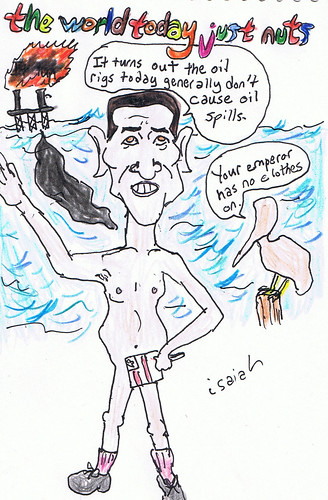
And having covered something important, we can now grab a laugh with Isaiah's The World Today Just Nuts "Gulf Coast Drilling Disaster 2010"

Gulf Coast Drilling Disaster 2010

Which brings us to Third. The following helped on the latest edition:


And Dallas! Some of us worked less than others. Ann, Kat, Elaine and I only worked on one thing. And what did we end up with:


Truest statement of the week -- This was Justin Raimondo of Antiwar.com. And they were going to go with just one truest . . .

Truest statement of the week II -- but Wally and Cedric brought this in and it was worth noting. We're hoping some of the CBC honesty proves catchy and that an American outlet might start doing something similar.

A note to our readers -- Jim's breaking down the edition. I spoke to Dona to get some background on the edition.

Editorial: Condolences, it's a Kagan -- Jim credits this to Ruth and that's the way it was. Ruth actually highlighted this comic not long ago at her site. And she mentioned it and everyone just agreed it was the thing to do. But everyone also agreed it was a short piece.

TV: They get paid for this? -- This was what I was most curious about. Ava and C.I. have a great article here but Jim notes that they raided Ava and C.I.'s piece for another one causing Ava and C.I. to have to go back and rewrite this. Dona thinks "it was a lot stronger" with the original parts. She advocated for leaving it alone and thinking up another topic. But Jim was insisting and Ava and C.I. went along on the promise that it would get them done quickly. That didn't happen. It was a long writing edition. I don't mean to imply this doesn't work. It does. But when they lost the health care aspect, they had to reinvent the opening and the ending and, Dona says, pull about one to two sentences out of every paragraph.


Roundtable -- Did Wally speak? He participated. Did he speak? NO!!!!! That was my question to Dona. She said, "Why do you point this out! You know I'm going to feel bad all day!" :D She will to. She tries to pay attention and make sure that everyone gets a chance to speak.


Don't list them as references -- This is a funny piece. I really like it. Dona rates it as one of her favorite of the short pieces this year. I can see why.


And that's why we got ObamaCare -- Okay, so they pulled out the quotes from Ava and C.I.'s TV commentary for this and they grabbed some of Ava and C.I.'s commentary and then expanded on it to make this article. It's an important article. And catches a really important point that's been ignored in the ObamaCare debate.


Iraq gay project has Movieline huffing homophobia -- Ty found this, however, Ty is not the Ty who left a complaint at the Movieline article. :D


Highlights -- Elaine, Ann, Kat and I worked on this and that's all we worked on. Wally, Rebecca, Cedric, Stan, Ruth, Betty and Marcia also worked on this.


Here's C.I.'s "Iraq snapshot:"


Monday, May 17, 2010. Chaos and violence continue, an 'antiwar' type praises George W. Bush, in the real world peace actions are being planned, tell the world it turns out Turkey is the model neighbor Iraq wants more of, no fraud found in Baghdad voting, two imans are targeted in today's violence, Janet Napolitano reveals a previously unknown desire to perform stand up, and more.

Starting with the Shame of the Movement. Little Raed Jarrar -- the Jar Jar Blinks of the Peace Movement. Today Jar Jar declares of the Status Of Forces Agreement, "It is very important to understand how we've managed to reach to the the current plan, which is a good plan aimed at ending the occupation completely." Note, "the the" is his typo. Didn't we always picture Jar-Jar as Eva Braun? Someone fly him to Highland Park ASAP so he can hop into the bunker with Bully Boy Bush. It's "a good plan." Gushing is second nature to Raed. No, it's a lousy contract. And the dope doesn't understand the US Constitution so he probably should sit his ass down, open a book and try to learn. It's clear he's never going back to Iraq. Fine, learn about this country or don't speak. Raed knows nothing about the law or the Constitution. He wastes his time -- when not posing as a Quaker (he's not a Quaker) -- and he wastes everyone else's. David Swanson, for all his many faults, grasps that the SOFA is unconstitutional. It flies right over Raed's head, so busy is he pulling his pud and exclaiming, "It's a withdrawal!" It's nothing of the sort. Raed's pimping Peace Action which ridiculously still brags on its website that they are "a leading member of the United for Peace and Justice and Win Without War coalition" -- yeah, the backstabbers who sold out the peace movement, hijacked it, turned it into a Get-Out-The-Vote action for the Democratic Party (which has not ended the Iraq War). You'll note how Peace Action ranks their goals by what gets listed first:

Peace Voter Campaign
Citizen Movement

How sad. Jar-Jar's an idiot. Ava and I gave up on educating him (he really seems to have some developmental issues) and I know Dona's had it with him as well. In
Friday's snapshot we were noting Nouri al-Maliki's summer of 2009 remarks about US forces remaining in Iraq after 2012. It doesn't matter whom you cite or what, Jar-Jar doesn't deal in reality. There is something seriously wrong with his head. In the real world William Rivers Pitt (Truthout) offers:

President Obama will not get the United States out of Iraq in his first term. If he wins a second term, it is highly unlikely he will get us out of Iraq before he finally leaves office.
Print that out and tack it to your wall. Six years from now, it will still be hanging there, yellow and curled, but entirely correct. We're not going anywhere.
[. . .]
Whether President Obama is a prisoner of this situation, or is actively continuing the policy, is entirely irrelevant at this point. He may hate this war, or he may love it, but at the end of the day, he will continue in the manner of his predecessor.
We're there, and unless this country erupts in a frenzy of furious protest and civil disobedience, we're staying. Even that may not make the nut, but it would be awfully nice to see this country shake itself out of its stupor and do what needs to be done.

Peace Mom Cindy Sheehan and Peace of the Action (not to be confused with Peace Action which just wants you to vote) are preparing for a Sizzlin' Summer Protest with a "Rethink Tyranny" 4th of July to kick things off at one in the afternoon in Lafayette Park. Monday through Friday (July 5th through 9th), Lafayette Park will be a meet up spot each morning and late in the afternoon. Afternoon protests will be in front of the White House during the day at the Smithsonian Air and Space Museum's Unmanned Aerial Vehicle display. The first week of summer protests will be celebrated that Saturday with a bash for Cindy Sheehan (July 10th is her birthday) and for the spirit of protest. There are many more July actions being planned and some are announced (click here). If you'd like to participate, they ask that you e-mail cindy@peaceoftheaction.org or josh@peaceoftheaction.org because they are attempting to get a head count.


Turning to Iraq and the post-election madness. Sunday,
Anthony Shadid (New York Times) reported that the results of the Baghdad recount (of the March 7th elections) have been released and there was no evidence of fraud, nor did the outcome change. Ayad Allawi's political slate remains 91 seats in the Parliament to Nouri al-Maliki's 89. al-Maliki's spokesperson declared no objections further indicating that the recount was always intended to be a stalling technique to question the legitimacy of Iraqiya's win allowing the raised doubts (and fears that al-Maliki would get his way) to sideline any attempts by Iraqiya to form a coalition-sharing alliance. Meanwhile Alsumaria TV informs, "Iraqi Prime Minister Nuri Al Maliki told Alsumaria that the State of Law Coalition has no other candidate than him for Premiership." Nouri also instilled the fear that backing Iraqiya was a lost cause because his 'helpmates' Ahmed Chalabi and Ali al-Lami were ensuring that various members of Iraqiya would not be seated. Today Anthony Shadid and Riyadh Mohammed (New York Times) report that a court issued a ruling today stating no elected candidate would be prevented from serving in the Parliament: "The decision Monday was handed down in the same obscure and capricious fashion that has plagued the entire de-Baathification process. It was not made public; that was left to Mr. Lami. Even as he promised to abide by the court ruling, he warned that he might open more cases against sitting members of Parliament. Electoral officials acknowledged being unclear over precisely what the decision said Monday." Ernesto Londono (Washington Post) adds, "The attempted disbarment of the candidates -- now newly elected members of parliament -- for alleged ties to Saddam Hussein's outlawed Baath Party was among the factors that prevented Iraqi officials from certifying the results of the election. [. . .] Maliki tacitly supported the disqualification process and was the driving force behind the recount in Baghdad. In the end, neither effort affected the seat distribution."Nouri played it very well. He knew Chris Hill, US Ambassador to Iraq, was both inept and a living failure. He knew he could make threats and bully and not even worry about Hill calling for a face-to-face talk over any of it. He knew that while Allawi, Iraq's Foreign Ministers and others called for US and UK involvement to ensure the post-election period was fair, the idiot Hill would continue to issue his 'everything is fine on the ground' reports to DC. He knew he could rob the store and burn it down and Hill would tell DC the 'real news' was that the store would be reopening. If you still haven't grasped what happened, try to do so now. Despite Nouri having all the power of the office, despite him tossing around bribes and election year promises, despite the press covering for him, despite the press insisting he (they should have said his party) was a shoe in and that it would win 100s of seats, the Iraqi people rejected him. Many Shi'ites rejected him by not voting. Others joined Sunni voters in voting for Iraqiya. Still others voted for the National Alliance. The big winner whom the press told you would dominate the elections barely came in second. The Iraqi people spoke. They wanted something different, they wanted something new. They were willing to risk an unknown in Iraqiya just because they knew they didn't want more of what Nouri had to offer. They did their part. They voted (or stayed home to register their objection). The election observers did their job. And yet despite that stunning upset, despite that huge rejection, thanks to Chris Hill, it now appears Nouri will remain in power. Something the majority of Iraqis did not want.

There may still be a challenge.
Waleed Ibrahim, Serena Chaudhry and Michael Roddy (Reuters) report, "Iraq's Sunni vice president [Tariq al-Hashemi] said on Monday that the cross-sectarian Iraqiya coalition he belongs to was more determined than ever to claim the right to form the next government after a recount maintained its election win." And that may be it because Saturday Hassan Abdul Zahra (AFP) reported that Moqtada al-Sadr's spokesperson was insisting al-Sadr no longer had any objection to Nouri being prime minister. (For life?) Reuters offers a breakdown on the basics once the results are certified. Reuters also notes, "After the last parliamentary election in 2005, violence erupted when politicians took more than five months to negotiate a new government." Elizabeth Palmer (CBS News) ponders whether a civil war is on the verge of breaking out.
And on that front,
Reuters reports Sheikh Abdullah Shakoor al-Salhy was beheaded today by assailants "wearing Iraqi military uniforms" and the iman's head was then put atop an electric pole in his Diyala Province village. AFP adds, "According to the Diyala military officer, in the village of Al-Bushaheen, 20 kilometres (12 miles) north of Baquba, gunmen burst into the home of Sheikh Hashim Arif at about 3:00 am (0000 GMT), dragged him to his garden and shot him dead in front of his family." And Press TV reports that a US helicopter crashed in Nasiriyah on Saturday.

Last week, Turkish press was still noting that Turkey had invaded Iraq's airspace (that's the way the
Turkish press billed it) as they chased after people they suspected of being PKK. Despite that (because of it?), Today's Zaman interviewed with Nouri al-Maliki's spokesperson Ali al-Dabbagh who made a surprising assertion, "Turkey is a very close friend of Iraq. We are proud that we have achieved this level in the relationship. Mr. [Iraqi Prime Minister Nouri al-]Maliki and [Turkish Prime Minister Recep Tayyip] ErdoÄŸan have that [shared] vision, and we at the different levels of the Iraqi government, most of us are sure that Turkey is our real partner, our strategic partner. And I think that our counterparts in Turkey feel the same. Iraq is a very important country for Turkey -- this understanding, this vision has spurred the relations to the level that they're at. It's a model partnership between two neighboring countries; we want to promote this model with Iran, we want to promote it with Saudi Arabia." Turkey should be the model for Iraq's interaction with other neighbors, according to Nouri's spokesperson.

Turkey's attacks are in northern Iraq -- which bothers Nouri very little and he'd most likely encourage more of them. Northern Iraq, the Kurdistan Regional Government, was the topic of
the most recent Inside Iraq (Al Jazeera) which began airing Friday.


Jasim al-Azawi: To discuss what lies behind the proposal of Massoud Barzani, president of the Kurdistan government, I am joined from Baghdad by Mohammad Ihsan, The Kurdistan Regional Government representative in Baghdad, and from London by Kurdish affairs analyst Fereydum Hilmi. Gentlemen, welcome to Inside Iraq. Fereydum Hilmi, this proposal as outlined by Massoud Barzani, the president of KRG in his interview to the New York Times, is a carbon copy of what [US] Vice President Joe Biden proposed almost two, three years ago and was rejected completely by the Iraqis as well as by Arab nationals and they called it the sectarian politics. So what makes Massoud Barzani go over an old ground?

Fereydun Hilmi: Well, Jasim, the proposal is not workable unfortunately -- of fortunately. Mr. Barzani has obviously taken the Joseph Biden proposal and he's trying to make a dream out of something which is not practical. I mean, he says that a united Iraq is a dream, but the proposal that he's come up with, and Joseph Biden has come up with, is also a dream. It cannot last. It may be possible to have three different heads or three different parts of Iraq, each ruling itself, with hardly anything between them to keep them together. And, of course, that would last for a very short length of time and it would disintegrate in the same way that a united Iraq is supposed to be disintegrating. The whole system, right from the start, was flawed. I said so right from the beginning. In this country we have had recently an election which has ended up in a hung Parliament. And this has been regarded as a disaster as far as Britain's concerned. Every body's very unhappy about it. They're trying to solve the problem. And yet in Iraq, they actually started with this disaster and they want to maintain such a sort of coalition whereas in Iraq, the differences are much greater, the conflict is much higher and the hatred between the two different --

Jasim al-Azawi: You used two words. Let me use them and throw them at Mohammad Ihsan. He called it a dream and he called it a disaster. The question begs itself again, why would the president of KRG go back to an idea that has been rejected by the Iraqis.

Mohammad Ihsan: First of all, good evening to you and good evening to your guest in London and your audience anywhere. First of all -- Second, it's not a proposal coming from President Barzani. Nor is it a photocopy or a copy coming from Biden. Iraq by itself now is a federalism. It's a federal state. And still we are discussing which sort of federalism we can adopt. One region or multiprovinces or two blocks or three blocks or four provinces or four regions or five regions? Still this is discussable among Iraqis and the idea of federal Iraq is not coming from Biden. It goes all the way back to [June] 1992 when the first INC conference in Vienna, then in Salahuddin [October 1992], then in London where most of the Iraqi opposition groups at that time adopted that system and currently Iraq is a federal state. It's not a propo -- It's not something new. But just Mr. Barzani, he stressed -- as has been -- as has been cleared through the article, Mr. Barzani, that he believed that the only hope left for stability -- which means for security -- to keep Iraq secure, divide it into three entities. Sunnis can be responsible for their security, Shia can be responsible for their securities and Kurds, they are now in charge of their security. If we look at the Kurd example, it's one of the best examples, so far Kurdistan, compared to other parts of the country, is secure. That was his intention, not dividing the country.

Fereydun Hilmi: Can I just say hello to you as well, Mohammad. I would like to ask you a question. You're saying we've got a federal state in Iraq. But, in fact, we don't have a federal state. We have a region that is governing itself and we have the rest of Iraq . . .

Mohammad Ihsan: That's it!

Fereydun Hilmi: There is no -- Yes, but it's not a federal state because a federal state has to have specific rules and regulations and it has to have specific laws to govern the various parts. You can't have just one federal state, which is Kurdistan, and a lot of Iraq, which is completely un - uncharted. There's no rule there. There's no rule of law. There's no government. You can't call it a government.

Mohammad Ihsan: Now-Now, Mr. --

Fereydun Hilmi: Can I just finish?

Mohammad Ihsan: Okay.

Fereydun Hilmi: The point is you can't -- you can't -- you can't build a room and then build a house to suit the room. Well that is what has happened here. We had a feder -- We had a state that was ruling itself and governing itself for 12 years. And then, suddenly, we are part of Iraq again and we want Iraq to be the same as us and we want to divide up Iraq into two other parts that will be similar to us. And that's not possible because the people of Iraq are different people. They have different relationships with their surroundings ---

Jasim al-Azawi: Let him answer that [crosstalk] But before he answers, let me just remind Mohammad Ihsan that federal law has never passed the Iraqi Parliament. Basically it's dead on arrival.


In other neighbor news, Saturday
Hassan Abdul Zahra (AFP) reported on the remarks of Saudi Arabia's Prince Turki al-Faisal, "Adding to the brutal mayhem taking place there, we are watching a deliberate effort on the part of the incumbent prime minister, Mr al-Maliki, to hijack the results of the election and deny the Iraqi people their legitimately elected government. The consequences of that are more bloodshed and potential civil war." An AFP story on the remarks themselves and their potential meaning notes, "Turki's comments reflected Riyadh's clear displeasure with Maliki since he became prime minister, with the Saudis refusing to open a full embassy in Baghdad and expressing suspicion of Maliki's relations with arch-rival Iran." With regards to the Palestinian issue, Turki states, "The Arab world has given Obama until Septemember to get things done. It is not enough to talk the talk. He has to walk the walk." Dow Jones provided the prince's full speech yesterday and these are his remarks on Iraq:On Iraq, I have consistently called for a United Nations Security Council Resolution, under Chapter 7 of the United Nations' Charter, guaranteeing Iraq's territorial integrity. With American forces due to leave Iraq next year, this is the only option that will meet the challenge posed by several Iraqi political factions whose main ambition is to partition Iraq. Equally sinister are the designs of some of Iraq's neighbors to take advantage of impending Iraqi internal conflict to advance their acquisition of Iraqi territories. We have already seen Iranian encroachment on Iraqi land at the beginning of the year. Imagine what will happen, once internal strife and fighting escalates. American withdrawal is nigh unto us, and, judging from the spike in bombings and killings that accompanied the recent election process in Iraq, the forces of evil are alive and well, and still, very much active. Adding to the brutal mayhem taking place there, we are watching a deliberate effort on the part of the incumbent Prime Minister, Mr. Nuri Al Maliki, to hijack the results of the elections and deny the Iraqi people their legitimately elected government. The consequences of that are more bloodshed and potential civil war. Hence, there is a vital need for a mechanism to protect Iraq from these developments and an international guarantee of its survival as a functioning sovereign state. The alternative is regional conflict on a scale not seen since the Ottoman-Safavid wars of the 17th and 18th centuries.As the actions of the US administration antagonizes Saudi Arabia, it's worth noting this from Richard Javad Heydarian (Asia Times):This century has witnessed China's emergence as the main challenger to the superpower status of the United States. In dramatic fashion, China is beginning to establish its foothold in the highly strategic, energy-rich region of the Middle East by forging strong ties with regional powers and gradually challenging US-Israel regional dominance. Thanks to decades of double-digit economic growth and accelerating military modernization, China now has both the need for and the capability of engaging the Middle East.

WikiLeaks knows no national boundaries. By providing the people with information that governments and corporations attempt to hide away, the organization has angered the Defense Dept. Monday April 5th, WikiLeaks released US military video of an assault in Iraq. 12 people were killed in the assault including two Reuters journalists Namie Noor-Eldeen and Saeed Chmagh. As Isaiah noted last month in "No Lasting Consequences," a cabinet official apparently gave the administration's response: "Appearing on ABC's This Week today, US Secretary of Defense Robert Gates weighed in on the July 12, 2007 assault in Baghdad in which 12 Iraqis were killed by US forces, 'But by the same token, I think-think is should not have any lasting consequences'." It's rather amazing and telling that Barack Obama has never been pressed by journalists to comment on the WikiLeaks video but apparently everyone works over time to keep the Killer-in-Chief's hands clean. Gates of course has many reasons to lash out including the fact that he was Secretary of Defense when the July 12, 2007 assault took place. This is far from the first time WikiLeaks has been targeted. On their website, in March, they published a US Defense Dept study by the Army's Counterinellgience Center which was prepared by Michael D. Horvath and [PDF format warning] entitled "Wikileaks.org -- An Online Reference to Foreign Intelligence Services, Insurgents, or Terrorists Groups?" From the paper's opening:(S//NF) Wikileaks.org, a publicly accessible Internet Web site, represents a potential force protection, counterintelligence, operational security (OPSEC), and information security (INFOSEC) threat to the US Army. The intentional or unintentional leaking and posting of US Army sensitive or classified information to Wikileaks.org could result in increased threats to DoD personnel, equipment, facilities, or installations. The leakage of sensitive and classified DoD information also calls attention to the insider threat, when a person or persons motivated bya particular cause or issue wittingly provides information to domestic or foreign personnel or organizations to be published by the news media or on the Internet. Such information could be of value to foreign intelligence and security services (FISS), foreign military forces, foreign insurgents, and foreign terrorist groups for collecting information or for planning attacks against US force, both within the United States and abroad. (S//NF) The possibility that a current employee or mole within DoD or elsewhere in the US government is providing sensitive information or classified information to Wikileaks.org cannot be ruled out. Wikileaks.org claims that the -- leakers‖ or -- whistleblowers‖ of sensitive or classified DoD documents are former US government employees. These claims are highly suspect, however, since Wikileaks.org states that the anonymity and protection of the leakers orwhistleblowers is one of its primary goals. Referencing of leakers using codenames and providing incorrect employment information, employment status, and other contradictory information by Wikileaks.org are most likely rudimentary OPSEC measures designed to protect the identity of the current or former insiders who leaked the information. On the other hand, one cannot rule out the possibility that some of the contradictions in describing leakers could be inadvertent OPSEC errors by the authors, contributors, or Wikileaks.org staff personnel with limited experience in protecting the identity of their sources. (U) The stated intent of the Wikileaks.org Web site is to expose unethical practices, illegal behavior, and wrongdoing within corrupt corporations and oppressive regimes in Asia, the former Soviet bloc, Sub-Saharan Africa, and the Middle East. To do so, the developers of the Wikileaks.org Web site want to provide a secure forum to where leakers, contributors, or whistleblowers from any country can anonymously post or send documentation and other information that exposes corruption or wrongdoing by governments or corporations. The developers believe that the disclosure of sensitive or classified information involving a foreign government or corporation will eventually result in the increased accountability of a democratic, oppressive, or corrupt the government to its citizens.WikiLeaks is in the news again due to efforts to target WikiLeaks' Julian Assange. Last night on Australia's Dateline (link has text and video, SBS), featured a report by Mark Davis.Mark Davis: Communications minister senator Steven Conroy, is preparing a growing list of internet sites that Australians will not be able to access and it's a list that cannot be seen or published. It's illegal to do so but of course WikiLeaks did and in turn earnt itself a place on the list.
Julian Assange: You know, it's a black list. How can we get off the black list? There is no procedure to get off the black list. I mean, it's a Soviet style system.
Mark Davis: The threat of you being served with legal papers, indeed the threat of you being arrested as you enter a jurisdiction has escalated dramatically.
Julian Assange: There are places, Dubai, who is trying to have us arrested, Switzerland under the bank secrecy laws, Cayman Islands. Australia had the Federal police in relation to its censorship list so there are some jurisdictions that from time to time it wouldn't be sensible to go there.
Mark Davis: Sensible or not, Assange entered Australia several days ago. He says immigration officials at the airport advised him that his passport was being cancelled on the premise that it was looking worn. Then at his mailing address he was greeted by this letter from senator Conroy's office, stating that the disclosure of the black list 'has been referred to the Australian Federal Police'. And that the media authority 'continues to liaise with the AFP on the matter'. As we go to air, the department of foreign affairs claim that his passport status is normal, but no one has yet advised Assange of that and no word yet whether the AFP have been able to contact him to help with their enquiries.

Nick Farrell (TechE) reports:
Wikileaks published a confidential Australian blacklist of websites to be banned under the government's proposed internet filter. It can only be assumed that the Australian government has moved prevent its dissidents from travelling to foreign parts and spreading rumours about the glorious Aussie regime.
Julian Assange told
The Age his passport was taken from him by customs officials at Melbourne Airport when he entered the country last week after he was told ''it was looking worn''.


Iraq was briefly noted at the White House today when veteran correspondent
Helen Thomas attempted to clue spokesperson Robert Gibbs in on a few basic facts.

Helen Thomas: What's the difference between your foreign policy and Bush's foreign policy?

Robert Gibbs: In what respect? In what issue?

Helen Thomas: In terms of the rest of the world -- Afghanistan, Iraq and so forth.

Robert Gibbs: Well, in Afghanistan, we committed three times the number of troops that were there during the Bush adminstration because we believe that was the central front on the war on terror.

Helen Thomas: Do you still think so?

Robert Gibbs: Absolutely.

Helen Thomas: Eight Americans killed on Saturday [in Afghanistan] and so forth; we keep killing and dying there.

Robert Gibbs: I don't think there's any doubt that Afghanistan and that region of the world present the most significant danger to our homeland in terms of possible planning of attacks and the possible providing of a safe haven if the Taliban were to come back in control as they were before 2001 and 9-11 --

Helen Thomas: You're in their country.

Robert Gibbs: I'm sorry?

Helen Thomas: Who's the enemy when you invade a country?

Turning to service member and veterans issues,
David Martin (CBS News) reports that the US army is recalling 44,000 combat helmets made by ArmorSource and that the army is not saying why they are being recalled but that the Justice Department has launched an investigation. Jeff Schogol (Stars and Stripes) states, "The Army has recalled 44,000 helmets because they failed ballistic tests, but it doesn't know where the helmets are, officials said Monday."

In England,
Laura Pitel (Times of London) reports on UK Lance Corporal Johnson Beharry who was highly decorated during the Iraq War and attempted to take his own life after returning to civilian life. David Willetts (The Sun) landed the interview with Iraq War veteran Johnson Beharry and link has text and video as well as Robert Marsh weighing in:Johnson's experiences must have been very difficult to come to terms with and this shows there is a huge need amongst veterans which isn't being met.Many former soldiers being looked after by Combat Stress say without our help they would either be dead or in prison.We launched the Enemy Within Appeal this year. The target is to raise £30million to develop the treatment in our three short stay residential centres and to expand by deploying 14 outreach teams.Robert Marsh works with Combat Stress which notes:Over the last five years the number of ex-Service men and women seeking our help has risen by 66% and we have a current caseload of more than 4,300 individuals. This already includes 94 Veterans who have served in Afghanistan and 390 who served in Iraq.Paul Bentley and Katherine Faulkner (Daily Mail) cover the story here. Meanwhile Benedict Carey (New York Times) reports on a new study published by The Lancet which states that mutliple deployments have less of an effect on British troops than they do on US troops and that "British troops who have fought in Iraq or Afghanistan suffer far lower rates of post-traumatic stress than Americans do". The Lancet's created a special online folder to highlight and explore the new study:Concerns have been raised about the psychological effect of continued combat exposure and of repeated military deployments. For the first time, an Article assesses the mental health of those deployed to both Iraq and Afghanistan from the UK perspective. An Editorial highlights several important messages arising from the study and key findings are discussed in an accompanying Comment and Podcast.

From the podcast:

Richard Lane: This week we're focusing on a study published online on Thursday May, 13th. It was funded by the UK Ministry of Defence and it concerns the health, particularly the mental health, of service personnel deployed in action to the conflicts in Iraq and Afghanistan. This follows up research from the same team who are at Kings College London in the UK in 2006. Let's now hear from two of the main investigators involved in the study from a press conference held in London this week, introduced by The Lancet's editor, Dr. Richard Horton. After that you'll hear first from Professor Simon Wessely from the Institute of Psychiatry at Kings College London. And then from Dr. Nicola Fear who is at the Academics Center for Defense also at Kings College.

Dr. Richard Horton: Welcome this morning. My name is Richard Horton from The Lancet. And, uh, very glad that you were able to come to launch a paper that we're publishing online tomorrow on the consequences of deployment of UK armed forces to Iraq and Afghanistan and looking at the mental health consequences. There are three of the authors of the study this morning and there will be questions afterwards. So let's start off with the principal author of this study, Professor. Simon Wessely from the Institute of Psychiatry.

Professor Simon Wessely: Thanks very much. Thanks for coming. You'll be amazed to know that we did actually plan to do this today because we thought, a week after the election, people would be fed up with politics and ready for some new stories and the room would be crowed out. This study began actually in 2003 with the start of the Iraq War and for the first time the UK MoD started to really take the concept of carrying out health surveillance on the armed forces seriously -- partly as a result of [. . .] Gulf War syndrome. And we were asked to carry out a study run from Kings, looking at a large random sample of those who were going to Iraq in 2003 and a large sample of those who weren't. And the idea was that this would be a rerun of the Gulf War kind of short shock as it were. One of the main questions at that time was would there be a rerun of the Gulf War Syndrome. So we did the study. We reported in 2005 that there hadn't been a Gulf War Syndrome. There hadn't actually been a deterioration in the mental health of our regular forces who had been in Iraq since 2003 to 2005 but there had been an impact on the mental health of reservists and we also reported that contrary to what many people might expect, one of the main problems that they had in the mental area was actually alcohol misuse rather than Post Traumatic Stress Disorder. And that we published in 2006 in Richard's journal. And of course since then, as you might say, the script didn't go exactly according to plan. The Iraq War continued and, indeed, by the time it had finished [for the UK] in 2009, it seemed to run on for as long as the Second World War. Casualties mounted. The south became much more dangerous to our forces than it had been previously and our rates of causalities started to mirror those of the US. And of course Afghanistan became a principal theatre of war as well, which it had not been up to that point and many of the forces now found themselves going back to Iraq or Afghanistan once or twice sometimes more than that. It will be common knowledge to you that issue around the mental health of the armed forces became a very, very hot media topic. Great concern was shown to individuals who clearly had returned from war with mental health problems including alcohol, homelessness and so on. And there was also talk that we might be facing in the future an epidemic of such problems. Not an unreasonable view because that was precisely what was happening over in the United States. And so it was -- We were asked to continue with the study which, in fact, had not been the original plan to reflect the changing circumstances and so what we did was, as you'll hear, we followed up, first of all, every single person that had been in the original study. And this is the first time ever that this has been done in the UK armed forces -- to have a prospective cohort study, as we call it, too look at what had changed in their health. But that group, of course, were getting older and many of them had left and we continued to trace them if they had left the forces but in order to make sure that the current study reflects what was going on at the moment, we introduced a new group of people, those who've joined the forces since 2003 and since then had had the opportunity to deploy to Iraq or Afghanistan. Finally, we introduced a third group of people to oversa -- to look at what was happening in Afghanistan. So the purist among you will realize that does make the paper a little bit complicated if you actually do get down to the methods which I'm sure you will. But that's just the way it is. Stuff happens.


A professor who quotes Donald Rumsfeld does not enstill trust but the more he speaks of that study, the more it fails to as well. So you're tracking a group of people since 2003 -- some who saw deployment and then, for a control group, some who did not -- except when you're not tracking them. Except when you're spoiling in the results by bringng in a new group?

They might qualify as biggest laugh of the day were it not for Janet Napolitano. Appearing before the Senate Committee on Homeland Security and Government Affairs this afternoon, she declared -- straight faced -- regarding the
Gulf Coast Drilling Disaster 2010, "Since day one, the Administration has engaged in an all-hands-on-deck response to this event." That was approximately one month ago and the ocean continues to have oil pouring into it. In fact, it was NPR, not the government, that informed us Friday that the amount pouring into the ocean "may be at least ten times the size of official estimates" (click here for Richard Harris' Morning Edition report). A month later and as many 84,000 barrels a day may be pouring into the Gulf waters and Napolitano wants to claim that the administration has been on the job since day one?

iraq
al jazeera
inside iraqjasim azawi
cindy sheehanpeace movement
wikileakssbsdatelinemark davistechenick farrelldow jonesthe asia timesrichard javad heydarian
the new york timesanthony shadidalsumaria tvcbs newselizabeth palmer
afphassan abdul zahra
the washington posternesto londono
jeff schogol
cbs news
david martin

Friday, May 14, 2010

Fringe

Friday at last!!!! :D Okay, first up we've got an NPR report from Morning Edition by Richard Harris and link's got audio and text:

RICHARD HARRIS: BP has repeatedly said there's no reliable way to measure their oil spill in the Gulf of Mexico by looking at the oil gushing out of the pipe. But scientists say there are actually many proven techniques for doing just that.

We asked Professor Steven Wereley at Purdue University to analyze videotape of the sea-floor gusher. He literally co-wrote the book on this technique, called PIV.

Professor STEVEN WERELEY (Purdue University): PIV is short for particle image velocimetry, and conceptually, it's a very simple technique.

HARRIS: A computer program simply tracks particles and calculates how fast they're moving. Wereley put the BP video of the gusher into his computer. He made a few simple calculations, and came up with an astonishing value for the rate of the oil spill - much higher than the official estimate of 5,000 barrels a day.

Prof. WERELEY: Seventy thousand barrels a day.

HARRIS: Plus or minus how much?

Prof. WERELEY: Oh, about 20 percent.

HARRIS: How confident are you in that?

Prof. WERELEY: Well, I guess I'm quite confident that it's within the bounds that we just discussed.

HARRIS: Given that uncertainty, the amount of material spewing out of the pipe could anywhere from 56,000 barrels to 84,000 barrels a day. It is important to note that it's not 100 percent oil. The very short video BP released starts out with a shot of methane.

Prof. WERELEY: And at the end, it seems to be mostly oil. And so there's potentially some fluctuation back and forth between methane and oil.

HARRIS: But assuming that the lion's share of the material coming out the pipe is oil, Wereley's calculations show that the official estimates are way low.

Prof. WERELEY: We're talking more than a factor of 10 difference between what I calculate and the number that's being thrown around.

This is Barack's Katrina and, just like Bush, it's revealing how inept he is. How unwilling to call out Big Oil he is.

This should have been addressed already instead Barack allows BP to dither along while our oceans are destroyed.

Okay, Fringe. Great, great episode. Amazing. Oliva crossed over with Walter and some others. She's trying to find Peter but also trying to prevent the destruction of the two worlds. Other World Walter? A criminal.

Last night, Stan and I flipped and talked each other's shows:


Here's C.I.'s "Iraq snapshot:"


Friday, May 14, 2010. Chaos and violence continue,


Oh, the stupidity. The Status Of Forces Agreement is a contract (it's a treaty) and as such it can be extended. We've gone over and over that point while idiots who want to pretend they know something about the law gas bag to the contrary. They don't know what the hell they're talking about.

We will spoon food one more time. If the SOFA could not be extended (or replaced with another contract), then you would not have Nouri al-Maliki speaking of US troops ever staying beyond the end of 2011, right? If it ends the war and the US occupation, then that's that. That means, since Thanksgiving 2008, I have been wrong and I have wrongly interpreted the SOFA and I didn't know what I was talking about. Except . . . Let's drop back to the
July 23, 2009 snapshot for this little detail:

Aljazeera reports, "The Iraqi prime minister has admitted US troops could stay in the country beyond 2011." Yeah, he did it today and it's only a surprise if you've never grasped what the Status Of Forces Agrement does and does not do. The Washington Post, for example, has one person on staff who understands the SOFA completely. That's one more than the New York Times has. Drop back to real time coverage (Thanksgiving 2008) and you'll see the Washington Post could explain what it did and didn't do and get it right. No other US outlet can make that claim. (The Los Angeles Times hedged their bets but did appear to grasp it in an article co-written by Tina Susman.) McClatchy Newspapers? Oh goodness, Leila Fadel made an idiot of herself over the SOFA. Even more so than the New York Times (Elisabeth Bumiller -- in December and January -- offered some realities but they were lost on the other reporters at the paper). The Times just got it wrong. Fadel got it wrong and sang praises of it. It wasn't reporting, it was column writing passed off as such. Today, Nouri declared, "Nevertheless, if the Iraqis require further training and support we shall examine this at the time, based on the needs of Iraq." Sound familiar? It should. This month you should have heard Adm Mike Mullen make the same statement, you should have heard General Ray Odierno make it over and over beginning in May and US Secretary of Defense Robert Gates has made it many times -- generally he's asked when he's visiting a foreign country because US reporters don't really seem to care. One exception would certainly be Dahr Jamail who was on KPFA's Flashpoints yesterday and explained, "We still have over 130,000 troops in Iraq. Troops are not being withdrawn from Iraq. They are being relocated to different bases, some of the bases still within cities, but they are not being withdrawn thus far." Dahr's latest book The Will to Resist: Soldiers Who Refuse to Fight in Iraq and Afghanistan has just been released this month. IPA provides this context from Global Policy Forum's James Paul: "For all the talk of 'U.S. withdrawal' from Iraq, the reality on the ground is starkly different. U.S. troops still patrol the cities, in flagrant violation of the U.S.-Iraqi security agreement, while Washington remains hugely influential in the politics of the country. The gigantic U.S. embassy looms large in Baghdad, U.S. forces still hold thousands of Iraqi prisoners in the vast U.S. prison camp in the southern desert, dozens of U.S. military bases remain in place including the sprawling 'Camp Victory' complex in Baghdad and Washington continues to press towards its ultimate goal -- the de facto privatization of Iraq's vast oil resources."

Nouri spoke of US forces remaining beyond the SOFA's 'withdrawal' -- that firm, firm SOFA. Ooops. That's because it's a contract. Both parties can follow every detail on the page and still decide that they want to extend it. That's how contracts work. We'll be kind and not name today's idiot, but, oh, the stupidity.

Idiot wants to pretend he knows the SOFA and he knows the law. He gives no indication that he knows either. First, he's unaware that a contract can be extended by the parties involved the agreement or replaced with another contract. The SOFA only exists to replace the UN mandate (the earlier contract which provided legal cover -- post-invasion -- for the occupation). The SOFA could be replaced with something else. Blathering on like an idiot, Idiot writes about "the governing document here is the bilateral Status of Forces Agreement which calls for a withdrawal of combat forces by the end of the summer and all forces by the end of 2011."

I'm not in the mood kids. Idiot doesn't understand the law. And the quote demonstrates he doesn't understand the SOFA. The SOFA has no call, repeating NO CALL, for a withdrawal of combat foces by the end of the summer. Why would it have that? Bush didn't put it in. That's Barack. And that's not in the SOFA. The SOFA was pushed through the Iraqi Parliament on Thanksgiving day 2008. Barack hadn't been sworn in. So sorry, Idiot, you don't know what the hell you're talking about. Read the SOFA and find the end of summer reference. It's not in there. (If the SOFA's too difficult for you to master, you can refer to
Karen DeYoung's Washington Post report from last March.)

On the topic of the drawdown, we'll note
Brian Montopoli (CBS News) today:

As CBS News National Security Correspondent David Martin
reported Thursday, "first the delay in the Iraqi elections and then the dispute over the results has forced Gen. Ray Odierno, the commander in Iraq, to slow down his withdrawal plans."
"Right now, it is still possible to move that many troops - but just barely," wrote Martin. "Any further delay in the drawdown will cause him to miss the deadline."

Justin Raimondo (Antiwar.com) weighs in:

With a
complicit Democratic majority in Congress, and a Republican minority all too eager to keep us bogged down in Iraq until Kingdom come, no one is holding the Obama administration accountable -- and the American public, which never hears anything about Iraq in the "mainstream" media, doesn't even know what's happening. They voted for Obama, in the Democratic primaries and the general election, in large part because he promised to end the war. That he now appears to be reneging on his firm pledge comes as no surprise to us foreign policy mavens, never mind observers of the Obama Method -- which is to strike an angular stance, and then come up with all sorts of convincing reasons for abandoning his position. To the majority of Americans, however, the pledge to get out of Iraq is carved in stone, and the only way to erase it is to shatter the tablet on which the President's electoral mandate is written. What the Democrats are counting on is the complicity of the "opposition" party, which is not going to make Iraq an election year issue -- except insofar as they see it as a "model" for how to win the war in Afghanistan. The administration is also counting on the silence of the "antiwar" left, in congress and at the grassroots, simply because these forces -- easily bought off, and/or intimidated -- haven't given them any reason to worry in the past.


Counter-insurgency is war against a native people. It's colonialism and it was used to trick and then attack and slaughter the Native Americans and it was used during Vietnam and at other periods. It has a long, long history and a long, long history of human rights activists calling this war on a people out. But that history sorts drops by the wayside in the last ten years. While some have called it out -- and certainly James Cameron's
Avatar drove the message home on what counter-insurgeny actually is -- people have been grossly silent. Barack groupies, of course, have to remain silent because Samantha Power, Sarah Sewell, Monty McFate, all of those counter-insurgency 'gurus' are Barack boosters and groupies don't call out their own. There is a development on the counter-insurgency front. Nancy A. Youssef (McClatchy Newspapers) reports it is now under internal criticism, "The biggest spur, however, is a growing recognition that large-scale counterinsurgency battles have high casualty rates for troops and civilians, eat up equipment that must be replaced and rarely end in clear victory or defeat."

Sahwa ("Awakening" Council and Sons Of Iraq are two other names) can be seen as a form of counter-insurgency or, more honestly, as paying the playground bully not to beat you up. Sahwa are Sunni fighters the US government put on the tax payer payroll because, as General David Petraeus and then-US Ambassador to Iraq Ryan Crocker repeatedly explained to the US Congress in April 2008, it stopped the Sahwa from attacking US military equipment and the US military. Nouri was supposed to have put them on the Iraqi payroll. It was announced repeatedly -- including in November 2009 -- but never really happened because "payroll" would mean every one of them would be paid and would be paid regularly.
Martin Chulov (Guardian) reports that the Sahwa remain under threat and their leaders are assigned bodyguards while Nouri continues to distrust them:

Major general Mudhir al-Mawla, the director of the Sons of Iraq file in Iraq's national reconciliation commission, confirmed the scepticism in the government: "Ever since they began, there have been members of Maliki's administration who oppose them," he said. "They said they are like a militia and they all need to be disarmed. But they have played a very important role in giving precise information because they are locals. They know the locals and they know where their allegiances lie."
In March last year, in a move that underscored the distrust, Maliki's troops arrested a Sons of Iraq leader in the central Baghdad district of Fadhil and a two-day battle ensued. Ever since, he has been reluctant to travel to the frontline areas.
"[Maliki] came here once," said Awakening Council leader Sabah al-Mashadani in what was once another no-go zone in Baghdad, the former battlefield suburb of Adamiyeh. "He was very surprised when he was well received. He said: 'I thought everyone hated me here'."
In Arab Jabour, Sheikh Moustafa has never seen the prime minister, but he has seen his special forces, who arrested the sheikh in January on trumped up charges that he had killed five local men in 2007. The US military quickly took responsibility for the killings and Sheikh Moustafa was released in Maliki's name.

Sahwa asserts they protect the region from al Qaeda in Iraq.
Lu Hui (Xinhua) reports, "Iraqi al-Qaida group has nominated its new leader called "minister of war" and vowed to continue deadly attacks with "dark days in blood color," said a statement posted on a militant website on Friday. The so-called "minister of war" of the Islamic State of Iraq was identified as al-Nasser Lideen Allah Abu Suleiman and he will replace Abu Ayyub al-Musri, who was killed in a military operation by Iraqi and U.S. forces last month"

Turning to Iraq,
Liz Sly and Raheem Salman (Los Angeles Times) declare, "In an embarrassing rejection of Prime Minister Nouri Maliki's efforts to overturn his rival's lead in Iraq's inconclusive parliamentary election, a laborious manual recount of votes in Baghdad has turned up no evidence of electoral fraud and will not change the final outcome, officials said Friday." I disagree and we'll get to why in a moment. Jomana Karadsheh (CNN) states "it's not good news for Prime Minister Nuri al-Maliki" and I disagree with that as well. Gabriel Gatehouse (BBC News) reports, "It took 11 days to recount by hand all 2.5m [million] ballots cast in Baghdad and the surrounding area. A spokesman for the electoral commission said the results would be made public on Monday and sent to the court for ratification." Khalid al-Ansary, Waleed Ibrahim, Jim Loney and Matthew Jones (Reuters) quote Independent High Electoral Commission spokesperson Qassim al-Aboudi stating, "There is no proof . . . that there was fraud or manipulation or big mistakes."

This is embarrassing for Nouri how? It be great if it were but how is it embarrassing if it is? Because no fraud was found? International observers were very clear that there was no fraud when Nouri was demanding a recount. If nothing had changed since then, this might be slightly embarrassing for Nouri. His political slate -- predicted to win -- had lost. If that were still the case, the recount results would be a major ha-ha.

But that's not how things stand. And the way it appears is Nouri stomped his feet for a recount but that was only one of the many stalling techniques he utilized to buy time to circumvent the Constitution and build a coalition. Screaming that there was fraud in the Baghdad recounts meant that others wouldn't rush to build a coalition with Ayad Allawi's slate (Iraqiya). Screaming fraud meant others might fear Allawi's lead would disappear. It bought time and Nouri, by that take, doesn't look embarrassed, he looks extremely crafty. Well played, puppet, well played. That hypothesis would explain why
Steven Lee Myers (New York Times) reports, "Mr. Maliki's supporters had once claimed that the recount could reverse as many as 20 seats, but a spokesman, Ali al-Mousawi, said on Friday evening that Mr. Maliki would 'respect the results of the recount in Baghdad, whatever they were'."


Meanwhile
Josh Rogin (Foreign Policy) reports on the post-no-fraud-recount scene in Iraq:

If Maliki is confirmed as Iraq's next prime minister, the U.S. will have a partner it knows well and has been carefully handling throughout the process. While some believe Maliki's actions in recent weeks show he will use any means to stay in power, the embassy's view is that he is something of an opportunist and can be encouraged to curb questionable behavior.
"Like any politician, Maliki will use all legal and political tools at his disposal," a senior embassy official said, referring to Maliki's work with the Accountability and Justice Commission, the controversial de-Baathification commission controlled by Ahmed Chalabi and Ali Faisal al-Lami.
Both Hill and his military counterpart, Gen. Raymond Odierno, have said publicly that Chalabi and Lami are heavily influenced by Iran and the embassy has no illusions about their goal. "This is an organization of questionable legitimacy employing less than transparent means to challenge a legitimate election," the senior embassy official said.
He also confirmed
reports that Hill will leave in July and be replaced by Ambassador to Turkey Jim Jeffrey. Stuart E. Jones, a deputy assistant secretary who handles Balkan affairs, will replace Baghdad No. 2 Robert Ford, who is still waiting out his stalled nomination process to become ambassador to Syria. Jones was previously the deputy chief of mission in Cairo.


In Tal Afar today, Iraqis attempting to enjoy a football game were greeted with bombings.
BBC News reports at least 10 people are dead and one-hundred-and-twenty wounded after a car bombing "at the entrance to the stadium" with possible bombings then following the first explosion. Khalid al-Tayi (AFP) notes the deaht toll climbed to 25 (cites Interior Ministry official for that figure) and quotes Hussein Nashad stating, "We heard a loud explosion and the people behind me shielded me from the shrapnel. I ran away, but then I heard someone shout 'Allahu akbar' (God is greatest), and then there was another explosion." Al Jazeera explains, "Friday's attacks follow blasts in the city last October and July that left dozens of people dead. In March 2007, 152 people were killed when truck bombs targeted markets in the town." In other reported violence . . .

Bombings?

Reuters notes a Baghdad bombing which claimed 4 lives and left eight people injured, a Mahaweel bombing which injured seventeen people and a failed bombing attempt in Tuz Khurmato on a provincial council member (who is also a Turkmen).

Shootings?


Reuters notes 1 police officer and one security guard were shot dead in Falluja by unknown assailants with silencers and 1 tailor ("specialising in military uniforms") were shot dead in Mosul.


In other Iraq news, Wednesday the
Center for Disease Control issued an alert for a Q Fever Infection: Increasing reports of Q fever among deployed U.S. military personnel due to endemic transmission in Iraq, as well as a large ongoing outbreak of Q fever in the Netherlands, may place travelers to these regions at risk for infection. Healthcare providers in the United States should consider Q fever in the differential diagnosis of persons with febrile illness, pneumonia or hepatitis who have recently been in Iraq or the Netherlands. Physicians are encouraged to submit samples for proper laboratory testing and contact the CDC for consultation if needed. Q fever cases in travelers should be promptly reported to proper authorities. Background Since Operation Iraqi Freedom commenced in 2003, over 200 cases of acute Q fever have been reported among U.S. military personnel deployed to Iraq. Since several of these cases were identified after returning to the U.S. or when they were no longer serving on active military duty, a heightened awareness for Q fever infection occurring in military personnel and civilian contractors is necessary to ensure prompt diagnosis and appropriate treatment. Q fever is endemic in the Middle East, and transmission may be influenced by hot, dusty conditions and livestock farming practices which may facilitate windborne spread. In addition, a large number of Q fever cases have occurred in the Netherlands since 2007, with over 3,700 human cases reported through March 2010. Infected dairy goat farms are believed to be the source of the outbreak, and the majority of human cases have been reported in the southern region of the country. To date, no imported cases of Q fever have been reported among American travelers returning home from the Netherlands. Because travelers to these countries may have a higher likelihood of exposure to Q fever, the CDC Rickettsial Zoonoses Branch advises that physicians evaluate travelers returning from Iraq (particularly military personnel and civilian contractors) and the Netherlands with febrile illness, pneumonia or hepatitis for potential Q fever infection. Probable and confirmed cases should be reported to their local or state health department. Q Fever Illness Q fever is a zoonotic disease with both acute and chronic phases caused by the pathogen Coxiella burnetii. The primary mode of transmission to humans is inhalation of aerosols or dust contaminated by infected animals, most commonly cattle, sheep or goats. Direct animal contact is not required for transmission to occur as the organism may be spread by dust or wind. Infections via ingestion of contaminated dairy products and human-to-human transmission via sexual contact have rarely been reported. Q fever does occur in the United States, but fewer than 200 cases are reported annually. Although asymptomatic infections may occur, an unexplained febrile illness, sometimes accompanied by pneumonia and/or hepatitis, is the most common clinical presentation. Illness onset typically occurs within 2–3 weeks after exposure. The mortality rate for acute Q fever is low (1–2%), and the majority of persons with mild illness recover spontaneously within a few weeks although antibiotic treatment will shorten the duration of illness and lessen the risk of complications. Chronic Q fever is uncommon (<1%>Washington Week begins airing on many PBS stations tonight (and throughout the weekend, check local listings) and joining Gwen around the table this week are Charles Babington (AP), Juliet Eilperin (Washington Post), Martha Raddatz (ABC News) and Pete Williams (NBC News). And Gwen's column this week is "The Blog Wars." Remember that the show podcasts in video and audio format -- and a number of people sign up for each (audio is thought to be so popular due to the fact that it downloads so much quicker). If you podcast the show, remember there is the Web Extra where Gwen and the guests weigh in on topics viewers e-mail about. And also remember that usually by Monday afternoon you can go to the show's website and stream it there (including Web Extra) as well as read the transcripts and more. Meanwhile Bonnie Erbe will sit down with Melinda Henneberger, Eleanor Holmes Norton and Genevieve Wood on the latest broadcast of PBS' To The Contrary to discuss the week's events. And at the website each week, there's an extra just for the web from the previous week's show and this week's it's the homophobic 'leader' who traveled with a paid male escort who hires himself out for sex. For the broadcast program, check local listings, on many stations, it begins airing tonight. And turning to broadcast TV, Sunday CBS' 60 Minutes:
The Blow OutScott Pelley investigates the explosion that killed 11, causing the ongoing oil leak in the waters off of Louisiana, and speaks to one of the oil rig platform crew survivors who was in a position to know what caused the disaster and how it could have been prevented. The report contains never-before-seen footage of the minutes after the explosion and new information about what led up to it.
Gustavo DudamelNow that he is the musical director of the Los Angeles Philharmonic, Gustavo Dudamel wants to transplant in the U.S. the Venezuelan child orchestra system that changed his life. Bob Simon reports.
60 Minutes, Sunday, May 16, at 7 p.m. ET/PT.


iraq
the washington postkaren deyoung
cbs newsbrian montopoli
antiwar.comjustin raimondo
the los angeles timesliz sly
bbc newsgabriel gatehouse

jomana karadsheh
the new york timessteven lee myers
mcclatchy newspapers
nancy a. youssef
the guardianmartin chulov
60 minutescbs newsto the contrarybonnie erbe
washington week