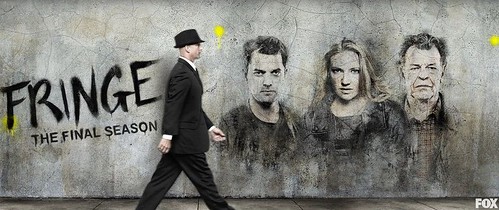
So it was a good return. And Amanda and Nikita were finally face to face.
Birkhoff, start of the episode, was with Sonya who revealed to him, as they all watched Nikita on the large screen in the control room, that she had passed on to Amanda that Nikita was coming. So it's a trap? Birkhoff can't believe Sonya would do that even with the kill chip in her head. And Birkhoff screams out, "It's a trap."
Just as he does, Nikita's facing Amanda's deadly blond. And the woman has this huge knife which she uses to slash Nikita's throat. Nikita can't believe it as the blood gushes out and Amanda watches.
Birkhoff, she asks into her comm, why didn't you warn me sooner?
Amanda announces she has no need for Sonya anymore and hits this remote control looking device. Sonya's still standing but her eyes are blood red and she's dead.
And thankfully this was all Birkoff's dream. But it forced him to go to Nikita.
What I didn't understand was why they didn't try to jam the signal or block it. They were talking about what they could do and that never crossed anyone's mind.
So Alex, Michael, Nikita, Birkhoff and their boss (I'm blanking on his name and he's been on since season one) plan a way to set a trap for Amanda and for her spy. Sonya was telling the truth that it wasn't just that she had to be a mole to avoid the kill chip, Amanda also had a mole in Division watching.
Who was it. That guy to her right (I think to her right) who was always shown in profile.
Alex really figured that out and exposed him. She had to take him down. Not before she and Michael had to pretend to be a couple to hook Amanda (who saw it as Nikita being miserable and needing Amanda). Also not before Michael outed her for doing drugs. Alex is apparently trying to go cold turkey because she can't see being in rehab and talking about killings.
So the bit match up with Amanda and Nikita.
After the manage to get the kill chip out of Sonya, they're able to go after Amanda. Michael and Nikita charage at her car. Blond goes after them. Amanda's saying not to hurt Nikita. (She wants her for something. I think a future plan or Nikita has something embedded that she's not aware of.) But blond tosses a grenade. It explodes sending Nikita's car hurling and tossing. It lands with a door on Michael's hand and Nikita's shaken up.
Blond comes running to kill her, ignoring Amanda. She and Nikta battle. Nikita wins, Blond is dead. But the car's on fire and Michael's trapped. His hand. Nikita cuts his hand free -- she cuts off his fingers. And that's the end of the episode.
Here's C.I.'s "Iraq snapshot:"
Wednesday, January 23, 2013. Chaos and violence continue, a bomb rips
through a funeral, ExxonMobil angles for the best oil deal it can get in
Iraq, one member of Barack Obama's Cabinet makes history today (Leon
Panetta) which may allow people to overlook that Secretary of State
Hillary Clinton screamed, snarled, laughed and had a meltdown before
Congress, and more.
Secretary of State Hillary Clinton appeared before Congress today. In the morning, she spun before the Senate Foreign Relations Committee, in the afternoon, she spun before the House Foreign Relations Committee. Does Hillary live in a bubble?
This morning, her voice broke as she read (from her prepared remarks), "I stood next to President Obama as the Marines carried those flag-draped caskets off the plane at Andrews. I put my arms around the mothers and fathers, sisters and brothers, sons and daughters."
Yes, she did meet with various family members. Equally true, a significant number of them have publicly rebuked her and the administration. Pat Smith is the mother of the late Sean Smith. She spoke with Anderson Cooper October 10th for CNN's Anderson Cooper 360. Here and here for video, here for transcript. Here's an excerpt of Pat Smith speaking about her son:
COOPER: Do you feel that you know what happened or are you still searching for answers? Have you been in contact with the State Department? Have they reached out to you and given you details of what happened?
SMITH: That's a funny subject. I begged them to tell me what was -- what happened. I said I want to know all the details, all of the details no matter what it is, and I'll make up my own mind on it. And everyone of them, all the big shots over there told me that -- they promised me, they promised me that they would tell me what happened. As soon as they figure it out. No one, not one person has ever, ever gotten back to me other than media people and the gaming people.
"No one," Pat Smith stated, "not one person has ever, ever gotten back to me other than media people and the gaming people." Charlie Woods is the father of the late Tyrone Woods. October 26th, he spoke with Megyn Kelly on America Live (Fox News).
Charlie Woods: My son was an American hero. And he had the moral strength to do what was right, even if that would professionally cost him his job, even if it would potentially cost him his life. He was a hero who was willing to do whatever was necessary to respond to their cries for help. If, in fact, those people from the White House were as courageous and had the moral strength that my son, Ty, had immediately within minutes of when they found there was the first attack, they would have sent, they would have given permission, not denied permission for those C130s to have gone up there.
The two parents above are not being partisan, they are being parents. We will note that Kate Quigley told Erin Burnett (Erin Burnett Out Front) that her family was getting updates. (Kate Quigley is the sister of the late Glen Doherty.) The families of Tyrone Woods, Glen Doherty and Sean Smith have largely been ignored/silence by the media. Even worse, their loved ones have gone unnamed over and over in reports which usually read "an attack that killed Chris Stevens and three other Americans."
Hillary did name all four. She also repeatedly noted there was one DS Agent still in Walter Reed (the agent's name was not given). But I didn't see anything that indicated this hearing was about that. Instead, we got a lot of nonsense, a lot of, "You are so wonderful, Hillary." That's garbage. You were there to ask questions. Four Americans are dead and I don't think "I am grateful" nonsense from senators recognizes the reality of those four deaths. Senator Ben Cardin walked the line very well, taking a brief moment to note Hillary's accomplishments and not getting lost in it. It's a real shame others couldn't do the same. Senator Robert Mendez was the acting Chair of the Senate Foreign Relations Committee. Bob Corker is the Ranking Member. ARB is Accountability Review Board. Senator Barbara Boxer waxed on about how "you stepped up" -- I don't know that the hearing established that.
One key exchange.
Ranking Member Bob Corker: To my knowledge, no one has been held accountable. Our staff had a meeting with one of the State Dept officials and I hate to use this word again but it was nothing short of bizarre as they talked about the communications. These officials were screaming out for more security. And I was just wondering if you might mention one reform that would be helpful so that you would have known of the needs of security that went undone.
Secretary Hillary Clinton: Well obviously, I have, uh, thought about this almost constantly since that date, Senator, uhm, you know I do feel responsible. I feel responsible for, uh, the nearly 70,000 people that work for the State Dept. You know, I take it very seriously. Uhm, the-the specific security requests, uhm, pertaining to Benghazi, you know, were handled by the security professionals in the department. I didn't see those requests. Uh, they didn't come to me. I didn't approve them. I didn't deny them. That's obviously one of the findings that Ambassador Pickering and Admiral Mullen made -- that these requests don't ordinarily come to the Secretary of State.
Ranking Member Bob Corker: If we could -- I know -- I respect you tremendously but we have short amount of time. They did come in to folks.
Secretary Hillary Clinton: That's right.
Ranking Member Bob Corker: We did have SST people on the ground at no cost to the State Dept. They were asked to be extended by the ambassador. Someone at the State Dept turned that down. They were at no charge -- 16 officers. So I just wonder, what has happened inside to make sure that never happens again?
Secretary Hillary Clinton: Well -- uh -- several things. Not only are we, uhm, on the path to implement all of the ARB recommendations but we've gone beyond that. Uhm, we did, uh, immediately do this high threat assessment using DoD assets as well as our own. That had never been done before. Uh, we have asked the Congress to help us, uh, reallocate funds. The Senate has given us that authority -- we-we don't yet have it from the House -- so that we can get more Marine guards, we can get more diplomatic security guards, we can try to put more money into the maintenance, the upgrades, the construction that's needed. I created the first ever -- it sounds like it should have been done years ago -- but first ever Department Deputy Assistant Secretary for High Threats. I'm also recommending that there be a regular process that includes the secretaries and the deputies in these decisions because nobody wants to sit where I am and have to think now about what coulda-woulda-shoulda happened in order to avoid this. Now, as I said, we've had 19 ARBS. Only two have ever been unclassified. The one coming out of the East Africa bombings where there was full transparency, there was a set of recommendations, many of which have been implemented, along with recommendations from other ARBS. But this Committee never had a public hearing about the 17 other ARBS because they were classified. So we're-we're-we're putting into action, steps that we think will help the next Secretary be able to make these decisions, be part of these decisions, have more insight into what is going on and we would, obviously, welcome the opportunity to work closely with a subcommittee or a set of members to make sure that that's what's happening.
That's a lot of words. If you know Hillary, and I do, she's not a "uhm" and "uh" and "the-the" type person. When she is that? She's hiding. That's reality. You can admit that or not.
But if you're on the fence about whether she's spinning, grasp that she used a lot of words. Ranking Member Bob Corker wanted to know -- and asked three times -- what she'd done that would ensure that the Secretary of State would be aware of the security needs and requests?
And Hillary couldn't answer it. She went on and on. To the point that Corker pointed out time was limited and re-directed her. She responded by going on and on and still not answering his question. So he tried asking it for a third time. And no answer.
That's not just disappointing, that's actually damning.
If you need to contrast? Senator James Risch asked her about what's going on in Algeria. She couldn't talk about it in terms of what it is but she, explained, she could talk about this ongoing situation in terms of the information she's receiving (that "we don't have anyway to confirm it" at present). Hillary didn't stammer once, she'd didn't pause and it wasn't until the end that she even fell into a "uh" (and there she was recalling what someone in another department had done). That question was out of left field. It played to her strengths, she is very knowledgeable. She is very smart. She thinks on her feet. She was pulling from news reports and briefings in her head, off the top of her head, and speaking eloquently and to the point. Contrast that completely unprepared for moment and how well she mastered it with her refusal to answer Corker's very basic question -- one she was asked three times.
Another serious issue "we knew we were piecing together what a host nation was not able to do." That Hillary speaking to Senator Marco Rubio. Who's insane idea was it that Libya could provide security? How many billions has the US government spent on Iraq's police and military? But the protection of the US staff there is US military and contractors. That issue has not been dealt with adequately by the press, by the Senate or by the State Dept. Do not say, "Well host countries provide security." No. Not in Iraq. According to Reuters timeline of the 2011 Libyan War, October 23, 2011, Libya is declared "liberated." The attack happened less than a year later. In what world does the US government assume that a regime not even a year old can provide adequate security? Don't distract with budgets or authorizations or other nonsense. Answer clearly who made the decision -- in State or out -- that the militias in Libya could protect US diplomatic staff?
"What difference at this point does it make!" she shouted to Senator Ron Johnson at one point in the hearing looking unhinged, unprofessional and, quite frankly, uncaring.
It was supposed to be a dramatic moment that showed her heart. She's a diplomat. Johnson was doing nothing but agreeing with her but she wanted a big TV moment apparently. Instead she's flying off the handle in a hearing where she's gotten more praise than any non-uniformed witness in the last six years. It wasn't pretty. Nor her attempts shortly afterwards -- during Senator Jeff Flake's line of questioning -- to laugh about the same topic ("we didn't [laughter] have a clear picture"). There are four people dead. I don't need to scream that as she did at Senator Johnson. But there are four people dead and America doesn't need your laughter, Hillary Clinton. She did not conduct herself in a professional manner and as this haunts and taints her legacy, look for people to step forward and insist it was health related and she should have waited a week or two longer before testifying. I'm not here to rescue her, I'm reporting what happened in the hearing and it was embarrassing. Wally will be covering Johnson's questions at Rebecca's site tonight, Ava will cover another aspect of the hearing at Trina's site and Ruth's covering it at her site (Ruth's offering an overview of the testimony Hillary offered).
It's public here that I supported Hillary in her 2008 run for the presidential nomination, that I like her and I know. I've also long shared that I can't stand Senator John McCain (Cindy McCain is a very sweet woman). I stated here as early as 2006 that I would not be voting for him. I would love to be reporting John McCain unleashed the crazy and Hillary was just amazing. But that's not what happened.
Senator John McCain: Four months -- or months -- after the Benghazi tragedy -- it's a tragedy when we lose four brave Americans, there are many questions that are unanswered and the answers, frankly, that you've been giving this morning are not satisfactory to me. Were you and the President made aware of the classified cable from Chris Stevens that said the United States Consulate in Benghazi could not survive a sustained assault? Numerous warnings -- including personally to me -- about the security were unanswered or unaddressed. It took a CNN reporter looking through the Consulate to find Chris Stevens' last warning. When were you made aware of that cable? When were you made aware of the attack on the British ambassador? And the assassination attempts? And the closing of the Consulates there? And what actions were taken? What were the president's activities during that seven hour period? On the anniversary of the worst attack in American history, September 11th, we didn't have the Department of Defense forces available for seven hours. Two brave Americans died in the last hour. With all these warnings, all these things took place, we didn't have a single Department of Defense asset apparently available to come to these rescue. I categorically reject your answer to Senator Johnson about 'Well, we didn't ask these survivors who were flown to Ramstein [Air Base] the next day that this was not a spontaneous demonstration.' You say that it was because an investigation was going on? The American people deserve to know answers and they certainly don't deserve false answers. And the answers that were given the American people on September 15th by the Ambassador to the United Nations [Susan Rice] were false -- in fact, contradicted by the classified information which was kept out of the Ambassador to the United Nations' report who, by the way, in the President's words, had nothing to do with Benghazi -- which questions why she was sent out to start with. Why is it that the administration still refuses to provide the full text of the e-mails regarding the deletions of references to al Qaeda and terrorism in the talking points? Why do we care? Because if the classified information had been included, it gives an entirely different version of events to the American people. Going to the American people and tell them what happened then you ought to have your facts straight -- including, the Ambassador said, "al Qaeda is decimated and our consulates and embassies are secure." So here we are, four months later, and we still don't have the basic information. Now if you want to go out and tell the American people what happened, you should have at least interviewed the people who were there instead of saying 'No, we couldn't talk to them because an FBI investigation was going on.' And, by the way, as I said at the time, I just happened to be on one of those talk shows, people don't bring RPGs and mortars to spontaneous demonstrations. That's a fundamental. And, of course, the president continued to say, days afterwards, September 12th, he made a reference to active terrorists, September 12th on 60 Minutes "too early to know," September 20th on Univision "we're still doing an investigation," September 24th on The View "we're still doing an investigation." The President of the United States, as late as September 24th, two weeks later, did not acknowledge that this was an act of terror conducted by people who were at least somehow connected to al Qaeda. And, finally, Madam Secretary, I strongly disagree with your depiction of what we did after [Libyan leader before the 2011 assault, Muammar] Gaddafi fell. We did not provide the security that was needed. We did not help them with border security. We did not give them the kind of assistance that would have been necessary to help dismantle these militias that still, to this day, remain a challenge to democracy in Libya and freedom. You knew Chris Stevens very well. I knew him very well. I knew him on July 7th, when I went to Libya to observe the elections. And at that time, on July 7th, he expressed to me his deep and grave concerns about security particularly in Begnhazi. And he continued to communicate with the State Dept -- and I don't know who else was privy to those cables -- of his deep concern about the security there and the need for additional assistance. And I will argue -- [will argue] with facts -- that after that event took place, after the fall of Gaddafi, the so-called 'soft footprint' was partially to some degree responsible for the tragedy that took place. The American people and the families of these four brave Americans still have not gotten the answers that they deserve. I hope that they will get them.
Secretary Hillary Clinton: Well Senator, I understand your very, very strong feelings. You knew Chris, you were a friend of Chris, you were one of the staunchest supporters of the efforts to dislodge Gaddaif and try to give the Libyan people, uh, a chance and we just have a disagreement. We have a disagreement about, uh, what did happen and when it happened, with respect to explaining, uh, the sequence of events. Uhm, we did get to, uh, talk to the DS Agents when they got back to this country. We did so. It was not before September 15th. We had no access to the surveillance cameras for weeks which helped to answer a number of questions. But with respect to helping the Libyans -- and that also goes to the question Senator Rubio asked -- we will provide a list of everything we were doing and were attempting to do but I will also tell you that since March 2011, Congressional holds have been placed on programs for many months for aid to Libya. Uh, we've had frequent Congressional complaints: Why are we doing anything for Libya, it's a wealthy country, it has oil, disagreement from some sources that we should never have been part of some UN mission in Libya. Currently, the House has holds on a bilateral security assistance on other kinds of support for anti-terrorism assistance, so we got to get our act together between the administration and the Congress if this is a priority and if we are serious about trying to help this government stand up security and deal with what is a very dangerous environment from east to west, then we have to work together, uhm, so I hope that, uh, we can have the kind of discussion where we can agree on, uh, certain approaches that will make a difference. We -- And, again, I would urge that you look and read both the classified 6and unclassified versions of the ARP that tries to deal with the very questions that you and Senator Johnson are raising -- the timing of it and the like. But I also hope we're looking forward because right now Libya is still dangerous, it is still in a very unstable status and whatever we can do for them we at least ought to agree we need to do and get out there and start delivering.
Again, a lot of words and none of them address the issues raised by McCain, do they? They do distract. He's asking about the failures and she's talking about how support needs to be firm for funding Libya. (Neither spoke of the illegal nature of the Libyan War -- the US involvement -- but War Hawks never do.)
It was an embarrassment and she might have been better off pleading health problems to avoid appearing before the Senate Foreign Relations Committee. We'll try to grab her appearance before the House Committee in tomorrow's snapshot and I also want to return to the Senate hearing to note something from Senator Bob Casey.
For now, the press made clear this morning that Iraq better have a ton of violence or they just aren't interested.
At least four dead and four injured meant nothing this morning to the world press. Alsumaria reports a Baquba car bombing claimed 1 life and left another person injured, 1 protest organizer, Mohammed Mustafa Hadi Jumail, was assassinated in Falluja, a Diyala Province bombing targeting a home left three family members injured, a Baghdad sticky bombing claimed the life of 1 senior officer in the Ministry of the Defense, and a Baghdad bombing outside the home of 1 Sahwa left him injured. All Iraq News notes that Mohammed Mustafa Hadi Jumail was also a Sahwa. Through yesterday, Iraq Body Count counts 256 violent deaths in Iraq this month. Alsumaria also reports that gunmen blew up towers and a generator at a division of Zain Telcom in eastern Mosul.
None of that mattered to the world press. Then came a Tuz Khurmatu suicide bombing at a funeral and that grabbed their attention. Duraid Adnan (New York Times) counts 35 dead and 117 injured -- "a number of high ranking regional dignitaries, military officers, professors and religious men among the Turkmen population." AFP's Prahsant Rao Tweeted:
Iraq suicide bomb at Shiite mosque kills 42 -@AFP's
latest wrap from Tuz: http://bit.ly/V7qOto
Pics: http://bit.ly/V7qQ4w
Expand
Photos by@AFP of the aftermath of today's suicide
bombing at a Shiite mosque in Tuz Khurmatu: http://www.imageforum-
Expand
Suicide bomb inside mosque in Tuz is single deadliest attack in Iraq since coordinated blasts in Taji on 23/7 - also killed 42 people
Expand
So it's the worst bombing in six months. The Washington Post's Liz Sly Tweeted this observation:
Another bombing in Iraq's Tuz Khurmato kills 42. Visited it in Nov; it's a tiny town, and people were terrified http://www.naharnet.com/
Expand
The Telegraph of London also counts 42 dead and quotes the Mayor Shallal Abdul stating, "Corpses are on the ground of the Husseiniyah (Shia mosque). The suicide bomber managed to enter and blow himself up in the middle of the mourners." Prensa Latina words it this way, "A man with a powerful explosive charge entered the husseiniya of the city of Tuyz Khurmatu and detonated the charge he was carrying amid the funeral service of a local politician's relative, who was shot the day before by an armed man, to cause the worst possible damage, witnesses told Al Manar television station." Zhu Ningzhu (Xinhua) adds, "The attacker targeted the funeral of a government employee killed the day before, who is a relative Ali Hashim, Shiite member of the Council of Salahudin province, the source said. Hashim and the deputy governor of Salahudin province were among the wounded, the source added." Mustafa Mohammed, Omar Mohammed, Aseel Kami, Patrick Markey and Louise Ireland (Reuters) quote injured survivor Abbas Qadir Mohammed stating, "I was sitting in the seats at the back when all of sudden I heard the sound of a huge explosion. Thank God I was behind because people in front of me saved me with their bodies." Mohammed Tawfeeq (CNN) quotes from a US Embassy in Baghdad statement:
This attack is meant to incite others into violence and is harmful to the interests of all Iraqis. We extend our condolences to the families of these victims, and hope for the swift recovery of those who were injured.
The worst attack in six months, Prahsant Rao noted citing July 23rd. From that day's snapshot:
Alsumaria notes the dead includes police officers and Sahwa members ("Awakenings" and "Sons/Daughters of Iraq") and that Baghdad, Nineveh Province, Diwaniyah Province, Kirkuk, Wasit Province, Diyala Province and Salahuddin Province were all targeted with bombs. Rami Ruhayem (BBC News -- link is video and text) reports, "Well the attacks took place all over the country in different cities. They seem to have targeted primarily security forces -- army as well as police -- checkpoints, convoys and even some police officers were targeted inside their homes. There have also been a number of incidents targeting civilians and marketplaces -- especially in Sadr City in Baghdad." In a sidebar on the right-hand side, the BBC notes the most violent attacks of 2012 and today replaces June 13th when 84 were killed and "nearly 300" wounded. Ala A. Nabhan and Sam Dagher (Wall St. Journal) add, "Several parked car bombs were detonated in markets packed with Ramadan shoppers in predominantly Shiite areas such as Baghdad's congested Sadr City district, the town of Taji northwest of the capital and the city of Diwaniya to the south, killing and wounding dozens, according to a Ministry of Interior official." Mark Leon Goldberg (UN Dispatch) notes over 100 dead.
Kareem Raheem (Reuters) puts
the death toll at 107.
Of today's violence, AP has a very strong report that, in the last third, features a strong round up of all the violence in Iraq today. BBC News adds, "In recent weeks, thousands of Sunnis have been holding mass protests in western Iraq against what they believe is discriminatory treatment by Prime Minister Nouri al-Maliki's Shia-dominated government." Protests continued today and are expected to be even larger tomorrow.
Alsumaria notes that MP Bahaa al-Araji (with Moqtada's bloc) declared yesterday that the failure to meet the demands of the protesters is aggravating the political crisis in Iraq. The UN Secretary-General's Special Envoy to Iraq is Martin Kobler. The United Nations this week began meeting with the protesters. Alsumaira notes that Kobler held a press conference in Kirkuk yesterday where he stated that the government needs to meet the demands of the protesters and that the UN doesn't see a resolve on the part of the Iraqi government currently to meet the protesters' demands. Kobler called for serious dialogue. Chris Fry covers the protests with "Opposition grows to Iraqi regime" (Workers World) and, from Fry's article, we'll note the protesters' demands:
The protesters are justly demanding:
1. The immediate release of detained protesters and dissident prisoners.
2 . An end to the death penalty.
3. The approval of an amnesty law for innocent detainees.
4. The abolition of anti-terrorism laws (especially Clause 4 used to target them).
5. The repeal of unfair rulings against dissidents.
6. Fair opportunities for work based on professionalism.
7. The end of the use of all military command based on geographic areas.
8. The provision of essential services to all areas in Iraq neglected by the guardian.co.uk, Jan. 17state.
9. The holding of all … governmental officials, army or security units who have committed crimes against dissidents accountable, especially those who have violated the honor of women in prisons.
10. A U.N.-sponsored population count.
11. An end to marginalization, a stop to agitating divisions between ethnic and religious groups, and a stop to the house raids without legal warrant based on the information of secret informers.
12. A stop to financial, administrative and legal corruption.
13. The combating of sectarianism in all its forms by returning religious buildings and all religious properties to their rightful owners, and the abolishment of law No. 19 of 2005.
The Maliki regime has used brutal repression to maintain its grip on power. The Baghdad government has admitted that it is holding 6,500 prisoners whom it accuses of “terrorism,” including 97 women, along with 15,000 prisoners for “civil” crimes, including 500 women. On Jan. 18, Baghdad TV announced that 97,000 people were arrested last November alone in Anbar, Diyalah and Salah-Adedeen provinces. (“Friday No Deception. Protesters to Maliki: Stop Cheating and Go Away,” Eman A. Khamas, Brussell’s Tribunal, Jan. 18)
The Kurdistan Regional Government notes a meeting (photo above) in Davos, Switzerland yesterday where KRG President Massoud Barzani and ExxonMobil CEO Rex Pilarson addressed oil exploration in the KRG. (Before Barzani arrived in Switzerland, he stopped in Germany where he visited the hospital where Iraqi President Jalal Talabani is being treated and he states Jalal's status has greatly improved.) Barzani was in Switzerland for the World Economic Conference. This follows Pilarson's meeting with Nouri al-Maliki this week to address ExxonMobil's plans in Iraq. Seeking Alpha notes speculation that ExxonMobil has received an offer from Nouri of "improved conditions" on the Iraq deal.
In the US, Secretary of Defense Leon Panetta announced a change of policy. Senator Patty Murray is the Chair of the Senate Veterans Affairs Committee and her office issued the following statement this afternoon:
FOR IMMEDIATE RELEASE
Wednesday, January 23, 2013
CONTACT: Murray Press Office
(202) 224-2834
Senator Murray's Statement on Sec. Panetta's Decision to Remove Ban on Women in Combat
Today, U.S. Senator Patty Murray, Chairman of the Senate Veterans' Affairs Committee, and a member of the Defense Appropriations Subcommittee, released the following statement on Secretary Leon Panetta's decision to remove the military's ban on women serving in combat.
"This is an historic step for equality and for recognizing the role women have, and will continue to play, in the defense of our nation. From the streets of Iraqi cities to rural villages in Afghanistan, time and again women have proven capable of serving honorably and bravely. In fact, it's important to remember that in recent wars that lacked any true front lines, thousands of women already spent their days in combat situations serving side-by-side with their fellow male servicemembers. I commend Secretary Panetta and the Joint Chiefs of Staff for their decision and look forward to working with them on quickly implementing the end of this ban.
Matt McAlvanah
Communications Director
U.S. Senator Patty Murray
202-224-2834 - press office
202--224-0228 - direct
matt_mcalvanah@murray.senate.
News Releases | Economic Resource Center | E-Mail Updates
Good for Leon Panetta. It is the right thing to do. There is concern that Barack's nominee for Secretary of Defense would be less of an advocate, so good for Panetta for acting and for making history. Ernesto Londono (Washington Post) reports:
Panetta made the decision “upon the recommendation of the Joint Chiefs of Staff,” a senior defense official said Wednesday, an assertion that stunned female veteran activists who said they assumed that the brass was still uneasy about opening the most physically arduous positions to women. The Army and the Marines, which make up the bulk of the military’s ground combat force, will present plans to open most jobs to women by May 15.
The Army, by far the largest fighting force, currently excludes women from nearly 25 percent of active-duty roles. A senior defense official said the Pentagon expects to open “many positions” to women this year; senior commanders will have until January 2016 to ask for exceptions.
The ACLU issued the following statement:
CONTACT: (212) 549-2666; media@aclu.org
“We are thrilled to hear Secretary Panetta’s announcement today recognizing that qualified women will have the same chance to distinguish themselves in combat as their brothers-in-arms, which they actually already have been doing with valor and distinction,” said Ariela Migdal, senior staff attorney with the ACLU Women’s Rights Project. “But we welcome this statement with cautious optimism, as we hope that it will be implemented fairly and quickly so that servicewomen can receive the same recognition for their service as their male counterparts.”
For more information please visit: www.aclu.org/womens-rights/
At Ms. magazine's blog, Rachel Kassenbrock reports on the historic development and notes:
Though this decision is a positive development, it will take time to implement and it remains unclear to what degree Congress will review the decision. As of now, the decision is receiving support from both sides: Sen. Kelly Ayotte (R-N.H.), remarked that the decision “reflects the increasing role that female service members play in securing our country.’’ Sen. Patty Murray (D-Wash.) chair of the Senate Veterans’ Affairs Committee, agrees:
Yes, we've already quoted Senator Murray. It's worth quoting her again because it's good to see some agreement from both sides of the Senate and because Senator Murray has raised the issue of women in combat as Chair of the Senate Veterans Affairs Committee and as a member of the Senate Veterans Affairs Committee before that. She has been one of the strongest voices in the Senate for the need to recognize that women are in combat in today's wars and they deserve to have the recognition for what their service actually was.
iraq
all iraq news
alsumaria
al mada
ayad al-tamimi
chris fry
workers world
the new york times
duraid adnan
alsumaria
the telegraph of london
reuters
patrick markey
afp
prashant rao
cnn
mohammed tawfeeq
xinhua
the washington post
ernesto londono
Secretary of State Hillary Clinton appeared before Congress today. In the morning, she spun before the Senate Foreign Relations Committee, in the afternoon, she spun before the House Foreign Relations Committee. Does Hillary live in a bubble?
This morning, her voice broke as she read (from her prepared remarks), "I stood next to President Obama as the Marines carried those flag-draped caskets off the plane at Andrews. I put my arms around the mothers and fathers, sisters and brothers, sons and daughters."
Yes, she did meet with various family members. Equally true, a significant number of them have publicly rebuked her and the administration. Pat Smith is the mother of the late Sean Smith. She spoke with Anderson Cooper October 10th for CNN's Anderson Cooper 360. Here and here for video, here for transcript. Here's an excerpt of Pat Smith speaking about her son:
COOPER: Do you feel that you know what happened or are you still searching for answers? Have you been in contact with the State Department? Have they reached out to you and given you details of what happened?
SMITH: That's a funny subject. I begged them to tell me what was -- what happened. I said I want to know all the details, all of the details no matter what it is, and I'll make up my own mind on it. And everyone of them, all the big shots over there told me that -- they promised me, they promised me that they would tell me what happened. As soon as they figure it out. No one, not one person has ever, ever gotten back to me other than media people and the gaming people.
"No one," Pat Smith stated, "not one person has ever, ever gotten back to me other than media people and the gaming people." Charlie Woods is the father of the late Tyrone Woods. October 26th, he spoke with Megyn Kelly on America Live (Fox News).
Charlie Woods: My son was an American hero. And he had the moral strength to do what was right, even if that would professionally cost him his job, even if it would potentially cost him his life. He was a hero who was willing to do whatever was necessary to respond to their cries for help. If, in fact, those people from the White House were as courageous and had the moral strength that my son, Ty, had immediately within minutes of when they found there was the first attack, they would have sent, they would have given permission, not denied permission for those C130s to have gone up there.
The two parents above are not being partisan, they are being parents. We will note that Kate Quigley told Erin Burnett (Erin Burnett Out Front) that her family was getting updates. (Kate Quigley is the sister of the late Glen Doherty.) The families of Tyrone Woods, Glen Doherty and Sean Smith have largely been ignored/silence by the media. Even worse, their loved ones have gone unnamed over and over in reports which usually read "an attack that killed Chris Stevens and three other Americans."
Hillary did name all four. She also repeatedly noted there was one DS Agent still in Walter Reed (the agent's name was not given). But I didn't see anything that indicated this hearing was about that. Instead, we got a lot of nonsense, a lot of, "You are so wonderful, Hillary." That's garbage. You were there to ask questions. Four Americans are dead and I don't think "I am grateful" nonsense from senators recognizes the reality of those four deaths. Senator Ben Cardin walked the line very well, taking a brief moment to note Hillary's accomplishments and not getting lost in it. It's a real shame others couldn't do the same. Senator Robert Mendez was the acting Chair of the Senate Foreign Relations Committee. Bob Corker is the Ranking Member. ARB is Accountability Review Board. Senator Barbara Boxer waxed on about how "you stepped up" -- I don't know that the hearing established that.
One key exchange.
Ranking Member Bob Corker: To my knowledge, no one has been held accountable. Our staff had a meeting with one of the State Dept officials and I hate to use this word again but it was nothing short of bizarre as they talked about the communications. These officials were screaming out for more security. And I was just wondering if you might mention one reform that would be helpful so that you would have known of the needs of security that went undone.
Secretary Hillary Clinton: Well obviously, I have, uh, thought about this almost constantly since that date, Senator, uhm, you know I do feel responsible. I feel responsible for, uh, the nearly 70,000 people that work for the State Dept. You know, I take it very seriously. Uhm, the-the specific security requests, uhm, pertaining to Benghazi, you know, were handled by the security professionals in the department. I didn't see those requests. Uh, they didn't come to me. I didn't approve them. I didn't deny them. That's obviously one of the findings that Ambassador Pickering and Admiral Mullen made -- that these requests don't ordinarily come to the Secretary of State.
Ranking Member Bob Corker: If we could -- I know -- I respect you tremendously but we have short amount of time. They did come in to folks.
Secretary Hillary Clinton: That's right.
Ranking Member Bob Corker: We did have SST people on the ground at no cost to the State Dept. They were asked to be extended by the ambassador. Someone at the State Dept turned that down. They were at no charge -- 16 officers. So I just wonder, what has happened inside to make sure that never happens again?
Secretary Hillary Clinton: Well -- uh -- several things. Not only are we, uhm, on the path to implement all of the ARB recommendations but we've gone beyond that. Uhm, we did, uh, immediately do this high threat assessment using DoD assets as well as our own. That had never been done before. Uh, we have asked the Congress to help us, uh, reallocate funds. The Senate has given us that authority -- we-we don't yet have it from the House -- so that we can get more Marine guards, we can get more diplomatic security guards, we can try to put more money into the maintenance, the upgrades, the construction that's needed. I created the first ever -- it sounds like it should have been done years ago -- but first ever Department Deputy Assistant Secretary for High Threats. I'm also recommending that there be a regular process that includes the secretaries and the deputies in these decisions because nobody wants to sit where I am and have to think now about what coulda-woulda-shoulda happened in order to avoid this. Now, as I said, we've had 19 ARBS. Only two have ever been unclassified. The one coming out of the East Africa bombings where there was full transparency, there was a set of recommendations, many of which have been implemented, along with recommendations from other ARBS. But this Committee never had a public hearing about the 17 other ARBS because they were classified. So we're-we're-we're putting into action, steps that we think will help the next Secretary be able to make these decisions, be part of these decisions, have more insight into what is going on and we would, obviously, welcome the opportunity to work closely with a subcommittee or a set of members to make sure that that's what's happening.
That's a lot of words. If you know Hillary, and I do, she's not a "uhm" and "uh" and "the-the" type person. When she is that? She's hiding. That's reality. You can admit that or not.
But if you're on the fence about whether she's spinning, grasp that she used a lot of words. Ranking Member Bob Corker wanted to know -- and asked three times -- what she'd done that would ensure that the Secretary of State would be aware of the security needs and requests?
And Hillary couldn't answer it. She went on and on. To the point that Corker pointed out time was limited and re-directed her. She responded by going on and on and still not answering his question. So he tried asking it for a third time. And no answer.
That's not just disappointing, that's actually damning.
If you need to contrast? Senator James Risch asked her about what's going on in Algeria. She couldn't talk about it in terms of what it is but she, explained, she could talk about this ongoing situation in terms of the information she's receiving (that "we don't have anyway to confirm it" at present). Hillary didn't stammer once, she'd didn't pause and it wasn't until the end that she even fell into a "uh" (and there she was recalling what someone in another department had done). That question was out of left field. It played to her strengths, she is very knowledgeable. She is very smart. She thinks on her feet. She was pulling from news reports and briefings in her head, off the top of her head, and speaking eloquently and to the point. Contrast that completely unprepared for moment and how well she mastered it with her refusal to answer Corker's very basic question -- one she was asked three times.
Another serious issue "we knew we were piecing together what a host nation was not able to do." That Hillary speaking to Senator Marco Rubio. Who's insane idea was it that Libya could provide security? How many billions has the US government spent on Iraq's police and military? But the protection of the US staff there is US military and contractors. That issue has not been dealt with adequately by the press, by the Senate or by the State Dept. Do not say, "Well host countries provide security." No. Not in Iraq. According to Reuters timeline of the 2011 Libyan War, October 23, 2011, Libya is declared "liberated." The attack happened less than a year later. In what world does the US government assume that a regime not even a year old can provide adequate security? Don't distract with budgets or authorizations or other nonsense. Answer clearly who made the decision -- in State or out -- that the militias in Libya could protect US diplomatic staff?
"What difference at this point does it make!" she shouted to Senator Ron Johnson at one point in the hearing looking unhinged, unprofessional and, quite frankly, uncaring.
It was supposed to be a dramatic moment that showed her heart. She's a diplomat. Johnson was doing nothing but agreeing with her but she wanted a big TV moment apparently. Instead she's flying off the handle in a hearing where she's gotten more praise than any non-uniformed witness in the last six years. It wasn't pretty. Nor her attempts shortly afterwards -- during Senator Jeff Flake's line of questioning -- to laugh about the same topic ("we didn't [laughter] have a clear picture"). There are four people dead. I don't need to scream that as she did at Senator Johnson. But there are four people dead and America doesn't need your laughter, Hillary Clinton. She did not conduct herself in a professional manner and as this haunts and taints her legacy, look for people to step forward and insist it was health related and she should have waited a week or two longer before testifying. I'm not here to rescue her, I'm reporting what happened in the hearing and it was embarrassing. Wally will be covering Johnson's questions at Rebecca's site tonight, Ava will cover another aspect of the hearing at Trina's site and Ruth's covering it at her site (Ruth's offering an overview of the testimony Hillary offered).
It's public here that I supported Hillary in her 2008 run for the presidential nomination, that I like her and I know. I've also long shared that I can't stand Senator John McCain (Cindy McCain is a very sweet woman). I stated here as early as 2006 that I would not be voting for him. I would love to be reporting John McCain unleashed the crazy and Hillary was just amazing. But that's not what happened.
Senator John McCain: Four months -- or months -- after the Benghazi tragedy -- it's a tragedy when we lose four brave Americans, there are many questions that are unanswered and the answers, frankly, that you've been giving this morning are not satisfactory to me. Were you and the President made aware of the classified cable from Chris Stevens that said the United States Consulate in Benghazi could not survive a sustained assault? Numerous warnings -- including personally to me -- about the security were unanswered or unaddressed. It took a CNN reporter looking through the Consulate to find Chris Stevens' last warning. When were you made aware of that cable? When were you made aware of the attack on the British ambassador? And the assassination attempts? And the closing of the Consulates there? And what actions were taken? What were the president's activities during that seven hour period? On the anniversary of the worst attack in American history, September 11th, we didn't have the Department of Defense forces available for seven hours. Two brave Americans died in the last hour. With all these warnings, all these things took place, we didn't have a single Department of Defense asset apparently available to come to these rescue. I categorically reject your answer to Senator Johnson about 'Well, we didn't ask these survivors who were flown to Ramstein [Air Base] the next day that this was not a spontaneous demonstration.' You say that it was because an investigation was going on? The American people deserve to know answers and they certainly don't deserve false answers. And the answers that were given the American people on September 15th by the Ambassador to the United Nations [Susan Rice] were false -- in fact, contradicted by the classified information which was kept out of the Ambassador to the United Nations' report who, by the way, in the President's words, had nothing to do with Benghazi -- which questions why she was sent out to start with. Why is it that the administration still refuses to provide the full text of the e-mails regarding the deletions of references to al Qaeda and terrorism in the talking points? Why do we care? Because if the classified information had been included, it gives an entirely different version of events to the American people. Going to the American people and tell them what happened then you ought to have your facts straight -- including, the Ambassador said, "al Qaeda is decimated and our consulates and embassies are secure." So here we are, four months later, and we still don't have the basic information. Now if you want to go out and tell the American people what happened, you should have at least interviewed the people who were there instead of saying 'No, we couldn't talk to them because an FBI investigation was going on.' And, by the way, as I said at the time, I just happened to be on one of those talk shows, people don't bring RPGs and mortars to spontaneous demonstrations. That's a fundamental. And, of course, the president continued to say, days afterwards, September 12th, he made a reference to active terrorists, September 12th on 60 Minutes "too early to know," September 20th on Univision "we're still doing an investigation," September 24th on The View "we're still doing an investigation." The President of the United States, as late as September 24th, two weeks later, did not acknowledge that this was an act of terror conducted by people who were at least somehow connected to al Qaeda. And, finally, Madam Secretary, I strongly disagree with your depiction of what we did after [Libyan leader before the 2011 assault, Muammar] Gaddafi fell. We did not provide the security that was needed. We did not help them with border security. We did not give them the kind of assistance that would have been necessary to help dismantle these militias that still, to this day, remain a challenge to democracy in Libya and freedom. You knew Chris Stevens very well. I knew him very well. I knew him on July 7th, when I went to Libya to observe the elections. And at that time, on July 7th, he expressed to me his deep and grave concerns about security particularly in Begnhazi. And he continued to communicate with the State Dept -- and I don't know who else was privy to those cables -- of his deep concern about the security there and the need for additional assistance. And I will argue -- [will argue] with facts -- that after that event took place, after the fall of Gaddafi, the so-called 'soft footprint' was partially to some degree responsible for the tragedy that took place. The American people and the families of these four brave Americans still have not gotten the answers that they deserve. I hope that they will get them.
Secretary Hillary Clinton: Well Senator, I understand your very, very strong feelings. You knew Chris, you were a friend of Chris, you were one of the staunchest supporters of the efforts to dislodge Gaddaif and try to give the Libyan people, uh, a chance and we just have a disagreement. We have a disagreement about, uh, what did happen and when it happened, with respect to explaining, uh, the sequence of events. Uhm, we did get to, uh, talk to the DS Agents when they got back to this country. We did so. It was not before September 15th. We had no access to the surveillance cameras for weeks which helped to answer a number of questions. But with respect to helping the Libyans -- and that also goes to the question Senator Rubio asked -- we will provide a list of everything we were doing and were attempting to do but I will also tell you that since March 2011, Congressional holds have been placed on programs for many months for aid to Libya. Uh, we've had frequent Congressional complaints: Why are we doing anything for Libya, it's a wealthy country, it has oil, disagreement from some sources that we should never have been part of some UN mission in Libya. Currently, the House has holds on a bilateral security assistance on other kinds of support for anti-terrorism assistance, so we got to get our act together between the administration and the Congress if this is a priority and if we are serious about trying to help this government stand up security and deal with what is a very dangerous environment from east to west, then we have to work together, uhm, so I hope that, uh, we can have the kind of discussion where we can agree on, uh, certain approaches that will make a difference. We -- And, again, I would urge that you look and read both the classified 6and unclassified versions of the ARP that tries to deal with the very questions that you and Senator Johnson are raising -- the timing of it and the like. But I also hope we're looking forward because right now Libya is still dangerous, it is still in a very unstable status and whatever we can do for them we at least ought to agree we need to do and get out there and start delivering.
Again, a lot of words and none of them address the issues raised by McCain, do they? They do distract. He's asking about the failures and she's talking about how support needs to be firm for funding Libya. (Neither spoke of the illegal nature of the Libyan War -- the US involvement -- but War Hawks never do.)
It was an embarrassment and she might have been better off pleading health problems to avoid appearing before the Senate Foreign Relations Committee. We'll try to grab her appearance before the House Committee in tomorrow's snapshot and I also want to return to the Senate hearing to note something from Senator Bob Casey.
For now, the press made clear this morning that Iraq better have a ton of violence or they just aren't interested.
At least four dead and four injured meant nothing this morning to the world press. Alsumaria reports a Baquba car bombing claimed 1 life and left another person injured, 1 protest organizer, Mohammed Mustafa Hadi Jumail, was assassinated in Falluja, a Diyala Province bombing targeting a home left three family members injured, a Baghdad sticky bombing claimed the life of 1 senior officer in the Ministry of the Defense, and a Baghdad bombing outside the home of 1 Sahwa left him injured. All Iraq News notes that Mohammed Mustafa Hadi Jumail was also a Sahwa. Through yesterday, Iraq Body Count counts 256 violent deaths in Iraq this month. Alsumaria also reports that gunmen blew up towers and a generator at a division of Zain Telcom in eastern Mosul.
None of that mattered to the world press. Then came a Tuz Khurmatu suicide bombing at a funeral and that grabbed their attention. Duraid Adnan (New York Times) counts 35 dead and 117 injured -- "a number of high ranking regional dignitaries, military officers, professors and religious men among the Turkmen population." AFP's Prahsant Rao Tweeted:
Iraq suicide bomb at Shiite mosque kills 42 -
 Prashant Rao
Photos by
Suicide bomb inside mosque in Tuz is single deadliest attack in Iraq since coordinated blasts in Taji on 23/7 - also killed 42 people
So it's the worst bombing in six months. The Washington Post's Liz Sly Tweeted this observation:
Another bombing in Iraq's Tuz Khurmato kills 42. Visited it in Nov; it's a tiny town, and people were terrified http://www.naharnet.com/
 Liz Sly
The Telegraph of London also counts 42 dead and quotes the Mayor Shallal Abdul stating, "Corpses are on the ground of the Husseiniyah (Shia mosque). The suicide bomber managed to enter and blow himself up in the middle of the mourners." Prensa Latina words it this way, "A man with a powerful explosive charge entered the husseiniya of the city of Tuyz Khurmatu and detonated the charge he was carrying amid the funeral service of a local politician's relative, who was shot the day before by an armed man, to cause the worst possible damage, witnesses told Al Manar television station." Zhu Ningzhu (Xinhua) adds, "The attacker targeted the funeral of a government employee killed the day before, who is a relative Ali Hashim, Shiite member of the Council of Salahudin province, the source said. Hashim and the deputy governor of Salahudin province were among the wounded, the source added." Mustafa Mohammed, Omar Mohammed, Aseel Kami, Patrick Markey and Louise Ireland (Reuters) quote injured survivor Abbas Qadir Mohammed stating, "I was sitting in the seats at the back when all of sudden I heard the sound of a huge explosion. Thank God I was behind because people in front of me saved me with their bodies." Mohammed Tawfeeq (CNN) quotes from a US Embassy in Baghdad statement:
This attack is meant to incite others into violence and is harmful to the interests of all Iraqis. We extend our condolences to the families of these victims, and hope for the swift recovery of those who were injured.
The worst attack in six months, Prahsant Rao noted citing July 23rd. From that day's snapshot:
Alsumaria notes the dead includes police officers and Sahwa members ("Awakenings" and "Sons/Daughters of Iraq") and that Baghdad, Nineveh Province, Diwaniyah Province, Kirkuk, Wasit Province, Diyala Province and Salahuddin Province were all targeted with bombs. Rami Ruhayem (BBC News -- link is video and text) reports, "Well the attacks took place all over the country in different cities. They seem to have targeted primarily security forces -- army as well as police -- checkpoints, convoys and even some police officers were targeted inside their homes. There have also been a number of incidents targeting civilians and marketplaces -- especially in Sadr City in Baghdad." In a sidebar on the right-hand side, the BBC notes the most violent attacks of 2012 and today replaces June 13th when 84 were killed and "nearly 300" wounded. Ala A. Nabhan and Sam Dagher (Wall St. Journal) add, "Several parked car bombs were detonated in markets packed with Ramadan shoppers in predominantly Shiite areas such as Baghdad's congested Sadr City district, the town of Taji northwest of the capital and the city of Diwaniya to the south, killing and wounding dozens, according to a Ministry of Interior official." Mark Leon Goldberg (UN Dispatch) notes over 100 dead.
Of today's violence, AP has a very strong report that, in the last third, features a strong round up of all the violence in Iraq today. BBC News adds, "In recent weeks, thousands of Sunnis have been holding mass protests in western Iraq against what they believe is discriminatory treatment by Prime Minister Nouri al-Maliki's Shia-dominated government." Protests continued today and are expected to be even larger tomorrow.
Alsumaria notes that MP Bahaa al-Araji (with Moqtada's bloc) declared yesterday that the failure to meet the demands of the protesters is aggravating the political crisis in Iraq. The UN Secretary-General's Special Envoy to Iraq is Martin Kobler. The United Nations this week began meeting with the protesters. Alsumaira notes that Kobler held a press conference in Kirkuk yesterday where he stated that the government needs to meet the demands of the protesters and that the UN doesn't see a resolve on the part of the Iraqi government currently to meet the protesters' demands. Kobler called for serious dialogue. Chris Fry covers the protests with "Opposition grows to Iraqi regime" (Workers World) and, from Fry's article, we'll note the protesters' demands:
The protesters are justly demanding:
1. The immediate release of detained protesters and dissident prisoners.
2 . An end to the death penalty.
3. The approval of an amnesty law for innocent detainees.
4. The abolition of anti-terrorism laws (especially Clause 4 used to target them).
5. The repeal of unfair rulings against dissidents.
6. Fair opportunities for work based on professionalism.
7. The end of the use of all military command based on geographic areas.
8. The provision of essential services to all areas in Iraq neglected by the guardian.co.uk, Jan. 17state.
9. The holding of all … governmental officials, army or security units who have committed crimes against dissidents accountable, especially those who have violated the honor of women in prisons.
10. A U.N.-sponsored population count.
11. An end to marginalization, a stop to agitating divisions between ethnic and religious groups, and a stop to the house raids without legal warrant based on the information of secret informers.
12. A stop to financial, administrative and legal corruption.
13. The combating of sectarianism in all its forms by returning religious buildings and all religious properties to their rightful owners, and the abolishment of law No. 19 of 2005.
The Maliki regime has used brutal repression to maintain its grip on power. The Baghdad government has admitted that it is holding 6,500 prisoners whom it accuses of “terrorism,” including 97 women, along with 15,000 prisoners for “civil” crimes, including 500 women. On Jan. 18, Baghdad TV announced that 97,000 people were arrested last November alone in Anbar, Diyalah and Salah-Adedeen provinces. (“Friday No Deception. Protesters to Maliki: Stop Cheating and Go Away,” Eman A. Khamas, Brussell’s Tribunal, Jan. 18)
The Kurdistan Regional Government notes a meeting (photo above) in Davos, Switzerland yesterday where KRG President Massoud Barzani and ExxonMobil CEO Rex Pilarson addressed oil exploration in the KRG. (Before Barzani arrived in Switzerland, he stopped in Germany where he visited the hospital where Iraqi President Jalal Talabani is being treated and he states Jalal's status has greatly improved.) Barzani was in Switzerland for the World Economic Conference. This follows Pilarson's meeting with Nouri al-Maliki this week to address ExxonMobil's plans in Iraq. Seeking Alpha notes speculation that ExxonMobil has received an offer from Nouri of "improved conditions" on the Iraq deal.
In the US, Secretary of Defense Leon Panetta announced a change of policy. Senator Patty Murray is the Chair of the Senate Veterans Affairs Committee and her office issued the following statement this afternoon:
FOR IMMEDIATE RELEASE
Wednesday, January 23, 2013
CONTACT: Murray Press Office
(202) 224-2834
Senator Murray's Statement on Sec. Panetta's Decision to Remove Ban on Women in Combat
Today, U.S. Senator Patty Murray, Chairman of the Senate Veterans' Affairs Committee, and a member of the Defense Appropriations Subcommittee, released the following statement on Secretary Leon Panetta's decision to remove the military's ban on women serving in combat.
"This is an historic step for equality and for recognizing the role women have, and will continue to play, in the defense of our nation. From the streets of Iraqi cities to rural villages in Afghanistan, time and again women have proven capable of serving honorably and bravely. In fact, it's important to remember that in recent wars that lacked any true front lines, thousands of women already spent their days in combat situations serving side-by-side with their fellow male servicemembers. I commend Secretary Panetta and the Joint Chiefs of Staff for their decision and look forward to working with them on quickly implementing the end of this ban.
###
Communications Director
U.S. Senator Patty Murray
202-224-2834 - press office
202--224-0228 - direct
matt_mcalvanah@murray.senate.
News Releases | Economic Resource Center | E-Mail Updates
Good for Leon Panetta. It is the right thing to do. There is concern that Barack's nominee for Secretary of Defense would be less of an advocate, so good for Panetta for acting and for making history. Ernesto Londono (Washington Post) reports:
Panetta made the decision “upon the recommendation of the Joint Chiefs of Staff,” a senior defense official said Wednesday, an assertion that stunned female veteran activists who said they assumed that the brass was still uneasy about opening the most physically arduous positions to women. The Army and the Marines, which make up the bulk of the military’s ground combat force, will present plans to open most jobs to women by May 15.
The Army, by far the largest fighting force, currently excludes women from nearly 25 percent of active-duty roles. A senior defense official said the Pentagon expects to open “many positions” to women this year; senior commanders will have until January 2016 to ask for exceptions.
The ACLU issued the following statement:
January 23, 2013
FOR IMMEDIATE RELEASECONTACT: (212) 549-2666; media@aclu.org
“We are thrilled to hear Secretary Panetta’s announcement today recognizing that qualified women will have the same chance to distinguish themselves in combat as their brothers-in-arms, which they actually already have been doing with valor and distinction,” said Ariela Migdal, senior staff attorney with the ACLU Women’s Rights Project. “But we welcome this statement with cautious optimism, as we hope that it will be implemented fairly and quickly so that servicewomen can receive the same recognition for their service as their male counterparts.”
For more information please visit: www.aclu.org/womens-rights/
At Ms. magazine's blog, Rachel Kassenbrock reports on the historic development and notes:
Though this decision is a positive development, it will take time to implement and it remains unclear to what degree Congress will review the decision. As of now, the decision is receiving support from both sides: Sen. Kelly Ayotte (R-N.H.), remarked that the decision “reflects the increasing role that female service members play in securing our country.’’ Sen. Patty Murray (D-Wash.) chair of the Senate Veterans’ Affairs Committee, agrees:
[The decision] is a historic step for recognizing the role women have, and will continue to play, in the defense of our nation. In recent wars that lacked any true front lines, thousands of women already spent their days in combat situations serving side-by-side with their fellow male service members.
Yes, we've already quoted Senator Murray. It's worth quoting her again because it's good to see some agreement from both sides of the Senate and because Senator Murray has raised the issue of women in combat as Chair of the Senate Veterans Affairs Committee and as a member of the Senate Veterans Affairs Committee before that. She has been one of the strongest voices in the Senate for the need to recognize that women are in combat in today's wars and they deserve to have the recognition for what their service actually was.
iraq
all iraq news
alsumaria
al mada
ayad al-tamimi
chris fry
workers world
the new york times
duraid adnan
alsumaria
the telegraph of london
reuters
patrick markey
afp
prashant rao
cnn
mohammed tawfeeq
xinhua
the washington post
ernesto londono