Tuesday, April 17, 2012

Revenge, Nikita and Fringe

Tuesday. You know I follow my favorite shows. And you probably know that Fringe is (yet again) in danger of being among the shows canceled. And Nikita might be as well. With Fringe, this has become a seasonal thing. And, as I pointed out Saturday, they have themselves to blame for this year: Giving us a sucky storyline that kept Olivia and Peter apart and then, when they finally learn that they are the real Olivia and Peter, refusing to give us the big scene where Peter tells her, "I know you're my Olivia."

And not only did they not give us that but they wasted an episode after, when all we care about is Olivia and Peter, by vanishing Peter and Olivia to devote an entire episode to Lincoln -- to two Lincolns in fact.

So if Fringe goes out this year, it's brought it on itself. No one asked them to piss on viewers all season long. Will I miss it? Yeah. But I won't miss this yearly jerk off that we've had going for some time now. They kept Peter and Olivia apart, remember, the season before by having Olivia (our Olivia) trapped on the alternate universe while fake Olivia was on this earth pretending to be her. But that was like 7 episodes. They didn't drag that out forever like they did this crap.

Anyway . . .

revenge

Rebecca's asked u to all note that her favorite show Revenge returns with new episodes (six in a row) tomorrow night on ABC.

That is a pretty cool show. Especially if you're a fan of Alexander Dumas' The Count of Monte Christo. (I love the book.) Emily (the blond pictured above) is out for revenge. Her father was wrongly imprisoned for terrorism. She was a little girl when that happened. Now she's an adult and she's out to destroy everyone who lied about her father.

On the issue of Fringe versus Nikita, I was asked which show I would save if I could only save one and I answered Nikita and thought that might upset some people.

Instead, all the e-mails on the topic have agreed that Fringe has dicked us around and that Nikita holds more promise at this point. Nikita because it doesn't have the pattern Fringe does of taking a huge section of the season to waste it with increasingly bad scenarios to keep Olivia and Peter apart.

So not only was that my vote, it's how others who weighed in voted as well.

Here's C.I.'s "Iraq snapshot:"

Tuesday, April 17, 2012. Chaos and violence continue, Nouri gets a press 'award' of sorts, we look at his long history of attacking the press since he became prime minister in 2006, the White House realizes (at least somewhat) that keeping Nouri happy won't hold Iraq together, corpses and bombings and shooting make it appear 2006 is stating a comeback, and more.
In Nouri al-Maliki's Iraq, everyone's targeted and that includes journalists. Nouri has long been anti-press. As we noted yesterday, Jane Arraf (Al Jazeera -- link has video and text) has asked Iraqi President Jalal Talabani about charges that Prime Minister and thug Nouri al-"Maliki is on the road to becoming a dictator" and Talabani denied the charge and stated, "There are some shortages -- it is not only him responsible. I am also responsible. I am responsible for looking after everything to guard the constitution. I must also speak, so we are all responsible for the shortages in the government." Yesterday's snapshot didn't have a working link to Jane Arraf's interview, my apologies. If Talabani agrees Iraq is his responsibility as well, he's going to have to learn to support and advocate on behalf of the press -- something he's never done, even before the Iraq War.
But let's focus on Nouri and his loathing of the press. At the start of the year, Canada's Centre For Law And Democracy released a report [PDF format warning] entitled "Freedoms in Iraq: An Increasingly Repressive Legal Net."
In recent years, the government has introduced a barrage of legislation relating to the fundamental freedoms of expression and assembly. In some cases, this legislation appears to be well intentioned, while in other cases positive interntions are less apparent. Regardless, all of these new laws, most of which have not yet been adopted, are problematical from the perspective of constitutional and international human rights guarantees.
This Report reviews five pieces of legislation affecting the freedoms of assembly and expression that have been introduced in recent years in Iraq. Of these, only one, the Journalistic Rights Law (Journalist Law), has actually been passed into law, in August 2011. The other four -- the draft Commission of Media and Communication Law (draft CMC Law), the draft Informatics Crimes Law (draft Internet Law), the draft Political Parties Law (draft Parties Law) and the draft Law of Expression, Assembly, and Peaceful Protest (draft Assembly Law) -- have not yet been formally adopted as laws.
[. . .]
One of the most problematical features of the five laws is that, taken together, they impose wide-ranging restrictions on the content of what may be published or broadcast through the media, during demonstrations, over the Internet and by political parties. These are in addition to the many content restrictions which are still found int he old 1969 Penal Code. A few issues receive particular attention in the new laws, such as public morals and more issues, incitement, in particular to religious hatred or criticism, and perhaps not surprisingly, public order and terrorism. Many of these fail to meet the standards of international law regarding restrictions on freedom of expression.
If a country really needed strong laws to provide a free press, it would be Iraq. Since becoming prime minister in 2006, Nouri's done nothing but attack the press. His disregard and hatred for it is well known and has influenced many incidents, most infamously a New York Times reporter had a gun aimed at them 'for fun' in the latter half of 2006, a gun aimed a pretend shot taken by one of Nouri's security forces who found the whole incident hilarious.
Therefore the proposals aren't really that surprising. Frightening, but not surprising. Of the proposed CMC Law, the Centre For Law And Democracy notes it is obsessed with "public morals" while the proposed Internet Law dictates that "moral, family or social values" must not be offended and similar dictates apply with the proposed Assembly Law. The Centre For Law And Democracy notes that speech that offends due to ideas can't be legitimately banned, the speech needs to do "harm to society" -- even so, the paper should be very clear -- and isn't -- because Nouri calls many things harmful to society including Iraqi politicians who criticize him.
Furthermore, the prohibited acts in these laws go well beyond public order and terrorism as normally understood. They also include undermining the constitution, jeopardising national interests, sending threatening or insulting messages or fabricated news, promoting terrorist ideologies (as opposed to terrorism per se) and publishing information about the manufacture of tools or materials usedd in terrorists acts.
These broad prohibitions simply cannot be justified. It is perfectly legitimate to 'undermine' (or criticise or seek to change) the constitution, as long as this is done through peaceful means. Otherwise, it would be a crime to seek to achiever any amendments to the constitution. The concept of 'national interests' is impossibly flexible. In many countries, it is a crime to make threats, but sending insulting messages is often perfectly legitimate or at worst may warrant a civil defamation suit. Similarly, promoting terrorism ideologies, whatever they may be, is not the same thing as inciting terrorism, and the narrower offence should be preferred.
Page 27 of the report notes the Journalists Rights bill. (PDF format warning, click here for that proposed law.) It was proposed in 2009 and modified in 2011. The modified version defines a journalist as "Every individual practicing a full time journalism job." This would leave out stringers, part-timers, freelancers and many other media workers. That's not an accident. The report doesn't point it out but Nouri's always attacked the press, always wanted them monitored as well. Let's drop back to the October 3, 2006 snapshot:
Operation Happy Talkers are on the move and telling you that Nouri al-Maliki offers a 'four-point' peace plan. You may have trouble reading of the 'four-point' plan because the third point isn't about "peace" or "democracy" so reports tend to ignore it. The first step has already been (rightly) dismissed by Andrew North (BBC) of the "local security committees": "In fact, most neighourhoods of Baghdad set up their own local security bodies some time ago to protect themselves -- because they do not trust the authorities to look after them." AP reports that the Iraqi parliament voted in favor of the 'peace' plan (reality title: "continued carnage plan"). Step three? Let's drop back to the September 7th snapshot:
["]Switching to the issue of broadcasting, were they showing episodes of Barney Miller or NYPD Blue? Who knows but police pulled the plug on the satellite network al-Arabiya in Baghdad. CNN was told by a company official (Najib Ben Cherif) that the offices "is being shut for a month." AP is iffy on who gave the order but notes that Nouri al-Malike started making warnings/threats to television stations back in July. CNN reports: "A news alert on Iraqi State TV said the office of Prime Minister Nuri al-Maliki ordered the office closed for a month."["]
Ah, yes, the puppet's war with the press. The so-called peace plan is more of the same. The third 'plank' is about the media. Which is why the "brave" US media repeatedly cites the first two and stays silent while a free media (something a democracy is dependent upon) walks the plank.
It's disgusting and shameful, the third 'plank.' The whole 'plan' is a joke. Reuters is one of the few to go beyond the first two 'steps' but even it does a really poor job and those over coverage of Iraq in the mainstream (producers to suits) are very concerned about this. (So why don't they report it?) The "plan" isn't a plan for peace, it's a plan for the puppet to attempt to save his own ass for a few more months. Lee Keath (AP) is only one of many ignoring the third step (possibly AP thinks readers are unable to count to four?) but does note that al-Maliki took office last May with a 24-point plan that, to this day, "has done little to stem the daily killings." Nor will this so-called 'peace plan.' The US military and the American "ambassador" have announced that Nouri al-Maliki better show some results ('after all we've paid' going unspoken).
So al-Maliki pulls a page from Paul Bremer's book and decides to go after the media. For those who've forgotten, on March 28, 2004, al-Hawza was closed down as a result of running a cartoon of Bremer leading to the violence in Falluja in April 2004.
Nouri's attacks on the press are as lengthy as his time in office as prime minister. It includes bring a lawsuit against the Guardian -- among others. January 12, 2011, Josh Halliday (Guardian) reported:
The Guardian has won its appeal against an Iraqi court ruling which judged that the paper had defamed the country's prime minister, Nouri al-Maliki.
The Iraqi National Intelligence Service (INIS) brought the libel action after the Guardian reported criticism of al-Maliki and the INIS in an article published in April 2009. The Al-Karakh primary court judged in November 2009 that the report was defamatory and ordered the Guardian to pay a fine of 100m dinar (£52,000).
However, the Iraqi appeal court ruled on 28 December that the article did not cause any defamation or harm to al-Maliki or the INIS, overturning the earlier court ruling.
With the above and so much more, these measures, largely drafted by Nouri and his inner circle, are anti-press isn't surprising. The Centre For Law And Democracy notes "we see in the collective approach of the five laws a dramatic lack of respect for the fundamental human rights to freedom of assembly and expression. In most cases, these rules seek to impose unwarranted restrictions on the exercise of these rights. Taken together with the broad content restrictions, as well as the undue degree of government control over the exercise of these rights, the five laws would impose very severe constraints indeed on basic human rights."
The findings are disturbing. What's even more disturbing is that the findings really aren't new. They've very similar to what the United Nations Assistance Mission For Iraq (UNAMI) found in the second half of 2009 [PDF format warning] Human Rights Report. For example:
Some of the law's provisions, however, give rise to concern. For example, the law gives broad discretionary power to govenrment, which could be used to restrict the right to freedom of expression. Several porvisions of the law clearly inhibit the realization of the rights of media workers; the prohibition of publishing materials which "compromise the security and stability of the country" is open to broad interpretation and may be abused by authorities. The draft law does not provide a guarantee for the protection of sources: rather, provisions state that the law requires the source to be revealed.
The draft law's narrow definition of a journalist as "one who works for press . . . and who is affiliated with the Iraqi Journalists' Syndicate" raises concerns about the ability of other media workers, such as editors, commentators, blogger, and freelancers to exercise their right to express their views publicly and in effect imposes a de facto obligation to register journalists. According to the law, media organizations operating in Iraq must issue contracts to journalists that have been prepared and authorized by the Iraqi Journalists' Syndicate. Not only contradicting article 39 of the Constitution which stipulates that no one shall be compelled to join any party.
It's nearly three years later and the proposed laws still have the same exact problems. There's been no improvement. In fact, it has worsened. In January of this year, the Society for Defending Press Freedom's Oday Hattem told Al Jazeera, "There is no freedom to workin journalism here -- if we compare the jounalism in Iraq with the West. [. . .] The political and freedom of speech situations are both descending. Maliki launched an attack on freedom of speech in February 2010, when he arrested tens of journalists and human rights activsts after the beginning of demonstrations in Baghdad."
I believe he's referring to February 2011. February 25, 2011 saw major protests in Baghdad and elsewhere in Iraq. It also saw Nouri crackdown on the press and activists. From February 26, 2011:
Yesterday Iraqis made their voices heard in multiple demonstrations. Wael Grace and Adam Youssef (Al Mada) report the disturbing news that after the demonstrations, four journalists who had been reporting on the protests were eating lunch when Iraqi security forces rushed into the restaurant and arrested them with eye witnesses noting that they brutal attacked the journalists inside the restaurant, cursing the journalists as they beat them with their rifle handles. One of the journalists was Hossam Serail who says that they left Tahrir Square with colleagues including journalists, writers intellectuals, filmmakers. They went into the restaurant where the Iraqi military barged in, beat and kicked them, hit them in the face and head with the handles of their rifles, cursed the press and journalists, put him the trunk of a Hummer. This is Nouri al-Maliki's Iraq -- the Iraq the US forces prop up at the command of the Barack Obama. Stephanie McCrummen (Washington Post) adds:

{}Four journalists who had been released described being rounded up well after they had left a protest at Baghdad's Tahrir Square. They said they were handcuffed, blindfolded, beaten and threatened with execution by soldiers from an army intelligence unit.
"It was like they were dealing with a bunch of al-Qaeda operatives, not a group of journalists," said Hussam al-Ssairi, a journalist and poet, who was among a group and described seeing hundreds of protesters in black hoods at the detention facility. "Yesterday was like a test, like a picture of the new democracy in Iraq." {}
Among those arrested and tortured were journalist and activist Hadi al-Mahdi. NPR's Kelly McEvers interviewed Hadi for Morning Edition after he had been released and she noted he had been "beaten in the leg, eyes, and head." He explained that he was accused of attempting to "topple" Nouri al-Maliki's government -- accused by the soldiers under Nouri al-Maliki, the soldiers who beat him. Excerpt:
Hadi al-Mahdi: I replied, I told the guy who was investigating me, I'm pretty sure that your brother is unemployed and the street in your area is unpaved and you know that this political regime is a very corrupt one.
Kelly McEvers: Mahdi was later put in a room with what he says were about 200 detainees, some of them journalists and intellectuals, many of them young protesters.
Hadi al-Mahdi: I started hearing voices of other people. So, for instance, one guy was crying, another was saying, "Where's my brother?" And a third one was saying, "For the sake of God, help me."
Kelly McEvers: Mahdi was shown lists of names and asked to reveal people's addresses. He was forced to sign documents while blindfolded. Eventually he was released. Mahdi says the experience was worse than the times he was detained under Saddam Hussein. He says the regime that's taken Sadam's place is no improvement on the past. This, he says, should serve as a cautionary tale for other Arab countries trying to oust dictators.
Hadi al-Mahdi: They toppled the regime, but they brought the worst -- they brought a bunch of thieves, thugs, killers and corrupt people, stealers.
September 8, 2011, Hadi al-Mahdi was assassinated in his home. Madhi had filed a complaint with the courts against the Iraqi security forces for their actions. Mohamed Tawfeeq (CNN) explains, "Hadi al-Mehdi was inside his apartment on Abu Nawas street in central Baghdad when gunmen shot him twice with silencer-equipped pistols, said the ministry official, who did not want to be identified because he is not authorized to speak to media."
Democracy and liberation haven't taken hold in Iraq but targeting the press certainly did. And today Nouri al-Maliki's Iraq can boast of one 'accomplishment' under his six years of leadership: Number one on the Committee to Protect Journalists' Impunity Index. Rachel McAthy (CPJ) explains:

Iraq remains at the top of the Committee to Protect Journalists (CPJ) Impunity Index for the fifth year in a row, with the press freedom group reporting that the cases of 93 journalists killed in the past 10 years remain unsolved.
The latest index, published annually by the group, lists the 12 countries that have seen at least five reporters killed with no resulting convictions from 2002 to 2011.
The CPJ reports that Iraq's rating for impunity "dwarfs that of every other nation" with a rating of 2.906 unsolved cases per million inhabitants.


Nouri was first named prime minister-designate April 22, 2006. It's been six years of stalling ever since. And it took a lot of stalling to ensure that 93 murders would go unsolved. That's the sort of 'leadership' Nouri's provided. What a proud day for him. What a sad day for Iraq and the press.
Staying with the topic of violence, Xinhua counts 13 dead in yesterday's violence and nine injured. Alsumaria reports a Kirkuk roadside bombing injured two people. And they note 1 police officer was shot dead outisde Mosul and a small child was left injured, 1 corpse was discovered in Dohak Province, 1 suspect was shot dead outside of Tikrit and 1 man apparently hanged himself in Basra. Sameer N. Yacoub (AP) reports Iraqiya MP Falah al-Naqeeb reports he escaped an assassination attempt last night in Taji. Iraqiya is headed by Ayad Allawi and is the political slate that came in first in the March 7, 2010 parliamentary elections. Nouri al-Maliki's State of Law came in second. Since December, Nouri's been demanding Deputy Prime Minister Saleh al-Mutlaq be stripped of his post and that Vice President Tareq al-Hashemi be arrested for 'terrorism.' Both al-Mutlaq and al-Hashemi are members of Iraqiya and Sunni. al-Hashmi tells Ipek Yezdani (Hurriyet Daily News), "We are facing a highly sensitive political crisis for the first time in nine years. If we cannot solve this crisis through the constitution and by sitting around a table, the future of my country will be gloomy and really worrying, and all options will be on the table. I hope none of them splits Iraq.' Sevil Kucukkosum (Hurriyet) adds, "Meanwhile, al-Hashemi has said he will stay in Istanbul for 'however long is necessary' and that Iraq needs Turkey's help in solving its political crisis. Al-Hashemi is currently residing with his family and guards at an apartment in Istanbul's Başakşehir district. In his temporary residence, al-Hashemi told Turkish daily Milliyet that his country needed him and that he would not allow his opponents to push him aside."
Nouri stomped his feet over the 2010 election results and demanded a recount and then wasn't happy with the recount. Ben Van Heuvelen (Washington Post) reminds today, "As the head of the Independent High Electoral Commission (IHEC), Haidari clashed with Maliki after the contested elections of March 2010, in which the prime minister's coalition placed a close second to the rival Iraqiya bloc, led by former prime minister Ayad Allawi. In one of the most significant disputes, Haidari rejected Maliki's petition to throw out thousands of votes for Iraqiya." Thursday he had the Independent High Electoral Commission's chair Farah al-Haidari and commission member Karim al-Tamimi arrested (they were released Sunday). Aswat al-Iraq reports:

A political analyst described the arrest of head of Election Commission Faraj al-Haidari as "a price for objecting the desires of Premier Nouri al-Maliki to control it".
Sarmad al-Ta'I told Aswat al-Iraq that "the arrest is a matter of vendetta and accounts settlements".
He added that "the case is grave with greater sensitivity due to the nearness of provincial elections that Maliki hopes to get a majority".
Ta'I added that Haidari was one of three who objected Maliki's policies.
The other two were the Governor of the Central Bank of Iraq Sinan al-Shibibi and ex-Chairman of Integrity Commission Raheem Ikaili.

Ayad al-Tamimi (Al Mada) reports plans to vote for the Electoral Commission to continue their work. But there appears to be some confusion over whether or not Faraj al-Haidari and Karim al-Tamimi could continue serving according to MP Mahmoud Hassan. Parliament needs to look at the files agains them to determine that issue and Hassan is calling for the formation of a parliamentary committee to examine the files and reach a conclusion so that the matter can be resolved quickly. If that seems helpful, remember it's a State of Law MP that brought the charges against the two men and remember that Hassan is State of Law.


Alsumaria reports the Kurdish Alliance is calling out Nouri's attempts to split them and rebuking his claim that they are dissatisfied with KRG President Massoud Barzani. (See yesterday's "Continued violence and chaos and Nouri gets catty.") As Mohammad Akef Jamal (Gulf News) observed yesterday of the ongoing political crisis, "The disagreements between the Al Iraqiya List and the State of Law Coalition has taken a back seat lately. The escalating differences between the central government and Arbil signal a breakdown of the biggest strategic alliance that was built outside Iraq prior to 2003, and one that worked on toppling Saddam Hussain's regime and has led the political process in the country ever since. The tension surrounding the Iraqi political process indicates it could be pushed towards the point of no return." KRG President Massoud Barzani visited DC two weeks ago and met with US President Barack Obama and Vice President Joe Biden. He made it very clear that the KRG needs friends and that the KRG isn't interested in one-way streets. He noted the history between the KRG and the US and how that history had built a relationship of trust which had been put into jeopardy with requests from the US repeatedly to back off this or compromise on this -- requests that come with promises from the US about what Nouri will do in exchange but the promises never emerge. He pointed to the US-brokered Erbil Agreement which ended the eight month Political Stalemate I which followed the 2010 elections. The US wanted Nouri to have a second term as prime minister. The Kurds ended up backing that but they were supposed to get -- and this is written into the agreement -- certain things in exchange. Nouri gladly grabbed a second term as prime minister and then refused to honor the Erbil Agreement.
Not only that but the KRG considers Kirkuk to be their province. The 2005 Constitution explains how the issue will be resolved: Census and referendum And, per the Constitution, Article 140, this is supposed to be taken care of by the end of 2007. Nouri's ignored it since 2006. And the Kurds were asked to make nice. April 5th, in DC, KRG President Massoud Barzani gave a speech and took questions. In reply to a question, he declared:
We have been waiting for the last six years for promises that were not delivered, for agreements that were not honored. We have waited and everytime they give us an excuse. Once they say that there are elections in Baghdad, another time, elections in the region. Once there is election in the United States. Then there is the Arab Summit, etc., etc. We have found out that we have passed six years waiting for these promises to be delivered. We cannot anymore wait for unfulfilled promises and undelivered promises. There has to be a specific and determined timeline for this to be delivered. We got tired of this and we are fed up with that. Therefore, what we will do is that we will work on the preferred option to work with the other Iraqi groups to find a solution. If not, then we go back to our people and to put all of these realities inf ront of our people for the people to be free to make their own decision. As far as the issue of the oil is concerned, in 2007, when we were working and we reached an agreement on a draft oil hydrocarbons law, we both agreed that if that law did not pass in the Parliament until May that same year that both sides -- the KRG and the federal government -- are free to continuing signing contracts with international oil companies. Therefore, whatever we have done in the region, we have not violated the Constitution. We have acted legally and Constitutionally within the framework of the Constitution.
As we noted then, "This speech was a declaration of independence on the part of the Kurds. The basic premise Massoud Barzani has outlined is: We will not be bound by empty words no matter who speaks them." In what is probably today's most important report, Alister Bull (Reuters) explains:
President Barack Obama, facing a damaging election-year problem if Iraq's political crisis worsens, has launched an urgent behind-the-scenes push to ease tensions between the Baghdad central government and the Kurds.
[. . .]
Reuters has learned that to demonstrate U.S. support, the White House and Congress agreed to lift a designation that treats Kurdistan's two main political parties as if they were terrorist groups, complicating members' travel to the United States. In addition, the U.S. consulate in Arbil will begin issuing U.S. visas before the end of 2012.


Meanwhile Al Rafidayn reports that the Ministry of the Interior (which still has no legal minister to run it so Nouri runs it -- and wants to, that's why he's refused to nominate a head for it all this time) is stating the cause of continued violence ("terrorism") in Iraq is due to the duplication of security -- there are too many security forces!

Yes, that is illogical. But carry it out, as Nouri no doubt will, and you've got Nouri eliminating or restricting all forces he doesn't control throughout Iraq. Throughout -- even in the three provinces that make up the KRG.

Monday, April 16, 2012

The scandal

Monday, Monday. I'm watching something called "Fly Jefferson Airplane." It's supposedly a documentary on the band but it's really just a few quotes between clips of them performing songs in concert of for TV shows.

I like Jefferson Airplane, so I'm okay with that. But if anyone's expecting a tough, hard-hitting look, they can forget it.

Which is a shame because Grace Slick's not someone who is shy. They have all the footage for a documentary, the filmmakers just didn't wan tto make one.

Kat's "Kat's Korner: Bonnie's got another classic" went up yesterday and I think she captured Bonnie Raitt's new album Slipstream perfectly. "God Only Knows" is my favorite track. I love the whole album but that track just stands out.

The Secret Service scandal. Jennifer Epstein (POLITICO) reports:


Defense Secretary Leon Panetta and Gen. Martin Dempsey, chairman of the Joint Chiefs of Staff, said Monday they were expecting a strong response to the alleged prostitution scandal that has enveloped 11 members of the Secret Service and at least five members of the military.

“Whether our forces are in Colombia or in any other country or here in this country, we expect them to abide by the highest standard of behavior,” Panetta said. “I don’t want to pre-judge it, but obviously, if violations are determined to have been the case, then those individuals will be held accountable.”

Can you believe that? Forget that prostitution is illegal, isn't the Secret Service supposed to be foucsed on protecting the president? Do they really think they're doing a good job protecting Barack when they're hooking up with prostitutes? David Nakamura and Scott Wilson (Washington Post) report:

The charges are triggering scrutiny of the culture of the Secret Service — where married agents have been heard to joke during aircraft takeoff that their motto is “wheels up, rings off” — and raising new questions at both the agency and the Pentagon about institutional oversight at the highest levels of the president’s security apparatus.

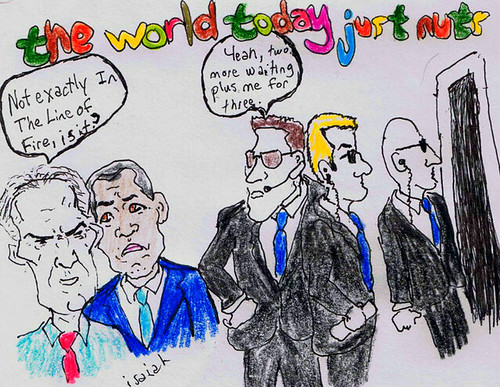
And this is the topic of Isaiah's The World Today Just Nuts "Spring Break Columbia: War On Women Edition" went up last night and Kat's "Kat's Korner: Bonnie's got another classic" went
up Sunday morning.

spring break columbia war on women edition

Along with Dallas, here's who worked on the edition:


The Third Estate Sunday Review's Jim, Dona, Ty, Jess and Ava,
Rebecca of Sex and Politics and Screeds and Attitude,
Betty of Thomas Friedman Is a Great Man,
C.I. of The Common Ills and The Third Estate Sunday Review,
Kat of Kat's Korner (of The Common Ills),
Mike of Mikey Likes It!,
Elaine of Like Maria Said Paz),
Cedric of Cedric's Big Mix,
Ruth of Ruth's Report,
Wally of The Daily Jot,
Trina of Trina's Kitchen,
Marcia of SICKOFITRDLZ,
Stan of Oh Boy It Never Ends,
Isaiah of The World Today Just Nuts,
and Ann of Ann's Mega Dub.

Now here's what we came up with:

I'm tired so that's it.


Here's C.I.'s "Iraq snapshot:"

Monday, April 16, 2012. Chaos and violence continue, Nouri's latest power-grab gets a little attention, Moqtada al-Sadr joins the list of people publicly rebuking Nouri, Bloomberg News warns that what everyone's watching Nouri do isn't even the half of it, and more.
In a new interview, Jane Arraf (Al Jazeera -- link has video and text) has asked Iraqi President Jalal Talabani about charges that Prime Minister and thug Nouri al-"Maliki is on the road to becoming a dictator" and Talabani denied the charge and stated, "There are some shortages -- it is not only him responsible. I am also responsible. I am responsible for looking after everything to guard the constitution. I must also speak, so we are all responsible for the shortages in the government." Well then Talabani needs to start exercising some responsibility and do so very quickly.
Yesterday Farah al-Haidari and Karim al-Tamimi were released from jail as was expected -- AFP reported Friday that they would "be jailed until Sunday, a fellow commission member told AFP." As noted in Friday's snapshot, last Tuesday the UN Secretary-General's Special Envoy Martin Kobler was praising the Independent High Electoral Commission to the United Nations Security Council and discussing how important it was to the upcoming provincial elections next year and then the parliamentary elections scheduled for the year after. So news that Nouri's had two members of that commission arrested on Thursday, as reported in real time by Raheem Salman (ioL news), was startling and alarming. Karim al-Tamimi serves on the commission while Faraj al-Haidari is the head of the commission.
How outrageous were the arrests? Saturday, Al Mada reported that Moqtada al-Sadr declared that the arrests were indications that Nouri al-Maliki might be attempting to delay the elections or call them off all together. He makes it clear that the the arrest needs to be based on eveidence and not on some whim of Nouri's and that it shouldn't be done because Nouri desires to "postpone or call of the election." Xinhua reported, "The government in Iraq's northern semi-autonomous Kurdistan region said Saturday that it has called on the central government in Baghdad to release the electoral commission's head and another member arrested on corruption charges." The Oman Tribune notes that the KRG issued the following statement on Friday: "The decision of the authorities in Baghdad to issue a detention order against Faraj Al Haidari and Karim Al Tamimi amounts to a gross violation and dangerous infringement of the political process. Such a decision is targeting the independence of the electoral commission ... We call (on the authorities) to reconsider the detention order immediately and refrain from persisting in insulting the democratic operation." As Mohamad Ali Harissi (AFP) observed, "Key political factions accused the premier of moving towards a dictatorship with the arrest of Iraq's electoral commission chief, a charge the prime minister denied on Saturday." W.G. Dunlop (AFP) quoted Iraqiya MP Haidar al-Mullah stating, "When the head of the independent electoral commission is being targeted, it means it is a message from the one who is targeting him that he is above the law and above the political process. The one who is standing behind this is the head of the State of Law coalition (Maliki), because he wants to send a message that either the elections should be fraudulent, or he will use the authorities to get revenge on the commission. This arrest is an indication that the judiciary has become an obedient tool in the hands of Mr Nuri al-Maliki."
Al Rafidayn explained Nouri al-Maliki released a statement Saturday decrying those who doubted the arrests were sound. The Baghdad court that Nouri controls made no attempt to even pretend to be impartial or about justice. The Supreme Judicial Council announced yesterday that Faraj al-Haidari had used UNHCR money to purchase plots of land and that he will face a seven year prison term for those actions. AFP spoke with al-Haidari after his release and he explained the charges are related to approved one-time bonuses for five employees of amounts between $80 and $125 (US equivalent). One-time bonuses to five employees. And he tells them this case was previously dismissed by the court but the State of Law MP bringing the charges filed an appeal. From the article:

He said that Hanan al-Fatlawi, an MP from Prime Minister Nuri al-Maliki's State of Law coalition, had pursued a large number of complaints against IHEC that eventually wound up with the Iraqi judiciary.
"For the last 6 months... the judiciary was sending warrants of investigation every day to the employees," Haidari said.

State of Law is the political slate that Nouri al-Maliki heads. Tim Arango (New York Times) points out, "Mr. Maliki has sought for two years to consolidate control over the electoral commission, whose independence is viewed as essential in ensuring that Iraqi elections are free from fraud, vote rigging and interference from political parties. Mr. Maliki's critics say the effort is a part of a pattern of power grabs -- his near total takeover of the security forces, a recent attempt to exert influence over the central bank and politically motivated arrests under the pretext of thwarting coup plots. And it reinforces a narrative that Mr. Maliki is emerging as an authoritarian leader in the wake of the American military withdrawl."
Meanwhile the editors of Bloomberg News note that the very visible power grabs aren't the end of the story:
More quietly, Maliki's government is pursuing worrisome measures that are potentially of greater long-term importance, as it crafts rules that will govern the new Iraq into the distant future.
These laws, regulating such things as mass communications and political parties, are necessary. Unfortunately, as detailed in a report by the Canada-based Centre for Law and Democracy, the versions drafted by Maliki's government for parliamentary approval would unreasonably hinder freedom of expression, assembly and association.
The Internet Bill provides for life imprisonment and heavy fines for offenses such as publishing information about the manufacture of "any tools or materials used in the planning or execution of terrorist acts." It sounds reasonable, but the measure could cover articles about the making of ink, paper, computers, guns, knives, or just about anything. An individual can be heavily fined or jailed for life for using a computer or information network to harm the reputation of Iraq. Similar laws elsewhere -- Turkey's infamous Article 301, for example, which made it a crime to "insult Turkishness" and a successor law that bars insulting the Turkish nation -- have inevitably led to dubious prosecutions and infringements on human rights.
And on to more violence. AFP notes that an Iraqi man apparently exploded his own Saadiyah home in the midst of an Iraqi military raid on the house -- in addition to his own life, the explosion killed 4 members of his family. In other violence, AP reports that 4 Shi'ite famers were shot dead today in Rashidiyah. ioL News notes yesterday saw a Taji home bombing which claimed the life of both parents and their five-year-old son ("a two-year-old girl survived but was wounded"), a Kirkuk car bombing claimed 1 life and left eleven people injured and a roadside bombing outside Nawafei village claimed the life of 1 man who was the son of a Sahwa leader. Margaret Griffis (Antiwar.com) notes other Sunday violence included a Wadi Hajar bombing which claimed the life of 1 police officer (three people injured), a Baghdad sticking bombing targeting a dentist claimed his life, 1 Shabak was shot dead in Mosul, 1 suspected assailant was shot dead by Mosul police, a Tuz Khormato home invasion claimed the life of 1 Iraqi soldier, 1 former government official was shot dead in Buhriz, a Gatoun bombing injured a woman and her daughter, a Tikrit bombing injured a police officer and "The body of the deputy major of Suleimaniya was discovered hanged in his jail cell. The family of Zana Hama Saleh insisted that he would not have committed suicide because he said he was awaiting release. No evidence of forced suicide was found. Saleh was detained on corruption charges." Alsumaria adds that a street cleaner was shot dead outside Tikrit.
On this week's Law and Disorder Radio -- a weekly hour long program that airs Monday mornings at 9:00 a.m. EST on WBAI and around the country throughout the week, hosted by attorneys Heidi Boghosian, Michael S. Smith and Michael Ratner (Center for Constitutional Rights), the hosts explored the topics of security, the law, the benefits, for whom, etc. with attorney and professor Natsu Taylor Saito who has written Meeting the Enemy: American Exceptionalism and International Law. In the section we're about to excerpt, they have been discussing the move to punish people for their perceived power, to silence a dream by silencing them.
Heidi Boghosian: There's -- There's so many names of individuals in this condition. Russell Maroon Shoatz also a former Black Panther who's been incarcerated I think almost 40 years but half of that has been in solitary confinement at SCI Greene in Pennsylvania. The reason they give there is that they're afraid that, at the age of seventy almost, that he will be seen as a leader, a political leader who will inspire other inmates to resist.
Natsu Taylor Saito: Yes. And what we're seeing is back in the 60s and 70s when they were targeting political activists -- when the federal government was targeting political activists -- it was clear that they were identifying people because of their ability to influence others. Like Fred Hampton, for example. Killing Fred Hampton was very significant because he was being effective in mobilizing a true rainbow coaltion -- not because he was a Black separatist or, you know, whatever.
Heidi Boghosian: Right.
Natsu Taylor Saito: But they were always pretending like that's not what it was about. And now they're coming out and being quite blatant, right? Your ideas, your ability to have what some of us would consider a positive influence on other inmates or young people who are incarcerated makes you dangerous and therefore we will impose these conditions. And that's really sort of the trend I see generally with so much of what has been happening recently is the taking of these political suppression techniques that were at least covert in the 60s and 70s and bringing them out, normalizing them, legitimizing them in their framework. You know, making them technically legal and pushing one step further each time with the PATRIOT Act, the Defense Authorization Act this time. You know, taking these types of COINTELPRO measures of spying on people and putting in informants and falsely accusing and arresting people and even assassinating people. We see that all being out in the open. And I find that particularly frightening that there seems to be acquiescence with that process.
Heidi Boghosian: We've seen it with the establishment of communications management units in which individuals such as Daniel McGowan, who was an animal rights activist, has been basically locked away, kept out of communication from others and it does seem that even in those movements that have emerged in the last, you know, 15 or 20 years, those techniques that you described are now routinely now applied to target leaders or charasmatic individuals who have a demonstrated track record that they can work to effect change.
Natsu Taylor Saito: Yes, it's like you are not allowed to be an effective communicator of the so-called wrong ideas. And even if we look at Lynne Stewart's case, right? They tagged her with terrorism offensives for facilitating a communication that everybody can see had no actual effect. But it was a communications restriction on her client that ended up getting her convicted.
Michael S. Smith: Yeah. She issued a press release and, for doing that, they put her away for ten years.
Natsu Taylor Saito: Mmm-hmm.
Michael S. Smith: And ironically, the person whom she was representing, his movement looks like it's coming into substantial power in Egypt.

Natsu Taylor Saito: That is interesting.
Michael S. Smith: I read a very good article that you wrote some years ago after the US PATRIOT Act was passed and one of the questions you posed, talking about homeland security, and you said, "Whose homeland and whose security?" That was seven years ago. Can you bring that up to date and ask that question again?
Natsu Taylor Saito: Yes. I think that really is becoming more and more clear. And it sort of ties back to some of the themes of this notion of American exceptionalism. You know, who is the American that's supposed to be so exceptional? And what is the America that is supposed to be so exceptional? I really see that reflected -- sort of frighteningly -- across the political spectrum. Like, I think in campaign rhetoric of the Republican primaries right now you see this constant reference to America being exceptional and we want to bring the country back to what it was and it's like whose country are they talking about? And who are they excluding? And it's fairly clear that they're not talking about people of color, they're not talking about poor people -- any of these other groups though sometimes they claim to be populist. But we also see it with the Obama administration authorizing of assassinations and indefinite detentions of American citizens. Well which American citizens are we talking about? And are they more secure? Are any of us more secure when this all rest on some secretive executive branch decision? And even with movements that seem to have, in many ways, wonderful political potential -- like the Occupy movement -- there is a sort of homogenizing of who it is we're talking about. And one example that will probably make your listeners hate me is in Denver there was an effort made by folks in the American Indian Movement and the community here in Denver to get the Occupy folks to acknowledge that -- there has to be acknowledgment of the fact that this land was taken from American Indians and that American Indians still have a right to self-determination -- not to just be lumped into 'we all want a share of this ill gotten pie,' right? But when that was taken apparently to the national movement, it was resoundingly rejected as being divisive. And, to me, that illustrates this notion that we get to define who's American and then then we get to propose a course of political action on their behalf. But each of these sectors has exclusionary definnitions of who's an American. And I find that really troubling.
Heidi Boghosian: Natsu, going back to your book Meeting the Enemy: American Exceptionalism and International Law, I think it's been a year since we've had you on to talk about that and we've been disappointed with President Obama's record: the invasion of Libya, other military actions, you've referenced some of our policies. But what's your take on what we're facing in the next year or so? What are the repercussions from our ill gained military power?
Michael S. Smith: Selectively applying international law.
Heidi Boghosian: Right.
Natsu: Yes. I think that that's a really major problem. And that's a lot of what I was talking about in there, this sort of selective reliance on international law. It's -- One of the misperceptions, I think, is that the United States doesn't care about international law. In fact, it utilizes international law heavily in certain arenas. For example, for preventing people in poor countries from getting access to drugs that US pharmaceutical companies have patents on and they're protected by certain intellectual property agreements. But on the other hand being willing to flaunt international law rather dramatically. And I think the invasion of Libya is a good example of that. Of going into another country that is in a certain state of political turmoil and essentially moving in to assassinate its leaders. I think the assassination of Osama bin Laden falls in that category. These are things that are being justified based on the personal characteristics of these individuals which is very dangerous. It violates long-standing international law on both state sovereignty but also the way in which political participation and true democracy is supposed to be working -- which the United States claims to be promoting. If you can go in and assassinate those indiviuals that you don't like, that completely throws out of whack international law in terms of the state relations. But also it sets up the precedent that anybody we don't like, we can just assassinate rather than giving due process of law to. I find that setting a very frightening precedent. And I think the renewal of the drone strikes in Pakistan is another good example of that. I don't think international law -- as it exists -- allows those kinds of measures. I don't think the United States would begin to argue it was legal if it was at least half of the rest of the countries of the world doing it. And it undermines the entire system in a way that really says "might makes right." And that's a dangerous position for everybody right now -- in the world -- but it's also dangerous for the United States because there's no assurance that the United States will always be the most powerful country in the world.
Staying with radio, the latest broadcast of Correspondents Report with Elizabeth Jackson (Australia's ABC -- link is audio), finds Stephanie Kennedy in DC visiting the section of Arlington Cemetery where the fallen from the Iraq War and the Afghanistan War are buried. Excerpt.

Stephanie Kennedy: They died on the battlefields in dusty deserts and on unforgiving mountains on foreign soil. But their final resting place is here, in the rolling meadows of Arlington Cemetery. Tucked away in a pocket of this hallowed ground is what's become known as "The Saddest Acre in America." Section 60 is in the south-east part of this vast cemetery. It's the burial ground for more than 800 American soldiers killed in Iraq and Afghanistan. Cemetery officials have very strict rules about adding decorations on gravestones here but, in this little corner, they've turned a blind eye. And the manicured grounds are the same as is the perfect symetry of the headstones. But what's different here is the personal touches left by the families of the fallen. Mementos of lives lived adorn many of the graves: laminated photographs of soldiers in uniform in happier times, with families and wives and fiancees, there's childrens' drawings, and even a can of tobacco on one grave, unopened beer bottles and with Easter came chocolate eggs and balloons. And here's a stuffed bear -- he's actually fallen over so I'll just prop him back up. It's actually -- It's actually a little Easter bunny -- or a big Easter bunny. There are cards and letters too. This one reads: "Beloved son, your smile lit up our world. Life is not nearly so bright without you. We love and miss you so much."
Finally, earlier this month, the US Justice Dept announced charges against a Home Depot in Arizona asserting that they had violated the Uniformed Services Employment and Reemployment Rights Act (see "Home Depot fires people for being deployed?"). The law firm of Boyle, Autry & Murphy have filed suit against the Pennsylvania Department of Corrections over their treatment of the firm's client Iraq War veteran Bryan Kubic:

Master Sgt. Bryan N. Kubic fought for his country for 23 years, but now is forced to battle his state government. With the help of Attorney Devon M. Jacob, Kubic is seeking civil relief after being harassed, criminally charged and wrongfully terminated from his employment by individuals at the Pennsylvania Department of Corrections (DOC).

The disturbing story began in 2010, when Tammy Ferguson became the DOC's chief of security. Ferguson continually harassed military personnel - including Kubic - about current and past requests for military leave. As a result, Kubic requested a transfer to a prior position he held at the DOC Training Academy.

Upon seeing the request to transfer, Ferguson called Kubic a "coward" and denied his request. She scolded him, saying that the "U.S. military does not trump the DOC." Kubic - who was awarded the Combat Infantry Badge while serving in Iraq - continued following DOC protocol for military leave requests, and Ferguson escalated her harassment by launching a criminal investigation into Kubic's military leave use history. Knowing he was in the right, Kubic waived his Miranda rights and voluntarily submitted to an interrogation by DOC investigator Stephen Allen.

Kubic provided evidence demonstrating that he was either on military duty or at Veterans Affairs (VA) medical appointments during his times of leave. Regardless, Allen brought criminal charges against Kubic for theft by deception and receiving stolen property, and Ferguson suspended Kubic's employment.

At a preliminary hearing on the charges, investigator Allen admitted that he had no evidence to establish that Kubic was not performing military duty during the times in question. Both charges were eventually dismissed and this story should have ended. Sadly, it did not.

Ferguson continued an extrajudicial campaign aiming to terminate Kubic's employment with the DOC. Kubic battled the disciplinary charges, providing the DOC with evidence convincingly demonstrating his military service on the dates in question and his compliance with DOC military leave directives.

In spite of the evidence clearly showing Kubic's proper and legal use of military leave, Ferguson terminated Kubic's employment. Perhaps Ferguson believed she had won the final battle of her personal power struggle over the DOC employees' ability to serve in the military. Regardless of Ferguson's motives, Kubic wants to see justice prevail, so that military personnel can freely work at the DOC without suffering unlawful discrimination.

"When you serve your country, you don't expect to be treated differently than anyone else," Kubic told CBS 21 news.

Kubic has teamed with Attorney Jacob of Boyle, Autry & Murphy to bring a federal civil rights lawsuit against Ferguson, Allen and one other DOC employee responsible for the charges unfairly leveled against him. The case, Kubic v. Allen, et al., is pending in the United States District Court for the Middle District of Pennsylvania.

The decorated war veteran - who is not suing the DOC itself - hopes to see Ferguson terminated for her abhorrent behavior. Kubic, who suffers from post-traumatic stress disorder (PTSD) as a result of his military service, is also seeking financial compensation for the psychological and financial harm caused by the criminal charges and the unlawful termination of his employment.

Kubic's disturbing story demonstrates the importance of the American civil justice system: Without the power of a civil lawsuit, Ferguson would have dealt the final, damaging blow to Kubic's reputation and livelihood.

With his day in court, Bryan Kubic will have an opportunity to clear his name and ensure that justice is achieved. Kubic has suffered irreparable harm to his reputation - something that money can't fix - but he believes that when he prevails in federal court it will help to guarantee that military personnel receive the equal treatment and respect that they deserve.

Saturday, April 14, 2012

The worst episode of Fringe ever

So I wait and wait for Hulu to post the episode of Fringe (from last Friday, not last night) so I can write about it. And why the hell did I even bother.

Did you ever see the Family Guy episode called "Not All Dogs Go To Heaven"? It's the one where Meg gets the mumps at a sci fi convention, has to stay in bed, the TV only gets the religious channel, she falls hard for Kirk Cameron, is born again and goes all over the town saying Brian doesn't believe in God. It creates havoc.

Near the start of the episode, after Meg's mumps are gone, she comes down to the kitchen table at breakfast, chattering away and Peter declares, "That's right folks it's going to be a Meg episode. Stick around for the fun. Here's the clicker. No one would blame you." (I think that's "No one'd blame you" but "one'd" doesn't pass spell check.)

So I start streaming the episode of Fringe. And it's not a Peter & Olivia episode. It's not a Peter episode. Or an Olivia episode. It's a Lincoln episode.

Why the hell do I want to watch that?

I don't dislike the actor and I'm glad that the other guy went off to that failed NBC show Prime Suspect or whatever it was. I prefer Lincoln to that guy.

But let me self-quote from last Saturday:

But if you're not getting why the whole thing was a cheat, they kept Peter and Olivia apart all damn season.

When the Watcher told Peter the truth, the next scene needed to be Peter and Olivia. We never got that scene, the one where they both know together that they're meant for each other. And after keeping them apart ALL DAMN SEASON the writers owed us that scene.

Now they're together and the writers are giving us a Lincoln episode. Are they unable to tell a damn storyline. It's as though we're sitting through Die Hard and all the sudden they've decided to alter the storyline and show us the security guard before he arrived at the bank, when he was getting those doughnuts and they want to show us that for fifty minutes while we're just wanting to see how John McClane's going to get out of the bank alive.

Again, I don't have anything against Lincoln the character or actor.

But I'm not in the mood for another diversionary episode.

This is why Fringe has BAD ratings. They pull this s**t all the time. While every other show right now is building up to a season finale climax, Fringe is off day dreaming and acting like they're doing the second episode of the season.

If Fringe gets the axe this year, it's their fault.

This entire season has been a waste, a complete waste.

Until the end of March, they tricked us about Peter not being home. They spent the entire season keeping Peter and Olivia apart. When they finally both know they are the real Peter and Olivia, the show is no longer interested in them and decides to focus on nonsense like mutated killers and Lincoln.

That's why this show's ratings suck. They have no one to blame but themselves. These stand-alone episodes? There's really no place for them ever on Fringe. But if you're going to do them, you do them at the start of the season. At the end, you're supposed to have every episode build up to a climatic finale that no one wants to miss.

Instead, they've aired yet another episode that just makes you not want to watch. The title of that awful episode, by the way, is "Everything In Its Right Place."

And if one Lincoln isn't enough to piss you off, he teams up with his other self when he goes to World 2. What a bunch of crap.

Here's C.I.'s "Iraq snapshot:"

Friday, April 13, 2012. Chaos and violence continue, Nouri's power-grab leads to more arrests, Nouri's 'promise' not to seek a third term is ignored as a third term is pushed, pilgrims are attacked in Iraq, and more.
As a friend who covers Iraq (but isn't there currently) said of the big news today, "You could say the s**t hit the fan but it seems to do that every week now since US forces left." Since most US forces left. And that's not an argument on my part for the US to send in more troops. It is noting that both Bush and Barack bear responsibility for the problems in Iraq because both administrations supported Nouri al-Maliki. Even after his secret prisons were known, even after the torture was known, even after he consolidated control of the security forces, even after he was rejected by the voters, the White House backed him in 2010. The election results meant that Iraq could have been freed of the US-installed tyrant. But Barack Obama decided to back Nouri. Despite the will of the Iraqi voters as expressed in the March 2010 elections.
Well's it's hit the fan again. Repeatedly today. For context, let's drop back to Tuesday when UN Secretary-General's Specail Envoy Martin Kobler was telling fairy tales to the United Nations Security Council. US Ambassador to the UN Susan Rice presided over the meeting.
Martin Kobler: Madam President, it goes without saying that there can be no democracy without free, fair and competative elections. This makes UNAMI's work to provide election support all the more important for consolidating democracy in Iraq. At the request of the Council of Representatives [Parliament], UNAMI has been serving as advisor and observer in the selection process of the board of commission of the Independent High Electoral Commission before the expiration of the current board's term this month. The participation of UNAMI and the NGOs in the selection process is a clear sign to ensure transparency in the process. The final vote and selection of the nine new commissioners -- which was expected by the end of this month -- is unlikely to take place. However, in order to avoid delays in the upcoming elections in the Kurdistan region in September and the provincial elections in early 2013, the Council of Representatives is encouraged to extend the mandate of the current board of commissioners to enable it to initiate preparations for the conduct of those polls.
Oh, what pretty little words. Oh, what pretty little fantasies. Dropping back to yesterday's snapshot:

In more dist[ur]bing power-grab news, Raheem Salman (ioL news) reports, "The head of Iraq's Independent High Electoral Commission (IHEC) and one of its members were arrested by police on Thursday on corruption charges, IHED officials said, in the latest apparent move for more government control of independent bodies. Iraq's Prime Minister Nuri al-Maliki won a court ruling in January 2011 that put the IHED and other entities, including the central bank, under cabinet supervision, raising concern over attempts to consolidate power by the Shi'a premier."
Yes, two arrested. Two arrested who were supposed to oversee the upcoming elections in the KRG and in the rest of Iraq. These are provincial elections. The last ones were in 2009 (early 2009 for the bulk of Iraq, the summer for the KRG). And there are no new commissioners in part because UNAMI couldn't get its act together. And now Nouri's arrested two of the commissioners whose terms were supposed to carry over for these upcoming elections.


AP notes that the two are Karim al-Tamimi and the commission's chief Faraj al-Haidari. Yeah, the chief of the commission. Kind of important role, kind of an important person. He and Nouri have a history, of course. Nouri's angered pretty much everyone -- even erstwhile ally Motada al-Sadr -- in his too-long reign. Reuters observes, "Critics fear that the premier may be showing autocratic tendencies in some of his actions and view Maliki's control over key security ministries with suspicion." AFP does a service by explaining the history behind what went down, "There is bad blood between Haidari, a 64-year-old Shia Kurd, and Iraqi Prime Minister Nuri a-Maliki's State of Law list over his refusal to carry out a national recount after 2010 parliamentary polls, in which the premier's list came in second to rival Iyad Allawi's Iraqiya list."
For those who've forgotten the March 2010 parliamentary elections, they played out like a little psy-ops operations -- in fact, you have to wonder if the US government just provided support on that or if they actively devised the plan?
Nouri is the head of Dawa. It is the political party he belongs to. They are Shi'ites. They had all these plans for the 2010 elections but they hadn't done well enough for Nouri in 2009 (provincial elections). Nouri misread the 2009 results. Dawa wasn't the big problem. The big problem was sectarianism. Iraq's rejected it. That's why a number of sure-thing pre-election announcements were revealed as empty gas baggery once the ballots were counted and the tallies released.
But Nouri lives in a bubble where he convinces himself that he's the fairests of them all and that his enemies are evil Snow Whites. He convinced himself that Dawa was being rejected because, unlike himself, they weren't 'strong.' He was the Iraqi strong-man who had restored order and surely the people loved him for it right? No, he's never been popular with the Iraqi people. In 2006, the US imposed him on Iraq to prevent the popular choice from becoming prime minister.
Convinced that he and he alone knew the right thing to do, he refused to run with Dawa and instead invented State of Law, a political slate headed by him, a slate whose very name would trumpet his 'accomplishment' of ruling Iraq with an iron fist.
A new slate emerged to rival him: Iraqiya. Ayad Allawi is the head. He might not have been the original head. That's not meant as an insult to him, that's just noting that a number of members of Iraqiya were forbidden by Nouri al-Maliki's Justice and Accountability Commission from running. They were (prepare to shudder) terrorists!
Or that's what Nouri and his cronies insisted. Strange, some of them were members of Parliament but now were accused of being unrepetant Ba'athists plotting the return of the Ba'ath Party. Were that true (it wasn't), why not make your allegation and let the people decide?
Probably because Nouri grasped that even the Ba'ath Party was more popular in Iraq than Nouri was. Al Jazeera did their last good reporting on the political issues and divisions with regards to the February and March 2010. They probably had to. The bulk of their viewers are Arabs. Arabs around the world have been outraged by Nouri's actions -- a fact that the US press doesn't like to inform you of. Which is how you get garbage like, most recently, "The Arab League Summit in Baghdad was a huge success!" followed by the whisper of, "Except none of the leaders of major Arab states attended."
The Arab world has seen a very different war than the US has and that includes not just who gought and who died but also the political policies and witch hunts that the US press has largely ignored. The US press pretends that Arab fighters cross over into Iraq to be part of al Qaeda in Mesopotamia and they site the anti-Arab SITE (run by the discredited Ritz Katz) as 'proof' for whatever false claims they make. Soemtimes they get honest enough that a few US outlets will say "al Qaeda linked" as opposed to declaring them "al Qaeda." It's all b.s. and nonsense. Arab fighters enter Iraq, throughout the long war and ongoing occupation, for one reason only: They preceive their Arab brothers and sisters to be victimized in the 'new' Iraq.
And they have that perception because that is what has taken place and what is taking place. The US press deludes Americans into thinking something puzzling took place when what happened is the most natural and obivous reaction and, if you remove the heightened term 'al Qaeda,' you have the story of every invasion and every response to it throughout history. But they want to play dumb and pretend that something puzzling and new and never-before-seen is taking place.
No such thing is or has happened.
In fairness to Shi'ites in Iraq, they lived as an oppressed people for years. It's very rare that an oppressed people learns from the experience. (A modern exception is South Africa where, after apartheid was finally overturned, the people sought justice and not vengence, equality and not oppression.) Equally true, most Shi'ites aren't taking part in oppressing anyone. Most Shi'ites are trying to go about their daily lives without getting killed the same as the Sunnis and other groupings.
Iraq is a country of widows and orphans. The current war, the sanctions before that and the Gulf War ensured that Iraq would remain a young country because so few people would live to an old age. The median age in Iraq is approximately 20.9 years. Again, it's a very young country age wise.
So all of the past oppressions could be distant enough that the Iraqi people could work together. The thing that prevents that, the thing always prevented that, has been the exiles the US placed in charge of the country.
Too damn scared to fight Saddam Hussein, they fled the country decades ago. Lived in Iran, Syria, England, etc. while they plotted to get other countries to over throw Iraq's president Saddam Hussein.
"Saddam tried to kill me!" Nouri has whimpered when telling his life story to a few members of the press. Yeah, maybe so. But your response was to run like a coward (he'd spend 8 years in Iran alone). Your response wasn't to stand up and fight. You're response wasn't to leave with dignity by making a life another country. You fled like a coward and spent years nursing your hatred. That's what you brought back with you to Iraq. that's all Nouri brought back, a grudge he's picked and nursed for decades. What kind of idiots would ever think someone like that should run a country?

Oh, that's right. The US government.
And not by accident. We commented on Nouri's paraonia months after he became prime minister in 2006. It was obivous to the naked eye. Thanks to WikiLeaks, we now know that as early as 2007, State Dept cables were noting Nouri's paranoia. Nouri was put in charge because he was paranoid. When you install a puppet, you don't want someone with a strong, positive self-image. They're harder to control. Hugo Chavez has a healthy ego. He was not installed by the US and cannot be co-opted by the US government because he doesn't have those inner demons. Nouri does.
With Nouri, the US always knew how to appeal to his vanity, how to prey on his fears. Want something done, tell Nouri that he looks weak, tell him that the Kurds are disrespecting him, feed his inner doubts and he will act.
He haas no core strength and he no ethics or beliefs he stands by. He is nothing but id and he responds not only instinctually but also instantly. That's why he became prime minister and that's why, in 2010, the White House backed him to continue as prime minister. A psychological dossier exits on Nouri and made him the best (meaning most pliable) choice for US interests. (I dispute that conclusion/finding. He accomplishes nothing. If the US government has certain goals that they want achieved via a puppet, they need a puppet who can accomplish something. Instead Nouri's technique of stalling leads to paralysis which is why the US puppet has still not been able to deliver and oil & gas law all these years later.)
The Iraqi people were supposed to be scared of Iraqiya. Members were being purged from the election. (If you were labeled a 'terrorist,' your name was pulled from the ballots.) The political slate was scrambling to find people to run. Nouri controlled state-TV and controlled the message. It should have been a landslide victory for Nouri -- as he was insisting it would be. As Quil Lawrence (NPR) reported the Monday after the Saturday elections (when no ballot totals existed) it was.
It wasn't. The Iraqi people continued the trend of 2009. The parliamentary elections reflected the provincial elections. In most cases, Iraqis didn't want sectarian rule. They were exhausted by it, they were tired of it and they were tired of living in fear (fear being the only thing Nouri had to campaign on).. They rejected it. And they rejected Nouri's State of Law.
Which is why it came in second to Iraqiya. For some reason -- attempts to whore for the US government? -- a number of reporters feel the need to insist that Iraqiya only won a few seats more than State of Law!
So what? It had many, many more votes. Since when do we refer to the voters desires by noting seats and not vote totals?
By votes, which is how the Iraqi people expressed themselves, Iraqiya was the clear winner and the direction the country to go in. Iraqiya, headed by Shi'ite Ayad Allawi, was a mixture of various sects. It was a party that spoke to national identity. They did this by the candidates they put forward, they did it by the spokespeople they put forward. Even now, the most prominent woman in Iraqi politics is the spokesperson for Iraqiya: Maysoon al-Damluji.
State of Law is the past, always refighting old battles, always seeking revenge. Iraqiya was a way forward for the country, representing a national identity ("We are Iraqis") and representing that all were taking part, regardless of sect, regardless of belief or religion, regardless of gender. Iraqiya's message was: "We are Iraq. We are the party of all Iraqis."
And then there was Nouri with his announcements that a terrorist attack would be taking place any second -- trying to use fear the way Bully Boy Bush did in the 2004 US elections.
That's why Iraqiya won despite all the problems they faced -- losing candidates (and that includes their candidates that were murdered in February -- no one killed State of Law candidates), losing the media wars, being outspent (Nouri bribes with potable water at election time, suddenly your village has water when Nouri shows up and he tells you that you will have water after the elections -- of course that doesn't come to be but he's all about the election cycle and not the future).
Iraqiya's victory was a huge victory and the press belittled it with "they only won a few seats more." THe press belittled because the US government was backing Nouri al-Maliki. Imagine if Iraqiya had run against Saddam Hussein and had the same outcome as they did in 2010? You don't think the world press would have been all over the surprise upset? Of course, it would have. But in 2010, the press curbed itself and took a surprise out-of-no-where win and demoted it to "no big deal."
Doing that allowed Nouri to steal the election. He first dug in his heels. He then announced the results of the Supreme Court he controls. Suddenly it was learned that Nouri had brought lawsuits regarding the process oof selecting a prime minister. No one knew about those lawsuits before hand. Damned the court he controlled didn't find in his favor.
There was the issue fo the Constitution but Nouri just ignored it. And dug his heels in creating Political Stalemate I which lasted eight months. During that time, the US and Iranian governments worked together to press everyone to give Nouri a second term as prime minister. The US held no sway over Moqtada al-Sadr but Iran did. So Moqtada's announcement that he would not back Nouri was set aside. The vote Moqtada held in April 2010, where he asked his followers to pick who he should back for prime minister also got set aside. While Iran worked on a number of Shi'ites (and Iran and the US worked on Amar al-Hakim, the head of ISCI), the US worked on the Kurds and Iraqiya. It was time to move forward was the message repeated over and over.
'Look, it's just a four year term. And if you give on this, if you show you're the better person, we will make sure that you receive concessions. In fact, we'll even make sure it's put in writing.'
Hence the Erbil Agreement which ended Political Stalemate I. A document with many concessions that allowed Nouri a second term. He honored the agreement . . . long enough to be established as prime minister for a second term. Then he trashed it and refused to deliver on what had been promised to the other political blocs.
To the Kurds, the promises in the Erbil Agreement covered a number of things but most importantly, it mean the question of Kirkuk would finally be addressed. The Kurds don't consider it disputed territory, they consider it to be their land. That was made very clear by KRG President Massoud Barzani when he spoke in the US last week. And even more so when he took questions on the issue of Kirkuk and the Erbil Agreement:
President Massoud Barzani: Article 140 is a Constitutional Article and it needed a lot of discussions and talks until we have reached this. This is the best way to solve this problem. It's regarding solving the problems of the territories that have been detached from Kurdistan Region. In fact, I do not want to call it "disputed areas" because we do not have any disputes on that. For us it is very clear for that. But we have shown upmost flexibility in order to find the legal and the Constitutional solution for this problem. And in order to pave the way for the return of these areas, according to the Constitution and the basis of law and legally to the Kurdistan Region. And we have found out that there is an effort to evade and run away from this responsibility for the last six years in implementing this Constitutional Article. And I want to assure you that implementing this Constitutional Article is in the interest of Iraq and in the interest of stability. There are people who think that time would make us forget about this. They are wrong. Time would not help forget or solve the problem. These are Kurdish countries, part of Kurdistan and it has to return to Kurdistan based on the mechanism that has been stipulated in the Constitution. And at the end of the day, as the Constitution stipulates, it's going back to what the people want to determine. So there is a referendum for the people of these areas and they will decide. If the people decide to join Kurdistan Region, they're welcome and if the people decide not to, at that time, we will look at any responsibility on our shoulders so people would be held responsible for their own decisions. As far as the second part of your question, the Erbil Agreement. In fact, the agreement was not only for the sake of forming the government and forming the three presidencies -- the presidency, the Speakership of Parliament and premier. In fact, it was a package -- a package that included a number of essential items. First, to put in place a general partnership in the country. Second, commitment to the Constitution and its implementation, the issue of fedarlism, the return of balance of power and especially in all the state institutions,the establishment in [. . .] mainly in the armed forces and the security forces, the hydrocarbons law, the Article 140 of the Constitution, the status of the pesh merga. These were all part of the package that had been there. Had this Erbil Agreement been implemented, we would not have faced the situation that we are in today. Therefore, if we do not implement the Erbil Agreement then there would certainly be problems in Iraq.
The Kurds have been the US government's biggest supporter in Iraq -- that's before the invasion, during the invasion and all the time that's followed. They wrongly thought that meant the US would look out for them and ensure that the Constitution and the Erbil Agreement were honored. They were wrong and they've slowly realized that. They've grasped that the US forever bends to Nouri and that, at present, it has no desire to stop.
That realization -- one that Iraqiya appears to have reached as well -- makes the ongoing political crisis all the more dangerous. And with Nouri now going after the independent commission overseeing elections, things are going to get a lot more dangerous.
An interesting development this week, Al Mada reports that the Islamic Supreme Council of Iraq is accusing State of Law of making the National Alliance less popular with the Iraqi people as a result of the war with the Kurds and Iraqiya. If someone were trying to figure out the reason for this public declaration, two spring quickly to mind. One, ISCI is speaking for others within the National Alliance and attempting to send Nouri a message that he needs to dial it back. Two, ISCI has already made a decision to replace Nouri and these statements are to prepare the public for that soon-to-emerge event. There are other possibilites, we're focusing on those two.

Why might they be concerned enough to be acting out either of the two scenarios? As Al Mada points out, Nouri sent to an independent MP with the National alliance (Ablzona al-Jawad) to the press yesterday to declare that Nouri is the only one who can lead. This is about a thrid term, as the MP makes clear. The third term's not that far away. Elections are now supposed to take place in 2014 -- though it may be 2015 or maybe Nouri will just call them off completely?
Nouri wants a third term. Nouri wants to be the New Saddam, actually. He hopes to go on and on and on in office. How else to keep his corrupts sons and cousins on the payroll? How else to fleece so much from the people of Iraq who live in poverty in an oil rich country while Nouri's own life is "palatial."

Nouri can't just run for a third term. There has to be a roll out. Because as Iraqis began protesting in January against him, against his fabeled "law and order" (they demanded to see their loved ones who'd been disappeared into the 'legal' system), against his corruption, and this took place while other leaders in the region were being challenged and overthrown. The protests in Iraq only grew in size and number. And what did Nouri do?
In March 2011, the New York Times editorial board offered "Mr. Maliki's Power Grab:"
Instead of taking responsibility, Mr. Maliki charged that the protests were organized by "terrorists." He ordered the closing of the offices of two political parties that helped lead the demonstrations.
His only concessions were vows not to seek a third term in 2014 and to cut his pay in half. That was not persuasive, especially given his many recent power grabs.
The press never followed up on the pay cut but how could they? No one knew then and no one knows now how much Nouri legally takes from the Iraqi treasury. But, as the editorial board noted, he did make a laughable claim that he wouldn't seek a third term. He made that claim to Sammy Ketz of AFP which quickly reported it. And other outlets quickly followed suit. But the day after he made that announcement, Ben Lando and Munaf Ammar (Wall St. Journal) reported that Nouri's spokesperson, Ali al-Mousawi, was declaring, "We would like to correct this article. Maliki said, 'I think that the period of eight years is adequate for the application of a successful program to the prime minister, and if he is not successful, he must vacate his place'."
From the February 7, 2011 snapshot:


Of course no one does easy, meaningless words like Nouri. Saturday, his words included the announcement that he wouldn't seek a third term. His spokesperson discussed the 'decision' and Nouri himself announced the decision to Sammy Ketz of AFP in an interview. Ketz reported him stating he won't seek a third term, that 8 years is enough and that he supports a measure to the Constitution limiting prime ministers to two terms.

Well Jalal Talabani declared he wouldn't seek a second term as President of Iraq in an interview and then . . . took a second term. Point, if you're speaking to a single journalist, it really doesn't seem to matter what you say. Did Nouri announce his decision to the people? No,
Iraqhurr.org is quite clear that an advisor made an announcement and that Malliki made no "public statement" today.


In other words, a statement in an interview is the US political equivalent of "I have no plans to run for the presidency" uttered more than two years before a presidential election. That's Iraqi politicians in general. Nouri? This is the man who's never kept a promise and who is still denying the existence of secret prisons in Iraq.
Deyaar Bamami (Iraqhurr.org) notes the Human Rights Watch report on the secret prisons and that they are run by forces Nouri commands.
And Nouri couldn't even make it 24 hours with his latest 'big promise.' Sunday, Ben Lando and Munaf Ammar (Wall St. Journal) reported that Nouri's spokesperson, Ali al-Mousawi, declared today, "We would like to correct this article. Maliki said, 'I think that the period of eight years is adequate for the application of a successful program to the prime minister, and if he is not successful, he must vacate his place'." Of course he's not announcing that. He's a thug. His previous four year term was an utter failure.

That's not speculation, that's not opinion. He agreed to the benchmarks that the White House set. He was supposed to achieve those in 2007. Those benchmarks, supposedly, were what would determine whether or not the US tax payer continued to foot the bill for the illegal war. But he didn't meet those benchmarks and apologists rushed forward to pretend like they weren't a year long thing and that, in fact, he had 2008 as well. Well 2008 came and went and the benchmarks were still not met. Nor were they in 2009. Nor were they in his last year in 2010.

That's failure. When you agree you will meet certain things -- such as resolving the Kirkuk issue -- and you do not, you are a failure. Not only did he fail at the benchmarks, he failed in providing Iraqis with basic services. He failed in providing them with security.

There is no grading system by which Nouri can be seen as a success.

But just as he will not admit to or own his failures from his first term as prime minister, do not expect to own or admit to his failures in his second term. In other words, Little Saddam wants to be around, and heading the Iraqi government, for a long, long time.

And, as 2011 entered its final month, Al Mada reported Nouri al-Maliki's legal advisor Fadhil Mohammad Jawad had stressed to the press that there is no law barring Nouri from a third term as prime minister. And at that moment, the trial balloon was officially floated.
Now we have it advanced even further by a Member of Parliament. And Nouri's arresting members of the electoral commission. And not a word, not a peep from the State Dept or from UANMI or from the United Nations.
It really is something how the world has destroyed Iraq.
We noted a friend at the top explaining how bad things had gotten since the bulk of US forces left Iraq. (Special Ops, 'trainers,' Marines to protect the embassy, the CIA and the FBI remain in Iraq as do thousands of contractors working for the State Dept.)
That was always going to happen, violence and power-grabs were always going to take place after most US forces left. We've argued and advocated for US forces to leave and to leave immediately. Most US forces leaving Iraq is not why you have the problems you have today. The problems you have right now go to Nouri al-Maliki and no one else in Iraq. Nouri is the cause of the problems. And the cause of Nouri is the US government.
The Bush administration demanded he be named prime minister in 2006. The Barack administration demanded he remain prime minister in 2010.
With US forces gone, Nouri no longer has to deal with the US military command. Nouri faced more calls for equality and fairness from US General Ray Odierno than he ever did from US Ambassador to Iraq Chris Hill. Odierno put pressure on him. And, yes, he could do that in part because he had forces Nouri needed the influence of. So those who want to say Iraq might be better off with a larger number of US forces on the ground may be right in the short term -- but that would also require having DoD in charge of them. Because Odierno did not represent the State Dept. And Barack has put the State Dept in charge of all operations in Iraq.
But possibly, for the short term, Iraq would be more peaceful right now -- at least in terms of the political process -- if a larger number of US forces were on the ground in Iraq and under DoD command. However, the struggle taking place currently would still take place at some point because US forces would have to leave at some point.
The mistake the US made after the initial mistake of starting an illegal war was to then go on and back Nouri al-Maliki whom the US government knew was deranged but thought they could control. "Control" not to protect the Iraqis, mind you, but control in terms of use him to influence Iraqi policies -- especially with regards to energy. That selfish choice (and idiotic one because Nouri can't influence anything, that was evident by 2007 if you paid attention) has doomed the Iraq people in the current situation that they're in. Barring a no-confidence vote the only hope Iraq has is the 2014 elections (if they take place) and, even then, you're asking Iraqis to risk violence to vote four years after they did just that and the US refused to respect their vote, the US refused to recognize their vote and the US government instead insisted that the losing political slate get to hold onto the post of prime minister.
Iraq today is a story of violence inflicted upon the average Iraqi by the US government and by puppets of the US govenrment. Reuters notes an armed attack on a bush of pilgrims headed to Samarra which left 5 dead and six injured and an armed attack on pilgrims headed to Kerbala which left 2 of them dead and six more injured. Alsumaria reports that 1 soldier was shot dead today in Mosul.
In the US, Senator Patty Murray is the Chair of the Senate Veterans Affairs Committee. The Committee notes:
Committee on Veterans' Affairs
United States Senate
112th Congress, Second Session
Hearing Schedule
Update: April 12, 2012
Saturday, April 21, 2012
10:30 am MST
2465 Grant Road
Billings, Montana
Field Hearing: Improving Access to Quality Health Care for Rural Veterans
Wednesday, April 25, 2012
10 am EST
Senate Dirksen Office Building Room 138
VA Mental Health Care: Evaluating Access and Accessing Care
Matthew T. Lawrence
Chief Clerk/System Administrator
Senate Committee on Veterans Affairs
202-224-9126